Joseph Chan on Confucianism and Democracy

http://www.youtube.com/watch?v=CsdI4J-lv_c

In IS210 today, we viewed a short clip from this interesting lecture by Professor Joseph Chan given at Cornell University. Professor Chan of the University of Hong Kong talks about the shared moral basis of contemporary Chinese society. With Leninism/Marxism/Maoism being discredited amongst most Chinese, the search begins for a new moral basis/foundation for society.

As Professor Dick Miller says in his introductory remarks:

In China, as in the United States, people feel a great need for an adequate, shared, ethical basis for public life. There, as here, people don’t think that freedom to get as rich as you can is an adequate basis.

So, what is that basis, if the official ruling ideology of the political regime no longer seems legitimate. Liberal democracy? Confucianism. There are adherents in China of both of these as the proper ethical foundation. What does Professor Chan have to say about the compatibility of Confucian ideals with democracy? Watch and find out. It’s a very informative lecture.

How many of the world’s inhabitants have become free since 1945?

One of the empirical facts of the post-WWII era has been the inexorable rise not only in the number of democratic states, but also in the number of the world’s denizens who reside in democracies. We’ve probably all seen the Freedom House world Maps of Freedom, which are published on an annual basis.

Freedom House World Map of Freedom 2014

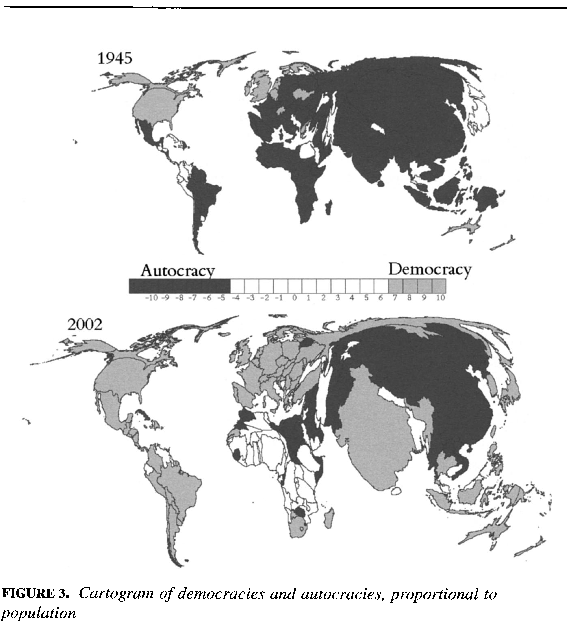
That’s great for providing a quick visual idea of how many of the world’s states have democratic regimes. But, it doesn’t tell us how many of the world’s inhabitants live in democracies. This clever cartogram by Gleditsch and Ward does this. Cartograms bend and mis-shape world maps on the basis of the values of the underlying variable–in this case, population. What do you think? The map below shows a dramatic rise since 1945 in both the number of states and the number of the world’s citizens who live in democracies. You’ll note that this map is from 2002 data, and there have been some important changes, notably Russia’s slide back toward autocracy in the last decade or so. Also, look at how massive India and China are (population-wise)!

gleditsch_ward_cartogram_democratization

Obstacles to Democratization in North Africa and the Middle East

In conjunction with this week’s readings on democracy and democratization, here is an informative video of a lecture given by Ellen Lust of Yale University. In her lecture, Professor Lust discuses new research that comparative analyzes the respective obstacles to democratization of Libya, Tunisia, and Egypt. For those of you in my IS240 class, it will demonstrate to you how survey analysis can help scholars find answers to the questions they seek. For those in IS210, this is a useful demonstration in comparing across countries. [If the “start at” command wasn’t successful, you should forward the video to the 9:00 mark; that’s where Lust begins her lecture.]

Political Regimes

Those of you in my IS210 class may find the Polity IV data to be of use when writing your paper. Click on the image below to take you to the website, where (if you scroll down to the bottom) you can see the regime scores (between -10 and +10) for each country over many years. See the example at the bottom of this post.

Political Regime Types–Polity IV Dataset

Here’s an exampe of the history of movements in regime for El Salvador from 1946 until 2010. How many changes in regime does El Salvador seem to have experienced in the post-WWII period? What happened in the early 1980s?


Polity IV Score in El Salvador

How much does political culture explain?

For decades now, comparativists have debated the usefulness of cultural explanations of political phenomena. In their path-breaking book, The Civic Culture, Almond and Verba argued that there was a relationship between, what they called, a country’s political culture and the nature and quality of democracy. (In fact, the relationship is a bit more complex in that the believed that a country’s political culture mediated the link between individual attitudes and the political system.) Moreover, the political culture was itself a product of underlying and enduring socially cultural factors, such as either an emphasis on the family, bias towards individualism, etc. Although Almond and Verba studied only five countries–the United States, West Germany, Mexico, Italy, and the United Kingdom–they suggested that the results could be generalized to (all) other countries.

How much, however, does culture explain? Can it explain why some countries have strong economies? Or why some countries have strong democracies? We know that cultural traits and values are relatively enduring, so how can we account for change? We know that a constant can not explain a variable.
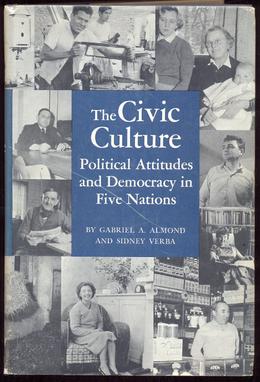
The 1963 Cover of Almond and Verba's classic work.

In a recent op-ed piece in the New York Times, Professor Stephen L. Sass asks whether China can innovate its way to technological and economic dominance over the United States. There is much consternation in the United States over recent standardized test scores showing US students doing poorly, relative to their global peers, on science exams. (How have Canadian students been faring?)

Professor Sass answers his own question in the negative. Why, in his estimation, will China not innovate to the top? In a word (well, actually two words)–political culture:

Free societies encourage people to be skeptical and ask critical questions. When I was teaching at a university in Beijing in 2009, my students acknowledged that I frequently asked if they had any questions — and that they rarely did. After my last lecture, at their insistence, we discussed the reasons for their reticence.

Several students pointed out that, from childhood, they were not encouraged to ask questions. I knew that the Cultural Revolution had upturned higher education — and intellectual inquiry generally — during their parents’ lifetimes, but as a guest I didn’t want to get into a political discussion. Instead, I gently pointed out to my students that they were planning to be scientists, and that skepticism and critical questioning were essential for separating the wheat from the chaff in all scholarly endeavors.

Although Sass admits that there are institutional and other reasons that will also serve to limit China’s future technological innovation, he ends up affirming the primacy of political culture:

Perhaps I’m wrong that political freedom is critical for scientific innovation. As a scientist, I have to be skeptical of my own conclusions. But sometime in this still-new century, we will see the results of this unfolding experiment. At the moment, I’d still bet on America.

Do you agree? What other important political phenomena can be explained by political culture?

Development and Underdevelopment–the Commanding Heights

We addressed the topic of development and underdevelopment in POLI 1100 this week. Amongst the many issues covered, we started to explore some of the alleged causes of economic growth and development. Why is there still such disparity in income and economic growth around the world, not only between countries, but within? Why have countries in the global “South” lagged behind, for the most part, their counterparts in the global “North”? There are various answers to this question and we addressed a couple of them in class. I showed clips from a fantastic documentary series put together by PBS, called (and based on the book of the same name) The Commanding Heights. All the information you’ll need is at the PBS website. Fortunately, each of the three 2-hour episodes has also been uploaded (in its entirety) to the Internet. From the narration at the beginning of the first episode, we learn that

This is the story of how the new global economy was born. A century-long battle as to which would control the commanding heights of the world’s economies–governments or markets.

I encourage you to watch all three episodes.


Global Debt Crisis and Relief

The issue of the global debt crisis–and particularly the onerous debt levels of developing world (“Southern”) countries–was a topic that we covered in POLI 1100 today. It will allow me to combine two class topics–issues pertaining development and underdevelopment, and interest groups (NGOs)–into one blog post. The interest group, Global Issues, is dedicated to analyzing “social, political, economic, and environmental issues that affect us all” and has a section on debt relief for the developing world. Here are some facts and figures related to the scale of the debt crisis in the developing world:

Consider the following:

  • In 1970, the world’s poorest countries (roughly 60 countries classified as low-income by the World Bank), owed $25 billion in debt.
  • By 2002, this was $523 billion
  • For Africa,
    • In 1970, it was just under $11 billion
    • By 2002, that was over half, to $295 billion
  • Debts owed to the multilateral institutions such as the IMF and World Bank is currently around $153 billion
  • For the poorest countries debts to multilateral institutions is around $70 billion.

$550 billion has been paid in both principal and interest over the last three decades, on $540bn of loans, and yet there is still a $523 billion dollar debt burden.

Here are some remarks by Professor Susan George on how to tackle the debt crisis. Money quote:

…there is no level of human suffering, which in and of itself, is going to change policy. The only way policy changes is because people demand it, and in this case, it has to be the people of the North, because the people of the South have very little political clout.

Electoral Systems

Here’s an interesting post by a student on the effect of different electoral systems on the strategic calculations of voters. Would Canadian voters vote differently if our electoral system were PR? The evidence suggests that for a substantial minority, the answer is yes.

Here’s an example: in many (most) ridings, there is no chance that a member of the Green Party would be elected to parliament. Thus, rather than voting for the Green Party, many voters in these ridings who would prefer to vote Green, vote their 2nd preference, meaning that the Liberal Party and the NDP receive more votes during our elections than they otherwise would under a PR system. (Very few voters whose favoured party is the Green Party have the Conservative Party as their 2nd preference). Check out the post…

Electoral Systems.

More on Representation and Electoral Systems

Prompted by a comment on a previous post regarding how voter representation would be different if Canada had a proportional representation system, I decided to do some reading on the Fair Vote website and stumbled upon some interesting facts. The first is an illuminating quote regarding the difference between decision-making (rule) and representation by somebody named Ernest Haville:

 “In a democratic government, the right of decision belongs to the majority, but the right of representation belongs to all.”

As we noted in class earlier today, many of the votes cast in our elections are wasted as a result of our first-past-the-post system. Below is a screenshot from the website wastedvotes.ca, which shows that in the 2008 federal election in Gatineau, QC, fully 70% of the voters were not represented. This is because the Bloc Quebecois candidate, Richard Nadeau, won a tight four-way battle, garnering a plurality of the vote at 29.2%.

This is just the most egregious example of wasted votes (and, thereby, of non-representation), but every Canadian election and electoral district sees wasted votes. Indeed, the folks at wastedvote.ca have calculated that of the more than 14 million votes cast during Canada’s last federal election (2011) only slightly more than half (50.4%) were effective, while 49.6% were wasted.

Why is this bad for democracy? Well, here is another excerpt from fairvote.ca:

Does Canada actually have representative democracy? In the 2008 federal election:

  • 940,000 voters supporting the Green Party elected no one, while fewer Conservative voters in Alberta alone elected 27 Conservative MPs.
  • In the prairie provinces, Conservatives received roughly twice the votes of the Liberals and NDP combined, but took seven times as many seats.
  • Similar to the last election, a quarter-million Conservative voters in Toronto elected no one and neither did Conservative voters in Montreal.
  • New Democrats: The NDP attracted 1.1 million more votes than the Bloc, but the voting system gave the Bloc 49 seats, the NDP 37.

What about majority rule? Canadians are usually ruled by majority governments that the majority voted against. In some provincial elections, parties coming in second in the popular vote have won majority control of the legislature.

In class, we noted the irony of the part above that is in bold font! The 1988 federal election was fought primarily on the basis of a pending free trade agreement amongst Canada, the United States, and Mexico. In Canada, the Progressive Conservatives (led by Prime Minister Brian Mulroney) were in favour of (what would become) NAFTA, while the NDP and the Liberal Party were against. In the end, a majority of Canadians voted for parties that were against NAFTA, yet the PCs won a majority of seats in parliament, enabling them to push through the necessary legislation.

Why do Young Canadians Vote Less than Others?

In POLI 1100 today, we looked at a table (from Dyck–Studying Politics) that demonstrated low (relative to other age groups) levels of political interest and politics are amongst young Canadians. We explored (that is, I asked students to conjecture about) some of the potential reasons for this in class.

A recent report by Marion Menard of the Social Affairs Division of the Canadian Library of Parliament explores a few potential causes of low voter turnout amongst Canadian youth. She lists four:

1 No Issues of Interest to Young People?

The explanation most often provided is that the issues that are important to young people are not part of the political parties’ election platforms. However, this hypothesis is challenged by political scientists who conducted a study for Elections Canada following the federal election in 2004. According to Elizabeth Gidengil and her fellow researchers, for instance, health was cited as a key issue for all survey respondents, regardless of age:

Issues that concern many young people are on the political agenda, and the political parties are taking positions on these issues. The problem seems to be that too often these messages are just not registering with a significant proportion of younger Canadians

2 Lack of Political Knowledge?

The authors of the Gidengil study asserted that there were “striking” gaps in young Canadians’ knowledge of politics.6 There is also consensus in the academic community that a significant number of young voters go to the polls without the necessary tools to make an informed decision.7 According to researchers, young people know little or nothing about the politicians and have no idea how the political institutions that run the country function. In a study conducted for the Institute for Research on Public Policy (IPRP), Henry Milner established a cause and effect relationship between the level of political knowledge and youth electoral participation.

3 Lack of Trust in the System?

According to Brenda O’Neill of the University of Manitoba, beyond limited knowledge about the political system, voters both young and old show a lack of interest in public affairs. She says that many voters doubt that voting every four years can truly influencethe decision-making process, and as a result, people stay away from the polls, which can lead to distrust and even cynicism over time

4 Media Influence?

When the issue of cynicism is raised, the media are often singled out as the culprits. Television is mentioned in particular since it tends to focus on the conflicts in politics.10

Yet media use reportedly has a positive impact overall on the acquisition of political knowledge, although its efficacy depends on the medium used. Reading newspapers and news websites has a strong positive impact on the electoral participation of young Canadians, while watching television and listening to the radio do not have as marked an effect.

Which of these do you think is the most important? If so, what is a potential remedy (assuming you share the view that youth political participation should be increased)?

Design a site like this with WordPress.com
Get started