More on Qualitative Research Analysis

50-foot Jesus statue in front of an abortion clinic

In IS240 on Monday we looked at some of the characteristics of  qualitative research methods. such as i) it is inductive, ii) normally interpretivist, and iii)  qualitative researchers view constructionist ontological viewpoints.  A final characteristic of most qualitative research is that its approach is naturalistic. As the textbook notes:

…qualitative researchers try to minimize the disturbance they cause to the social worlds they study.

We can see the nature of this quality implicitly teased out by Lori Freedman, who discusses some of the research she did for her Master’s degree. Freedman writes about the relationship between abortion and religion (it’s not what you’re expecting) and the time she spent observing in a hospital that performed abortions. Here’s the part related to her research methods:

Claudia [a deeply religious Catholic woman who was having an abortion–JD] told me this story 13 years ago, while I was conducting ethnographic research as a participant-observer in a hospital-based abortion service. I spent considerable time there helping, observing, and intermittently conducting as many interviews as I could with counselors, doctors, and nurses, in order to gain a rich view of abortion clinic life. This study became my master’s thesis, but nothing else. I feared publication might amount to a gratuitous exposé of people I respected dearly. I couldn’t think of any policy or academic imperative that necessitated revealing the intimate dynamics of this particular social world—certainly nothing that could make the potential feelings of betrayal worthwhile. Ultimately, I just tucked it away.


Political Regimes

Those of you in my IS210 class may find the Polity IV data to be of use when writing your paper. Click on the image below to take you to the website, where (if you scroll down to the bottom) you can see the regime scores (between -10 and +10) for each country over many years. See the example at the bottom of this post.

Political Regime Types–Polity IV Dataset

Here’s an exampe of the history of movements in regime for El Salvador from 1946 until 2010. How many changes in regime does El Salvador seem to have experienced in the post-WWII period? What happened in the early 1980s?


Polity IV Score in El Salvador

‘Thick Description’ and Qualitative Research Analysis

In Chapter 8 of Bryman, Beel, and Teevan, the authors discuss qualitative research methods and how to do qualitative research. In a subsection entitled Alternative Criteria for Evaluating Qualitative Research, the authors reference Lincoln and Guba’s thoughts on how to assess the reliability, validity, and objectivity of qualitative research. Lincoln and Guba argue that these well-known criteria (which developed from the need to evaluate quantitative research) do not transfer well to qualitative research. Instead, they argue for evaluative criteria such as credibility, transferability, and objectivity.

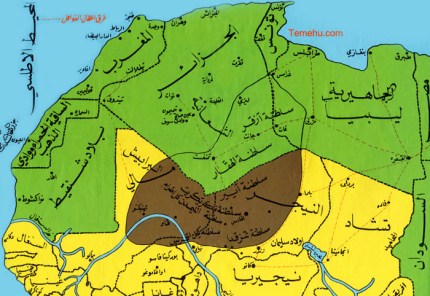
Saharan Caravan Routes
Saharan Caravan Routes–The dotted red lines in the above map are caravan routes connecting the various countries of North Africa including Egypt, Libya, Algeria, Morocco, Mali, Niger and Chad. Many of the main desert pistes and tracks of today were originally camel caravan routes. (What do the green, yellow, and brown represent?)

Transferability is the extent to which qualitative research ‘holds in some other context’ (the quants reading this will immediately realize that this is analogous to the concept of the ‘generalizability of results’ in the quantitative realm). The authors argue that whether qualitative research fulfills this criterion is not a theoretical, but an empirical issue. Moreover, they argue that rather than worrying about transferability, qualitative researchers should produce ‘thick descriptions’ of phenomena. The term thick description is most closely associated with the anthropologist Clifford Geertz (and his work in Bali). Thick description can be defined as:

the detailed accounts of a social setting or people’s experiences that can form the basis for general statements about a culture and its significance (meaning) in people’s lives.

Compare this account (thick description) by Geertz of the caravan trades in Morocco at the turn of the 20th century to how a quantitative researcher may explain the same institution:

In the narrow sense, a zettata (from the Berber TAZETTAT, ‘a small piece of cloth’) is a passage toll, a sum paid to a local power…for protection when crossing localities where he is such a power. But in fact it is, or more properly was, rather more than a mere payment. It was part of a whole complex of moral rituals, customs with the force of law and the weight of sanctity—centering around the guest-host, client-patron, petitioner-petitioned, exile-protector, suppliant-divinity relations—all of which are somehow of a package in rural Morocco. Entering the tribal world physically, the outreaching trader (or at least his agents) had also to enter it culturally.

Despite the vast variety of particular forms through which they manifest themselves, the characteristics of protection in tbe Berber societies of the High and Middle Atlas are clear and constant. Protection is personal, unqualified, explicit, and conceived of as the dressing of one man in the reputation of another. The reputation may be political, moral, spiritual, or even idiosyncratic, or, often enough, all four at once. But the essential transaction is that a man who counts ‘stands up and says’ (quam wa qal, as the classical tag bas it) to those to whom he counts: ‘this man is mine; harm him and you insult me; insult me and you will answer for it.’ Benediction (the famous baraka),hospitality, sanctuary, and safe passage are alike in this: they rest on the perhaps somewhat paradoxical notion that though personal identity is radically individual in both its roots and its expressions, it is not incapable of being stamped onto tbe self of someone else. (Quoted in North (1991) Journal of Economic Perspectives, 5:1 p. 104.

A Virtual Trip to Myanmar for my Research Methods Class

For IS240 next week, (Intro to Research Methods in International Studies) we will be discussing qualitative research methods. We’ll address components of qualitative research and review issues related to reliability and validity and use these as the basis for an in-class activity.

The activity will require students to have viewed the following short video clips, all of which introduce the viewer to contemporary Myanmar. Some of you may know already that Myanmar (Burma) has been transitioning from rule by military dictatorship to democracy. Here are three aspects of Myanmar society and politics. Please watch as we won’t have time in class to watch all three clips. The clips themselves are not long (just over 3,5,and 8 minutes long, respectively).

The first clip shows the impact of heroin on the Kachin people of northern Myanmar:

The next clip is a short interview with a Buddhist monk on social relations in contemporary Myanmar:

The final video clip is of the potential impact (good and bad) of increased international tourism to Myanmar’s most sacred sites, one of which is Bagan.

The Trilemma of International Finance

In IS210, we will be reading about domestic political economy next week. Understanding the role of state and market, politics and economics, we can learn about what causes some countries’s economies to grow quite rapidly and other countries’ economies to grow more slowly. We’ll look at the role of domestic institutions and policy choices as key root causes in economic development. [How does this contrast with Inglehart’s arguments, or Weber’s idea of the ‘Protestant work ethic?’] Increasingly, though, our ever more globalized and interdependent world economy provides domestic economies with opportunities and threats that didn’t exist to nearly this extent even 50 years ago. We’ll look at economist N. Gregory Mankiw’s New York Times editorial piece on the “trilemma of international finance.”

Have a look at this Frontline excerpt on the Asian financial crisis of 1997 and the role that fixed exchange rates played:

What causes civil conflict?

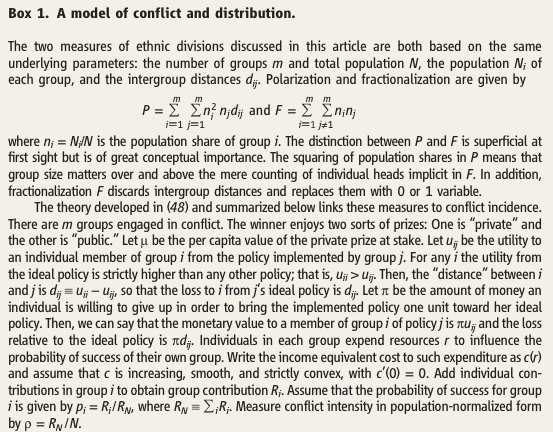
In a series of recent articles, civil conflict researchers Esteban, Mayoral, and Ray (see this paper for an example) have tried to answer that question. Is it economic inequality, or cultural differences? Or maybe there is a political cause at its root. I encourage you to read the paper and to have a look at the video below. Here are a couple of images from the linked paper, which you’ll see remind you of concepts that we’ve covered in IS210 this semester. The first image is only part of the “Model of Civil Conflict.” Take a look at the paper if you want to see the “punchline.”

Screen shot 2014-02-07 at 1.54.26 AM

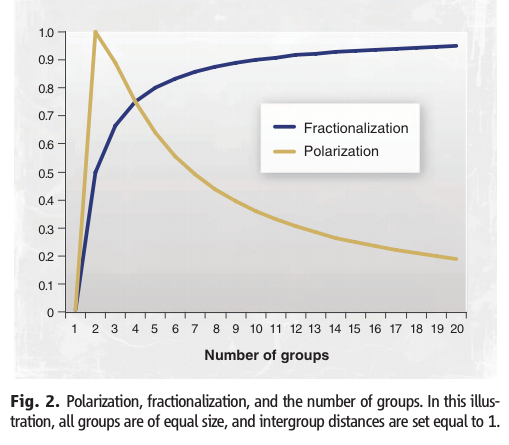
Here is the relationship between fractionalization and polarization. What does each of these measures of diversity measure?

Screen shot 2014-02-07 at 1.56.50 AM

And here’s a nice youtube video wherein the authors explain their theory.

Field Experiments in the Social Sciences–Health Outcomes

One of the more well-known examples of a field experiment in the social sciences is Esther Duflo’s experiment on the usage of mosquito bed nets. Duflo argues that there has been much debate about the effects and efficiency of aid in less-developed countries.

Regarding the bed nets issue, it is well understood that sleeping under a mosquito bed-net in malaria-ravaged regions greatly decreases the chances of contracting malaria. Bed nets are cheap to make and distribute (about $10 US per net), so it’s a relatively efficient way to prevent people (particularly young children) from dying from one of the world’s most deadly diseases. So, why not just give bed nets to those wanting/needing them? Duflo discusses some reasons for and against. Indeed, there are many good reasons a prior to support both the view that bed nets should be given away and that people should be forced to pay for them. There are other issues as well, which you can learn about from the video.

Randomization in a Field Experiment

For this post, what is most crucial is that prior to Duflo (and her colleagues’) field experiments, there was no empirical evidence as to what the best approach to dealing with the bed-nets issue was. Following these field experiments, we have the first concrete empirical data to adjudicate amongst the approaches. In order to guarantee the internal validity of these experiments, however, the researchers had to be careful about ensuring randomization. Remember, random does not mean haphazard. The word has a specific meaning, which we’ll discuss next week. The image above is a screenshot from Duflo’s TED talk, showing the result (but not the method of) randomization in one experiment. How is randomization important for both internal and external validity?

Indicators and The Failed States Index

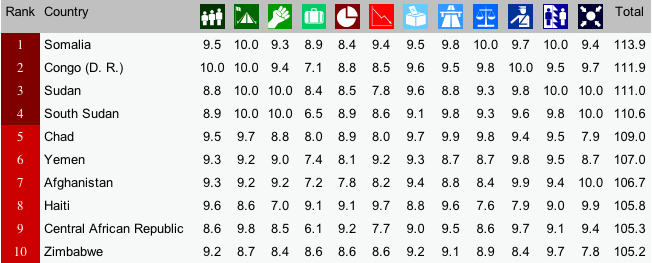
The Failed State Index is created and updated by the Fund for Peace. For the most recent year (2013), the Index finds the same cast of “failed” characters as previous years. There is some movement, the “top” 10 has not changed much over the last few years.

The Top 10 of the Failed States Index for 2013

Notice the columns in the image above. Each of these columns is a different indicator of “state-failedness”. If you go to the link above, you can hover over each of the thumbnails to find out what each indicator measures. For, example, the column with what looks like a 3-member family is the score for “Mounting Demographic Pressures”, etc. What is most interesting about the individual indicator scores is how similar they are for each state. In other words, if you know Country X’s score on Mounting Demographic Pressures, you would be able to predict the scores of the other 11 indicators with high accuracy. How high? We’ll just run a simple regression analysis, which we’ll do in IS240 later this semester.

For now, though, I was curious as to how closely each indicator was correlated with the total score. Rather than run regression analyses, I chose (for now) to simply plot the associations. [To be fair, one would want to plot each indicator not against the total but against the total less that indicator, since each indicator comprises a portion (1/12, I suppose) of the total score. In the end, the general results are similar,if not exactly the same.]

So, what does this look like? See the image below (the R code is provided below, for those of you in IS240 who would like to replicate this.)

Plotting each of the Failed State Index (FSI) Indicators against the Total FSI Score

Here are two questions that you should ponder:

  1. If you didn’t have the resources and had to choose only one indicator as a measure of “failed-stateness”, which indicator would you choose? Which would you definitely not choose?
  2. Would you go to the trouble and expense of collecting all of these indicators? Why or why not?

R-code:


install.packages("gdata") #This package must be installed to import .xls file

library(gdata) #If you find error message--"required package missing", it means that you must install the dependent package as well, using the same procedure.

fsi.df<-read.xls("http://ffp.statesindex.org/library/cfsis1301-fsi-spreadsheet178-public-06a.xls")  #importing the data into R, and creating a data frame named fsi.df

pstack.1<-stack(fsi.df[4:15]) #Stacking the indicator variables in a single variable

pstack.df<-data.frame(fsi.df[3],pstack.1) #setting up the data correctly

names(pstack.df)<-c("Total","Score","Indicator") #Changing names of Variables for presentation

install.packages("lattice")  #to be able to create lattice plots

library(lattice) #to load the lattice package

xyplot(pstack.df$Total~pstack.df$Score|pstack.df$Indicator,  groups=pstack.df$Indicator, layout=c(4,3),xlab="FSI Individual Indicator Score", ylab="FSI Index Total")

Deal or no deal and rational choice theory

As my students are aware, I have been under the weather since the beginning of January and am finally feeling somewhat like a human being again. During my down time, I took some rest and had time to do some non-school-related activities, one of which was trying out the Deal or No Deal app on my smartphone. You do remember the TV show hosted by Howie Mandel, right?

Deal or No Deal and Rational Choice Theory

Anyway, the basic idea of the show is this:

  • There are 26 suitcases on state, each with a card containing a dollar amount between $1 and $1 Million.
  • The game begins when the contestant chooses one of the 26 suitcases as “their” suitcase. If the contestant keeps the suitcase until the end of play, they win the dollar amount written on the card inside the suitcase.
  • The contestant must begin opening a certain amount of suitcases during each round of play–5 the first round, 4 the next, etc.
  • After each round, the game pauses and the contestant receives an offer from the mysterious banker via telephone with Howie as the intermediary.
  • The contestant is then asked whether there is a “deal, or no deal.” The contestant may accept the banker’s offer or continue. [There is where the drama gets ramped up to 11!]
  • If you have watched the show, you’ll notice that the banker’s offer depends upon which dollar amounts have been revealed. If the contestant reveals many high-value suitcases, it becomes like likely (probable) that the suitcase s/he chose at the beginning is a high-value suitcase.

The smartphone version is slightly different from the TV show in that the suitcases do not have dollar amounts attached but point multiples (that is, you win 1X, 2X, 3x, etc. 1000X the pot).

Take a look at the images above screenshot (is that the past participle?) from my smartphone. What do you notice about the banker’s offer? What’s of importance here is the red boxes in each picture. These are two separate games, btw.

These are two separate games. In the top game, there are only two suitcases left–one of them is the 20X and the 200X, Therefore, I have either the 20X or the 200X. That’s quite a big difference in winnings–ten times. So, what would you do? What would a rational choice theorist say you should do? Are the bankers offers rational in each case? Why or why not?

Resources for First Paper (IS 210)–Risk Assessment

World Map of The Failed States  Index for 2013
World Map of The Failed States Index for 2013

Here are some data resources that may be helpful to you while researching and writing your first paper assignment.

jd's avatarClouds, Clocks, and Sitting at Tables

Here are some data resources that may be helpful to you while researching and writing your first paper assignment. I’ll be showing you how to use/access some of these sources in class on Thursday, September 23rd.

View original post 41 more words

Design a site like this with WordPress.com
Get started