Today in IS 302 we viewed the video “Can the UN Keep the Peace”, which looked at the challenges that face the UN Mission in the Democratic Republic of the Congo. Like the pairing of the perfect wine with the right meal, this video was (at least in my opinion) a perfect complement to today’s readings.
Category: Sub-Saharan Africa
How Big is Africa?
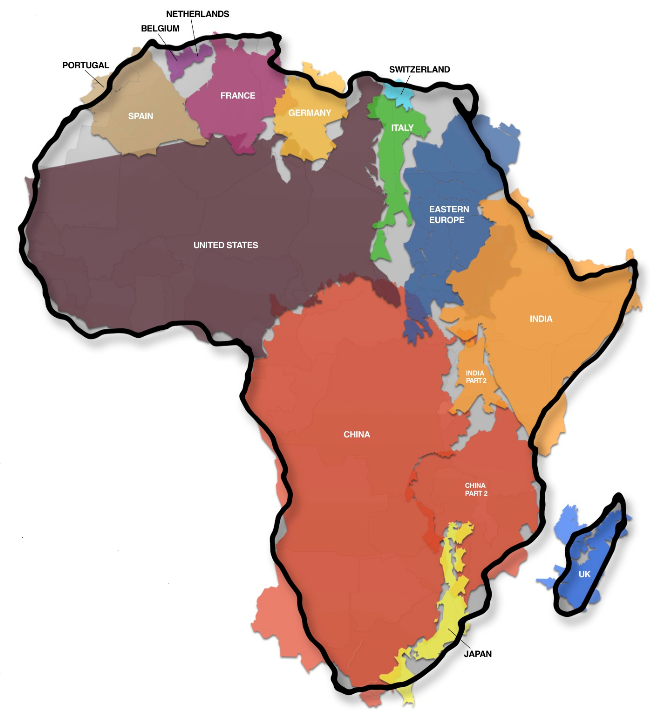
In the second half of the Comparative World Government course we’ll be analysing issues and concepts that will allow us to learn more about the many countries located on the diverse continent of Africa. In addition to being very diverse, Africa is a very large continent. Many of us have little idea about just how big the continent is. Here’s a revealing graphic by Kai Krause, that will hopefully cure us of a little bit of our immapancy–insufficient geographical knowledge. Click on the link above to view a larger picture, with more information.
Worse Than War
In IS 302 today, we viewed the first 2/3 of the PBS documentary, Worse than War, based on the work of genocide (note: not genocidal) scholar Daniel Goldhagen , who is probably known best for his book Hitler’s Willing Executioners. Many of the issues raised by Goldhagen in the documentary were relevant to the readings of this week by Kaldor, et al.
Does Africa Need a New Map?
In a recent article in Foreign Policy magazine, G. Pascal Zachary argues that it’s time to redraw Africa’s political borders, which are “unnatural” and a legacy of 19th and 20th-century colonialism. As is well-known the newly independent states that comprised the Organisation for African Unity met in 1964 and agreed that the extant international borders in Africa were sacrosanct, believing that this would best guarantee stability on the continent. It worked, to a degree. While there have certainly been very few international (i.e. inter-state) wars in Africa in the intervening 45 years, the continent has been ravaged by intra-state (i.e., internal, or “civil”) wars during the same period. What are the potential benefits of redrawing Africa’s borders to make them more coterminous with ethnic boundaries (as has been done recently in, amongst other places, the Balkans and the former Soviet Union)? Zachary’s claim:
Borders created through some combination of ignorance and malice are today one of the continent’s major barriers to building strong, competent states. No initiative would do more for happiness, stability, and economic growth in Africa today than an energetic and enlightened redrawing of these harmful lines.
How important is for for state strength and stability for ethnic and political border to be coterminous? The redrawing of borders–and it is obvious that the mechanism would be military force–would almost certainly lead to tremendous suffering and bloodshed, with competing campaigns of ethnic cleansing. But, as Zachary notes, since the start of the post-colonial era millions of Africans have died in internal conflicts, and:
Rethinking the borders could go far to quelling some of these conflicts. Countries could finally be framed around the de facto geography of ethnic groups. The new states could use their local languages rather than favoring another ethnicity’s or colonial power’s tongue. Rebel secessionist movements would all but disappear, and democracy could flourish more easily when based upon policies, rather than simple identity politics. On top of that, new states based on ethnic lines would by default be smaller, more compact, and more manageable for governments on a continent with a history of state weakness.
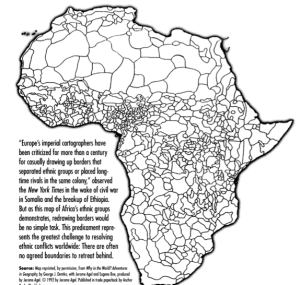
Assuming that the political will to achieve this goal were to evolve, what would be the best mechanism? What would Herbst’s argument be? Is this even feasible? Where would one draw the new boundaries? How would one define an ethnic group? Refer to these two maps to get a sense of the near impossibility of the task at hand. While there are about 50-odd states in Africa, there are literally hundreds of geographically-concentrated ethnic groups. In addition, there is a tremendous amount of inter-mingling of ethnic groups as well.

Failed States and the Fund for Peace’s Failed States Index 2010
On Thursday, September 23rd we will begin to analyse the exceptionally important concept–the state. It will become strikingly obvious that a strong state is a necessary–but not sufficient–condition for political stability, political and personal liberty, democracy, and economic well-being. Conversely, citizens living in weak, failing, or failed states face lives of economic destitution, personal insecurity (think of Hobbes’ state of nature, where life is nasty, brutish, and short), and lack of basic rights and freedoms. The Fund for Peace publishes an annual index of failed and failing states. A quick look at the results over the last decade or so finds that the same dozen or so states are continually at the top of the list of failed/failing states. Here is a map depicting the results of the most recent index:
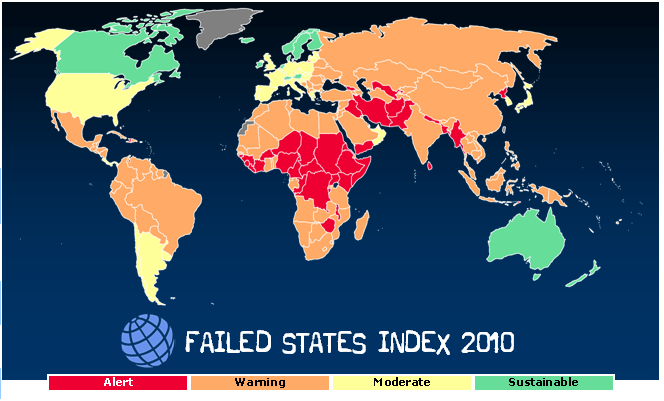
Notice the geographical concentration of failed states (in red). Why are the vast majority of the world’s failed states found in central Africa and southwest Asia?
What are the characteristics of failed states that distinguish them from more stable states? Maybe this video of life in Somalia will provide some clues:
Events/Lectures that may be of Interest
I’ll use this blog to keep you informed about lectures and events that may be of interest to you that are taking place on campus or in the greater Vancouver area. There are two events this week that are relevant.
This evening, Monday September 13th, at 7:00pm the Philosophers’ Cafe is kicking off the first event of its fall series at the Shadbolt Centre for the Arts at Deer Lake in Burnaby. This evening’s discussion is titled “Mixed Up: Is Canada’s cultural mix more like a melting pot, mosaic or matrix?” We’ll be addressing issues of identity and culture in about two weeks time in IS 210. The admission is $5, and the event will be moderated by Randall Mackinnon, who has served as a president, board member, executive and consulting staff for a diversity of community service organizations since 1970. For more information about tonight’s event and directions to the venue, click here.
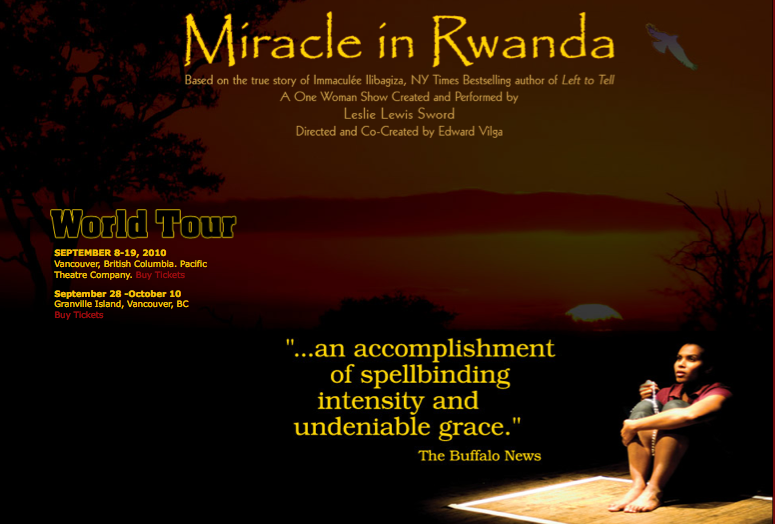
The second event is a one-woman show entitled Miracle in Rwanda, which is showing all of this week at Pacific Theatre Company and will also have a two-week run on Granville Island beginning later this month. To learn more about the show, and to purchase tickets, go here.
Update: The website I linked to above links to the wrong page. Miracle in Rwanda is part of this year’s Vancouver Fringe Festival. Here’s the correct link to information regarding show times and tickets.
Resource Dependent Regimes in Sub-Saharan Africa
Jensen and Wantchekon (2000) have created an index of resource dependence and determined the level of the same for the states of sub-Sarahan Africa. The scores range from 1 (no resource dependence) to 4 (extreme resource dependence). They use this as an important independent variable in determining democratic transition, consolidation, and government effectiveness. How much of an effect does resource dependence have on each of these dependent variables? You’ll have to read the paper to find out, or attend my class in intro to comparative tomorrow.

The United Nations and Peacekeeping in Congo
In PLSC250–intro to IR–this week we viewed a documentary made by the National Film Board of Canada, which addresses the UN’s peacekeeping role in Congo. After reading Chapter 7 of Mingst, you should now be aware that the UN in the world’s most important and powerful IGO, and the UN Security Council plays the most prominent global role in the area of international security. Here are a couple of screen shots from the film and the film’s description:
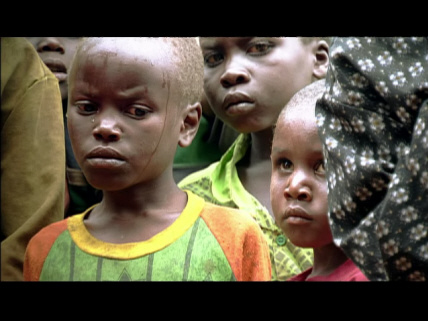
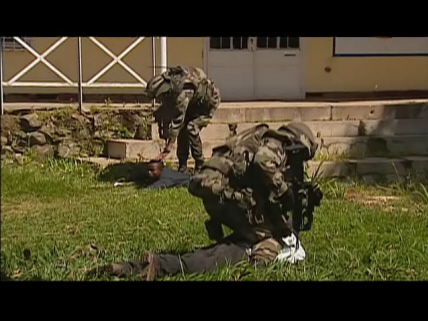
With unprecedented access to the United Nations Department of Peacekeeping, The Peacekeepers provides an intimate and dramatic portrait of the struggle to save “a failed state.” The film follows the determined and often desperate manoeuvres to avert another Rwandan disaster, this time in the Democratic Republic of Congo (the DRC).
Focusing on the UN mission, the film cuts back and forth between the United Nations headquarters in New York and events on the ground in the DRC. We are with the peacekeepers in the ‘Crisis Room’ as they balance the risk of loss of life on the ground with the enormous sums of money required from uncertain donor countries. We are with UN troops as the northeast Congo erupts and the future of the DRC, if not all of central Africa, hangs in the balance.
In the background, but often impinging on peacekeeping decisions, are the painful memory of Rwanda, the worsening crisis in Iraq, global terrorism and American hegemony in world affairs. As Secretary General Kofi Annan tells the General Assembly at the conclusion of The Peacekeepers: “History is a harsh judge. The world will not forgive us if we do nothing.” Whether the world’s peacekeeper did enough remains to be seen.
Afrobarometer–Key Findings
The very first Afrobarometer Briefing Paper–here’s the link to a PDF version–(April 2002) presents some key findings regarding the views of African residents in about a dozen African countries on phenomena such as democracy, freedom, governance, etc. Here are a few I found interesting:
- Corruption is seen as pervasive
Whereas about one-half of survey respondents think that corruption among public officials is common (52 percent), about one-third think it is rare (35 percent). Perceived corruption is highest in Ghana, Nigeria, Tanzania, and Zimbabwe, and lowest in Botswana, Lesotho and Namibia. Generally, however, people perceive more corruption than they themselves have personally experienced. Such perceptions, and the social inequalities they reflect, tend to corrode satisfaction with economic reform policies and with democracy.
In class, I use the module on economic and political development as an opportunity to ask students if they have ever tried to bribe an official for any reason whatsoever. The answer amongst my mostly suburban-bred American students is a unanimous “no.” Generally only I (and sometimes a foreign student) raise our hands to answer in the affirmative. I try to impress upon the students that bribery and corruption is a normal part of life in most non-Western countries. In most citizens’ dealings with official (read: governmental and quasi-governmental) institutions, bribing at least one official is absolutely necessary to get anything done.
Afrobarometer Public Opinion Surveys
The Afrobarometer survey allows public access to its data, with a two-year time lag. From a description found on its home page, the Afrobarometer is “a comparative series of public attitude surveys on democracy, markets, and civil society in Africe.” The site is full of resources, in addition to the data, such as publications (including downloadable working papers), results, news and events.
Here are the countries surveyed and the years for each:
|
Country
|
Round 1
|
Round 2
|
Round 3
|
Other
|
| Benin |
—
|
—
|
2005
|
—
|
| Botswana |
1999
|
2003
|
2005
|
—
|
| Cape Verde |
—
|
2002
|
2005
|
—
|
| Ghana |
1999
|
2002
|
2005
|
1997
|
| Kenya |
—
|
2003
|
2005
|
—
|
| Lesotho |
2000
|
2003
|
2005
|
—
|
| Madagascar |
—
|
—
|
2005
|
—
|
| Malawi |
1999
|
2003
|
2005
|
—
|
| Mali |
2001
|
2002
|
2005
|
—
|
| Mozambique |
—
|
2002
|
2005
|
—
|
| Namibia |
1999
|
2003
|
2006
|
2002
|
| Nigeria |
2000
|
2003
|
2005
|
2001, 2007
|
| Senegal |
—
|
2002
|
2005
|
—
|
| South Africa |
2000
|
2002
|
2006
|
1994, 1995, 1997, 1998, 2004
|
| Tanzania |
2001
|
2003
|
2005
|
—
|
| Uganda |
2000
|
2002
|
2005
|
—
|
| Zambia |
1999
|
2003
|
2005
|
1993, 1996
|
| Zimbabwe |
1999
|
2004
|
2005
|
—
|
 Clouds, Clocks, and Sitting at Tables


You must be logged in to post a comment.