Are Homebuyers Rational Decision-Makers?

According to rational choice theorists, how do individuals make decisions?  Put simply, they act so as to maximize their expected utility, given their a priori preferences and some general idea of the nature of the world (by this, they mean that individuals have some idea of the probability of certain actions leading to specific outcomes).  While rational choice theory was first developed in academic disciplines such as economics, political scientists have adopted the technique and it’s use has proliferated in that discipline.  One of the criticisms of using rational choice theory to explain political phenomena is that often individuals have difficulty ordering preferences adequately.  This is because there is no single “currency” of utility in political science.  The same, however, can not be said for economics as it is much easier to order preferences when there are dollar values attached.  But what happens when time, leisure, etc., have to be taken into account.  Well, it turns out that individuals make many “mistakes” that diverge from that expected of instrumentally rational decision-makers.

Jonah Lehrer informs his readers of a fascinating series of studies done by Ap Dijksterhuis, a psychologist at Radboud University in the Netherlands.  One of these studies looks at decisions related to real estate purchases.  The studies:

look at how people shop for “complex products,” like cars, apartments, homes, etc. and how they often fall victim to what he calls a “weighting mistake”. Consider two housing options: a three bedroom apartment that is located in the middle of a city, with a ten minute commute time, or a five bedroom McMansion in the suburbs, with a forty-five minute commute. “People will think about this trade-off for a long time,” Dijksterhuis writes. “And most them will eventually choose the large house. After all, a third bathroom or extra bedroom is very important for when grandma and grandpa come over for Christmas, whereas driving two hours each day is really not that bad.” What’s interesting is that the more time people spend deliberating, the more important that extra space becomes. They’ll imagine all sorts of scenarios (a big birthday party, Thanksgiving dinner, another child) that will turn the suburban house into an absolute necessity. The lengthy commute, meanwhile, will seem less and less significant, at least when compared to the allure of an extra bathroom.

But, as Dijksterhuis points out, that reasoning process is exactly backwards: “The additional bathroom is a completely superfluous asset for at least 362 or 363 days each year, whereas a long commute does become a burden after a while.” For instance, a recent study found that, when a person travels more than one hour in each direction, they have to make forty per cent more money in order to be as “satisfied with life” as someone with a short commute. Another study, led by Daniel Kahneman and the economist Alan Krueger, surveyed nine hundred working women in Texas and found that commuting was, by far, the least pleasurable part of their day. And yet, despite these gloomy statistics, nearly 20 percent of American workers commute more than forty-five minutes each way. (More than 3.5 million Americans spend more than three hours each day traveling to and from work: they’re currently the fastest growing category of commuter. For more on commuter culture, check out this awesome New Yorker article.) According to Dijksterhuis, these people are making themselves miserable because they failed to properly “weigh” the relevant variables when they were choosing where to live. Because these deliberative homeowners tended to fixate on details like square footage or the number of bathrooms, they assumed that a bigger house in the suburbs would make them happy, even if it meant spending an extra hour in the car everyday. But they were wrong.:

Risk, Uncertainty–From Governor Weld to the Modern Financial System

Canadian academic Thomas Homer-Dixon (we will read one of his papers this semester in Intro to IR) has written a piece for Canada’s “paper of record”–the Globe and Mail, which is titled “From Risk to Uncertainty.”  Those of you in my intro to comparative politics class will surely recognize immediately the difference between the tho concepts.

Remember when we read the first two chapter of Shepsle and Bonchek on instrumental rationality, the authors used the example of then-Massachusetts Governor Weld.  Weld had to decide whether to run for Governor again, or to commit to challenging Democratic Senator Ted Kennedy’s Senate seat.  A win there would have given him a nice platform for an eventual presidential run.  Weld, as we know, was operating in a world or risk rather than uncertainty when making his decision, given that there were public opinion polls published that estimated his chances of winning in either election.

What is the difference between risk and uncertainty and how does it apply to the contemporary global financial system (which, by the way, for those of you not paying attention is precariously teetering on the edge of meltdown–you heard it here first!)?

So the rules of the game have now fundamentally changed. Our global financial system has become so staggeringly complex and opaque that we’ve moved from a world of risk to a world of uncertainty. In a world of risk, we can judge dangers and opportunities by using the best evidence at hand [what Shepsle and Bonchek call beliefs] to estimate the probability of a particular outcome. But in a world of uncertainty, we can’t estimate probabilities, because we don’t have any clear basis for making such a judgment. In fact, we might not even know what the possible outcomes are. Surprises keep coming out of the blue, because we’re fundamentally ignorant of our own ignorance. We’re surrounded by unknown unknowns.

Resource Dependent Regimes in Sub-Saharan Africa

Jensen and Wantchekon (2000) have created an index of resource dependence and determined the level of the same for the states of sub-Sarahan Africa.  The scores range from 1 (no resource dependence) to 4 (extreme resource dependence).  They use this as an important independent variable in determining democratic transition, consolidation, and government effectiveness.  How much of an effect does resource dependence have on each of these dependent variables?  You’ll have to read the paper to find out, or attend my class in intro to comparative tomorrow.

resource_dependence_scores.jpg

Social Impact and the Decision to Vote

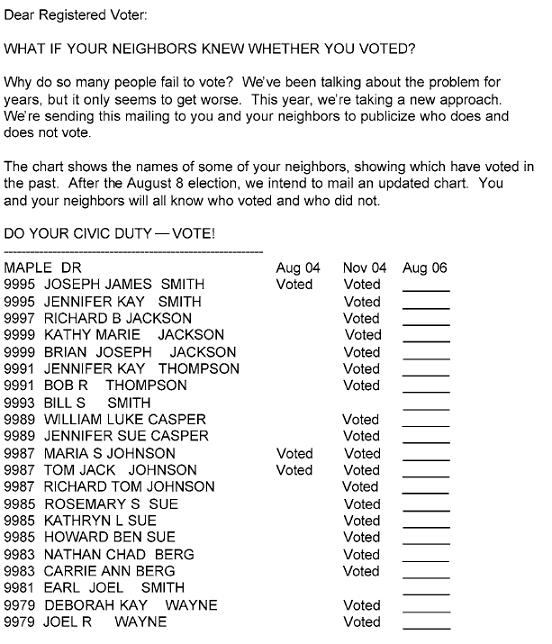
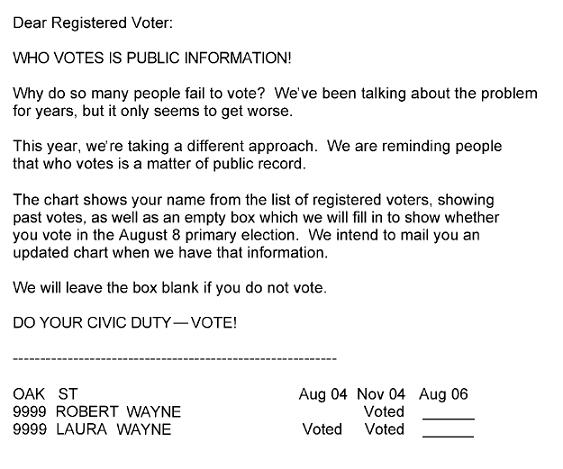
In continuing with today’s theme of the impact of the “social” in political science, we note that political parties the world over have spent a lot of money and developed various ideas and hypotheses regarding what motivates voters to go to the polls and exercise their most basic democratic right. In the most recent issue (which is behind a pay wall) of the American Political Science Review–the flagship journal of the American Political Science Association–a group of political scientists, led by Donald Green at Yale, has demonstrated that social shaming may be a way to increase overall voter turnout.* Here is the abstract, with a sample of the letters sent below:

Voter turnout theories based on rational self-interested behavior generally fail to predict significant turnout unless they account for the utility that citizens receive from performing their civic duty. We distinguish between two aspects of this type of utility, intrinsic satisfaction from behaving in accordance with a norm and extrinsic incentives to comply, and test the effects of priming intrinsic motives and applying varying degrees of extrinsic pressure. A large-scale field experiment involving several hundred thousand registered voters used a series of mailings to gauge these effects. Substantially higher turnout was observed among those who received mailings promising to publicize their turnout to their household or their neighbors. These findings demonstrate the profound importance of social pressure as an inducement to political participation.

Would you be susceptible to being shamed into voting? Well, the authors find that the overall impact of threatening to publicize your (non)-voting behavior to your neighbors was to increase turnout by 8.1 percentage points. That’s an astounding impact. Here are the letters:

social_pressure_vote.jpg

This letter increased the rate of voter turnout by 4.9 percentage points, a much stronger effect than appeals to civic duty alone (which raised turnout from between 1.8 and 2.5 percentage points.

social_pressure_vote2.jpg

This is the letter that produced an 8.1 percentage point increase in voter turnout.

*For a web site that tracks voter turnout rates worldwide, please see this post.

Serbian Electorate Must Choose–Stomach or Heart?

narodna_skupstina_srbije.jpgThe Serbian coalition government, with moderate nationalist Vojislav Koštunica as Prime Minister–has collapsed following dissension within the multi-party governing coalition over the “loss of Kosovo.” Voters will go to the polls to elect a new government on May 11th having to make a stark choice in the polling booth: whether to side with the nationalists in their struggle to forestall Kosovar independence, or to vote in a more moderate pro-European government, thereby placating not only members of the European Union but calming the nerves of wary international investors, who have become the life-blood of the Serbian economic system. As reports reports:

…The coalition government collapsed at the weekend, with nationalist Prime Minister Vojislav Koštunica blaming disunity over the conflicting goals of pursuing European Union membership versus defending Kosovo, the province which seceded last month with EU backing.

“Right now, around 1.0 billion euros worth of investments have been put on hold,” [Deputy Prime Minster Božidar] Djelić said. “There is a growing risk perception considering that some parties want to halt Serbia’s road to Europe. The elections will be a choice between Europe and investors are extremely careful.”

Heavily reliant on foreign investment for growth, Serbia is believed to need between 3.0 billion and 5.0 billion euros a year to ensure solid economic growth, single digit inflation and financing of its current account gap of 16 percent of GDP.

“In the absence of the required level of foreign investment, foreign creditors could also decide to put on hold lending to Serbian companies,” said Pavle Petrović of the FREN/CEVES thinktank said.

“The resulting crisis would lead to forcible reduction in external gaps through inflation, currency depreciation, a fall in output and wages. In that case, the central bank could soothe and postpone, but not eliminate the crisis,” he said.

PLSC240–Next Blog Assignment

Hello student-bloggers:

Your next blog post will be due on Friday, February 15th at 6:00pm.

The prompt for your post is “The rational choice/political culture debate and [my topic].” Once again, I will emphasize that you have wide latitude to post, and anything will be acceptable as long as it is somehow related to the prompt above. In addition, please take note of the rubric I will be using to grade your blog.  Remember that I will give you a provisional grade as of the mid-term break (this grade will not be factored into your final grade; it is meant to give you an idea of what your blog grade would be at the end of the semester if the character/quality of your posts were to remain the same until the end of the semester).  You can find the rubric in the Assignments folder of Blackboard.

Best of luck,

J.

Challenges to Rational Choice Theory

The fundemental assumption regarding human behavior, upon which the whole edifice of rational choice theory (RCT) rests is that human beings are rational; specifically, it means that they act in order to maximize their self-interest by “maximizing expected utility”. The construction above takes into account our preferences (utility) and the fact that the link between our actions and outcomes are rarely certain, but that we are able to adequately estimate (beliefs) the likelihood of achieving a specific goal given an accompanying action.

In the example of Lebron James I posted earlier, he has a generally good idea of his preferences (he prefers–other things equal–to hit a 3-pointer over a field goal or a free throw) and his beliefs (he knows his stats regarding his 3-point shooting percentage, his field goal, and free throw percentages as well). Given his beliefs and preferences, Lebron can easily act–and generally does–in an instrumentally rational manner.

How valid, though, is the assumption that human beings do act in an instrumentally rational manner? In other words, do individuals always maximize their expected utility? The short answer is no. Some political scientists believe that political culture often acts to mitigate instrumentally rational behavior. [We’ll discuss this in class on Tuesday.] Whole sub-disciplines in behavioral psychology and behavioral economics can point to copious amounts of research data demonstrating the lack of rationality in human beings, often in fairly simple situations. Michael Sherman asks “why people believe weird [i.e., irrational] things about money”:

Would you rather earn $50,000 a year while other people make $25,000, or would you rather earn $100,000 a year while other people get $250,000? Assume for the moment that prices of goods and services will stay the same.

Surprisingly — stunningly, in fact — research shows that the majority of people select the first option; they would rather make twice as much as others even if that meant earning half as much as they could otherwise have. How irrational is that?

Continue reading “Challenges to Rational Choice Theory”

Lebron James behaving in an Instrumentally Rational Manner

In PLSC240 today, I introduced you to the rational choice theory (RCT), an increasingly important explanatory mechanism in political science. The basic idea behind RCT is that one can analyze political outcomes on the basis of understanding individual behavior. The fundamental assumption regarding individual behavior is that all human beings (regardless of where they are from) act in an instrumentally rational manner. What does this mean? It means selecting the means or action (instrument) that will maximize one’s expected utility. Huh? Well, here’s an explanation by way of an example from King James. Click on the picture to link to a page where you can view the video clip.lebron.jpg

In that clip, we saw Lebron James hit a “step-back 3”; in other words, he stepped his right foot back behind the 3-point line so that his shot (were it to go in the basket) would be worth three points rather than two. You often see players do this. In so doing, they are acting in an instrumentally rational manner by maximizing their expected utility. Follow along for the logic, and for some mathematical notation.

We all value things in life, and an NBA player–during the 48 minutes (or portion thereof) that he is on the floor values points (among other things). He wants to score as many points as possible, other things being equal. Because he values points, they give him utility. From a rational choice perspective, an individual is acting in an instrumentally rational manner if she takes the action/behavior that will maximize her expected utility. Moreover, she should be consistent–i.e., given the same utility and environmental constraints the individual should select the same action/behavior every time, and any other individual would do the same.

In the NBA, some shots from “the field” are worth 3 points, while others are worth 2. Thus, Lebron in the situation shown in the video clip can quantify the utility of his preferences: they are u(3pt) = 3, u(2pt) = 2. In other words, the utility (u) to Lebron of making a 3-point shot is 3, and of making a 2-point shot is 2. Deciding whether to take a 3-point shot or a 2-point shot would be a straightforward task if he knew for certain that the ball would go in the hoop every time he shot. Of course, he isn’t certain. What are his beliefs about the probability of each of these shots going in?

Well, fortunately the NBA keeps statistics on these types of things. He shoots 33% from beyond the 3-point line, and 40% from a foot inside that line. Thus, his beliefs are Pr(2pt )= 0.4, and Pr(3pt) = 0.33. The probability of successfully making a 2-point shot–one foot inside the line–is 0.4, etc. Given that we now know both his preferences and beliefs, we can determine what is the instrumentally rational action for Lebron to take.

What is his expected utility (EU) of attempting a 2-point shot?

EU(2pt) = Pr(2pt) · u(2pt), which is 0.4· 2 = 0.8

What is his expected utility (EU) of attempting a 3-point shot?

EU(3pt) = Pr(3pt) · u(3pt), which is 0.33· 3 = 0.99

Since 0.99 > 0.8, Lebron is “maximizing his expected utility” by “stepping back to hit the three.” Isn’t rational choice fun?

Modeling Social Processes–Abortion in Cross-national Comparison

Thanks to a post by Zoe and Geoff, I decided to use the social fact of variation in abortion rates from country to country as the inspiration for class discussion today on the modeling process in social sciences. First, the data* (listing only the top and bottom 10–the US is 30th (out of 90 countries with data available) with a rate of 23.9% in 2003):

Country

Year

%

Russia

2005

52.5

Greenland

2004

50.2

Bosnia and Herzegovina

1988

48.9

Estonia

2004

47.4

Romania

2004

46.9

Belarus

2004

44.6

Hungary

2004

42.0

Guadeloupe

2005

41.4

Ukraine

2004

40.4

Bulgaria

2004

40.3

Suriname

1994

3.0

Puerto Rico

2001

2.2

Malta

2004

1.7

Qatar

2004

1.3

Portugal

2005

0.8

Venezuela

1968

0.8

Mexico

2003

0.2

Poland

2004

0.06

Panama

2000

0.02

Chile

1991

0.02

Now, according to Lave and March, the next step in the model-building process is to consider a social process that would lead to this outcome. There were three potential answers given in class, which correspond to three categories of explanation that we will address throughout the course:

1) Cultural–it would seem that religion is very important to individuals in the countries with the lowest rates. Most of these countries are strongly Catholic and the Church’s official policies are strongly anti-abortion (pro-life). Thus, individuals in these societies are inculcated with a strong view of what to do in the case of an unwanted pregnancy.

2) Rational Choice–one of the groups argued that the decision to abort (or not) a fetus was made on the basis of strategic calculations of self-interest. The countries at the bottom, these students argued, were agricultural and poorer, and children are needed as a source of labor for the household, as a future hedge against retirement for parents who live in societies with a poorly developed social welfare state, with little hope of receiving retirement funds from the government.

3) Institutional–rules, laws, regulations. Some students argued that some countries (like Chile) have laws making abortion illegal, thus either lowering the number overall, or decreasing the incentive for those having illegal abortions to report them to the official authorities.

That was great work; give yourselves a pat on the back or a round of applause.

The third step in the modeling process is, then, to tease out further implications of your preferred hypothesis above. Let’s go back to the cultural explanation. If it’s true that the Catholic Church has a tremendous impact on people’s views of what is right and wrong then, as one student asked, “wouldn’t it also be the case that divorce levels in these countries should be lower than divorce levels in the countries at the top of the list (since the Catholic Church also frowns upon divorce) ?

Continue reading “Modeling Social Processes–Abortion in Cross-national Comparison”

Weber’s Theory of Social Action

Weber’s theory of social action is important because it sets out, I believe, more clearly than any other theorist the idea behind social action, and the foundations for explanation in the social sciences.

Andrew Roberts, at the University of Middlesex, has written a critical commentary on Weber’s concept of social action:

Continue reading “Weber’s Theory of Social Action”

Design a site like this with WordPress.com
Get started