“Ghosts of Rwanda” Documentary

As a video supplement to the Rwanda chapter from Samantha Power’s book on genocide, and the Gourevitch book, we viewed the first part of the PBS Frontline documentary “Ghosts of Rwanda” in class today. Please view the remaining hour or so sometime before next Friday’s class as we will use the first portion of that session to continue our discussion on the international community’s failure to halt the slaughter of more than 800,000 Tutsis by the Hutu-led Rwandan government.Here’s the first part of the documentary. Click on the video to take yourself to Youtube, where you will easily find the remaining parts.


Worse Than War

In IS 302 today, we viewed the first 2/3 of the PBS documentary, Worse than War, based on the work of genocide (note: not genocidal) scholar Daniel Goldhagen , who is probably known best for his book Hitler’s Willing Executioners. Many of the issues raised by Goldhagen in the documentary were relevant to the readings of this week by Kaldor, et al.

New and Old Wars Reading Questions

Here are some questions that we will try to answer in class, based on the Mueller, Kalyvas, Collier & Hoeffler, and Kaldor readings:

Thematic Questions:

  1. How has the nature of warfare changed (or has it) over the course of the last 70 years or so? Provide evidence from at least four sources.
  2. Comparatively assess the arguments of Collier & Hoeffer, Kalyvas, Mueller, and Kaldor. What are some commonalities? Divergence of opinion?
  3. What are the policy implications–from a humanitarian perspective–of taking each of the authors’ arguments seriously? Discuss.

Collier & Hoeffler (2004) “Greed and Grievance in Civil War

  1. De fine `greed’ and `grievance’ in the context of the analysis of rebellion/civil war.
  2. What are the types of causal mechanisms that each term implies?
  3. What do C & L mean by `opportunity’?
  4. Based on the statistical results, what conclusion do C & L draw regarding the causes of the onset of rebellion?
  5. What is the analytical importance of diaspora communities?
  6. How important are ethnic grievances in fomenting rebellion?

. Mueller (2000) The Banality of `Ethnic War’

  1. Why does Mueller put the words ethnic war in scare quotes in the title?
  2. What does Mueller mean when he says that ethnic war is `banal?’
  3. What evidence does Mueller use to support his main argument(s)?
  4. According to Mueller, what are the stages of ethnic war and ethnic cleansing?
  5. What is `ethnic cleansing’?
  6. Did ethnicity play any role in the inter-ethnic violence in Yugoslavia and Rwanda? Continue reading “New and Old Wars Reading Questions”

Does Africa Need a New Map?

In a recent article in Foreign Policy magazine, G. Pascal Zachary argues that it’s time to redraw Africa’s political borders, which are “unnatural” and a legacy of 19th and 20th-century colonialism. As is well-known the newly independent states that comprised the Organisation for African Unity met in 1964 and agreed that the extant international borders in Africa were sacrosanct, believing that this would best guarantee stability on the continent. It worked, to a degree. While there have certainly been very few international (i.e. inter-state) wars in Africa in the intervening 45 years, the continent has been ravaged by intra-state (i.e., internal, or “civil”) wars during the same period. What are the potential benefits of redrawing Africa’s borders to make them more coterminous with ethnic boundaries (as has been done recently in, amongst other places, the Balkans and the former Soviet Union)? Zachary’s claim:

Borders created through some combination of ignorance and malice are today one of the continent’s major barriers to building strong, competent states. No initiative would do more for happiness, stability, and economic growth in Africa today than an energetic and enlightened redrawing of these harmful lines.

How important is for for state strength and stability for ethnic and political border to be coterminous? The redrawing of borders–and it is obvious that the mechanism would be military force–would almost certainly lead to tremendous suffering and bloodshed, with competing campaigns of ethnic cleansing. But, as Zachary notes, since the start of the post-colonial era millions of Africans have died in internal conflicts, and:

Rethinking the borders could go far to quelling some of these conflicts. Countries could finally be framed around the de facto geography of ethnic groups. The new states could use their local languages rather than favoring another ethnicity’s or colonial power’s tongue. Rebel secessionist movements would all but disappear, and democracy could flourish more easily when based upon policies, rather than simple identity politics. On top of that, new states based on ethnic lines would by default be smaller, more compact, and more manageable for governments on a continent with a history of state weakness.

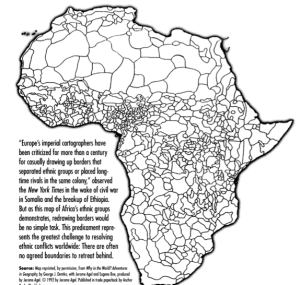
Assuming that the political will to achieve this goal were to evolve, what would be the best mechanism? What would Herbst’s argument be? Is this even feasible? Where would one draw the new boundaries? How would one define an ethnic group? Refer to these two maps to get a sense of the near impossibility of the task at hand. While there are about 50-odd states in Africa, there are literally hundreds of geographically-concentrated ethnic groups. In addition, there is a tremendous amount of inter-mingling of ethnic groups as well.


Michael Ignatieff and Humanitarian Intervention

Current leader of the Canadian Federal Liberal Party, Michael Ignatieff has long been involved in the issue of human rights–as a historian, journalist, public intellectual, and as the former Carr Professor and Director of the Carr Center for Human Rights Policy at the Kennedy School of Government.

In the aftermath of the contentious NATO military intervention in Kosovo (1999), Ignatieff sat down with WBUR’s Chris Lydon to assess what had gone right (and wrong) during the intervention. A self-identified member of the “something must be done [to stop alleged Serbian war crimes against the Kosovar Albanians]”, Ignatieff stands by his support for the intervention, claiming that, on the whole, the benefits outweighed the costs.

Israel and Syria once again Negotiating over Golan Heights

In intro to IR on Wednesday we addressed global environmental issues and we went over this chart outlining Thomas Homer-Dixon’s overview regarding the link between environmental scarcity and security. According to Homer-Dixon, environmental degradation is not only an important economic, social, and health issue, it is crucially an issue of importance for global security.

We see the important link between increased environmental scarcity and social effects (like ethnic conflicts, deprivation conflicts and coups d’etat), facilitated indirectly at times by the conditions of weakened states.

Homer-Dixon argues that these environmentally-driven conflicts will increase the more the environment degrades. Moreover, it is just those places in the world that have the least capacity to deal with the potentially negative effects of environmental degradation whose environments will be most likely to suffer.

In the far left column is “unequal resource access”. One of the most important resources to humankind is water. The conflict between Syria and Israel over the Golan Heights is crucially linked to water. As we learn from the New York Times:

JERUSALEM — Peace overtures between Israel and Syria moved up a gear on Wednesday when a Syrian cabinet minister said that Prime Minister Ehud Olmert of Israel had sent a message to President Bashar al-Assad to the effect that Israel would be willing to withdraw from all the Golan Heights in return for peace with Syria.

The Syrian expatriate affairs minister, Buthaina Shaaban, told Al Jazeera television, “Olmert is ready for peace with Syria on the grounds of international conditions; on the grounds of the return of the Golan Heights in full to Syria.” She said that Turkey had conveyed the message.

Israeli officials did not deny the statement from Damascus but would not confirm it either, offering a more general, positive reaction. “Israel wants peace with Syria; we are interested in a negotiated process,” said Mark Regev, a spokesman for Mr. Olmert. “The Syrians know well our expectations, and we know well their expectations…”

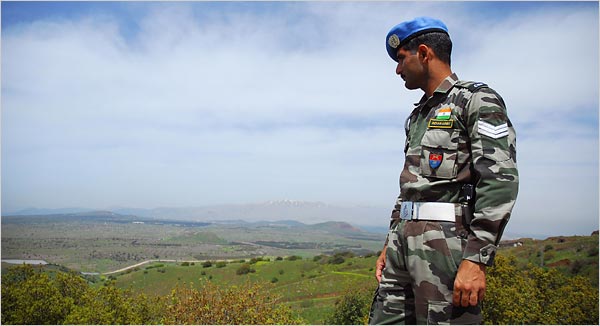
“…Withdrawal from the Golan Heights is a contentious issue in Israel. The territory is a strategic plateau that overlooks a large swath of northern Israel. Israel has objected to past Syrian demands for access to the shore of the Sea of Galilee, a main water source for Israel.

Yehuda Raizner/Agence France-Presse — Getty Images

An Indian member of the United Nations force in the Golan Heights, a strategic

plateau that overlooks a swath of northern Israel.

Newsweek Editor Fareed Zakaria Says “No” to Olympic Boycott

In a recent column, Newsweek’s Fareed Zakaria argues that the US should not boycott the Olympic Games in Beijing this summer.  He argues that it would have the opposite of the intended effect.  Here are some snippets:

Public humiliation does not work nearly as well on the regime in Beijing as private pressure. At first glance, China’s recent crackdown in Tibet looks like a familiar storyline: a dictatorship represses its people. And of course that’s part of the reality — as it often is in China. But on this issue, the communist regime is not in opposition to its people. The vast majority of Chinese have little sympathy for the Tibetan cause. To the extent that we can gauge public opinion in China and among its diaspora, ordinary Chinese are, if anything, critical of the Beijing government for being too easy on the Tibetans. The real struggle here is between a nationalist majority and an ethnic and religious minority looking to secure its rights.

In these circumstances, a boycott of the Olympics would have precisely the opposite effect that is intended. The regime in Beijing would become only more defensive and stubborn. The Chinese people would rally around the flag and see the West as trying to humiliate China in its first international moment of glory. (There are many suspicions that the United States cannot abide the prospect of a rising China.) For most Chinese, the Games are about the world’s giving China respect, rather than bolstering the Communist Party’s legitimacy…

…Some want to punish China for its association with the Sudanese government, which is perpetrating atrocities in Darfur. But to boycott Beijing’s Games because it buys oil from Sudan carries the notion of responsibility too far. After all, the United States has much closer ties to Saudi Arabia, a medieval monarchy that has funded Islamic terror. Should the world boycott America for this relationship?

SKY News Report on Situation in Tibet

Here is an interesting video, which captures the events surrounding an organized (by the Chinese authorities) visit of non-Chinese journalists to the capital city of Tibet, Lhasa.  It seems as though events conspired against the Chinese authorities just a little bit:

Ethnic Conflict and Strife

A couple of days ago all blog posts seemed to be related to the theme “the social logic of politics”. Today, there seems to be a surge in episodes of inter-ethnic conflict worldwide. First, we learn from the Washington Post, that there is unrest and violence in the Tibetan capital of Lhasa, where a week of increasing confrontations between native Tibetans and the Chinese government have turned violent, with native Tibetans battling with Chinese police and troops and also attacking ethnic Han Chinese, which is either unprecedented or extremely rare.

BEIJING, March 14 — A week of tense confrontations over Chinese rule in Tibet erupted in violence Friday, as hundreds of protesters clashed with police and set fire to shops in the center of Lhasa. Doctors reported dozens of wounded streaming into area hospitals, and one witness said the downtown area was “in a state of siege.”

The rare breakout of violence, the worst in 20 years in the capital city of a remote mountainous region that is the heart of Tibetan Buddhism, posed a challenge to the Chinese government as it prepares to host the 2008 Olympic Games in August. Seeking to make the Games a worldwide celebration of its swift economic progress during the past three decades, the Chinese government has steadfastly attempted to project an image of harmony and stability, even while tightening its grip over the restive region.

“This spiraling unrest has triggered the scenario the Chinese prayed would not happen,” said Robbie Barnett, director of modern Tibetan studies at Columbia University. “Now we’re just watching the clock tick until people get off the street or the Chinese open fire.”

In a different part of the world, Malaysia, in which once again ethnic Chinese are involved, the New York Times reports on post-electoral tension on the island of Penang:

PENANG, Malaysia — Chanting “Long Live the Malays!” several hundred members of Malaysia’s largest ethnic group gathered Friday on this largely Chinese island, defying a police ban on protests and raising communal tensions after sharp electoral losses by the country’s governing party.

Newly elected state governments have moved rapidly to abolish some of the long-held privileges of ethnic Malays. Those efforts have challenged the core of Malaysia’s ethnic-based political system and inflamed the sensibilities of Malays. Until the March 8 elections, Malays thoroughly dominated politics through the country’s largest party, the United Malays National Organization, known by its initials, U.M.N.O.

The opposition parties that beat U.M.N.O. and its partners in five states say affirmative action should be based on need rather than ethnicity. But the opposition, too, is struggling to contain fissures along ethnic lines as a Chinese opposition party competes with its Malay counterpart.

“We’re living in very sensitive times,” said Tricia Yeoh, director of the Center for Public Policy Studies, an independent research center in Kuala Lumpur, the capital.

The affirmative action program favoring the Malays has been in place for more than three and a half decades and gives Malays everything from discounts on new houses to 30 percent quotas in initial public offerings of companies. It is known as the New Economic Policy.

Finally, in Iraq, where in the last four years the minority Christian community has been decimated, either through targeted killings or ethnic cleansing, we hear news of the killing of a prominent Catholic Bishop:
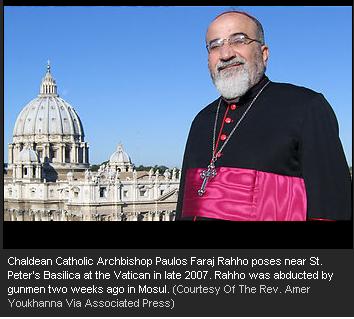
bishop_rahro.jpg BAGHDAD, March 13 — The body of a senior Christian cleric was found Thursday in the northern city of Mosul, two weeks after gunmen abducted him there and killed three of his associates.

The death of Paulos Faraj Rahho, 65, archbishop of Mosul’s Chaldean community, prompted expressions of remorse and condemnation from the Iraqi government and Christian leaders.

Pope Benedict XVI, in a message to the Chaldean patriarch in Iraq, called the killing an “act of inhuman violence that offends the dignity of the human person and seriously harms the cause of fraternal coexistence among the beloved Iraqi people.”

Iraqi Prime Minister Nouri al-Maliki said it was a crime of “aggression aimed at inciting sedition among” Iraqis.

Serbian Electorate Must Choose–Stomach or Heart?

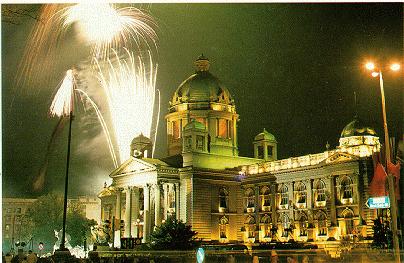
narodna_skupstina_srbije.jpgThe Serbian coalition government, with moderate nationalist Vojislav Koštunica as Prime Minister–has collapsed following dissension within the multi-party governing coalition over the “loss of Kosovo.” Voters will go to the polls to elect a new government on May 11th having to make a stark choice in the polling booth: whether to side with the nationalists in their struggle to forestall Kosovar independence, or to vote in a more moderate pro-European government, thereby placating not only members of the European Union but calming the nerves of wary international investors, who have become the life-blood of the Serbian economic system. As reports reports:

…The coalition government collapsed at the weekend, with nationalist Prime Minister Vojislav Koštunica blaming disunity over the conflicting goals of pursuing European Union membership versus defending Kosovo, the province which seceded last month with EU backing.

“Right now, around 1.0 billion euros worth of investments have been put on hold,” [Deputy Prime Minster Božidar] Djelić said. “There is a growing risk perception considering that some parties want to halt Serbia’s road to Europe. The elections will be a choice between Europe and investors are extremely careful.”

Heavily reliant on foreign investment for growth, Serbia is believed to need between 3.0 billion and 5.0 billion euros a year to ensure solid economic growth, single digit inflation and financing of its current account gap of 16 percent of GDP.

“In the absence of the required level of foreign investment, foreign creditors could also decide to put on hold lending to Serbian companies,” said Pavle Petrović of the FREN/CEVES thinktank said.

“The resulting crisis would lead to forcible reduction in external gaps through inflation, currency depreciation, a fall in output and wages. In that case, the central bank could soothe and postpone, but not eliminate the crisis,” he said.

Design a site like this with WordPress.com
Get started