ICG Report–Diamonds and the Central African Republic (CAR)

The International Crisis Group (ICG) has just released a new report on the influence of diamonds on the political situation in the Central African Republic (CAR). We’ve read various papers on the link between resource wealth (“lootable resources”) and political outcomes, such as regime type and economic outcomes. This report analyses the link between the presence of large stores of diamond wealth in CAR, the level of political instability (it’s essentially a failing state) and the existence of endemic conflict.  From the executive summary of the report:

In the diamond mines of the Central African Republic (CAR), extreme poverty and armed conflict put thousands of lives in danger. President François Bozizé keeps tight control of the diamond sector to enrich and empower his own ethnic group but does little to alleviate the poverty that drives informal miners to dig in perilous conditions. Stringent export taxes incentivise smuggling that the mining authorities are too few and too corrupt to stop. These factors combined – a parasitic state, poverty and largely unchecked crime – move jealous factions to launch rebellions and enable armed groups to collect new recruits and profit from mining and selling diamonds illegally. To ensure diamonds fuel development not bloodshed, root and branch reform of the sector must become a core priority of the country’s peacebuilding strategy.

Nature scattered diamonds liberally over the CAR, but since colonial times foreign entrepreneurs and grasping regimes have benefited from the precious stones more than the Central African people. Mining companies have repeatedly tried to extract diamonds on an industrial scale and largely failed because the deposits are alluvial, spread thinly across two large river systems. Instead, an estimated 80,000-100,000 mostly unlicensed miners dig with picks and shovels for daily rations and the chance of striking it lucky. Middlemen, mostly West Africans, buy at meagre prices and sell at a profit to exporting companies. The government lacks both the institutional capacity to govern this dispersed, transient production chain and the will to invest diamond revenues in the long-term growth of mining communities.

Chronic state fragility has ingrained in the political elite a winner-takes-all political culture and a preference for short-term gain. The French ransacked their colony of its natural resources, and successive rulers have treated power as licence to loot. Jean-Bédel Bokassa, the CAR’s one-time “emperor”, created a monopoly on diamond exports, and his personal gifts to French President Giscard d’Estaing, intended to seal their friendship, became symbols of imperial excess. Ange-Félix Patassé saw nothing wrong in using his presidency to pursue business interests and openly ran his own diamond mining company. Bozizé is more circumspect. His regime maintains tight control of mining revenues by means of a strict legal and fiscal framework and centralised, opaque management.

The full report can be accessed here. Here is a Al-Jazeera English news report on the situation in CAR.
The Age of Global (In)equality?

Many of the readings from Chapter 9 of O’Neil’s Essential Readings address the issue of global divergence/convergence in economic growth and/or inequality over the last few decades (and even further back than that–i.e., the Pritchett reading). The question comes down to whether there has been more or less inequality over time. Which is it? Well, the answer depends to a large extent on how one chooses to measure inequality. I’ll begin my response to this by quoting a student’s e-mail I received earlier today:

Hello, below is a link to a video showing one aspect or area of convergence.

I don’t know if I agree that countries are converging in regards to wealth and health; after all, Africa still seems very far behind.  I general, yes, countries today are healthier (longer life spans) and wealthier (not looking at inequality) than they were 200 years ago…

…For our purposes, what is the meaning of convergence and divergence?  From Pritchett, he seems to be measuring growth in terms of GDP and concluding that there is divergence between developed and developing nations (i.e. the levels of growth are not coming together, but separating).  What about China and India, who experienced faster or “larger growth” than some developed nations in the 80’s to mid 90’s?  Then with Milanovic, he is talking about inequality – how it is decreasing at the world level (when Indian and China are included) and this shows convergence.  To me, O’Neil seems to be trying to present two sides of an issue; however, I see two separate issues.  One is divergence in economic growth and the other is convergence in equality. I suppose that China’s and India’s economic growth can explain or at least correlate to lower inequality at the world level, but is that the correct way of interpreting Milanovic?  Is he saying that there’s a convergence of equality (or lower inequality gap worldwide), because countries (when including China and India) are converging in regards to economic growth?

Thank you.

This student is essentially correct in his reading of the respective arguments. As I mentioned earlier, which view one takes on the question of the recent direction of inequality convergence/divergence depends upon how one chooses to measure inequality. To put it differently, it depends upon whether your unit-of-analysis is the country or the individual. A Gini Index score that is calculated on the basis of mean levels of national income (or wealth) may not be the same as one calculated on the basis of comparing the wealth of individuals worldwide. In fact, Milanovic tells us that the values are indeed different, and the difference is due mainly to what has happened in China and India over the last two decades or so.


“Ghosts of Rwanda” Documentary

As a video supplement to the Rwanda chapter from Samantha Power’s book on genocide, and the Gourevitch book, we viewed the first part of the PBS Frontline documentary “Ghosts of Rwanda” in class today. Please view the remaining hour or so sometime before next Friday’s class as we will use the first portion of that session to continue our discussion on the international community’s failure to halt the slaughter of more than 800,000 Tutsis by the Hutu-led Rwandan government.Here’s the first part of the documentary. Click on the video to take yourself to Youtube, where you will easily find the remaining parts.


German Chancellor Merkel–German Multiculturalism a Complete Failure

In a speech to the youth wing of her party last week, German Chancellor Angela Merkel proclaimed multiculturalism in Germany a “complete failure.” Merkel’s remarks have caused some consternation both within Germany and abroad. Detractors have used the speech to highlight what they claim is an increasingly strident anti-immigrant (and particularly anti-Muslim) tone in the words and deeds of the right and centre-right in Germany. The clip below–from Al Jazeera’s English-language news program–places Merkel’s comments within the context of the contemporary debate in Europe on issues related to the assimilation/integration of Muslim immigrants. (Note the clip on the recent “burqa controversy” in France.

There is, I believe, a more charitable reading of Chancellor Merkel’s comments. The public debate in Germany on immigration, multiculturalism and the place of immigrants in German society has-for peculiarly German reasons–lagged the reality for a long while. It was not until the election of Gerhard Schroeder’s SDP/Green coalition in 1998 that the German citizenship law was changed to make it consistent with the social reality.

http://www.youtube.com/watch?v=04AHUU_wxVg

Can the UN Keep the Peace?

Today in IS 302 we viewed the video “Can the UN Keep the Peace”, which looked at the challenges that face the UN Mission in the Democratic Republic of the Congo. Like the pairing of the perfect wine with the right meal, this video was (at least in my opinion) a perfect complement to today’s readings.

How Big is Africa?

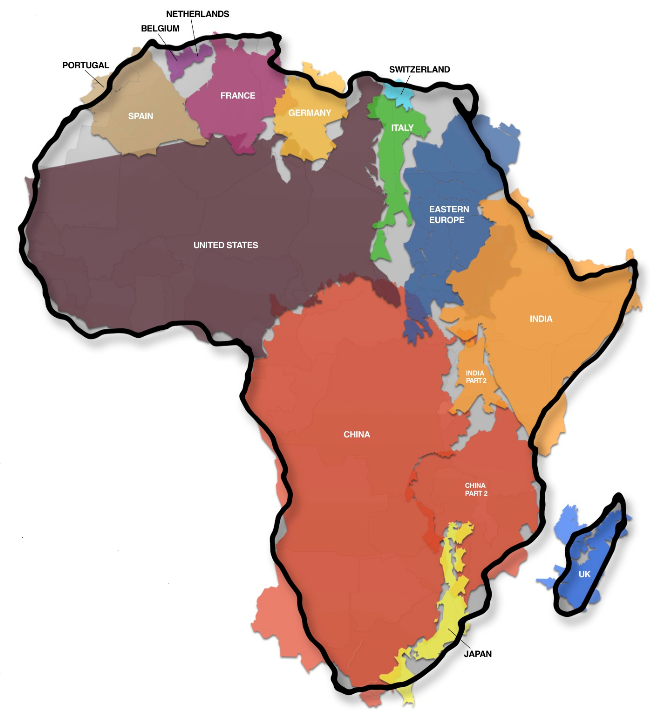
In the second half of the Comparative World Government course we’ll be analysing issues and concepts that will allow us to learn more about the many countries located on the diverse continent of Africa. In addition to being very diverse, Africa is a very large continent. Many of us have little idea about just how big the continent is. Here’s a revealing graphic by Kai Krause, that will hopefully cure us of a little bit of our immapancy–insufficient geographical knowledge. Click on the link above to view a larger picture, with more information.

What does the HDI measure?

This post is prompted by an e-mail from one of the students in my Comparative World Government class. Here’s the e-mail message:

I’m just studying and going through my notes, and had a quick question. In topic 4 when you were talking about GDPs and the Gini Index you said that there actually was a correlation between countries with a high GDP and a low Gini index, but isn’t GDP used in calculating the gini index? So wouldn’t it kind of skew the data, forcing the gini index to be more likely to follow the same pattern as the GDP?

Just curious

Here is my response:

Thanks for the question. I’m almost certain that I didn’t say that, since there’s generally no correlation between the Gini Index and the GDP. Some rich countries have relatively high equality (Sweden, for example) and some have high inequality (USA). Conversely, some poor countries have high levels of equality (India), while some poor countries have very high levels of inequality (Central African Republic).

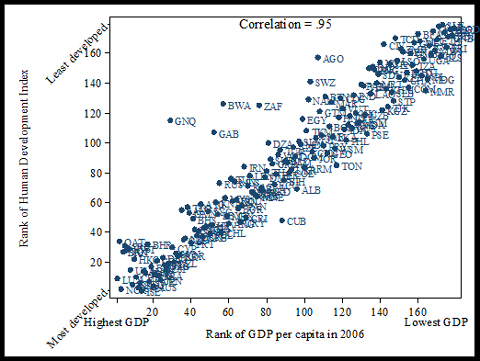
What I most likely said was that there was a very high correlation between a country’s GDP and is score on the Human Development Index (HDI). Just a bit of research…turns up this interesting bit of analysis by Justin Wolfers at the NY Times Freakonomics blog, showing a correlation of 0.95 between a country’s HDI rank and GDP rank (2006). That’s an exceptionally high correlation, suggesting that the HDI isn’t measuring much more than the country’s level of GDP.

Wolfers created a graph using the 2006 data for GDP rank and HDI rank, while I provide for your viewing pleasure below.

Accessing online journal articles from off-campus

Hello Students:

Some of you have e-mailed inquiring about how to access the subscription-only online journals from off-campus. With the roll-out of the library’s new “fast search” feature, it’s now as easy as 1-2-3…4-5!

Here’s what you do:

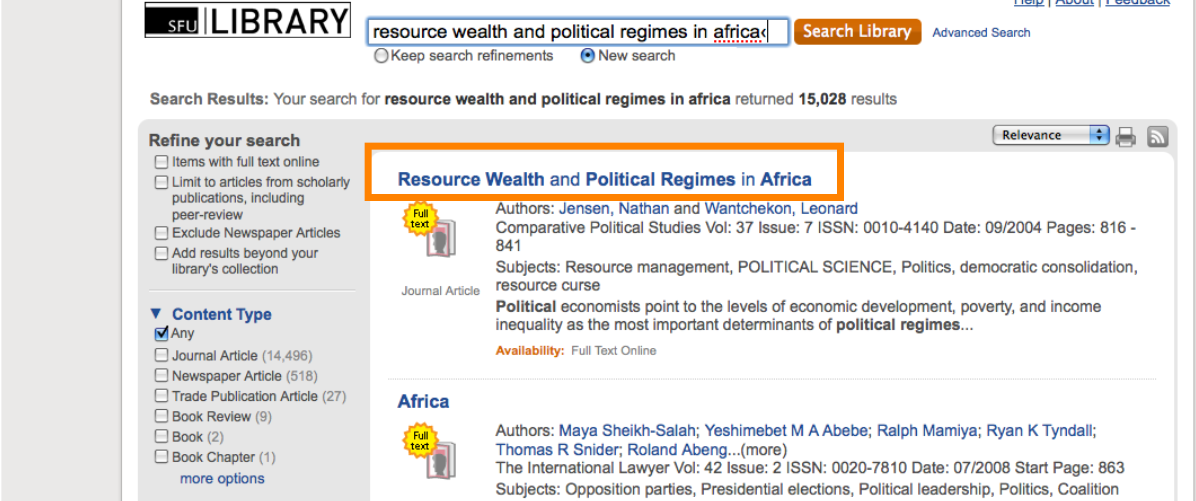
1) Go to the library’s website http://www.lib.sfu.ca/ and check that the “Fast Search” has been selected in the search area (it should be the default).

2) Type the name of the article you’re seeking in the appropriate place (see pic below) and click “Search.”

3) A new browser window will open. If you see the name of the article, click the appropriate link (inside the orange rectangle in the picture below):

Continue reading “Accessing online journal articles from off-campus”

Tips for Students on Writing Good Papers

Henry Farrell, who teaches political science at George Washington University, has posted an essay with tips for students writing political science papers. There are some important insights, such as “cut to the chase”, “organize, organize, organize”, and “avoid data dumps.” In my opinion, his most important tip (and this would also apply to examinations) is “read the requirements for the assignment.” If you’re unsure about the requirements, or there is something you don’t understand, seek clarification from your professor/instructor. The whole essay can be found here:


The face of Statelessness–Canadian Style

Last week I asked if all the world’s residents have citizenship. We discovered that the answer is `no’ and that there are approximately 15 million  stateless persons worldwide.  On the way to work this morning, I was listening to the CBC program The Current, which reported on the peculiar story of a young girl living in Belgium, whose father is a Canadian citizen, but who is currently not a citizen of any country. She does not fulfill the requirements of Belgian citizenship (which does not have universal jus soli citizenship rules), and as of last year falls through a loophole in Canadian citizenship law as of changes in the law that were enacted last year.

From the program:

Citizens of Nowhere – Ian Goldring

Chloe Goldring is 15 months old. She lives in Brussels, Belgium. And she has no citizenship. She is officially stateless. She has ended up in this situation because of a change made to the Canadian Citizenship Act in April of 2009.

Since then Canadians who were born abroad, in this case her father, are no longer able to pass on Canadian citizenship to their children, unless those children are born in Canada. The change was brought in to target parents born outside Canada who come here, obtain citizenship, and then return to their country of origin and pass along Canadian citizenship to children who may never have any intention of coming to Canada.

You may remember this became an issue in the summer of 2006 when there was a public outcry over Canada’s move to rescue Lebanese Canadians during the Israeli bombardment of Lebanon that summer. Well that is the change that Chloe Goldring has been swept up in.

Chloe’s father Ian Goldring is a Canadian who lives in Brussels.

Design a site like this with WordPress.com
Get started