Two Opportunities for Summer Study Abroad

Via the polcan listserv (Canadian Political Science Association) comes word about two opportunities for study abroad in the area of (ethnic) conflict. The first is a course offered in Kenya by the University of Toronto. The course, PCS361Y–Special Topics in Peace and Conflict Studies: Conflict in Africa: Causes, Consequences, and Responses–is described as “an intensive inquiry into the causes, consequences, and especially possible to conflict in Africa.” The course will be taught in Nairobi, Masai Mara, and Mombasa from May 13 through June 6. For more information, go here.

The second course will be taught as part of the American University in Kosovo summer program. Here is a description of the program:

American University in Kosovo is now accepting applications for the Summer of 2011 to study Peacebuilding, Post-conflict Transformation, and Development in the fun and safe ‘living laboratory’ of the Balkans. This four-week program offers a wide selection of courses in related areas from an impressive array of global scholars, diplomats, retired military officers, ex-combatants, practitioners, and representatives of international organizations. The goal of the program is to bridge the gap between theory and practice. Last year’s program included about 60 students from over 30 countries — including 6 Canadians. About 2/3 of the students were undergraduates — the remaining graduate students. Undergraduate course credits are transferrable. Several participants from 2010 referred to their experiences in the program as ‘life transforming.’

For more about this program, go here.

How to read tables of statistical regression results

Next week–January 21st–we’ll be looking at the debate between cultural and rationalist approaches to the analysis of political phenomena. As Whitefield and Evans note in the abstract of their 1999 article in the British Journal of Political Science:

There has been considerable disagreement among political scientists over the relative merits of political culture versus rational choice explanations of democratic and liberal norms and commitments. However, empirical tests of their relative explanatory power using quantitative evidence have been in short supply.

Their analysis of the political attitudes of Czech and Slovak residents is relatively rare in that the research is explicitly designed to assess the relative explanatory purchase of cultural and rationalist approaches to the study of political phenomena. Whitefield and Evans compile evidence (observational data) by means of a survey questionnaire given to random samples of Czech and Slovak residents. In order to assess the strengths of rationalist versus cultural accounts, Whitefield and Evans use statistical regression analysis. Some of you may be unfamiliar with statistical regression analysis, This blog post will explain what you need to know to understand the regression analysis results summarised in Tables 7 through 9 in the text.

Let’s take a look at Table 7. Here the authors are trying to “explain” the level of “democratic commitment”–that is, the level of commitment to democratic principles–of Czech and Slovak residents. Thus, democratic commitment is the dependent variable. The independent, or explanatory, variables can be found in the left-most column. These are factors that the authors hypothesize to have causal influence on the level of democratic commitment of the survey respondents. Some of these are nationality–Slovaks, Hungarians, political experience and evaluations–past and future–of the country’s and family’s well-being.

Each of the three remaining columns–Models 1 through 3–represents the results of a single statistical regression analysis (or model). Let’s take a closer look at the first model–ethnic and country dummy variables. In this model, the only independent variables analysed are one’s country and/or ethnic origin. The contrast category is Czechs, which means that the results are interpreted relative to how those of Czech residence/ethnicity answered. We see that the sign for the result of each of the two explanatory variables–Slovaks and Hungarians–is negative. What this means is that relative to Czechs, Slovaks and Hungarians demonstrated less democratic commitment. The two ** to the right of the numerical results (-0.18 and -0.07, respectively) indicate that this result is unlikely to be due to chance and is considered to be statistically significant. This would suggest that deep-seated cultural traditions–ethnicity/country or residence–have a strong causal (or correlational, at least) effect on the commitment of newly democratic citizens to democracy. Does this interpretation of the data still stand when we add other potential causal variables, as in Models 2 and 3? What do you think?

A New Semester

I hope that all of you had a restful and pleasant holiday and are ready to jump into the new semester. I’ll be teaching two courses this semester–IS 210 (Comparative World Government) and IS 309 (Ethnic Conflict, Violence, and Peace)–so look for a lot of posts that explore these two subjects.

Here’s to a successful semester for all,

J


The Age of Global (In)equality?

Many of the readings from Chapter 9 of O’Neil’s Essential Readings address the issue of global divergence/convergence in economic growth and/or inequality over the last few decades (and even further back than that–i.e., the Pritchett reading). The question comes down to whether there has been more or less inequality over time. Which is it? Well, the answer depends to a large extent on how one chooses to measure inequality. I’ll begin my response to this by quoting a student’s e-mail I received earlier today:

Hello, below is a link to a video showing one aspect or area of convergence.

I don’t know if I agree that countries are converging in regards to wealth and health; after all, Africa still seems very far behind.  I general, yes, countries today are healthier (longer life spans) and wealthier (not looking at inequality) than they were 200 years ago…

…For our purposes, what is the meaning of convergence and divergence?  From Pritchett, he seems to be measuring growth in terms of GDP and concluding that there is divergence between developed and developing nations (i.e. the levels of growth are not coming together, but separating).  What about China and India, who experienced faster or “larger growth” than some developed nations in the 80’s to mid 90’s?  Then with Milanovic, he is talking about inequality – how it is decreasing at the world level (when Indian and China are included) and this shows convergence.  To me, O’Neil seems to be trying to present two sides of an issue; however, I see two separate issues.  One is divergence in economic growth and the other is convergence in equality. I suppose that China’s and India’s economic growth can explain or at least correlate to lower inequality at the world level, but is that the correct way of interpreting Milanovic?  Is he saying that there’s a convergence of equality (or lower inequality gap worldwide), because countries (when including China and India) are converging in regards to economic growth?

Thank you.

This student is essentially correct in his reading of the respective arguments. As I mentioned earlier, which view one takes on the question of the recent direction of inequality convergence/divergence depends upon how one chooses to measure inequality. To put it differently, it depends upon whether your unit-of-analysis is the country or the individual. A Gini Index score that is calculated on the basis of mean levels of national income (or wealth) may not be the same as one calculated on the basis of comparing the wealth of individuals worldwide. In fact, Milanovic tells us that the values are indeed different, and the difference is due mainly to what has happened in China and India over the last two decades or so.


Tips for Students on Writing Good Papers

Henry Farrell, who teaches political science at George Washington University, has posted an essay with tips for students writing political science papers. There are some important insights, such as “cut to the chase”, “organize, organize, organize”, and “avoid data dumps.” In my opinion, his most important tip (and this would also apply to examinations) is “read the requirements for the assignment.” If you’re unsure about the requirements, or there is something you don’t understand, seek clarification from your professor/instructor. The whole essay can be found here:


Citizenship and Statelessness

Do all persons have citizenship?

No. It has been estimated that there are currently about 15 million stateless persons worldwide. From the Nubian people of Kenya to residents of the Dominican Republic of Haitian descent, statelessness is a global phenomenon affecting the health, economic well-being, and human security of the individuals, families, and groups involved.

The Open Society Justice Initiative has produced a series of documentaries on the issue, the introduction to which can be viewed below. From the description:

Although some stateless people are refugees, many have never crossed a border or left their country of birth. Although the problems related to statelessness may manifest themselves differently, at the root is a group of people who have been denied a legal identity.

A stateless person is not recognized as a citizen by any state. Citizenship enables you not only to vote, hold public office, and exit and enter a country freely, but also to obtain housing, health care, employment, and education. Citizenship is necessary in order to live a decent human life. Stateless people are denied that right.

For more information, visit http://www.soros.org/stateless

Resources for First Paper (IS 210)–Risk Assessment

Here are some data resources that may be helpful to you while researching and writing your first paper assignment. I’ll be showing you how to use/access some of these sources in class on Thursday, September 23rd.

Continue reading “Resources for First Paper (IS 210)–Risk Assessment”

Failed States and the Fund for Peace’s Failed States Index 2010

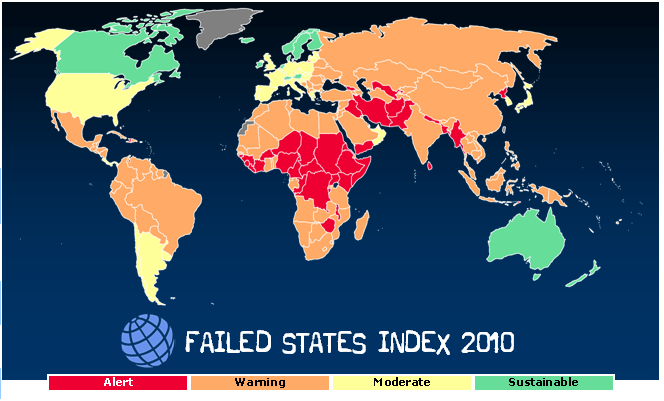
On Thursday, September 23rd we will begin to analyse the exceptionally important concept–the state. It will become strikingly obvious that a strong state is a necessary–but not sufficient–condition for political stability, political and personal liberty, democracy, and economic well-being. Conversely, citizens living in weak, failing, or failed states face lives of economic destitution, personal insecurity (think of Hobbes’ state of nature, where life is nasty, brutish, and short), and lack of basic rights and freedoms. The Fund for Peace publishes an annual index of failed and failing states. A quick look at the results over the last decade or so finds that the same dozen or so states are continually at the top of the list of failed/failing states. Here is a map depicting the results of the most recent index:

Notice the geographical concentration of failed states (in red). Why are the vast majority of the world’s failed states found in central Africa and southwest Asia?

What are the characteristics of failed states that distinguish them from more stable states? Maybe this video of life in Somalia will provide some clues:

The “New Humanitarianism” and Rule vs. Act Utilitarianism (Consequentialism)

In chapter 3 of Humanitarian Intervention Weiss analyses “new wars” and “new humanitarianisms.”  The changing nature of humanitarian work is characterized by many things, but I’d like to focus on one particularly, which will lead us to a discussion of the importance of neutrality and the concepts of rule and act utilitarianism.

Weiss argues that humanitarian responses, by NGOs particularly,  are becoming more ambitious in scope and thereby shifting from a focus on short-term emergency relief to “attacking the root causes and post-conflict peacebuilding.” He continues,

“rather than provide band-aids, they [humanitarians] wish to use assistance and protection as levers. Many aid agencies desire to spread development, democracy, and human rights and create stable, effective, and legitimate states.” (76)

This has led, concomitantly, to a change in the humanitarian principles of neutrality and impartiality. These principles, Weiss notes, “made sense if the objective was to provide relief and gain access to affected populations.” These principles, it is argued, foundered upon the reality that contemporary wars–“new wars”–were creating “unanticipated and unintended negative consequences.” Moreover, in a world in which the combatants are state militaries, neutrality and impartiality retained some internal logic. However, as genocidaires and other ty[es of rebel groups become the main combatants in civil wars and the predominant perpetrators of crimes against humanity, the principles of neutrality and impartiality come to be seen increasingly as relics of a bygone era.

A few students took issue with this argument, insisting that there are also likely to be unintended consequences of humanitarian organizations repudiating the principles of neutrality and impartiality. They mentioned some of these in class. This prompted a quick excursion by me into the difference between act and rule utilitarianism/consequentialism. I’ll explain below the fold:

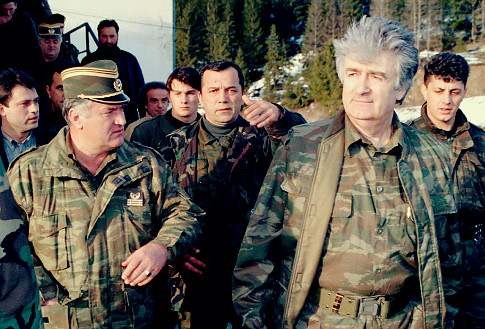
Bosnia Muslim leaders argued that the neutrality policy allowed Messrs. Karadzic and Mladic free reign in their campaign to ethnically cleanse large swaths of Bosnia of (well-fed) Muslims.

Continue reading “The “New Humanitarianism” and Rule vs. Act Utilitarianism (Consequentialism)”

Current United Nations Peacekeeping Operations

We discussed Tom Weiss’ book–Humanitarian Intervention–in IS 302 today. We spent some time on the changing nature, and number, of peacekeeping operations since the end of the Cold War. Below is a map listing the 16 current UN peacekeeping operations. You can find the source image, which is clickable, here.  How many of these operations are proceeding under the auspices of Chapter VII of the UN Charter?

Here is part of the textof the UNSC resolution, authorizing the establishment of MONUSCO in the Democratic Republic of the Congo:

Resolution 1925 (2010)
Adopted by the Security Council at its 6324th meeting, on 28 May 2010

The Security Council,

Continue reading “Current United Nations Peacekeeping Operations”

Design a site like this with WordPress.com
Get started