Regime Change, Freedom, Democracy, and Islam

In our IS210 class, we’ve been assessing nondemocratic regimes. I had my students read an article by M. Steven Fish, published in World Politics in 2002, titled “Islam and Authoritarianism.” In it, the author notes the striking empirical finding that a majority of Arab Muslim countries had nondemocratic regimes, even after controlling for potentially confounding factors such as oil wealth, level of political violence, poverty, etc. Fish asks what it is about Islam that is linked to authoritarianism. Or, to put it another way, he searches for the causal mechanism lining Islam and regime type. He tentatively finds it in the status of women in contemporary Muslim societies.


Nothing could be less heartening to democratic idealists than the notion that a particular religion is inimical to democracy. Religious traditions are usually constants within societies; they are variables only
across societies. Societies usually are “stuck” with their religious traditions and the social and psychological orientations they encode and reproduce. Yet religious practices and the salience of particular beliefs can change. Even if Muslim countries are more male dominated in some respects than non-Muslim countries, there is no logical reason why such a state of affairs must be immutable. Rigid segregation according to sex and male domination does not have a firm scriptural basis. The Koran provides no justification whatsoever for practices such as female genital mutilation and it condemns all infanticide as a heinous sin, even if it is motivated by a fear of want (17:31; 81:1–14). Much of the Koran’s instruction on marriage, divorce, and other aspects of relations between the sexes (for example, 2:222–41; 4:3; 4:128; 33:1–5; 58:1–4) is more liberal than the sharia (religious law) as practiced in some modern-day Muslim societies. It is therefore as dubious to try to locate the sources of social practice and order in scripture in Islamic settings as it is to try to locate them there in Christian and Jewish settings, because as with all holy injunction based on sacred text, interpretive traditions are powerful and ultimately determine practice. The status of women in Muslim societies is thus both paradoxical and mutable.

At the present time, however, the evidence shows that Muslim countries are markedly more authoritarian than non-Muslim societies, even when one controls for other potentially influential factors; and the station of women, more than other factors that predominate in Western thinking about religious systems and politics, links Islam and the democratic deficit.

What do the recent upheavals in the Muslim-majority states of north Africa and the Middle East portend not only for democracy but for the status of women in these societies. CBC Radio’s “the Current” program set out to try to answer that question in a show dedicated to “women and political upheaval.” Here’s a description of the women interviewed on that evening’s show:

We started this segment with a clip from Mona Seif. She was heavily involved in the protests that brought down former Egyptian President Hosni Mubarak. And in the days leading up to his resignation, she told us she really believed the revolt would lead to a significant improvement in the lives of Egyptian women.

But since then, there have been reports that the situation for Egyptian women has regressed to the way it used to be. So we checked in again with Mona Seif. She’s still in Tahrir Square. But she’s feeling a little less optimistic.

Women have often played leading roles in pushing for change in the Arab and Muslim worlds. But when the dust settles, the gains they think they have made are often elusive. For their thoughts on why that is and whether things may be different this time … we were joined by three women who have spent decades trying to improve the position of women in their societies.

Before the Iranian revolution, Mahnaz Afkhami was Iran’s Minister for Women’s Affairs. She’s now the Founder and President of the Women’s Learning Partnership. She was in Washington, D.C.

Asma Khader is a former Jordanian minister of culture. She’s now the Secretary General of the Jordanian National Commission for Women. She was in Amman, Jordan.

And Leila Ahmed is an Egyptian-born professor at Harvard University’s Divinity School. Her research focuses on women in Islam. And her book, The Quiet Revolution: The Veil’s Resurgence From the Middle East to America will be published next month. She was in Cambridge, Massachusetts.


Social Network Media and Revolution

In the wake of the revolutionary changes that have (hopefully) taken place in Tunisia and Egypt, much has been made about the role of social media–particularly Facebook–in facilitating the participatory aspect of the revolutionary end-game. (A Google search of `Facebook AND Egypt revolution’ turns up over 22 million hits.) The Globe and Mail’s  Chrystia Freeland is the latest journalist to address the phenomenon, quoting economists Daron Acemoglu and Matthew Jackson.

Freeland notes that social network media have helped resolve what social scientists refer to as the collective action problem.

“It is a question of co-ordinating people’s beliefs,” said Daron Acemoglu, a professor of economics at the Massachusetts Institute of Technology, who, with Matthew Jackson of Stanford University in California, is working on a paper about the effect of social networks on collective action problems.

Protesting against an authoritarian regime is a prime example of this issue, Mr. Acemoglu said, because opponents of a dictator need to know that their views are widely shared and that a sufficient number of their fellow citizens are willing to join them to make opposition worthwhile.

“I need to know if other people agree with me and are willing to act,” he said. “What really stops people who are oppressed by a regime from protesting is the fear that they will be part of an unsuccessful protest. When you are living in these regimes, you have to be extremely afraid of what happens if you participate and the regime doesn’t change.”

That makes publicly protesting an oppressive regime a classic collective action problem: If everyone who wants regime change takes to the streets, the group will achieve its shared goal. But if too few protest, they will fail and be punished. Even if an overwhelming majority wants change, it is smart for individuals to speak out only if enough compatriots do, too.

To Freeland’s characterisation of the collective action problem I would add that the reason it is “smart for individuals to speak out only if enough compatriots do, too” is because each individual reasons in the following manner:

  • I am only one person; my individual marginal contribution to the probability of having a successful revolution is infinitesimally small.
  • Thus, my taking part or not will not be determinative. That is, the revolution will succeed or fail regardless with or without my participation.
  • Given the above, and given potential costs of participating, it is rational for me to not participate.

Social media, however, can help to change the calculus of participation by assuring the would-be participant that millions of others will also participate, thereby decreasing the potential costs of participation to any one individual. I do have an issue, however, with Freeland’s use of the Groupon analogy, which is based on the difference between the types of private goods Groupon specialises in and the truly public good that is a revolution.

China and Civil Society

This week in IS 210 we addressed the concept of civil society–its institutions, and the relationships thereof with the state and market sectors. As part of today’s lecture, we viewed an excerpt of a video recording of a roundtable discussion about China and civil society. In a highly informative presentation, George Mason University (Fairfax, VA) research professor, Carol Lee Hamrin, assessed the changes in Chinese civil society over the last few decades. As the power and reach of the Chinese party-state recedes it has opened up room for the increasing independence of civil society institutions and (especially) the commercialisation of the Chinese economy.

You can view the whole video here.

Links to Articles and other Sources on State Capacity

For your first paper assignment (IS 210) you will be required to compare the nature of the state in two countries. One of the dimensions across which you will compare is state capacity. To help you out, here are some interesting sources:

First, here is the link to a presentation at the World Bank building state capacity in Africa. Here is a description:

If Africa is to have a well-functioning public sector there needs to be a paradigm shift in how to analyze and build state capacity. This is the core message in a new book from the World Bank, Building State Capacity in Africa: New Approaches, Emerging Lessons. Specifically, African governments and their partners should move from a narrow focus on organizational, technocratic, and public management approaches, to a broader perspective that incorporates both the political dynamics and the institutional rules of the game within which public organizations operate.BUILDING STATE CAPACITY IN AFRICA presents and analyzes recent experiences with supply-side efforts to build administrative capacity (administrative reform, pay policies, budget formulation), and demand-side efforts to strengthen government accountability to citizens (role and impact of national parliaments, dedicated anticorruption agencies, political dynamics of decentralization, education decentralization).

The second source is a paper by Mauricio of the Brookings Institution on “State Capacity in Latin America”. Cardenas writes:

State capacity is exceptionally low in Latin America, even when compared to other former colonies. This paper analyzes four possible factors that could potentially explain this troubling feature: political inequality, inequality, interstate conflict and civil war. With the exception of external war, these variables have a negative effect on state-building in models where the accumulation of state capacity is analogous to investment under uncertainty. These analytical predictions are then tested with cross-country data, paying special attention to Latin America. Democracy’s impact on state capacity is quite positive, as is the effect of the frequency of external wars when data for the last century is used. However, in the data for the last half century, external wars have little effect, but the negative effects of internal wars and income inequality become highly significant. The model explains why Latin America has failed to develop its state, despite the improvement in the various measures of democracy. In fact, both the theoretical model and the empirical evidence suggest that the effects of democracy are undermined in the presence of high economic inequality.


How to read tables of statistical regression results

Next week–January 21st–we’ll be looking at the debate between cultural and rationalist approaches to the analysis of political phenomena. As Whitefield and Evans note in the abstract of their 1999 article in the British Journal of Political Science:

There has been considerable disagreement among political scientists over the relative merits of political culture versus rational choice explanations of democratic and liberal norms and commitments. However, empirical tests of their relative explanatory power using quantitative evidence have been in short supply.

Their analysis of the political attitudes of Czech and Slovak residents is relatively rare in that the research is explicitly designed to assess the relative explanatory purchase of cultural and rationalist approaches to the study of political phenomena. Whitefield and Evans compile evidence (observational data) by means of a survey questionnaire given to random samples of Czech and Slovak residents. In order to assess the strengths of rationalist versus cultural accounts, Whitefield and Evans use statistical regression analysis. Some of you may be unfamiliar with statistical regression analysis, This blog post will explain what you need to know to understand the regression analysis results summarised in Tables 7 through 9 in the text.

Let’s take a look at Table 7. Here the authors are trying to “explain” the level of “democratic commitment”–that is, the level of commitment to democratic principles–of Czech and Slovak residents. Thus, democratic commitment is the dependent variable. The independent, or explanatory, variables can be found in the left-most column. These are factors that the authors hypothesize to have causal influence on the level of democratic commitment of the survey respondents. Some of these are nationality–Slovaks, Hungarians, political experience and evaluations–past and future–of the country’s and family’s well-being.

Each of the three remaining columns–Models 1 through 3–represents the results of a single statistical regression analysis (or model). Let’s take a closer look at the first model–ethnic and country dummy variables. In this model, the only independent variables analysed are one’s country and/or ethnic origin. The contrast category is Czechs, which means that the results are interpreted relative to how those of Czech residence/ethnicity answered. We see that the sign for the result of each of the two explanatory variables–Slovaks and Hungarians–is negative. What this means is that relative to Czechs, Slovaks and Hungarians demonstrated less democratic commitment. The two ** to the right of the numerical results (-0.18 and -0.07, respectively) indicate that this result is unlikely to be due to chance and is considered to be statistically significant. This would suggest that deep-seated cultural traditions–ethnicity/country or residence–have a strong causal (or correlational, at least) effect on the commitment of newly democratic citizens to democracy. Does this interpretation of the data still stand when we add other potential causal variables, as in Models 2 and 3? What do you think?

Events/Lectures that may be of Interest

I’ll use this blog to keep you informed about lectures and events that may be of interest to you that are taking place on campus or in the greater Vancouver area. There are two events this week that are relevant.

This evening, Monday September 13th, at 7:00pm the Philosophers’ Cafe is kicking off the first event of its fall series at the Shadbolt Centre for the Arts at Deer Lake in Burnaby. This evening’s discussion is titled “Mixed Up: Is Canada’s cultural mix more like a melting pot, mosaic or matrix?” We’ll be addressing issues of identity and culture in about two weeks time in IS 210. The admission is $5, and the event will be moderated by Randall Mackinnon, who has served as a president, board member, executive and consulting staff for a diversity of community service organizations since 1970. For more information about tonight’s event and directions to the venue, click here.

The second event is a one-woman show entitled Miracle in Rwanda, which is showing all of this week at Pacific Theatre Company and will also have a two-week run on Granville Island beginning later this month. To learn more about the show, and to purchase tickets, go here.

Update: The website I linked to above links to the wrong page. Miracle in Rwanda is part of this year’s Vancouver Fringe Festival. Here’s the correct link to information regarding show times and tickets.

India–an “exceptional” Country with Democratic Deficit

In comparative politics, there are two countries that are truly exceptional–the USA and India.  By “exceptional”, I mean just that; they are both exceptions to general rules that have solid support, empirically and theoretically.  For example, when looking cross-nationally there is a strong negative relationship between religiosity and economic development.  That is, the richer a country, the less religious (ceteris paribus) are its residents.  Except for the United States.  The USA is exceptional in many regards; i.e., it doesn’t behave like all other advanced industrial democracies.

India is also exceptional, but in different ways from the US.  For example, there is strong support for hypotheses about democracy and social (ethnic/religious) heteroeneity, which suggest that there is no way that India should still be (after more than 60 years) a fairly well functioning democracy.  Many observers keep waiting for the other shoe to drop as India’s democracy has lurched from crisis-to-crisis, and has to contend with endemic levels of corruption, particularly in its judiciary (as we see in this excerpted report–written by the Asian Human Rights Commission and which I found at the Human Security Gateway, a great source for information about security issues in world politics).  Somehow, though, India’s democracy hangs on.

By recommending the impeachment of a High Court judge, the Chief Justice of India has revived a dead debate concerning the Indian judiciary. On August 2, 2008 in a letter addressed to the Prime Minister, the Chief Justice recommended the impeachment of judge Soumitra Sen of Calcutta High Court. Judge Sen is accused of having been involved in financial misappropriation before he was appointed as a judge. It is reported that in 1984 while judge Sen was practising as a lawyer he was appointed as the receiver in a dispute concerning the Steel Authority of India. It is alleged that in the capacity of the receiver he misappropriated a sum of INR 2,500,000 [USD 59523], which judge Sen reportedly paid back on orders from the court. Later, he was appointed a judge at the Calcutta High Court in 2003. A judge accused of corruption facing impeachment, a process by which a sitting judge could be removed from service in India, is nothing special. A corrupt public servant is not worthy of continuing in service and is least desirable to serve as a judge in a court of law, a public office that demands scrupulous impartiality and untainted personality. Anyone accused of a crime must be prosecuted and the crime investigated into. The fact that the accused is a judge must not provide the person with any immunity. Judge Sen being the first person recommended for impeachment by a Chief Justice of India does not mean that the judiciary is immune from corruption and other vicious practices. There are similar allegations against some judges in India. But not a single judicial officer was impeached so far. The only exception was the case of judge V. Ramaswami who faced impeachment in 1991, an attempt that failed due to the absence of a political consensus. It is expected that history will not be repeated. If it is repeated it would be a shame upon the Indian judiciary and its accountability. The accountability of judges, particularly in the context of increasing allegations of malpractices resorted to by judges is a grave concern in India. As of now there is no open process for the selection, promotion and if required the dismissal of High Court or Supreme Court judges in the country. The entire process is retained within the whims of the Supreme Court. All attempts so far to enforce accountability on the judiciary were vetoed by the judiciary itself. There is also the absence of a political consensus over this issue.

What are the Fundamental Tenets of Confucianism…Culture as Destiny?

Over the past few weeks, we have addressed the debate regarding the relative explanatory power of cultural versus institutional and rational choice approaches to the analysis of political phenomena.  In the book excerpt, “A Brief History of Human Liberty,” Newsweek editor Fareed Zakaria analyzes the cultural argument regarding economic growth and democracy. He quotes the former Singaporean Prime Minister Lee Kuan Yew:

“…if you want to see how culture works, compare the performance of German workers and Zambian workers anywhere in the world.  You will quickly come to the conclusion that there is something very different in the two cultures that explains the results.”

Zakaria has some sympathy for this argument, but then argues that it is strange that Lee Kuan Yew is such a strong proponent of cultural arguments* given that while Singapore is culturally very similar to its neighbor, Malaysia, Singapore has been much more effective in its economic policies than has its neighbor.  In fact, I would add that a strong argument against cultural explanations of democracy and economic development are the differences between East Germany and West Germany (in the post-WWII-era until unification) and the present difference between North and South Korea.

The 38th parallel may be just a line on a map, and the division of the nation of Korea into two separate states may be a historically contingent act, but it demonstrates the tremendously powerful impact of institutions on a society.  South Korea was able to develop good political and economic institutions, while North Korea has not.  The cultural foundation of each state was similar (although I’m not an expert on Korea, so maybe there was a cultural difference between the “north” and the “south” that can account for the vast differences in the two states today–although I’m highly skeptical) before the division and we know, in a methodological sense, that a constant can not explain an outcome that varies.

Getting back to Zakaria and Lee Yuan Kew, Zakaria writes that

“the key to Singapore’s success…is Lee Kuan Yew, not Confucius.  The point is not that culture is unimportant; on the contrary it matters greatly…But culture can change…A hundred years ago, when East Asia seemed immutably poor, many scholars–most famously Max Weber [we’ve read his Protestant Ethic argument]–argued that Confucian-based cultures discouraged all the attributes necessary for success in capitalism…A decade ago, when East Asia was booming, scholars had turned this explanation on its head, arguing that Confucianism actually emphasized the traits essential for economic dynamism. Today the wheel has turned again and many see in ‘Asian values’ all the ingredients of crony capitalism.”‘

What are these Confucian and ‘Asian values’ about which there has been so much discussion.  Well, needless to say Asia is a vast land mass, with exceedingly high levels of diversity–culturally, linguistically, religiously, racially, etc.  So the concept of ‘Asian values’ may be so amorphous as to http://onpoint.wbur.org/2006/08/15/china-and-confucian-democracy http://onpoint.wbur.org/2006/08/http://onpoint.wbur.org/2006/08/15/china-and-confucian-democracy/china-and-confucian-democracy.  Confucianism, however, is a distinct and compact body of ideas that has a comprehensive philosophical foundation.  What are Confucian values, then and do they help or hinder China’s precarious journey towards democracy and economic development?  Well, here’s an answer from political philosopher Daniel Bell, who insists that ultimately, Confucianism is about three core values.  What are these?  Listen to the first ten minutes of the audio podcast from this episode of “On Point.”  Here’s a link to the URL on which you can find an archived version of the show.

**Here, it should be noted that a reason Lee Kuan Yew is strongly predisposed to arguing on the basis of culture is his contempt for the licentiousness of Western values and his desire to prevent demands for those kinds of freedoms (as long as political liberty) to take root in the strongly authoritarian state of Singapore.  Just read his statements during the infamous Michael Fay incident.

It wasn’t long before Singapore patriarch Lee Kuan Yew weighed in. He reckoned the whole affair revealed America’s moral decay. “The U.S. government, the U.S. Senate and the U.S. media took the opportunity to ridicule us, saying the sentence was too severe,” he said in a television interview. “[The U.S.] does not restrain or punish individuals, forgiving them for whatever they have done. That’s why the whole country is in chaos: drugs, violence, unemployment and homelessness. The American society is the richest and most prosperous in the world but it is hardly safe and peaceful.”

Here’s another story on the incident.

Reagan to Gorbachev–“Tear Down This Wall”

Getting ready for our mock German election tomorrow has me thinking about the German political system, the respective political parties, and German reunification.  It reminded me of this famous speech by President Ronald Reagan at Brandenburg Gate in (West) Berlin.

Political Ideology/Attitudes and Happiness

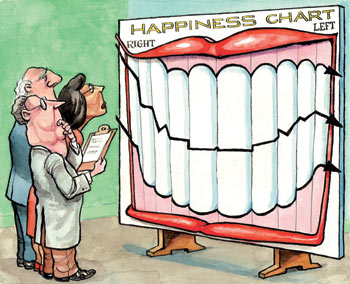
Are individuals of a certain political attitude orientation more likely to be happy than those with competing political attitudes?  The short answer, in the United States at least, may be yes; moreover, self-defined conservatives seem to be much happier (or at least claim they are) than are liberals, and extremists of either group are happier than moderates.  From the Economist:

economist_happiness.jpgIn 2004 Americans who called themselves “conservative” or “very conservative” were nearly twice as likely to tell pollsters they were “very happy” as those who considered themselves “liberal” or “very liberal” (44% versus 25%). One might think this was because liberals were made wretched by George Bush. But the data show that American conservatives have been consistently happier than liberals for at least 35 years.

This is not because they are richer; they are not. Mr Brooks thinks three factors are important. Conservatives are twice as likely as liberals to be married and twice as likely to attend church every week. Married, religious people are more likely than secular singles to be happy. They are also more likely to have children, which makes Mr Brooks confident that the next generation will be at least as happy as the current one.

When religious and political differences are combined, the results are striking. Secular liberals are as likely to say they are “not too happy” as to say they are very happy (22% to 22%). Religious conservatives are ten times more likely to report being very happy than not too happy (50% to 5%). Religious liberals are about as happy as secular conservatives.

Why should this be so? Mr Brooks proposes that whatever their respective merits, the conservative world view is more conducive to happiness than the liberal one (in the American sense of both words). American conservatives tend to believe that if you work hard and play by the rules, you can succeed. This makes them more optimistic than liberals, more likely to feel in control of their lives and therefore happier. American liberals, at their most pessimistic, stress the injustice of the economic system, the crushing impersonal forces that keep the little guy down and what David Mamet, a playwright, recently summed up as the belief that “everything is always wrong”. Emphasising victimhood was noble during the 1950s and 1960s, says Mr Brooks. By overturning Jim Crow laws, liberals gave the victims of foul injustice greater control over their lives. But in as much as the American left is now a coalition of groups that define themselves as the victims of social and economic forces, and in as much as its leaders encourage people to feel helpless and aggrieved, he thinks they make America a glummer place.

Design a site like this with WordPress.com
Get started