Deal or no deal and rational choice theory

As my students are aware, I have been under the weather since the beginning of January and am finally feeling somewhat like a human being again. During my down time, I took some rest and had time to do some non-school-related activities, one of which was trying out the Deal or No Deal app on my smartphone. You do remember the TV show hosted by Howie Mandel, right?

Deal or No Deal and Rational Choice Theory

Anyway, the basic idea of the show is this:

  • There are 26 suitcases on state, each with a card containing a dollar amount between $1 and $1 Million.
  • The game begins when the contestant chooses one of the 26 suitcases as “their” suitcase. If the contestant keeps the suitcase until the end of play, they win the dollar amount written on the card inside the suitcase.
  • The contestant must begin opening a certain amount of suitcases during each round of play–5 the first round, 4 the next, etc.
  • After each round, the game pauses and the contestant receives an offer from the mysterious banker via telephone with Howie as the intermediary.
  • The contestant is then asked whether there is a “deal, or no deal.” The contestant may accept the banker’s offer or continue. [There is where the drama gets ramped up to 11!]
  • If you have watched the show, you’ll notice that the banker’s offer depends upon which dollar amounts have been revealed. If the contestant reveals many high-value suitcases, it becomes like likely (probable) that the suitcase s/he chose at the beginning is a high-value suitcase.

The smartphone version is slightly different from the TV show in that the suitcases do not have dollar amounts attached but point multiples (that is, you win 1X, 2X, 3x, etc. 1000X the pot).

Take a look at the images above screenshot (is that the past participle?) from my smartphone. What do you notice about the banker’s offer? What’s of importance here is the red boxes in each picture. These are two separate games, btw.

These are two separate games. In the top game, there are only two suitcases left–one of them is the 20X and the 200X, Therefore, I have either the 20X or the 200X. That’s quite a big difference in winnings–ten times. So, what would you do? What would a rational choice theorist say you should do? Are the bankers offers rational in each case? Why or why not?

Statistics, GDP, HDI, and the Social Progress Index

That’s quite a comprehensive title to this post, isn’t it? A more serious social scientist would have prefaced the title with some cryptic phrase ending with a colon, and then added the information-possessing title. So, why don’t I do that. What about “Nibbling on Figs in an Octopus’ Garden: Explanation, Statistics, GDP, Democracy, and the Social Progress Index?” That sounds social ‘sciencey’ enough, I think.

Now, to get to the point of this post: one of the most important research topics in international studies is human welfare, or well-being. Before we can compare human welfare cross-nationally, we have to begin with a definition (which will guide the data-collecting process). What is human welfare? There is obviously some global consensus as to what that means, but there are differences of opinion as to how exactly human welfare should be measured. (In IS210, we’ll examine these issues right after the reading break.) For much of the last seven decades or so, social scientists have used economic data (particularly Gross Domestic Product (GDP) per capita as a measure of a country’s overall level of human welfare. But GDP measures have been supplemented by other factors over the years with the view that they leave out important components of human welfare. The UN’s Human Development Index is a noteworthy example. A more recent contribution to this endeavour is the Social Progress Index (SPI) produced by the Social Progress Imperative.

HDI–Map of the World (2013)

How much better, though, are these measures than GDP alone? Wait until my next post for answer. But, in the meantime, we’ll look at how “different” the HDI and the SPI are. First, what are the components of the HDI?

“The Human Development Index (HDI) measures the average achievements in a country in three basic dimensions of human development: a long and healthy life, access to knowledge and a decent standard of living.”

So, you can see that it goes beyond simple GDP, but don’t you have the sense that many of the indicators–such as a long and healthy life–are associated with GDP? And there’s the problem of endogeneity–what causes what?

The SPI is a recent attempt to look at human welfare even more comprehensively, Here is a screenshot showing the various components of that index:

Screen shot 2014-01-23 at 2.17.50 PMWe can see that there are some components–personal rights, equity and inclusion, access to basic knowledge, etc.,–that are absent from the HDI. Is this a better measure of human well-being than the HDI, or GDP alone? What do you think?

How much does political culture explain?

For decades now, comparativists have debated the usefulness of cultural explanations of political phenomena. In their path-breaking book, The Civic Culture, Almond and Verba argued that there was a relationship between, what they called, a country’s political culture and the nature and quality of democracy. (In fact, the relationship is a bit more complex in that the believed that a country’s political culture mediated the link between individual attitudes and the political system.) Moreover, the political culture was itself a product of underlying and enduring socially cultural factors, such as either an emphasis on the family, bias towards individualism, etc. Although Almond and Verba studied only five countries–the United States, West Germany, Mexico, Italy, and the United Kingdom–they suggested that the results could be generalized to (all) other countries.

How much, however, does culture explain? Can it explain why some countries have strong economies? Or why some countries have strong democracies? We know that cultural traits and values are relatively enduring, so how can we account for change? We know that a constant can not explain a variable.

The 1963 Cover of Almond and Verba's classic work.

In a recent op-ed piece in the New York Times, Professor Stephen L. Sass asks whether China can innovate its way to technological and economic dominance over the United States. There is much consternation in the United States over recent standardized test scores showing US students doing poorly, relative to their global peers, on science exams. (How have Canadian students been faring?)

Professor Sass answers his own question in the negative. Why, in his estimation, will China not innovate to the top? In a word (well, actually two words)–political culture:

Free societies encourage people to be skeptical and ask critical questions. When I was teaching at a university in Beijing in 2009, my students acknowledged that I frequently asked if they had any questions — and that they rarely did. After my last lecture, at their insistence, we discussed the reasons for their reticence.

Several students pointed out that, from childhood, they were not encouraged to ask questions. I knew that the Cultural Revolution had upturned higher education — and intellectual inquiry generally — during their parents’ lifetimes, but as a guest I didn’t want to get into a political discussion. Instead, I gently pointed out to my students that they were planning to be scientists, and that skepticism and critical questioning were essential for separating the wheat from the chaff in all scholarly endeavors.

Although Sass admits that there are institutional and other reasons that will also serve to limit China’s future technological innovation, he ends up affirming the primacy of political culture:

Perhaps I’m wrong that political freedom is critical for scientific innovation. As a scientist, I have to be skeptical of my own conclusions. But sometime in this still-new century, we will see the results of this unfolding experiment. At the moment, I’d still bet on America.

Do you agree? What other important political phenomena can be explained by political culture?

More on Milgram’s Methods of Research

In a previous post, I introduced Stanley Milgram’s experiments on obedience and authority. We watched a short video clip in class and students responded to questions about Milgram’s research methods. Upon realizing that the unwitting test subjects were all males, one student wondered whether that would have biased the results in a particular direction. The students hypothesized that women may have been much less likely to defer to authority and continue to inflict increasing doses of pain on the test-takers. While there are good reasons to believe either that women would be more or less deferential than are men, what I wanted to emphasize is the broader point about evidence and theory as it relates to research method and research ethics.

The 'sophisticated' machinery of the Milgram Obedience Experiment
The ‘sophisticated’ machinery of the Milgram Obedience Experiment

In the video clip, Milgram states candidly that his inspiration for his famous experiments was the Nazi regime’s treatment of Europe’s Jews, both before and during World War II. He wanted to understand (explain) why seemingly decent people in their everyday lives could have committed and/or allowed such atrocities to occur. Are we all capable of being perpetrators of, or passive accomplices to, severe brutality towards our fellow human beings?

Milgram’s answer to this question is obviously “yes!” But Milgram’s methods of research, his way of collecting the evidence to test his hypothesis, was biased in favour of confirming his predetermined position on the matter. His choice of lab participants is but one example. This is not good social science, however. The philosopher of science, Carl Hempel, long ago (1966) laid out the correct approach to  producing good (social) science:

  1. Have a clear model (of the phenomenon under study), or process, that one hypothesizes to be at work.
  2. Test out the deductive implications of that model, looking at particularly the implications that seem to be least plausible,
  3. Test these least plausible implications against empirical reality.

If even these least plausible implications turn out to be confirmed by the model, then you have srong evidence to suggest that you’ve got a good model of the phenomenon/phenomena of interest. As the physicist Richard Feynman (1965) once wrote,

…[through our experiments] we are trying to prove ourselves wrong as quickly as possible, because only in that way can we find progress.

Did the manner in which Milgram set up his experiment give him the best chance to “prove himself wrong as quickly as possible” or did he stack the deck in favour of finding evidence that would confirm his hypothesis?

Globalization is good…or is it?

Is globalization good for those in developing countries? What is the link between globalization and poverty? What about globalization and democracy? Today in IS210 we watched a documentary in which the narrator argued that more globalization is good for the poor in developing countries. He argued that countries that have (and are) globalizing, such as Taiwan and Vietnam,  have become richer, more democratic, and poverty levels have plummeted. On the other hand, countries that haven’t democratized, regardless of whether this is the result of domestic or external policy, have done poorly. They’re less democratic and poorer than they otherwise could be.

Here’s a link to the documentary, and some questions that you may want to think about:

  1. Has globalization been beneficial or detrimental to Taiwan’s economic development? Explain.
  2. What role, according to the narrator, do multi-national corporations (MNCs) play in globalization? Should LDCs embrace the arrival of MNCs into their economies? How can the example of Vietnam inform our answers to these questions? Is there a link between MNCs and worker productivity?
  3. According to the narrator, what was the role of sweatshops in the development of Taiwan’s economy? Were they necessary?
  4. What is the link between globalization and democracy? What is the process that causes this empirical link?
  5. What is the reason for Africa’s slow growth, according to the narrator? Which of Collier and Gunning’s [from Chapter 9 of Essential Readings) four categories would apply? How does the situation of Kenya inform our answers to this question?
  6. What is the e ect of developing countries trade policies on economic outcomes in Kenya and in other parts of the developing world?

Does Globalization Cause Ethnic Conflict?

Today’s session in IS 309 addressed the link between globalization and ethnic conflict. Our main reading material came from Amy Chu’s book, World On Fire, the thesis of which is that the twin phenomena of economic globalization and the spread of liberal democracy cause ethnic conflict in countries that have “market-dominant minorities.” Cynthia Olzak’s recently published article in the Journal of Conflict Resolution answers the same question in this way:

This article examines how different components of globalization affect the death toll from internal armed conflict. Conventional wisdom once held that the severity of internal conflict would gradually decline with the spread of globalization, but fatalities still remain high. Moreover, leading theories of civil war sharply disagree about how different aspects of globalization might affect the severity of ethnic and nonethnic armed conflicts. Using arguments from a variety of social science perspectives on globalization, civil war, and ethnic conflict to guide the analysis, this article finds that (1) economic globalization and cultural globalization significantly increase fatalities from ethnic conflicts, supporting arguments from ethnic competition and world polity perspectives, (2) sociotechnical aspects of globalization increase deaths from
ethnic conflict but decrease deaths from nonethnic conflict, and (3) regime corruption increases fatalities from nonethnic conflict, which supports explanations suggesting that the severity of civil war is greater in weak and corrupt states.

Chua’s book was received with some praise but also with a fair amount of criticism. Here are some links to videos that may be of interest to you:

Where do most of the World’s Poor Live?

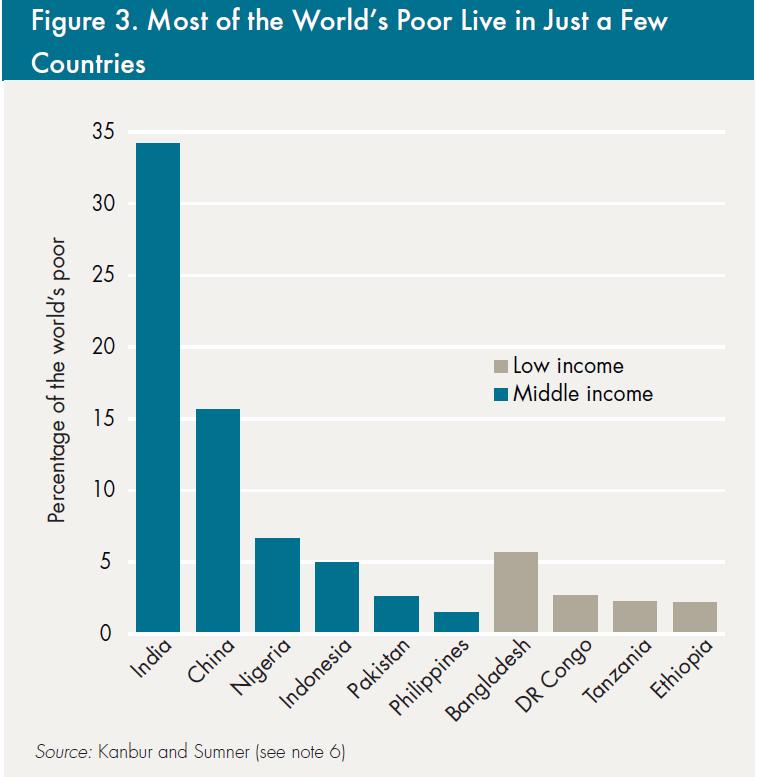
In a recently released report. the Center for Global Development argues that there are more poor people in middle-income countries (MICs) than in low-income countries (LICs). The new “bottom billion” (the phrase made famous by economic Paul Collier’s book of the same name) is not only the result of India and China having moved from LIC to MIC status. Indeed, according to the authors of the report, “the proportion of the world’s poor in MICs has still tripled, not only from a range of other countries like Nigeria, Pakistan, Indonesia, but also from some surprising MIC countries such as Sudan, Angola, and Cameroon.” Whereas twenty years ago, more than 90% of the world’s poor lived in LICs, today more than 70% of the world’s poor live in MICs.

Since 2000, over 700 million poor people have “moved” into MICs by way of their countries’ graduating from low-income status (see figure 1). And this is not just about China and India. Even without them, the proportion of the world’s poor in MICs has still tripled, not only from a range of other countries like Nigeria, Pakistan, Indonesia, but also from some surprising MIC countries such as Sudan, Angola, and Cameroon. The total number of LICs has fallen from 63 in 2000 to just 40 in the most recent data (see figure 2), and this trend is likely to continue.3 India and three other countries (Pakistan, Indonesia, and Nigeria) account for much of the total number of the new MIC poor (see figure 3). Among all MICs (new and old), five populous countries are home to 854 million poor people, or two-thirds of the world’s poor. These are Pakistan, India, China, Nigeria, and Indonesia.

One might ask how sensitive the shift is to the thresholds themselves? Of the new MICs, several are very close to the threshold—notably, Lesotho, Nicaragua, Pakistan, Senegal, Vietnam, and Yemen. India is only US$180 per capita per year over the threshold, but it is reasonable to assume that growth in India will continue and keep it out of danger of slipping back. It is important to recognize, however, that a significant number of the new MICs still fall under the threshold for the International Development Association (IDA), the World Bank’s concessionary lending window for poor countries.

The authors argue that this change in the location of the world’s poor carries with it important policy implications. If most of the world’s poor live in MICs, what does that mean for foreign aid and for the economic development policies and goals of rich countries and international organizations alike? Read the report to find their answer. The report, in addition, contains some interesting charts:

Digital Media and Political Unrest

Via the Oxford University Press blog (what a great idea!), Philip Howard assesses the link between digital (specifically, social) media and political unrest in the Middle East and north Africa. Although he cautions against running afoul of the common “correlation is not causation” fallacy, Howard does make an illuminating point about the impact of social media and civil society on the potential for a country to experience political unrest:

Digitally enabled protesters in Tunisia and Egypt tossed out their dictator. The protests in Libya have posed the first serious challenge to Gaddafi’s rule in decades and the crisis in that country is not over. Several regimes have had to dismiss their cabinets and offer major concessions to their citizens. Discontent has cascaded over transnational networks of family and friends to Algeria, Bahrain, Jordan, Lebanon, Saudi Arabia, and Yemen. Ben Ali ruled Tunisia for 20 years, Mubarak reigned in Egypt for 30 years, and Gaddafi has held Libya in a tight grip for 40 years. Yet their bravest challengers are 20- and 30-year-olds without ideological baggage, violent intentions or clear leaders.

The answer, for the most part, is online. And it is not just that digital media provided new tools for organizing protest and inspiring stories of success from Tunisia and Egypt. The important structural change in Mideast political life is not so much about digital ties between the West and the Arab street, but about connections between Arab streets.

But a reasonable foreign policy question remains. If digital media changes the political game in countries run by tough dictators, who will fall next?

Here’s a handy chart that gives us an indication of the answer to that question:

Microcon Releases Publications in honour of International Women’s Day

As many of you may know, since the early 1900s March 8th is used to observe International Women’s Day. In honour of this day, the Microcon group, which is a group of scholars who analyze violent conflict using micro-level approaches, has made publicly available a set of research papers related to sex, gender, and violence.

International Women’s Day

These publications are being issued to coincide with the International Women’s Day, which takes place on 8th March each year. Annually on 8 March, thousands of events are held throughout the world to inspire women and celebrate achievements towards gender equality.

MICROCON is working on gender issues in conflict-affected areas in two main ways. First of all, it has a set of three projects which take gender as the main object of their analysis. The policy briefing below by Kathleen Jennings is the product of one of these projects.

Secondly, MICROCON is attempting to meet the EU guidelines in relation to gender equality, by bringing in women researchers at all levels, addressing women’s specific needs in its research rather than working in a gender neutral fashion in all aspects of our work, and ensuring that everything we do ‘contribute[s] to an enhanced understanding of gender issues’. The paper below by Colette Harris assesses our progress in this respect, and attempts to demonstrate how gender can be used at different conceptual levels in conflict analysis, and what can be gained from this analytically.

For more information see MICROCON’s gender framework, and visit the International Women’s Day website.

Of particular interest is a research working paper by Colette Harris, ” What Can Applying a Gender Lens Contribute to Conflict Studies? A review of selected MICROCON1 working papers”:

It is rare to find gender a specific focus of scholarship in conflict studies. In MICROCON we have tried to place gender in a central position within all projects and to convince all researchers to use a gender lens for their analysis. This paper uses a set of MICROCON working papers to illustrate how gender can be used at different conceptual levels in conflict analysis, and aims to show what can be gained by the use of a gender lens. The papers bear out Enloe’s insistence that those seeking an in-depth understanding of the social and political world require a feminist curiosity – that is, a curiosity about the roles gender categories play in political debate and action, as well as in scholarship.


The Partition of India in 1947

The importance of international borders can not be overstated. Despite predictions that the combined forces of globalization would undermine the importance and political meaning of borders, the territorially-defined state remains the world’s predominant form of political organization. As multi-national empires/states collapse, much of the violence that ensues is the result of efforts to draw and redraw what had once been internal borders. Here is a fascinating documentary about the partition of the Indian sub-continent, into India and Pakistan. The narrator observes:

As a British barrister draws a line on a map, the once peaceful land implodes. People are forced out of the villages they have lived in for generations. Fifteen million scramble to be on the right side of the border. At least one million die in the process.

http://www.youtube.com/watch?v=WQcMPbHfxaA


Design a site like this with WordPress.com
Get started