A Wave of Protests across North Africa and the Middle East

Following closely in the aftermath of the dramatic changes that have taken place in Tunisia recently, the political unrest seems to have swept its way across northern Africa, with the situation in Egypt now drawing most of the attention. Alan Cowell of the New York Times writes:

After days of protests that have toppled one president and shaken many others, governments across the Middle East braced on Friday for http://www.guardian.co.uk/global/blog/http://www.guardian.co.uk/global/blog/2011/jan/25/middleeast-tunisia://www.guardian.co.uk/global/blog/2011/jan/25/middleeast-tunisia/jan/25/middleeast-tunisia outbursts of rage and discontent directed at entrenched regimes confronting an exceptional clamor for democracy.

The immediate epicenter of the protests was Egypt, where Internet and cellphone connections were closed or restricted in Cairo, Alexandria and other places. Riot police took to the streets of Cairo before the Friday noon prayers that in http://www.guardian.co.uk/global/blog/2011/jan/25/middleeast-tunisia parts of the Islamic world have been a prelude to unrest as worshippers pour onto the streets.

The protests have underscored the blistering pace of events that have transformed the visage of the Arab world, particularly among regimes that have traditionally enjoyed the support of successive administrations in Washington.

Note the words that I have changed to red in the quote above. Is this author using these words as synonyms? If so, is he using them as precisely as he could be? Is he using them incorrectly?

For more information, here’s a useful set of reports, with myriad links to video and audio, from the UK Guardian’s Jack Shenker reporting in Cairo. In addition, the CBC website has an interesting flash-type graphic showing how the geographical extent of the spread of the protests.

ICG Report–Diamonds and the Central African Republic (CAR)

The International Crisis Group (ICG) has just released a new report on the influence of diamonds on the political situation in the Central African Republic (CAR). We’ve read various papers on the link between resource wealth (“lootable resources”) and political outcomes, such as regime type and economic outcomes. This report analyses the link between the presence of large stores of diamond wealth in CAR, the level of political instability (it’s essentially a failing state) and the existence of endemic conflict.  From the executive summary of the report:

In the diamond mines of the Central African Republic (CAR), extreme poverty and armed conflict put thousands of lives in danger. President François Bozizé keeps tight control of the diamond sector to enrich and empower his own ethnic group but does little to alleviate the poverty that drives informal miners to dig in perilous conditions. Stringent export taxes incentivise smuggling that the mining authorities are too few and too corrupt to stop. These factors combined – a parasitic state, poverty and largely unchecked crime – move jealous factions to launch rebellions and enable armed groups to collect new recruits and profit from mining and selling diamonds illegally. To ensure diamonds fuel development not bloodshed, root and branch reform of the sector must become a core priority of the country’s peacebuilding strategy.

Nature scattered diamonds liberally over the CAR, but since colonial times foreign entrepreneurs and grasping regimes have benefited from the precious stones more than the Central African people. Mining companies have repeatedly tried to extract diamonds on an industrial scale and largely failed because the deposits are alluvial, spread thinly across two large river systems. Instead, an estimated 80,000-100,000 mostly unlicensed miners dig with picks and shovels for daily rations and the chance of striking it lucky. Middlemen, mostly West Africans, buy at meagre prices and sell at a profit to exporting companies. The government lacks both the institutional capacity to govern this dispersed, transient production chain and the will to invest diamond revenues in the long-term growth of mining communities.

Chronic state fragility has ingrained in the political elite a winner-takes-all political culture and a preference for short-term gain. The French ransacked their colony of its natural resources, and successive rulers have treated power as licence to loot. Jean-Bédel Bokassa, the CAR’s one-time “emperor”, created a monopoly on diamond exports, and his personal gifts to French President Giscard d’Estaing, intended to seal their friendship, became symbols of imperial excess. Ange-Félix Patassé saw nothing wrong in using his presidency to pursue business interests and openly ran his own diamond mining company. Bozizé is more circumspect. His regime maintains tight control of mining revenues by means of a strict legal and fiscal framework and centralised, opaque management.

The full report can be accessed here. Here is a Al-Jazeera English news report on the situation in CAR.

Citizenship and Statelessness

Do all persons have citizenship?

No. It has been estimated that there are currently about 15 million stateless persons worldwide. From the Nubian people of Kenya to residents of the Dominican Republic of Haitian descent, statelessness is a global phenomenon affecting the health, economic well-being, and human security of the individuals, families, and groups involved.

The Open Society Justice Initiative has produced a series of documentaries on the issue, the introduction to which can be viewed below. From the description:

Although some stateless people are refugees, many have never crossed a border or left their country of birth. Although the problems related to statelessness may manifest themselves differently, at the root is a group of people who have been denied a legal identity.

A stateless person is not recognized as a citizen by any state. Citizenship enables you not only to vote, hold public office, and exit and enter a country freely, but also to obtain housing, health care, employment, and education. Citizenship is necessary in order to live a decent human life. Stateless people are denied that right.

For more information, visit http://www.soros.org/stateless

Failed States and the Fund for Peace’s Failed States Index 2010

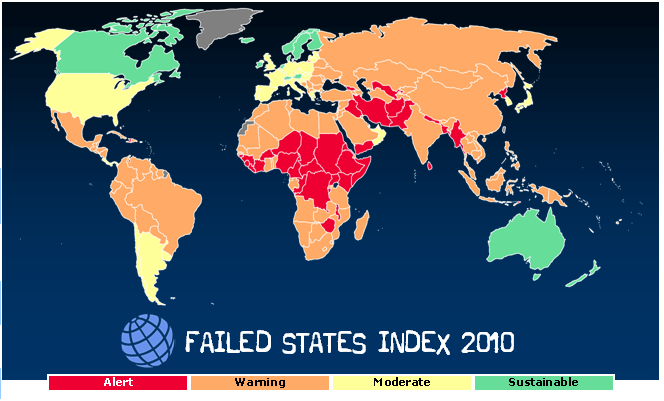
On Thursday, September 23rd we will begin to analyse the exceptionally important concept–the state. It will become strikingly obvious that a strong state is a necessary–but not sufficient–condition for political stability, political and personal liberty, democracy, and economic well-being. Conversely, citizens living in weak, failing, or failed states face lives of economic destitution, personal insecurity (think of Hobbes’ state of nature, where life is nasty, brutish, and short), and lack of basic rights and freedoms. The Fund for Peace publishes an annual index of failed and failing states. A quick look at the results over the last decade or so finds that the same dozen or so states are continually at the top of the list of failed/failing states. Here is a map depicting the results of the most recent index:

Notice the geographical concentration of failed states (in red). Why are the vast majority of the world’s failed states found in central Africa and southwest Asia?

What are the characteristics of failed states that distinguish them from more stable states? Maybe this video of life in Somalia will provide some clues:

External Threat and State Capacity

We addressed the history of state-formation in continental Europe and learned that, as Charles Tilly has noted, war and state-making were interconnected.  The stronger the nascent state, the better it was able to wage war and vice versa.  War-making, of course, required strong coercive and extractive (in the form of taxes and other renumerations) of the state vis-a-vis its domicile population.  Mix in a little bit of nationalism and you’ve got the perfect recipe for a strong state.

A recent article in the Journal of Peace Research [subscription only] by David Lektzian and Brandon Pine, demonstrates the empirical validity of the state-making/war-making nexus.  The argue that the larger the perception of “external threat” the more latitiude do leaders have in increasing the capacity of the state.  Here is the abstract to the paper:

Taming the Leviathan: Examining the Impact of External Threat on State Capacity

This article argues that the systemic security environment influences the structure of domestic political and economic institutions. If states have been primarily created to protect one group from predation by another, then the state may visibly change as external threats rise and fall. The authors argue that political elites respond to threatening environments by enhancing the ability of the state to extract resources from society in order to protect itself. Using data from the Armed Conflict Dataset, Banks’s Cross National Data Archive, and COW data from 1975 to 1995, the authors find evidence that supports the conjectured relationship between threat and state strength. As a response to a more threatening environment, the authors find that states significantly increase their capacity in terms of revenue, government spending, and military spending, but they do not easily relinquish these gains. The authors also observe that nation-state security is heavily influenced by regional regime-type patterns. State capacity increases as the regional neighborhood becomes increasingly autocratic. This suggests political elites not only regard violent conflict in the region as a serious concern to national security, but also appear to consider political change a threat as well.

What are the Fundamental Tenets of Confucianism…Culture as Destiny?

Over the past few weeks, we have addressed the debate regarding the relative explanatory power of cultural versus institutional and rational choice approaches to the analysis of political phenomena.  In the book excerpt, “A Brief History of Human Liberty,” Newsweek editor Fareed Zakaria analyzes the cultural argument regarding economic growth and democracy. He quotes the former Singaporean Prime Minister Lee Kuan Yew:

“…if you want to see how culture works, compare the performance of German workers and Zambian workers anywhere in the world.  You will quickly come to the conclusion that there is something very different in the two cultures that explains the results.”

Zakaria has some sympathy for this argument, but then argues that it is strange that Lee Kuan Yew is such a strong proponent of cultural arguments* given that while Singapore is culturally very similar to its neighbor, Malaysia, Singapore has been much more effective in its economic policies than has its neighbor.  In fact, I would add that a strong argument against cultural explanations of democracy and economic development are the differences between East Germany and West Germany (in the post-WWII-era until unification) and the present difference between North and South Korea.

The 38th parallel may be just a line on a map, and the division of the nation of Korea into two separate states may be a historically contingent act, but it demonstrates the tremendously powerful impact of institutions on a society.  South Korea was able to develop good political and economic institutions, while North Korea has not.  The cultural foundation of each state was similar (although I’m not an expert on Korea, so maybe there was a cultural difference between the “north” and the “south” that can account for the vast differences in the two states today–although I’m highly skeptical) before the division and we know, in a methodological sense, that a constant can not explain an outcome that varies.

Getting back to Zakaria and Lee Yuan Kew, Zakaria writes that

“the key to Singapore’s success…is Lee Kuan Yew, not Confucius.  The point is not that culture is unimportant; on the contrary it matters greatly…But culture can change…A hundred years ago, when East Asia seemed immutably poor, many scholars–most famously Max Weber [we’ve read his Protestant Ethic argument]–argued that Confucian-based cultures discouraged all the attributes necessary for success in capitalism…A decade ago, when East Asia was booming, scholars had turned this explanation on its head, arguing that Confucianism actually emphasized the traits essential for economic dynamism. Today the wheel has turned again and many see in ‘Asian values’ all the ingredients of crony capitalism.”‘

What are these Confucian and ‘Asian values’ about which there has been so much discussion.  Well, needless to say Asia is a vast land mass, with exceedingly high levels of diversity–culturally, linguistically, religiously, racially, etc.  So the concept of ‘Asian values’ may be so amorphous as to http://onpoint.wbur.org/2006/08/15/china-and-confucian-democracy http://onpoint.wbur.org/2006/08/http://onpoint.wbur.org/2006/08/15/china-and-confucian-democracy/china-and-confucian-democracy.  Confucianism, however, is a distinct and compact body of ideas that has a comprehensive philosophical foundation.  What are Confucian values, then and do they help or hinder China’s precarious journey towards democracy and economic development?  Well, here’s an answer from political philosopher Daniel Bell, who insists that ultimately, Confucianism is about three core values.  What are these?  Listen to the first ten minutes of the audio podcast from this episode of “On Point.”  Here’s a link to the URL on which you can find an archived version of the show.

**Here, it should be noted that a reason Lee Kuan Yew is strongly predisposed to arguing on the basis of culture is his contempt for the licentiousness of Western values and his desire to prevent demands for those kinds of freedoms (as long as political liberty) to take root in the strongly authoritarian state of Singapore.  Just read his statements during the infamous Michael Fay incident.

It wasn’t long before Singapore patriarch Lee Kuan Yew weighed in. He reckoned the whole affair revealed America’s moral decay. “The U.S. government, the U.S. Senate and the U.S. media took the opportunity to ridicule us, saying the sentence was too severe,” he said in a television interview. “[The U.S.] does not restrain or punish individuals, forgiving them for whatever they have done. That’s why the whole country is in chaos: drugs, violence, unemployment and homelessness. The American society is the richest and most prosperous in the world but it is hardly safe and peaceful.”

Here’s another story on the incident.

Monty Python’s take on Constitutional Government

I am a huge fan of the British sketch comedy group Monty Python.  For a political science professor, this clip is like politico-comedic gold.  Here is Dennis the peasant’s views on democratic legitimacy, the proper role of popular mandates in the wielding of supreme executive power, and a sarcastic critique of socialist critiques of liberal capitalism (“oh, there you go bringing class into it again!”).  And remember, “you don’t vote for kings.”

Israel and Syria once again Negotiating over Golan Heights

In intro to IR on Wednesday we addressed global environmental issues and we went over this chart outlining Thomas Homer-Dixon’s overview regarding the link between environmental scarcity and security. According to Homer-Dixon, environmental degradation is not only an important economic, social, and health issue, it is crucially an issue of importance for global security.

We see the important link between increased environmental scarcity and social effects (like ethnic conflicts, deprivation conflicts and coups d’etat), facilitated indirectly at times by the conditions of weakened states.

Homer-Dixon argues that these environmentally-driven conflicts will increase the more the environment degrades. Moreover, it is just those places in the world that have the least capacity to deal with the potentially negative effects of environmental degradation whose environments will be most likely to suffer.

In the far left column is “unequal resource access”. One of the most important resources to humankind is water. The conflict between Syria and Israel over the Golan Heights is crucially linked to water. As we learn from the New York Times:

JERUSALEM — Peace overtures between Israel and Syria moved up a gear on Wednesday when a Syrian cabinet minister said that Prime Minister Ehud Olmert of Israel had sent a message to President Bashar al-Assad to the effect that Israel would be willing to withdraw from all the Golan Heights in return for peace with Syria.

The Syrian expatriate affairs minister, Buthaina Shaaban, told Al Jazeera television, “Olmert is ready for peace with Syria on the grounds of international conditions; on the grounds of the return of the Golan Heights in full to Syria.” She said that Turkey had conveyed the message.

Israeli officials did not deny the statement from Damascus but would not confirm it either, offering a more general, positive reaction. “Israel wants peace with Syria; we are interested in a negotiated process,” said Mark Regev, a spokesman for Mr. Olmert. “The Syrians know well our expectations, and we know well their expectations…”

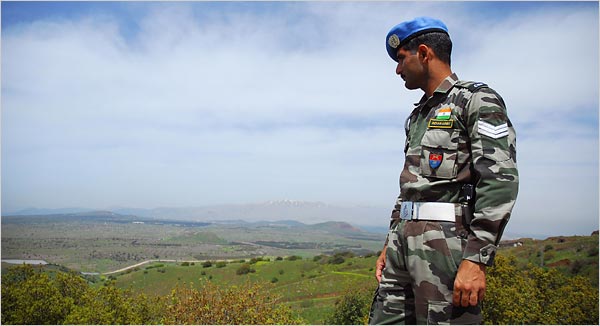
“…Withdrawal from the Golan Heights is a contentious issue in Israel. The territory is a strategic plateau that overlooks a large swath of northern Israel. Israel has objected to past Syrian demands for access to the shore of the Sea of Galilee, a main water source for Israel.

Yehuda Raizner/Agence France-Presse — Getty Images

An Indian member of the United Nations force in the Golan Heights, a strategic

plateau that overlooks a swath of northern Israel.

Poor Countries, Agriculture, and IMF Policies

There has been a rapid increase in food prices over the last couple of years, seen most dramatically in the recent 30% one-day rise in the price of rice worldwide.  This is putting tremendous pressure on the poor and is leading to instability in countries around the world.  There have been violent demonstrations–and equally violent government responses–to food rioting in Egypt and Haiti in the last couple of weeks.  They may be but a harbinger of the economic and political instability to come.  Here is a report from the BBC, in which an expert argues that IMF policies have contributed to the rise in food prices:

“Poor countries need to invest heavily in agriculture to feed their people.  There’s been a dearth of investment in agriculture in poor countries, mainly because of IMF and World Bank policies…”

The Bretton Woods System and the International Financial System

Anticipating the end of World War II, world leaders gathered in the New Hampshire town of Bretton Woods to create the financial architecture of the post-war global financial system.  The three main pillars were the World Bank, the IMF (both of which were created) and the International Trade Organization (this was never built but the governing philosophy behind it eventually gave rise to the General Agreement and Trade and Tariffs (GATT), which morphed into the World Trade Organization (WTO).  We’ll discuss these institutions in much more detail beginning Monday.

Here is an excerpt from a newsreel describing the meetings at Bretton Woods in 1944:

Design a site like this with WordPress.com
Get started