Mock German Election Simulation–Government Formation Results

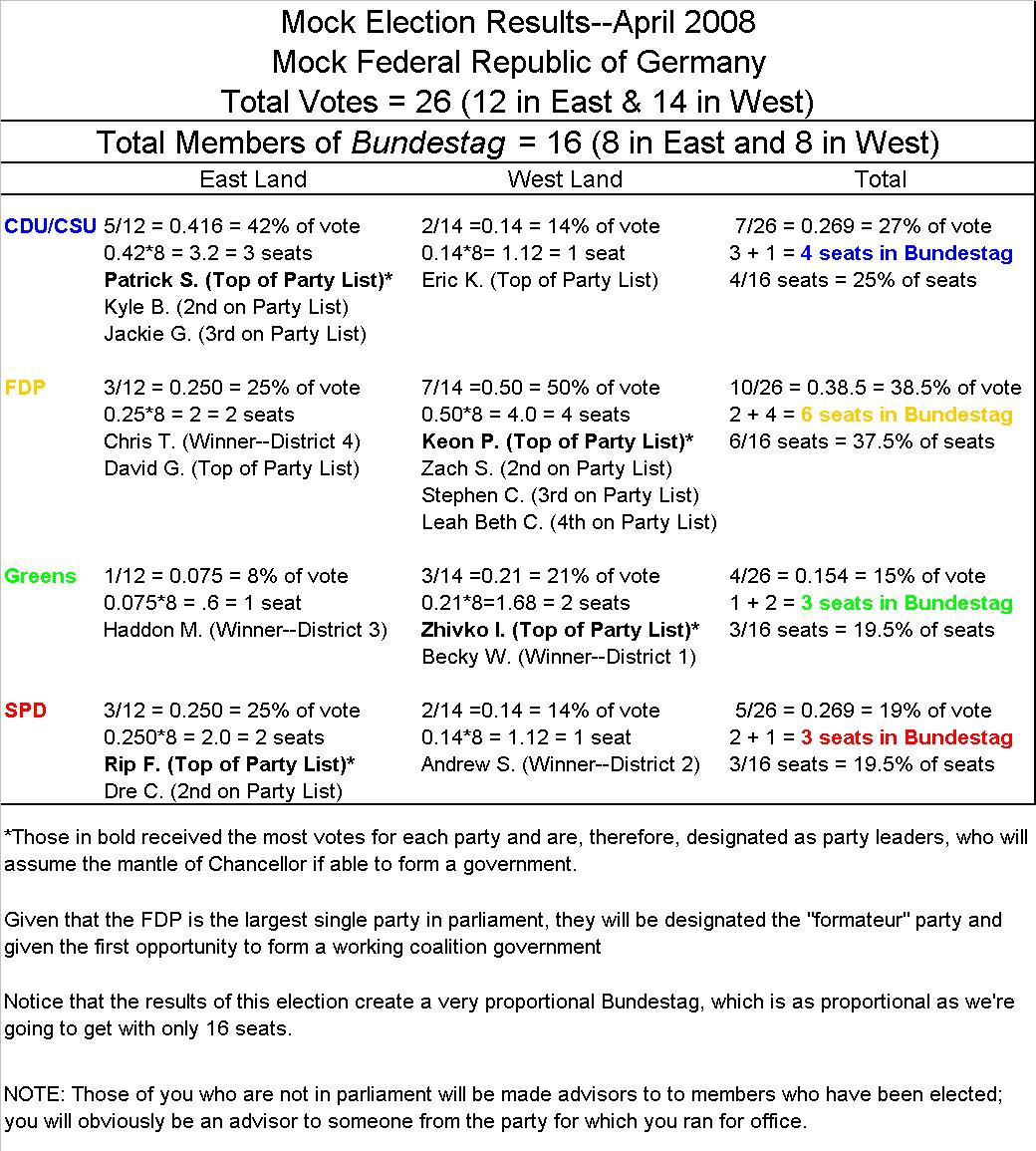
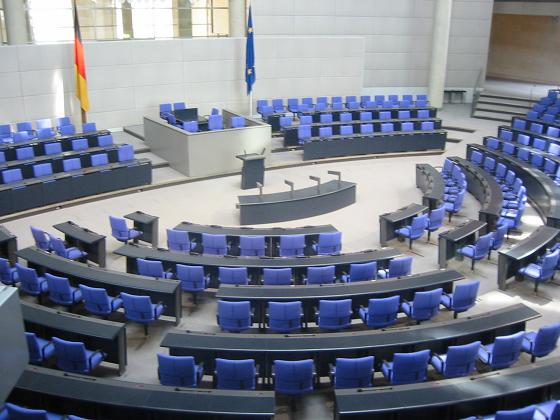
In the second part of our mock German election simulation–the government formation negotiations–we were able to get a new government voted into power by the recently elected Bundestag.  (I refer you to this post for more information about the electoral results.)

To remind you, following the election, we had the composition of the Bundestag was:

FDP–6 mandate (formateur party)

CDU/CSU–4 mandates

SPD–3 mandates

Greens–3 mandates

In order to have a secure governing coalition, a governing coalition of at least 9 mandates would be needed in this sixteen-member parliament.

The FDP were unable to convince any of the other parties to form a governing coalition with them, and the government that was voted into office, by a majority vote of 10-6 was a three-party coalition of the Greens, CDU/CSU, and the SPD.

In the end, it was the personal ambition of the CDU/CSU leader–Patrick S.–that ruled the day.  He wanted to become Chancellor and this steely determination served him well as he, with his fellow party members and advisory committee, was able to effectively forge a rather wieldy three-party governing coalition.

Why did Patrick S. want to become Chancellor so desperately?  There have been reports in some of the leading journals that it has been his dream since childhood.  But in a sit-down interview with Deutsche Welle following his ascension to the Chancellorship, Chancellor S. claimed that it was because this election was crucial to the future of the German state.  According to the Chancellor, he and his party believe that a moral crisis of epic proportions has descended upon Germany and only his party had the necessary moral acuity to set Germany back on the correct path.

The Chancellor and the six-member Cabinet is composed of the following:

Chancellor–Patrick S. (CDU/CSU)

Minister of Education–Becky W. (Greens)

Minister of the Interior–Erick K. (CDU/CSU)

Minister of the Environment–Zhivko I. (Greens)

Minister of Foreign Affairs–Kyle B. (CDU/CSU)

Minister of Health–Rip F. (SPD)

Minister of Labor–Andrew S. (SPD)

One of the advisers to the SPD commented that the SPD actually had refused to sign a coalition agreement offered to them by the FDP, which in retrospect, was better for the SPD than the one they signed ultimately.  There seemed to be a consensus within the SPD that the arrogance of the FDP had created friction between the two potential coalition partners.

I look forward to reading your impressions of the simulation exercise on your blogs.
FDP Wins Plularity of Bundestag Seats in Mock German Election–Spring 2008

[UPDATE: I made a mistake when I was initially tabulating results, necessitating a slight change in the composition of the Bundestag. As it now stands, the problem occurred in West Land, where is seems some poll workers had imbibed a little bit too much of that noted Bavarian beverage, bier. A recount (which is easy given that paper ballots were used) results in the following change: one more mandate for the FDP in West Land–I’ve slotted in the 4th candidate from the FDP party list from that Land–and one fewer mandate for the SPD in the same Land. Therefore, the final results are FDP-6; CDU-4; Greens-3; SPD-3. The party leader of FDP will still be given the role of party formateur.]

[UPDATE 2: The aforementioned poll workers have been fired and are now in AA.]

[UPDATE 3: Please see below how the adviser roles have been distributed.]

Here are the results from the mock election to the lower house of the German Reichstag held this afternoon. Those of you who were not elected to represent your district or Land in the Bundestag will nonetheless also be actively involved (as advisers to your fellow party members) in the second part of the simulation–negotiations to form a government. I will send more instructions regarding that portion of the simulation later this weekend. As you can see below, the FDP has won a plurality in the Bundestag and will be given first crack at putting together a workable coalition, trying to reach a formal agreement with one of the other parties. Signing coalition agreements with either the CDU/CSU or the SPD are most likely (given that there is a total of 16 seats in our parliament) but don’t count out a coalition with the Greens either.

As I mentioned earlier, I’ll have more information regarding the specifics of the coalition negotiations and also post a sample coalition agreement form on Blackboard later, but in the meantime think about the most important elements of the negotiation process:

  1. Which party/parties will form the government? Remember you need a majority in parliament to vote the new government into power.
  2. Who will become the Chancellor (i.e., the Prime Minister)?
  3. What will be the general orientation of the government’s policy-making agenda? Given the campaign pledges you made (either to your district and/or your Land) can you plausibly vote for a government that is dedicated to carrying out this policy agenda?
  4. What about some of the policy specifics? Changes to the citizenship law? Higher taxes on carbon emitting industries? Higher (lower) income/consumption taxes? Anything else of importance to you or your district/Land?
  5. Who will get which Ministerial Portfolios? Who will become Foreign Minister? Minister of the Environment? Minister of Health? Minister of Finance? Minister of Justice? Minister of Labor?
  6. Which individuals will be given these portfolios?

I will set up a new folder in the Discussion Board section of Blackboard so that you can all begin the “feeling out” process prior to the official negotiations on Tuesday afternoon.

Click here to see the current members of the German Federal Cabinet (which is the Chief Executive), which is made up of the Chancellor (currently Angela Merkel) and 15 Cabinet ministers.

NOTE: You will notice that some of you who ran for election in districts have nonetheless been elected to parliament on the basis of party lists. I had to do this, given the relatively small number of students in the class. In general, the party lists are much larger than the ones you saw on your ballots as there were simply not enough students and I wanted to have four SMDs. Therefore, where it was warranted, I moved non-SMD-winners over to party lists (i.e., when the proportion of votes generated a number of seats for that party in excess of the number of individuals on the party list. Of course, this would never happen in a real German election as the party lists always have many more candidates than the party will end up earning on the basis of PR. I’ll go over this on Tuesday.

Here are the advisers and the party member whom you will be advising over the course of the government formation negotiations on Tuesday.

Lecture on German Political Parties April 17th

Talk about serendipity!  We will finish our mock German election and government formation simulation on Tuesday, April 15th and two days later there will be a guest lecture on campus by Dieter Dettke, Visiting Scholar at the American Institute for Contemporary German Studies and Adjunct Professor at Georgetown University, Security Studies Program.  on “Is Germany Moving to the Left?  The Changing German Party System.

You can find below a copy of the flyer announcing the lecture, which will begin at 5:30 at the Gottwald Science Center Auditorium.  I’ll see you there.

The Richmond Eric M. Warburg Chapter

of the American Council on Germany

cordially invites you to a

Discussion and Reception

with

Dr. Dieter Dettke

Visiting Scholar at the American Institute for Contemporary German Studies and

Adjunct Professor at Georgetown University, Security Studies Program

on

“Is Germany Moving to the Left?

The Changing German Party System"

Thursday, April 17, 2008

5:30 – 6:45 pm

at

The University of Richmond, Gottwald Science Center Auditorium

Directions: If coming from Three Chopt Road, turn onto Boatwright Drive and continue straight ahead at the welcoming wall at the bottom of the winding hill (do not turn left for the main campus gate). After passing the Robins Center on your left and a large parking lot on your right, proceed for another 300 yards on College Road to the Westhampton entrance on your left. (If coming from River Road, turn onto College Road and turn right into the Westhampton entrance.) Continue on Keller Road to the Modlin Center and pass through the archway. Opposite the stop sign are parking spaces in front of the Westhampton Deanery and even more spaces between it and the cafeteria and science center. The science center auditorium is in the Gottwald Science Center across from the cafeteria. (In case the above parking spaces are full,  there is a parking lot behind the Modlin Center which you can access by turning right at the stop sign or left if exiting the parking lot across from the stop sign.)

If you have any questions, please contact Dr. Arthur B. Gunlicks,

Dr. Dieter Dettke is currently a visiting scholar at the American Institute for Contemporary German Studies and Adjunct Professor at Georgetown University, Security Studies Program. He is working on a book on German foreign policy and transatlantic relations – with the working title “In Search of Normalcy: German Foreign and Security Policy Between Realpolitik and the Civilian Power Paradigm.” He has also been a fellow at both the Woodrow Wilson Center and the German Marshall Fund of the United States.

From 1985 to 2006 he served as US Representative and Executive Director of the Washington Office of the Friedrich Ebert Foundation – which is affiliated with Germany’s Social Democratic Party (SPD). Prior to his work with the Ebert Foundation, Dr. Dettke was Political Counsellor of the SPD Parliamentary Group of the German Bundestag (1974 – 1984) and Staff Director of the Working Group on US-German relations. In this capacity, he coordinated all foreign, security and defence policy related issues on the agenda of the German Bundestag and the Committees for Foreign Affairs, Defence, German-German relations, Development Policy and European Affairs.

He has lectured frequently in Europe and the United States on transatlantic relations, German-American security issues and European-American economic relations. He has also presented papers, acted as a discussant and/or chair at U.S. and international conferences of the American Political Science Association, the International Studies Association, the German Studies Association and the American Association of Slavic Studies. In addition, Dr. Dettke testified in Congress on the implications of German unification for the United States and US-European relations.

Dr. Dettke has appeared on the News Hour with Jim Lehrer, C-SPAN, Voice of America as well as other American, German, Swiss, and British television and radio programs to discuss issues and developments related to domestic and foreign policy developments in Europe and the United States. Dr. Dettke studied political science and law at the universities of Bonn and Berlin (Germany) and Strasbourg (France). He was a Fulbright Scholar at the University of Washington in Seattle (1967/68).

Mock German Election and Government Formation Simulation

Here is a great link to information about the German electoral and political party system. You can find all sorts of information and links (to youtube videos even!) related to German political parties and the electoral system. Here are a couple of images from the link above:

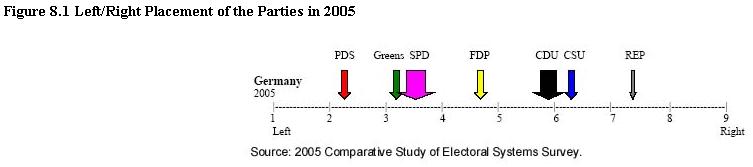
The first is a one-dimensional left-right placement of political parties. Remember that given our relatively small class size, you will be a representative of only one of four parties–CDU/CSU, FDP, SPD, Green Party. [Update: I notice that they have the CDU and CSU listed as separate parties, which they technically are.  As I noted in the assignment instructions, the CSU is essentially the CDU, but in Bavaria.  They always forms coalitions in the Bundestag when deciding on government formation.]

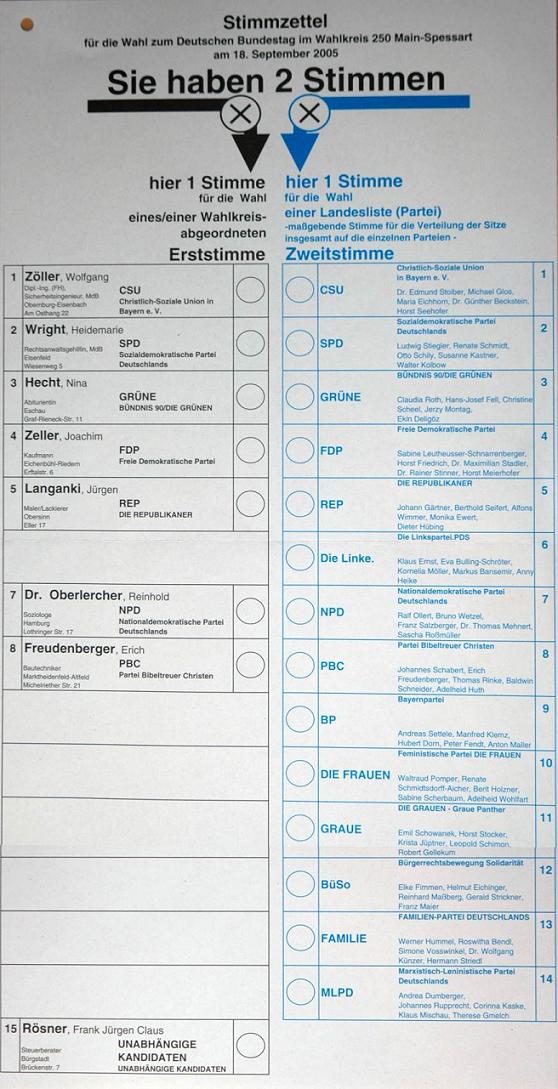
The second image is the unique two-vote electoral ballot; remember that Germans get to vote twice–once for a candidate to fill one of the 299 single-member districts, and once for a party list in a multi-member district. You’ll notice the left side of the ballot has the individual candidate’s name prominently displayed, whereas the party-list side (the right-side of the ballot) has the party name prominently displayed.

Here’s a nice breakdown of the characteristics of demographic support for each of the parties during the 2005 Bundestag elections, the result of which was a “grand coalition” between Angela Merkel’s CDU/CSU (Merkel was voted in by parliament as the Chancellor) and Gerhard Schroeder’s SPD.

From CSM–In Turkey, Secularists Escalate Fight Against Ruling AKP

Amongst the readings we’ll be addressing tomorrow in introduction to comparative politics is Alfred Stepan’s “The Twin Tolerations”, which analyzes the necessary mutual respect between religious society and political society that democracy demands. Please read this recent article from the Christian Science Monitor on the battle between Turkish secularists and the Islamic-oriented ruling party in Turkey, the Justice and Development Party (AKP), which is headed to Turkey’s court system. The secularists argue that the Turkish Constitution’s strict separation of church and state has been violated by the religious nature of the ruling party. Please bring this article to class tomorrow. Be prepared to discuss how well the “twin tolerations” are working here. Here are some excerpts:

Under scrutiny: Prime Minister Recep Tayyip Erdogan and his ruling party are facing heightened criticism for straying from the Constitution’s secular principles.
Umit Bektas/Reuters

turkey.jpg

After protesting the AKP’s presidential candidate, precipitating new elections, and then losing out to the AKP at the polls last year, hard-line secularists are now taking a new tack: trying to shut down the party for “expunging” the Constitution’s secular principles.

Turkey’s highest court is set to decide in the coming days whether to allow the motion, filed by the country’s top prosecutor on March 14, to go forward. If the Constitutional Court decides to allow the case to proceed, it could plunge Turkey into a deep crisis, threatening the country’s emerging political and economic stability and further jeopardizing its already troubled bid for European Union membership.

“This would definitely hinder the government in many ways. There are so many things to be done, such as issues relating to the EU, Cyprus, and the economy, and the government would no longer be in a position of authority,” says Sahin Alpay, a political science professor at Istanbul’s Bahcesehir University. “What the people going after the party are doing is really shooting the country in its own feet.”

EU officials have criticized the closure move, calling it antidemocratic.

“In a normal European democracy, political issues are debated in parliament and decided in the ballot box, not in the courtroom,” said EU Enlargement Commissioner Olli Rehn in response to the prosecutor’s unexpected call to shut down the AKP. “It is difficult to see that this lawsuit respects the democratic principles of a normal European society.”

24 parties closed since 1963

Turkish law gives the judiciary broad powers to shut political parties down. The Constitutional Court has closed 24 parties since it was established in 1963. The court is currently deciding on a motion to close the pro-Kurdish Democratic Society Party (DTP), accused of promoting ethnic separatism.

Join Me in Welcoming the World’s Newest Democracy

The Himalayan state of Bhutan has become the world’s newest democracy, upon the completion of elections there on Monday. As this Washington Post story notes, the change from monarchical to democratic rule was initiated by the benevolent monarchy. Bhutanese were reticent about what this would mean for Bhutan’s social cohesiveness and some lamented the potential danger of faction, with various political parties competing for the political allegiance of the newly-minted voters:

TOKTOKHA, Bhutan, March 24 — Without revolution or bloodshed, this tiny Himalayan kingdom became the world’s newest democracy Monday, as wildflower farmers, traditional healers, Buddhist folk artists and computer engineers voted in their country’s first parliamentary elections, ending a century of royal rule.

In a historic event for the country of 700,000, entire families took to winding mountainous roads, traveling sometimes for days in minivans, on horseback and on foot to cast their ballots, marking Bhutan’s transition to a constitutional monarchy.

Despite concerns that Bhutanese would be turned off by the rough-and-tumble world of politics, more than 79 percent of the estimated 318,000 registered voters turned out at polling places.

It was the king, as well as his father and predecessor, who ordered the subjects to vote, in the belief that democracy would foster stability in a geographically vulnerable country wedged between China and India and known as the Land of the Thunder Dragon.

Here’s an informative news report from the Canadian Broadcasting Corporation (CBC) on politics in Bhutan.

It’s Spring, so how is your Bracket Doing?

pakistan_gilani.jpg
Well, it’s that time of year again. Has your bracket been busted? How many of you can honestly claim that you predicted the upset of Yousaf Raza Gilani becoming Pakistan’s new Prime Minister? Now I realize that most of you were predicting a victory for Ma Ying-jeou in Taiwan’s recent presidential elections. But did you honestly think that he would win by 15! (He won 57.5% of the vote.) Mr. Gilani almost busted my bracket, but I think that I may be able to redeem myself with my pick for the winner of the upcoming Serbian Parliamentary elections (given that the Balkan Conference is a mid-major, that group of countries has not been followed very closely and I have a little bit of an advantage in prognosticating the outcome there).
taiwan_ying_jeou.jpg
Current Prime Minister, Vojislav Koštunica, disbanded his coalition government on March 13 due to tensions within the governing coalition as a result of the declaration of independence by the former Serbian province of Kosovo. New elections are slated to be held on May 11 of this year, with Koštunica’s conservative and nationalistic Democratic Party of Serbia will find its strongest challenge from Serbian President Boris Tadić‘s bloc of pro-democratic and pro-Western parties and the ultra-nationalist Serbian Radical Party. It will be interesting to observe how much the apparent loss of the Kosovo (the “Serbian Jerusalem”) will help the ultra-nationalists and hurt Koštunica.
And finally, my surprise pick to get to the Final Four from the East Region is the tiny Himalayan state of Bhutan, which has been flying under the radar but has been getting its democratic game together. As Agence-France Presse reports, democracy is marching inexorably onward in a fit of Fukuyaman glee:
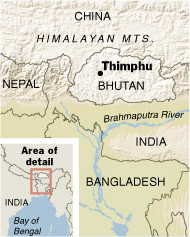
0324-web-bhutanmap.jpgTHIMPHU, Bhutan (Agence France-Presse) — Bhutan stands poised to become the world’s newest democracy on Monday with elections ordered by its revered royal family to end its absolute rule.
The tiny Buddhist state, wedged in the Himalayas between India and China, will elect members for a lower house, ending the century-long rule of the hugely popular Wangchuck dynasty.Bhutan’s Oxford-educated ruler, King Jigme Khesar Namgyel Wangchuck, 28, made a forceful last-minute appeal over the weekend to his subjects — some of whom were initially reluctant to bring in democracy — to vote.

“As you approach the duty of voting at the elections that will bring democracy, do so with pride and confidence of a people that have achieved so much,” he said in a statement published in the nation’s newspapers. “First and foremost, you must vote. Every single person must exercise his or her franchise.”

The king is the fifth ruler in the dynasty, in power since 1907. The path to democracy began in 2001, when the former king, Jigme Singye Wangchuck, handed over the day-to-day tasks of government to a council of ministers, and finally stepped down in favor of his son in late 2006.

Since then, father and son have traveled the country to explain to its 670,000 people why the nation should embrace democracy.

Wow! I think we have one of those rare instances of enlightened despotism.

Resource Dependent Regimes in Sub-Saharan Africa

Jensen and Wantchekon (2000) have created an index of resource dependence and determined the level of the same for the states of sub-Sarahan Africa.  The scores range from 1 (no resource dependence) to 4 (extreme resource dependence).  They use this as an important independent variable in determining democratic transition, consolidation, and government effectiveness.  How much of an effect does resource dependence have on each of these dependent variables?  You’ll have to read the paper to find out, or attend my class in intro to comparative tomorrow.

resource_dependence_scores.jpg

Ethnic Conflict and Strife

A couple of days ago all blog posts seemed to be related to the theme “the social logic of politics”. Today, there seems to be a surge in episodes of inter-ethnic conflict worldwide. First, we learn from the Washington Post, that there is unrest and violence in the Tibetan capital of Lhasa, where a week of increasing confrontations between native Tibetans and the Chinese government have turned violent, with native Tibetans battling with Chinese police and troops and also attacking ethnic Han Chinese, which is either unprecedented or extremely rare.

BEIJING, March 14 — A week of tense confrontations over Chinese rule in Tibet erupted in violence Friday, as hundreds of protesters clashed with police and set fire to shops in the center of Lhasa. Doctors reported dozens of wounded streaming into area hospitals, and one witness said the downtown area was “in a state of siege.”

The rare breakout of violence, the worst in 20 years in the capital city of a remote mountainous region that is the heart of Tibetan Buddhism, posed a challenge to the Chinese government as it prepares to host the 2008 Olympic Games in August. Seeking to make the Games a worldwide celebration of its swift economic progress during the past three decades, the Chinese government has steadfastly attempted to project an image of harmony and stability, even while tightening its grip over the restive region.

“This spiraling unrest has triggered the scenario the Chinese prayed would not happen,” said Robbie Barnett, director of modern Tibetan studies at Columbia University. “Now we’re just watching the clock tick until people get off the street or the Chinese open fire.”

In a different part of the world, Malaysia, in which once again ethnic Chinese are involved, the New York Times reports on post-electoral tension on the island of Penang:

PENANG, Malaysia — Chanting “Long Live the Malays!” several hundred members of Malaysia’s largest ethnic group gathered Friday on this largely Chinese island, defying a police ban on protests and raising communal tensions after sharp electoral losses by the country’s governing party.

Newly elected state governments have moved rapidly to abolish some of the long-held privileges of ethnic Malays. Those efforts have challenged the core of Malaysia’s ethnic-based political system and inflamed the sensibilities of Malays. Until the March 8 elections, Malays thoroughly dominated politics through the country’s largest party, the United Malays National Organization, known by its initials, U.M.N.O.

The opposition parties that beat U.M.N.O. and its partners in five states say affirmative action should be based on need rather than ethnicity. But the opposition, too, is struggling to contain fissures along ethnic lines as a Chinese opposition party competes with its Malay counterpart.

“We’re living in very sensitive times,” said Tricia Yeoh, director of the Center for Public Policy Studies, an independent research center in Kuala Lumpur, the capital.

The affirmative action program favoring the Malays has been in place for more than three and a half decades and gives Malays everything from discounts on new houses to 30 percent quotas in initial public offerings of companies. It is known as the New Economic Policy.

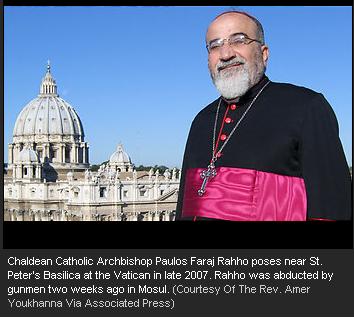
Finally, in Iraq, where in the last four years the minority Christian community has been decimated, either through targeted killings or ethnic cleansing, we hear news of the killing of a prominent Catholic Bishop:

bishop_rahro.jpg BAGHDAD, March 13 — The body of a senior Christian cleric was found Thursday in the northern city of Mosul, two weeks after gunmen abducted him there and killed three of his associates.

The death of Paulos Faraj Rahho, 65, archbishop of Mosul’s Chaldean community, prompted expressions of remorse and condemnation from the Iraqi government and Christian leaders.

Pope Benedict XVI, in a message to the Chaldean patriarch in Iraq, called the killing an “act of inhuman violence that offends the dignity of the human person and seriously harms the cause of fraternal coexistence among the beloved Iraqi people.”

Iraqi Prime Minister Nouri al-Maliki said it was a crime of “aggression aimed at inciting sedition among” Iraqis.

Social Impact and the Decision to Vote

In continuing with today’s theme of the impact of the “social” in political science, we note that political parties the world over have spent a lot of money and developed various ideas and hypotheses regarding what motivates voters to go to the polls and exercise their most basic democratic right. In the most recent issue (which is behind a pay wall) of the American Political Science Review–the flagship journal of the American Political Science Association–a group of political scientists, led by Donald Green at Yale, has demonstrated that social shaming may be a way to increase overall voter turnout.* Here is the abstract, with a sample of the letters sent below:

Voter turnout theories based on rational self-interested behavior generally fail to predict significant turnout unless they account for the utility that citizens receive from performing their civic duty. We distinguish between two aspects of this type of utility, intrinsic satisfaction from behaving in accordance with a norm and extrinsic incentives to comply, and test the effects of priming intrinsic motives and applying varying degrees of extrinsic pressure. A large-scale field experiment involving several hundred thousand registered voters used a series of mailings to gauge these effects. Substantially higher turnout was observed among those who received mailings promising to publicize their turnout to their household or their neighbors. These findings demonstrate the profound importance of social pressure as an inducement to political participation.

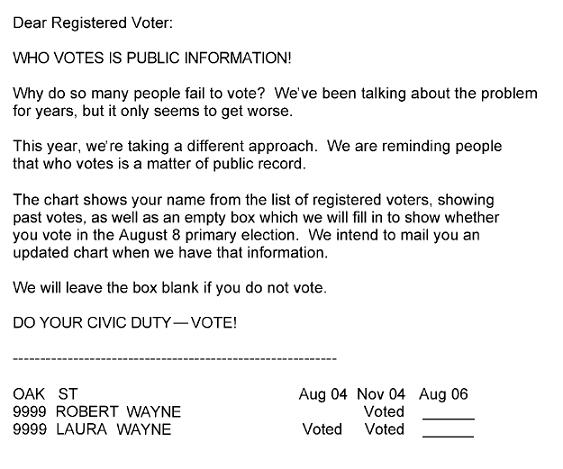
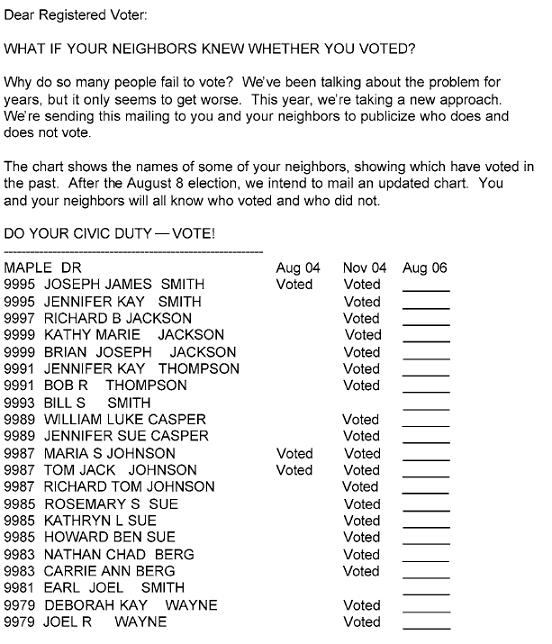
Would you be susceptible to being shamed into voting? Well, the authors find that the overall impact of threatening to publicize your (non)-voting behavior to your neighbors was to increase turnout by 8.1 percentage points. That’s an astounding impact. Here are the letters:

social_pressure_vote.jpg

This letter increased the rate of voter turnout by 4.9 percentage points, a much stronger effect than appeals to civic duty alone (which raised turnout from between 1.8 and 2.5 percentage points.

social_pressure_vote2.jpg

This is the letter that produced an 8.1 percentage point increase in voter turnout.

*For a web site that tracks voter turnout rates worldwide, please see this post.

Design a site like this with WordPress.com
Get started