Does Africa Need a New Map?

In a recent article in Foreign Policy magazine, G. Pascal Zachary argues that it’s time to redraw Africa’s political borders, which are “unnatural” and a legacy of 19th and 20th-century colonialism. As is well-known the newly independent states that comprised the Organisation for African Unity met in 1964 and agreed that the extant international borders in Africa were sacrosanct, believing that this would best guarantee stability on the continent. It worked, to a degree. While there have certainly been very few international (i.e. inter-state) wars in Africa in the intervening 45 years, the continent has been ravaged by intra-state (i.e., internal, or “civil”) wars during the same period. What are the potential benefits of redrawing Africa’s borders to make them more coterminous with ethnic boundaries (as has been done recently in, amongst other places, the Balkans and the former Soviet Union)? Zachary’s claim:

Borders created through some combination of ignorance and malice are today one of the continent’s major barriers to building strong, competent states. No initiative would do more for happiness, stability, and economic growth in Africa today than an energetic and enlightened redrawing of these harmful lines.

How important is for for state strength and stability for ethnic and political border to be coterminous? The redrawing of borders–and it is obvious that the mechanism would be military force–would almost certainly lead to tremendous suffering and bloodshed, with competing campaigns of ethnic cleansing. But, as Zachary notes, since the start of the post-colonial era millions of Africans have died in internal conflicts, and:

Rethinking the borders could go far to quelling some of these conflicts. Countries could finally be framed around the de facto geography of ethnic groups. The new states could use their local languages rather than favoring another ethnicity’s or colonial power’s tongue. Rebel secessionist movements would all but disappear, and democracy could flourish more easily when based upon policies, rather than simple identity politics. On top of that, new states based on ethnic lines would by default be smaller, more compact, and more manageable for governments on a continent with a history of state weakness.

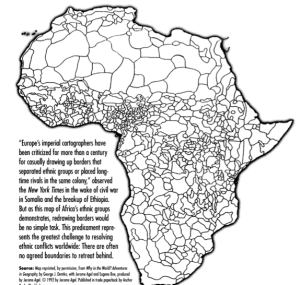
Assuming that the political will to achieve this goal were to evolve, what would be the best mechanism? What would Herbst’s argument be? Is this even feasible? Where would one draw the new boundaries? How would one define an ethnic group? Refer to these two maps to get a sense of the near impossibility of the task at hand. While there are about 50-odd states in Africa, there are literally hundreds of geographically-concentrated ethnic groups. In addition, there is a tremendous amount of inter-mingling of ethnic groups as well.

Events/Lectures that may be of Interest

I’ll use this blog to keep you informed about lectures and events that may be of interest to you that are taking place on campus or in the greater Vancouver area. There are two events this week that are relevant.

This evening, Monday September 13th, at 7:00pm the Philosophers’ Cafe is kicking off the first event of its fall series at the Shadbolt Centre for the Arts at Deer Lake in Burnaby. This evening’s discussion is titled “Mixed Up: Is Canada’s cultural mix more like a melting pot, mosaic or matrix?” We’ll be addressing issues of identity and culture in about two weeks time in IS 210. The admission is $5, and the event will be moderated by Randall Mackinnon, who has served as a president, board member, executive and consulting staff for a diversity of community service organizations since 1970. For more information about tonight’s event and directions to the venue, click here.

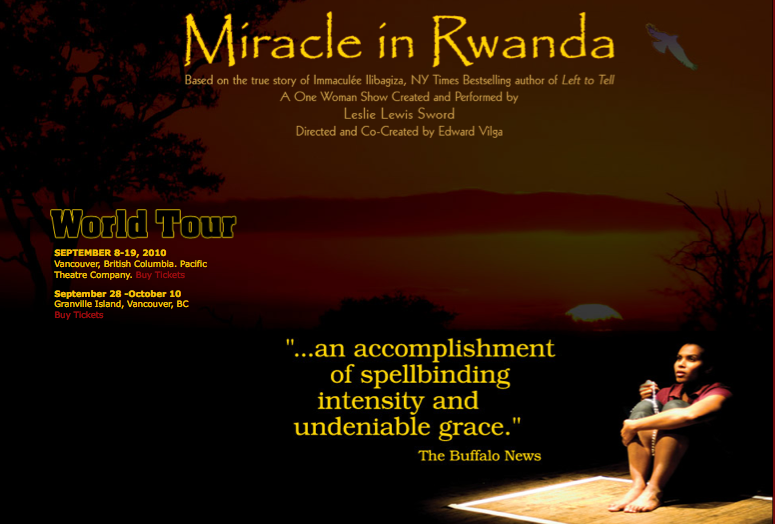
The second event is a one-woman show entitled Miracle in Rwanda, which is showing all of this week at Pacific Theatre Company and will also have a two-week run on Granville Island beginning later this month. To learn more about the show, and to purchase tickets, go here.

Update: The website I linked to above links to the wrong page. Miracle in Rwanda is part of this year’s Vancouver Fringe Festival. Here’s the correct link to information regarding show times and tickets.

Political Terror Scale

Authoritarian regimes use both “carrots” and “sticks” in order to control their citizens. The “sticks” approach encompasses everything from surveillance to outright physical brutality.  While the use of physical terror to undermine the bodily integrity of their citizens by authoritarian regimes is fairly well known, it is also evident that democracies are not immune to using this form of control over their populations.  Almost by definition, authoritarian regimes terror-prone, but how much more so than democracies. You can fine the answers to this at the Political Terror Scale website, where they have a set of interesting interactive maps.

How is “political terror” defined?  Well, they have created a scale (from 1-5) which is an indicator of the level of political terror citizens in a country face in any given year. The definitions for each of the categories is below.

El Salvador during the 1980s was ruled by a military regime, which used to death squads to “disappear” its internal opponents.  U2 took note:

rating scale Political Terror Scale Levels
Level 5 : Terror has expanded to the whole population. The leaders of these societies place no limits on the means or thoroughness with which they pursue personal or ideological goals.
Level 4 : Civil and political rights violations have expanded to large numbers of the population. Murders, disappearances, and torture are a common part of life. In spite of its generality, on this level terror affects those who interest themselves in politics or ideas.
Level 3 : There is extensive political imprisonment, or a recent history of such imprisonment. Execution or other political murders and brutality may be common. Unlimited detention, with or without a trial, for political views is accepted.
Level 2 : There is a limited amount of imprisonment for nonviolent political activity. However, few persons are affected, torture and beatings are exceptional. Political murder is rare.
Level 1 : Countries under a secure rule of law, people are not imprisoned for their view, and torture is rare or exceptional. Political murders are extremely rare.

Monty Python’s take on Constitutional Government

I am a huge fan of the British sketch comedy group Monty Python.  For a political science professor, this clip is like politico-comedic gold.  Here is Dennis the peasant’s views on democratic legitimacy, the proper role of popular mandates in the wielding of supreme executive power, and a sarcastic critique of socialist critiques of liberal capitalism (“oh, there you go bringing class into it again!”).  And remember, “you don’t vote for kings.”

Newsweek Editor Fareed Zakaria Says “No” to Olympic Boycott

In a recent column, Newsweek’s Fareed Zakaria argues that the US should not boycott the Olympic Games in Beijing this summer.  He argues that it would have the opposite of the intended effect.  Here are some snippets:

Public humiliation does not work nearly as well on the regime in Beijing as private pressure. At first glance, China’s recent crackdown in Tibet looks like a familiar storyline: a dictatorship represses its people. And of course that’s part of the reality — as it often is in China. But on this issue, the communist regime is not in opposition to its people. The vast majority of Chinese have little sympathy for the Tibetan cause. To the extent that we can gauge public opinion in China and among its diaspora, ordinary Chinese are, if anything, critical of the Beijing government for being too easy on the Tibetans. The real struggle here is between a nationalist majority and an ethnic and religious minority looking to secure its rights.

In these circumstances, a boycott of the Olympics would have precisely the opposite effect that is intended. The regime in Beijing would become only more defensive and stubborn. The Chinese people would rally around the flag and see the West as trying to humiliate China in its first international moment of glory. (There are many suspicions that the United States cannot abide the prospect of a rising China.) For most Chinese, the Games are about the world’s giving China respect, rather than bolstering the Communist Party’s legitimacy…

…Some want to punish China for its association with the Sudanese government, which is perpetrating atrocities in Darfur. But to boycott Beijing’s Games because it buys oil from Sudan carries the notion of responsibility too far. After all, the United States has much closer ties to Saudi Arabia, a medieval monarchy that has funded Islamic terror. Should the world boycott America for this relationship?

Lecture on German Political Parties April 17th

Talk about serendipity!  We will finish our mock German election and government formation simulation on Tuesday, April 15th and two days later there will be a guest lecture on campus by Dieter Dettke, Visiting Scholar at the American Institute for Contemporary German Studies and Adjunct Professor at Georgetown University, Security Studies Program.  on “Is Germany Moving to the Left?  The Changing German Party System.

You can find below a copy of the flyer announcing the lecture, which will begin at 5:30 at the Gottwald Science Center Auditorium.  I’ll see you there.

The Richmond Eric M. Warburg Chapter

of the American Council on Germany

cordially invites you to a

Discussion and Reception

with

Dr. Dieter Dettke

Visiting Scholar at the American Institute for Contemporary German Studies and

Adjunct Professor at Georgetown University, Security Studies Program

on

“Is Germany Moving to the Left?

The Changing German Party System"

Thursday, April 17, 2008

5:30 – 6:45 pm

at

The University of Richmond, Gottwald Science Center Auditorium

Directions: If coming from Three Chopt Road, turn onto Boatwright Drive and continue straight ahead at the welcoming wall at the bottom of the winding hill (do not turn left for the main campus gate). After passing the Robins Center on your left and a large parking lot on your right, proceed for another 300 yards on College Road to the Westhampton entrance on your left. (If coming from River Road, turn onto College Road and turn right into the Westhampton entrance.) Continue on Keller Road to the Modlin Center and pass through the archway. Opposite the stop sign are parking spaces in front of the Westhampton Deanery and even more spaces between it and the cafeteria and science center. The science center auditorium is in the Gottwald Science Center across from the cafeteria. (In case the above parking spaces are full,  there is a parking lot behind the Modlin Center which you can access by turning right at the stop sign or left if exiting the parking lot across from the stop sign.)

If you have any questions, please contact Dr. Arthur B. Gunlicks,

Dr. Dieter Dettke is currently a visiting scholar at the American Institute for Contemporary German Studies and Adjunct Professor at Georgetown University, Security Studies Program. He is working on a book on German foreign policy and transatlantic relations – with the working title “In Search of Normalcy: German Foreign and Security Policy Between Realpolitik and the Civilian Power Paradigm.” He has also been a fellow at both the Woodrow Wilson Center and the German Marshall Fund of the United States.

From 1985 to 2006 he served as US Representative and Executive Director of the Washington Office of the Friedrich Ebert Foundation – which is affiliated with Germany’s Social Democratic Party (SPD). Prior to his work with the Ebert Foundation, Dr. Dettke was Political Counsellor of the SPD Parliamentary Group of the German Bundestag (1974 – 1984) and Staff Director of the Working Group on US-German relations. In this capacity, he coordinated all foreign, security and defence policy related issues on the agenda of the German Bundestag and the Committees for Foreign Affairs, Defence, German-German relations, Development Policy and European Affairs.

He has lectured frequently in Europe and the United States on transatlantic relations, German-American security issues and European-American economic relations. He has also presented papers, acted as a discussant and/or chair at U.S. and international conferences of the American Political Science Association, the International Studies Association, the German Studies Association and the American Association of Slavic Studies. In addition, Dr. Dettke testified in Congress on the implications of German unification for the United States and US-European relations.

Dr. Dettke has appeared on the News Hour with Jim Lehrer, C-SPAN, Voice of America as well as other American, German, Swiss, and British television and radio programs to discuss issues and developments related to domestic and foreign policy developments in Europe and the United States. Dr. Dettke studied political science and law at the universities of Bonn and Berlin (Germany) and Strasbourg (France). He was a Fulbright Scholar at the University of Washington in Seattle (1967/68).

40th Anniversary of the Prague Spring and Soviet Invasion of Czechoslovakia

 This Spring marks the 40th anniversary of the Prague Spring–a domestic, Czech-led liberalization and democratization movement in the former Czechoslovakia–and the subsequent Soviet military invasion of that former communist state.  As Czechs sang and wrote their way towards a regime Czechs would describe as “Communism with a human face”, Leonid Brezhnev–the leader of the Soviet Union–rolled Soviet tanks onto the streets of Prague to put an end to Alexander Dubcek’s reforms.  This was the first concrete foreign policy manifestation of the “combating of anti-socialist forces,” which came to be known as the Brezhnev Doctrine.

Euronews has an interesting report on the commemoration of the Prague Spring, which has been uploaded to youtube.  I encourage you to take a look.

Chinese Conceptions of “Rights”: From Mencius to Mao–and Now

Elizabeth has written the above-titled article, which has been published in the most recent issue of Perspectives on Politics. I will be adding this to the readings under the topic of democracy. I’ll adjust the syllabus on Blackboard accordingly and provide an electronic link to the full-text article on the electronic version of the syllabus. You can also link to the article here. [Updated: The link doesn’t work; go to Blackboard for the link.]

We will address the implications of “Asian values” for democracy and seek to understand the moral underpinnings of Chinses society (remember that we are not equating “Asian” with Chinese; Asia is a vast and heterogeneous continent), and whether western conceptions of democracy and human rights are necessary. How is political authority legitimized in Chinese society, according to Mencius, Confucius, and Mao? Here is the abstract to Perry’s article:

The recent explosion of popular protest in China, often framed as a demand for the fulfillment of “rights,” has captured widespread attention. Some observers interpret the protests as signs of a “moral vacuum.” Others see the unrest as signaling a powerful new “rights consciousness.” In either case, the protests are often regarded as a major challenge to the stability of the political system. In this article, an examination of Chinese conceptions of “rights,” as reflected in the ethical discourses of philosophers, political leaders, and protesters (and as contrasted with American understandings of rights), provides the basis for questioning prevailing assumptions about the fragility of the Chinese political order. For over two millennia, Chinese political thought, policy, and protest have assigned central priority to the attainment of socioeconomic security. As a result, the meaning of “rights” inChinese political discourse differs significantly from the Anglo-American tradition. Viewed in historical context, China’s contemporary “rights” protests seem less politically threatening. The Chinese polity appears neither as vacuous nor as vulnerable as it is sometimes assumed to be.

Empty Olympic Promises? China as Global Citizen

The New York Times editorial board has chosen to use its valuable op-ed space to evaluate the nature of China’s behavior on the world stage.   The granting of the 2008 Summer Olympic Games to China years ago was meant to serve as a “carrot” in the carrot-and-stick approach being used by sovereign states, like the US, Canada, etc., and IGOs, like the United Nations to nudge China along the road to democratic reform and the protection of personal liberties in that communist state.  Has it worked?  Here’s a data point that rebuts the theory:

Six months out from the 2008 Olympics, China has jailed another inconvenient dissident. Hu Jia was dragged from his home by state police agents, and last week he was formally charged with inciting subversion. To earn the right to host the Games, China promised to improve its human rights record. Instead, it appears determined to silence anyone who dares to tell the truth about its abuses.

Mr. Hu and his wife, Zeng Jinyan, are human rights activists who spent much of 2006 restricted to their apartment. She used the power of the Internet to blog about life under detention while he wrote online about peasant protests and human rights cases.

Mr. Hu’s recent testimony, by telephone, to the European Parliament about Olympics-related rights violations may have been the last straw. Ms. Zeng and the couple’s two-month-old baby remain in their apartment under house arrest, with telephone and Internet connections now severed.

Improving its human rights record isn’t China’s only unmet commitment to the International Olympic Committee. It also promised to improve air quality. Now athletes and their coaches are figuring out how to spend as little time as possible in China’s smog-swamped capital, where they may need masks to breathe.

I’ve written about China before and mentioned the work of an NGO whose goal is to make the Chinese Olympics, the “Genocide Olympics”, highlighting China’s complicity in the genocide in Darfur.  See this post also by one of my students in Intro to IR.

Kenyan Violence Menacing for Intertribal Marriages

Kenya’s political troubles have had a immediate impact on marriages composed of partners of different tribes. Individuals in inter-tribal or inter-ethnic marriages are often twice cursed in the event of inter-ethnic violence. On the one hand, each marriage partner is increasingly distrusted by members of the other ethnic/tribal group. But what makes matter even worse is that they are also ostracized and often the victims of violence on the part of members of their own group. Their sin is that, having married someone from the rival ethnic group/tribe, they are no longer seen as trustworthy. In noticed in Croatia that this led to counter-intuitive outcomes where individuals who had married spouses of the other ethnic group often become publicly intolerant toward members of the spouse’s group. This was not the result of true ethnic hostility but in order to prove the individual’s ethnic/nationalist bona fides to his (and it was mostly males in this case) own ethnic brethren.

Here is a report from the Associated Press about a woman in Kenya whose husband had to leave home, fearing for his life.

He doesn’t call. He doesn’t write. His cell phone has been switched off for weeks. After 17 years, Naomi Kering’s husband is gone — one more intertribal marriage fallen victim to the violence that has followed Kenya‘s disastrous presidential election.

“The kids always ask me, ‘Where is he?’ And I always say he is going to come back,” Kering, a 34-year-old of the Kalenjin tribe, told The Associated Press as she stood in the rubble of her home, torched by a mob last month because her kenya_divided_love_abc5031.jpghusband is a Kikuyu. “But I hope he stays away, because I love him and I want him to be safe.”

Since the Dec. 27 vote, marriages that united different ethnic groups have felt the strain as communities shun the Kikuyu tribe of President Mwai Kibaki, whose disputed re-election unleashed a wave of bloodshed that has killed at least 685 people.

Until now, marriages like Kering’s were common enough to go largely unnoticed, representing hope for what Kenya could be as a nation. But now the fabric of Kenyan society is fraying, forcing families to confront tribal identities many had cast aside long ago.

“This election has changed the very essence of these marriages,” said the Rev. Charles Kirui, a Catholic priest whose church in the nearby town of Burnt Forest shelters hundreds of Kikuyus. “Marriages are breaking up because of a tribal conflict, which means we really have a problem in Kenya.”

There are no figures on how many families are affected, but the impact is particularly felt in the heart of opposition territory in western Kenya, where tribal tensions have been most inflamed by the election.

This country of 38 million was once seen as a stable democracy on a violent continent. But it depended on a delicate balance of intertribal power.

Design a site like this with WordPress.com
Get started