Comparative Political Party and Electoral Systems

In a few weeks, we will conduct an in-class exercise that simulates a German national election.  This will give you a good idea of the specifics of the German political party and electoral systems, which you will then be able to compare to other systems around the world.  The German system is fairly complicated in that each citizen casts two votes, one for a member running in a single-member district, while the other is cast for a party via a proportional system.

Elections are, of course, the conditio sine qua non–and the minimal institutional requirement–of democratic political systems.   A great web site dedicated to keeping track of elections around the world is electionguide.org They do not as of yet have the results from the most recent national elections in Spain, (they will shortly) but they do have election results for countries around the world going back decades for some countries.  You should check them out.

The Christian Science Monitor  on the incumbent Spanish government’s re-election this past week:

oresults_p1.jpgAided by a near-record turnout, José Luis Rodríguez Zapatero and the Socialist Party won the Spanish national elections – suggesting further changes toward diversity in a young democracy whose older generations cut their teeth on the Franco dictatorship and the moral authority of the Roman Catholic church.

The Socialist victory suggests Mr. Zapatero’s party has broken out of the longtime secondary status it has labored under, despite winning the last election in 2004.

Now, say analysts, the Socialists’ more liberal appeal to young people, women, and immigrants – along with its contemporary style of campaigning – must be taken seriously by the conservative Popular Party (PP), which ran on an older message of Spanish traditionalism and antipathy toward the feisty Basque and Catalonia regions.

Do the cited paragraphs remind you of any other electorate?

First, Conflict Diamonds; now, Junta Jade?

I know; the j in junta is pronounced like an h. Regardless, The Christian Science Monitor asks “Who’s buying Burma’s gems?: Laura Bush’s campaign for a global boycott is being undone by China’s appetite for Olympic souvenirs made of Burmese jade.” The US First Lady argues that those of you purchasing precious gems from Burma are indirectly supporting the rule of the brutal military dictatorship in that southeast Asian country.
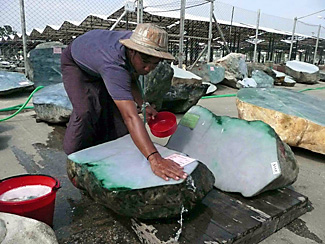
burma_jade.jpgIt’s the last hour of the last day of the gems auction in Rangoon, and tired buyers are fanning themselves with worn auction catalogs, and making their final bids.

Over the past five days, jade, rubies, sapphires, and close to $150 million have passed hands here, according to the Union of Myanmar Economic Holdings Ltd., the consortium that dominates Burma’s gemstone trade and is owned by the defense ministry and a clutch of military officers.

Who’s buying? China, India, Singapore, and Thailand are scooping up Burma’s stones. US first lady Laura Bush’s efforts at a global boycott of Burma’s gems seem to have done little to reduce China’s appetite for Burmese jade to make trinkets and souvenirs to sell at the Summer Olympics.

At this recent auction, 281 foreigners attended, leaving behind much-needed foreign currency and generally turning the auction into a resounding success, according to the state-run New Light of Myanmar newspaper.

Mrs. Bush – and human rights campaigners – would not be pleased.

The first lady has taken on the military regime in Burma (Myanmar), urging jewelers not to buy gems from a country where the undemocratic rulers and their cronies amass fortunes selling off the country’s stones, as well as many of the county’s other natural resources – such as minerals, timber, gold, oil, and gas – but keep Burma’s citizens in abject poverty.

She has urged UN Secretary General Ban Ki Moon to act more forcibly on Burma and stood beside President Bush on several occasions recently as he announced the growing list of US sanctions on the country. And, on International Human Right’s Day this past December, Mrs. Bush added her voice to those seeking a global boycott on gems from Burma.

“Consumers throughout the world should consider the implications of their purchase of Burmese gems,” she said in a statement from the White House. “Every Burmese stone bought, cut, polished, and sold sustains an illegitimate, repressive regime.”

Earlier in the semester, we read an article [which he has made available to the general publilc on his web site] by Richard Snyder on the link between “lootable wealth” and political stability. In fact, the final section of his paper deals explicitly with the Burmese tropical timber trade and its role in funding rebel groups. What are the implications of Snyder’s argument for how we–as potential consumers of junta jade–should respond to Laura Bush’s plea? Of course the two phenomena are not exactly the same (Snyder is seeking to understand the link between “lootable wealth” political stability, while Laura Bush is arguing that “lootable wealth” supports dictatorial rule.) Here is the abstract to Snyder’s article:

This article proposes a political economy of extraction framework that explains political order and state collapse as alternative outcomes in the face of lootable wealth. Different types of institutions of extraction can be built around lootable resources – with divergent effects on political stability. If rulers are able to forge institutions of extraction that give them control over revenues generated by lootable resources, then these resources can contribute to political order by providing the income with which to govern. In contrast, the breakdown or absence of such institutions increases the risk of civil war by making it easier for rebels to organize. The framework is used to explain two puzzling cases that experienced sharply contrasting political trajectories in the face of lootable resources: Sierra Leone and Burma. A focus on institutions of extraction provides a stronger understanding of the wide range of political possibilities – from chaos, to dictatorship, to democracy – in resource-rich countries.

Oil, Islam, and Women

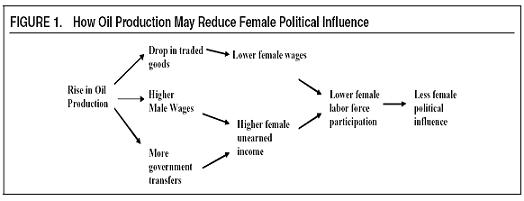
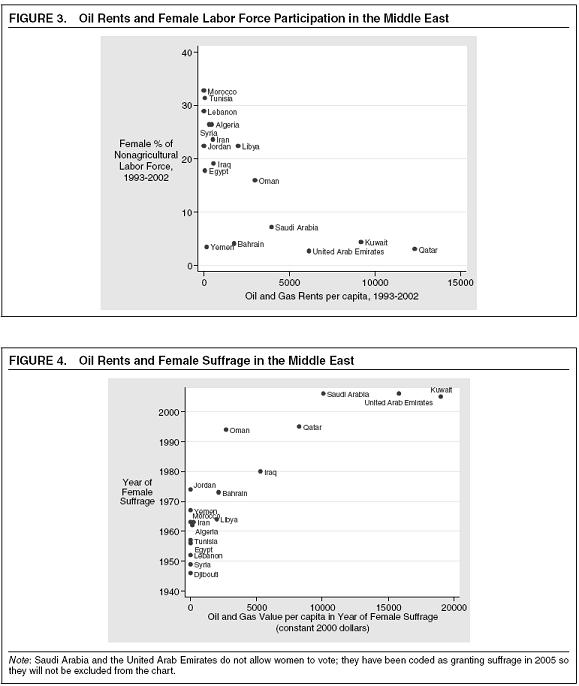
There is a new article [paywall] in the most recent issue of the American Political Science Review written by Michael L. Ross entitled “Oil, Women, and Islam.” Ross has written a lot about the nexus between resources and regime type, the so-called “resource curse” phenomenon. In this article, Ross argues that the well-known empirial link between lack of women’s rights and Islam washes away once controls related to oil production are incorporated into statistical models. (Note that the analysis is restricted to the Middle East.)

Here is the abstract and a couple of his charts:

Women have made less progress toward gender equality in the Middle East than in any other region. Many observers claim this is due to the region’s Islamic traditions. I suggest that oil, not Islam, is at fault; and that oil production also explains why women lag behind in many other countries. Oil production reduces the number of women in the labor force, which in turn reduces their political influence. As a result, oil-producing states are left with atypically strong patriarchal norms, laws, and political institutions. I support this argument with global data on oil production, female work patterns, and female political representation, and by comparing oil-rich Algeria to oil-poor Morocco and Tunisia. This argument has implications for the study of the Middle East, Islamic culture, and the resource curse.

ross_oil_women_1.jpg

ross_oil_women_2.jpg

The United Nations and Peacekeeping in Congo

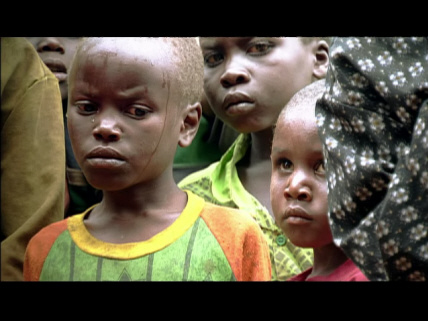
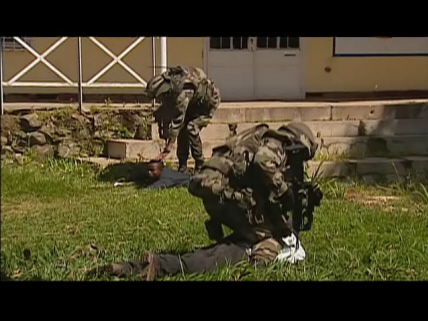
In PLSC250–intro to IR–this week we viewed a documentary made by the National Film Board of Canada, which addresses the UN’s peacekeeping role in Congo. After reading Chapter 7 of Mingst, you should now be aware that the UN in the world’s most important and powerful IGO, and the UN Security Council plays the most prominent global role in the area of international security. Here are a couple of screen shots from the film and the film’s description:

peacekeepers_1.jpg

peacekeepers_2.jpg

With unprecedented access to the United Nations Department of Peacekeeping, The Peacekeepers provides an intimate and dramatic portrait of the struggle to save “a failed state.” The film follows the determined and often desperate manoeuvres to avert another Rwandan disaster, this time in the Democratic Republic of Congo (the DRC).
Focusing on the UN mission, the film cuts back and forth between the United Nations headquarters in New York and events on the ground in the DRC. We are with the peacekeepers in the ‘Crisis Room’ as they balance the risk of loss of life on the ground with the enormous sums of money required from uncertain donor countries. We are with UN troops as the northeast Congo erupts and the future of the DRC, if not all of central Africa, hangs in the balance.
In the background, but often impinging on peacekeeping decisions, are the painful memory of Rwanda, the worsening crisis in Iraq, global terrorism and American hegemony in world affairs. As Secretary General Kofi Annan tells the General Assembly at the conclusion of The Peacekeepers: “History is a harsh judge. The world will not forgive us if we do nothing.” Whether the world’s peacekeeper did enough remains to be seen.

Islam Democracy, and Authoritarianism and Paper Assignment

The topic for the next paper assignment in PLSC240  is “Democracy and Culture”.  You will be required to assess the democratic potential of various cultural orientations for democracy, using the Diamond and Morlino volume as a guide.  In Assessing the Quality of Democracy, various essential components of democracy are analyzed, including responsiveness, equality, freedom and accountability.  Your task will be to comparatively assess the quality of democracy in two countries, one of which is “Western” in its cultural orientation, the other of which is “non-Western.”  I’ll have more information for you on the specifics of the assignment when you get back from break on the 18th.

For now, I’ll remind you that on Thursday, those of you who did not leave early for spring break watched a Frontline documentary on Muslims and the democratic potential of Islam. You were shown the diversity in the manner in which Islam is practiced across five different countries–Egypt, Iran, Malaysia, and Turkey, and Nigeria. You were also able to begin to understand the varied roles and treatment of women across all of these predominantly Muslim countries.  This tied in well with the Steven Fish article [you have to be on campus to access the article] that you were assigned to read in advance of viewing the video.  What is Fish’s argument about the link between women in Islamic societies and democracy?  I’ve attached a preview of the documentary below. You can watch the whole documentary online, by clicking here.

United Nations Security Council Imposes more Sanctions on Iran

In intro to IR, we’ll analyze the role of IGOs, NGOs, and international law in international politics.  Arguably the most important IGO is the United Nations Security Council (UNSC)  Today, the UNSC voted (14-0) to impose tougher sanctions against Iran as a result of that country’s continued pursuit of nuclear weapons.  From the New York Times:

unsc_iran_vote_03mar2008.jpg

UNITED NATIONS — The Security Council on Monday adopted its third resolution imposing sanctions on Iran for its refusal to cease enriching uranium, an activity that the West suspects Iran may be using to create fuel for a nuclear weapon.

 The previous two measures gained the unanimous support of the 15-member panel, but in balloting on Monday Indonesia abstained, saying it “remained to be convinced of the efficacy of adopting additional sanctions at this juncture.” Fourteen countries voted in favor.

The resolution authorizes inspections of cargo to and from Iran that is suspected of carrying prohibited equipment, tightens the monitoring of Iranian financial institutions and extends travel bans and asset freezes against persons and companies involved in the nuclear program.

It adds 13 names to the existing list of 5 individuals and 12 companies subject to travel and asset restrictions. The new names include people with direct responsibility for building fast-spinning centrifuges that enrich uranium ore and a brigadier general engaged in “efforts to get around the sanctions” in the two earlier resolutions.

Notice two things: first, the use of “targeted sanctions.”  Second, the story byline reads “United Nations”, not New York.  I wonder if this is standard practice for stories originating from the United Nations headquarters in New York.  Does anyone know?

Failed States and the Threat of Terrorism

In both intro to IR and intro to comparative, we’ve read about failed states and their impact not only on those living in them but those living even thousands of miles away. Rotberg, Krasner, and Sadowski, have all written about the potential dangers of states that do not have complete sovereignty over their territory. In another example of the potential threat posed by failing states, the Associated Press reports on a US attack on extremists in Somalia:

WASHINGTON – The U.S. launched a military airstrike in Somalia to go after a group of terrorist suspects, defense officials said Monday.

“It was a deliberate, precise strike against a known terrorist and his associates,” one U.S. military official said, speaking on condition of anonymity because he was not authorized to comment on the record.

He gave few other details, except to say the targets were believed staying in building known to be used regularly by terrorist suspects.

In the strike early Monday, Somali police said three missiles hit a Somali town held by Islamic extremists, destroying a home and seriously injuring eight people.

The strike follows one last year in which the U.S. shelled suspected al-QaidaU.S. Navy ship off the shore of the lawless East African nation. targets in Somalia, using gunfire from a

Most Recent Issue of the CrisisWatch Newsletter Released

Crisis Group–an NGO that analyzes and tracks extant and potential conflicts around the world–allows individuals to sign up for the monthly CrisisWatch newsletter. This month’s newsletter informs its readers that “twelve actual or potential conflict situations around the world deteriorated in February 2008, and four improved.”

The situation deteriorated in Armenia, where – as CrisisWatch went to press – a violent crackdown sought to suppress eleven days of protests after presidential elections that the opposition claimed were rigged. A state of emergency has been declared, and armed forces are reportedly mobilising for broader repression.

Attacks on Timor-Leste’s president and prime minister underlined the need for security sector reform in the fragile country. Yet their aftermath – including the killing of former head of military police Alfredo Reinado, who led the attack on the president – presents an opportunity for the government to address key issues.

Rebels in Chad launched a major assault on the capital N’Djamena in which hundreds were killed and thousands displaced. A state of emergency is still in place amid reports of a heavy government crackdown. In Darfur, the Sudanese government attacked three towns and an IDP camp from both ground and air, marking the worst violence in the region in months.

The situation also deteriorated in Cameroon, Comoros Islands, DR Congo, Ethiopia/Eritrea, Israel/Occupied Territories, Philippines, Serbia and Somalia.

How do you Prove You’re a Jew?

Gershon Gorenberg has written a new article in the New York Times Sunday Magazine
on the difficulties some Israeli Jews are having proving their Jewishness before rabbinic courts in that country.  The article is interesting and touches upon many of the issues we discussed in intro to comparative that deal with concepts of identity–nationhood, ethnicity, citizenship, etc.  In fact, I think I’ll be including this article in the syllabus during future iterations of this course.  In addition, I did not know that there is no civil marriage ceremony (marriage ceremonies are purely a religious affair in Israel) in Israeli law, but upon further reflection, I probably should have guessed that would be the case.

The story is particularly significant for American Jews, to which the accompanying snippets below attest:

02jewish1-500.jpgOne day last fall, a young Israeli woman named Sharon went with her fiancé to the Tel Aviv Rabbinate to register to marry. They are not religious, but there is no civil marriage in Israel. The rabbinate, a government bureaucracy, has a monopoly on tying the knot between Jews. The last thing Sharon expected to be told that morning was that she would have to prove — before a rabbinic court, no less — that she was Jewish. It made as much sense as someone doubting she was Sharon, telling her that the name written in her blue government-issue ID card was irrelevant, asking her to prove that she was she…

…In recent years, the state’s Chief Rabbinate and its branches in each Israeli city have adopted an institutional attitude of skepticism toward the Jewish identity of those who enter its doors. And the type of proof that the rabbinate prefers is peculiarly unsuited to Jewish life in the United States. The Israeli government seeks the political and financial support of American Jewry. It welcomes American Jewish immigrants. Yet the rabbinate, one arm of the state, increasingly treats American Jews as doubtful cases: not Jewish until proved so.

More than any other issue, the question of Who is a Jew? has repeatedly roiled relations between Israel and American Jewry. Psychologically, it is an argument over who belongs to the family. In the past, the casus belli was conversion: Would the Law of Return, which grants automatic citizenship to any Jew coming to Israel, apply to those converted to Judaism by non-Orthodox rabbis? Now, as Sharon’s experience indicates, the status of Jews by birth is in question. Equally important, the dividing line is no longer between Orthodox and non-Orthodox. The rabbinate’s handling of the issue has placed it on one side of an ideological fissure within Orthodox Judaism itself, between those concerned with making sure no stranger enters the gates and those who fear leaving sisters and brothers outside.

The story reminds me of a friend of mine who–of Croatian parentage but born in Canada– upon her arrival in Croatia (she had decided to move there during the middle of the war in the 1990s) had gone to the local police station with the aim of registering her presence (at that time, all foreigners were required to report to police within 24 hours of their arrival).  When she took out her Canadian passport, a clerk at the Ministry of Internal Affairs asked her the names of her parents.  After my friend responded, the clerk refused to allow her to register as a foreigner and insisted that she take out Croatian citizenship on the spot.  When my friend insisted that she was a Canadian citizen, the clerk responded “your father is ours, your mother is ours, that makes you  one of us also.”


Janjaweed Militia Renews Scorched-Eart Policy in Darfur

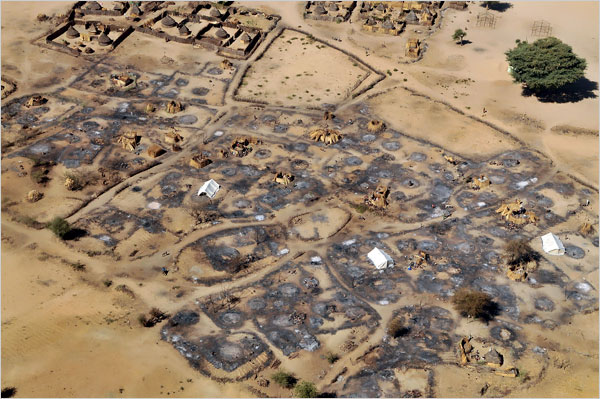
The New York Times reports that the notorious Janjaweed militia is once again active in Darfur.

 darfur_scortched_earth.jpg

Abu Surouj, Sudan, after government forces and allied militias burned the town last month. Such attacks in Sudan are a return to the tactics that terrorized Darfur in the early, bloodiest stages of the conflict.

Photo: Lynsey Addario for The New York Times

 SULEIA, Sudan — The janjaweed are back.

They came to this dusty town in the Darfur region of Sudan on horses and camels on market day. Almost everybody was in the bustling square. At the first clatter of automatic gunfire, everyone ran.

The militiamen laid waste to the town — burning huts, pillaging shops, carrying off any loot they could find and shooting anyone who stood in their way, residents said. Asha Abdullah Abakar, wizened and twice widowed, described how she hid in a hut, praying it would not be set on fire.

“I have never been so afraid,” she said.

The attacks by the janjaweed, the fearsome Arab militias that came three weeks ago,, were a return to the tactics that terrorized Darfur in the early, bloodiest stages of the conflict.

Such brutal, three-pronged attacks of this scale — involving close coordination of air power, army troops and Arab militias in areas where rebel troops have been — have rarely been seen in the past few years, when the violence became more episodic and fractured. But they resemble the kinds of campaigns that first captured the world’s attention and prompted the Bush administration to call the violence in Darfur genocide.

I noticed the same pattern during the wars in the former Yugoslavia in the 1990s, with militia groups acting in close concert with government support.  In my study of the Croatian region of Baranya, I noticed that the villages in which civilians were killed all had one thing in common–they were on (or very near) a major regional road.  This meant that government military forces (with their tanks and armed personnel carriers) had easy access to these villages, allowing the militias to swoop in and do their thing.

Design a site like this with WordPress.com
Get started