How do you Prove You’re a Jew?

Gershon Gorenberg has written a new article in the New York Times Sunday Magazine
on the difficulties some Israeli Jews are having proving their Jewishness before rabbinic courts in that country.  The article is interesting and touches upon many of the issues we discussed in intro to comparative that deal with concepts of identity–nationhood, ethnicity, citizenship, etc.  In fact, I think I’ll be including this article in the syllabus during future iterations of this course.  In addition, I did not know that there is no civil marriage ceremony (marriage ceremonies are purely a religious affair in Israel) in Israeli law, but upon further reflection, I probably should have guessed that would be the case.

The story is particularly significant for American Jews, to which the accompanying snippets below attest:

02jewish1-500.jpgOne day last fall, a young Israeli woman named Sharon went with her fiancé to the Tel Aviv Rabbinate to register to marry. They are not religious, but there is no civil marriage in Israel. The rabbinate, a government bureaucracy, has a monopoly on tying the knot between Jews. The last thing Sharon expected to be told that morning was that she would have to prove — before a rabbinic court, no less — that she was Jewish. It made as much sense as someone doubting she was Sharon, telling her that the name written in her blue government-issue ID card was irrelevant, asking her to prove that she was she…

…In recent years, the state’s Chief Rabbinate and its branches in each Israeli city have adopted an institutional attitude of skepticism toward the Jewish identity of those who enter its doors. And the type of proof that the rabbinate prefers is peculiarly unsuited to Jewish life in the United States. The Israeli government seeks the political and financial support of American Jewry. It welcomes American Jewish immigrants. Yet the rabbinate, one arm of the state, increasingly treats American Jews as doubtful cases: not Jewish until proved so.

More than any other issue, the question of Who is a Jew? has repeatedly roiled relations between Israel and American Jewry. Psychologically, it is an argument over who belongs to the family. In the past, the casus belli was conversion: Would the Law of Return, which grants automatic citizenship to any Jew coming to Israel, apply to those converted to Judaism by non-Orthodox rabbis? Now, as Sharon’s experience indicates, the status of Jews by birth is in question. Equally important, the dividing line is no longer between Orthodox and non-Orthodox. The rabbinate’s handling of the issue has placed it on one side of an ideological fissure within Orthodox Judaism itself, between those concerned with making sure no stranger enters the gates and those who fear leaving sisters and brothers outside.

The story reminds me of a friend of mine who–of Croatian parentage but born in Canada– upon her arrival in Croatia (she had decided to move there during the middle of the war in the 1990s) had gone to the local police station with the aim of registering her presence (at that time, all foreigners were required to report to police within 24 hours of their arrival).  When she took out her Canadian passport, a clerk at the Ministry of Internal Affairs asked her the names of her parents.  After my friend responded, the clerk refused to allow her to register as a foreigner and insisted that she take out Croatian citizenship on the spot.  When my friend insisted that she was a Canadian citizen, the clerk responded “your father is ours, your mother is ours, that makes you  one of us also.”
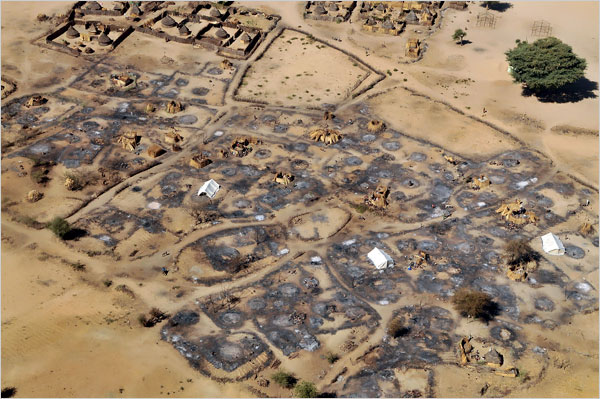
 

Janjaweed Militia Renews Scorched-Eart Policy in Darfur

The New York Times reports that the notorious Janjaweed militia is once again active in Darfur.

 darfur_scortched_earth.jpg

Abu Surouj, Sudan, after government forces and allied militias burned the town last month. Such attacks in Sudan are a return to the tactics that terrorized Darfur in the early, bloodiest stages of the conflict.

Photo: Lynsey Addario for The New York Times

 SULEIA, Sudan — The janjaweed are back.

They came to this dusty town in the Darfur region of Sudan on horses and camels on market day. Almost everybody was in the bustling square. At the first clatter of automatic gunfire, everyone ran.

The militiamen laid waste to the town — burning huts, pillaging shops, carrying off any loot they could find and shooting anyone who stood in their way, residents said. Asha Abdullah Abakar, wizened and twice widowed, described how she hid in a hut, praying it would not be set on fire.

“I have never been so afraid,” she said.

The attacks by the janjaweed, the fearsome Arab militias that came three weeks ago,, were a return to the tactics that terrorized Darfur in the early, bloodiest stages of the conflict.

Such brutal, three-pronged attacks of this scale — involving close coordination of air power, army troops and Arab militias in areas where rebel troops have been — have rarely been seen in the past few years, when the violence became more episodic and fractured. But they resemble the kinds of campaigns that first captured the world’s attention and prompted the Bush administration to call the violence in Darfur genocide.

I noticed the same pattern during the wars in the former Yugoslavia in the 1990s, with militia groups acting in close concert with government support.  In my study of the Croatian region of Baranya, I noticed that the villages in which civilians were killed all had one thing in common–they were on (or very near) a major regional road.  This meant that government military forces (with their tanks and armed personnel carriers) had easy access to these villages, allowing the militias to swoop in and do their thing.

Cross-National Comparisons in Incarceration Rates

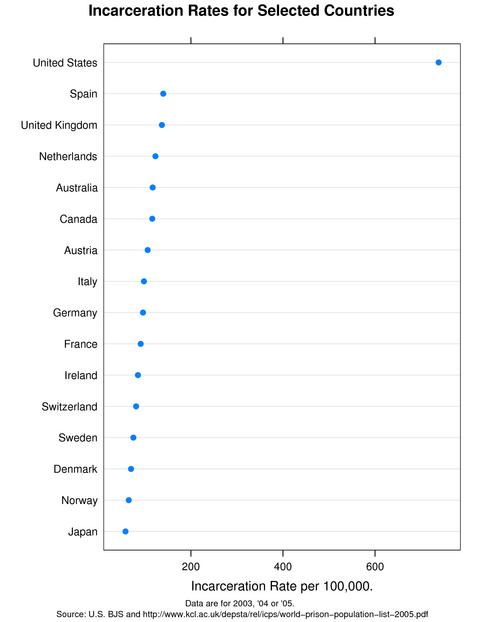
Every time I hear or read about a numerical fact, I always ask myself “is this high, low, average” for this particular phenomenon.  In order to answer this question, I’m required to make at least an implicit comparison.  So when I read today that for the first time ever, 1 in 100 American adults is incarcerated, I wondered how that compared to other countries.  The information is not hard to find.  Here’s a chart for your perusal.  What do you think accounts for the variation in incarceration rates across countries?

Here are some snippets from ABC News:

incarceration-oecd.jpg For the first time in U.S. history, more than one of every 100 adults is in jail or prison, according to a new report documenting America’s rank as the world’s No. 1 incarcerator. It urges states to curtail corrections spending by placing fewer low-risk offenders behind bars.

Using state-by-state data, the report says 2,319,258 Americans were in jail or prison at the start of 2008 one out of every 99.1 adults. Whether per capita or in raw numbers, it’s more than any other nation.

The report, released Thursday by the Pew Center on the States, said the 50 states spent more than $49 billion on corrections last year, up from less than $11 billion 20 years earlier. The rate of increase for prison costs was six times greater than for higher education spending, the report said.

The steadily growing inmate population “is saddling cash-strapped states with soaring costs they can ill afford and failing to have a clear impact either on recidivism or overall crime,” the report said.

Susan Urahn, managing director of the Pew Center on the States, said budget woes are pressuring many states to consider new, cost-saving corrections policies that might have been shunned in the recent past for fear of appearing soft on crime.

King Abdullah II of Jordan Speech at the Woodrow Wilson School

In intro to IR, we examined the role of individuals this past week and their effect on international politics.  Elites, other private individuals, and mass publics all have an impact on the shape of international politics.  One such individual–a foreign policy elite–was Woodrow Wilson, who said:
 “Friendship is the only cement that will ever hold the world together. There must be, not a balance of power, but a community of power; not organized rivalries, but an organized peace.”
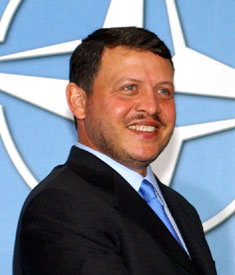
You can’t get a more concise expression of Wilsonian liberalism (idealism).  King Abdullah II of Jordan spoke to an audience at the Woodrow Wilson School of International Affairs on the subject of peace in the Middle East.  Here are his remarks in their entirety.  (H/t to A. Gunlicks)


Embassy of Jordan – Washington, DC

Information Bureau


Remarks by His Majesty King Abdullah II

Woodrow Wilson School of Public and International Affairs

Princeton University

29′ February 2008


Bismillah ar-Rahman ar-Rahim


king_abdullah.jpg            Fifty-seven countries are not at peace with Israel today.


Fifty-seven countries out of 193 countries in the world.


            Fifty-seven countries with a total population greater than Europe and the United States combined.


Fifty-seven countries, representing one third of the members of the United Nations.


Fifty-seven countries for whose citizens the conflict in Palestine is the issue of their time.


We must, therefore, ask the important question. What are the implications for global stability if this continues?


Continue reading “King Abdullah II of Jordan Speech at the Woodrow Wilson School”

Peace and Punishment–An Insider’s Account of the ICTY

Marko Attila Hoare, whose blog (Greater Surbiton) is a great place to read about South East European politics, has a post on the recently published book by former spokeswoman of the International Criminal Tribunal for the former Yugoslavia (ICTY), Florence Hartmann.  The book is written in French and the title is Paix et chatiment: Les guerres secretes de la politique et de la justice internationales [Peace and Punishment: Secret Politial Wars and International Justice].

Hoare has a long post about the book. Here are some snippets:

[Hartmann] has used her eyewitness’s insight into the inner workings of the ICTY to support her blistering critique of the failure of the Western alliance to support the cause of justice for the former Yugoslavia. Her book paints a portrait of Western powers, above all the US, Britain and France, stifling the ICTY and preventing the arrest of war-criminals through a combination of obstruction, manipulation, mutual rivalry and sheer inertia.

One of the best parts of the book concerns what Hartmann terms the ‘fictitious pursuit’ of the two most prominent Bosnian Serb war-criminals, Radovan Karadzic and Ratko Mladic, involving repeated failures to arrest them. Hartmann gives various reasons why the Western powers might have behaved in this manner, among them the alleged agreement in 1995 between Milosevic, Mladic and French President Jacques Chirac, that in return for the release of two French pilots shot down by the Serbs over Bosnia, Mladic would never be prosecuted by the ICTY; the similar alleged agreement between Karadzic, Mladic and the US’s Richard Holbrooke in 1996, for Karadzic to withdraw from political life in return for a guarantee that he would never be prosecuted; and the readiness in 2002 of Bosnia’s High Representative, Britain’s Paddy Ashdown, to sabotage the attempts of Bosnian intelligence chief Munir Alibabic to track down Karadzic, out of rivalry with the French intelligence services with which Alibabic was working…

Peace and Punishment, nevertheless, remains essential reading for several reasons. It reminds us that, however critical one may be of del Ponte’s performance as Chief Prosecutor, she was very far from being the only senior individual responsible for the ICTY’s failures. It gives an insight into the sort of debates and conflicts over strategy that preoccupied war-crimes investigators at the OTP. And it highlights the fact that, far from being an agent of Western imperialism, the Chief Prosecutor was acting in a frequently hostile international arena, in which she had to struggle for international cooperation, and in which the ICTY was frequently squeezed rather than supported by the Great Powers. Although, as I have indicated, I am highly critical of several aspects of this book, I would nevertheless recommend it to anyone interested in the subject of why international justice has failed the peoples of the former Yugoslavia.

NGOs and Their Changing Roles–How Have They Changed

Here is a two-part interview, available on YouTube with Norman Cook, and long-time practitioner and student of NGOs and the role they play in international politics.  We’ll be looking at NGOs next week, so you may want to take a look at this interview to learn a little bit more about how the role of NGOs has changed over time.

Here is a description of the interview:

Interview with Norman Cook, Canadian development expert (and jazz lover). How have the roles of NGOs changed? Are they becoming near-governmental – “embedded” with power politics? How our development models and criteria often don’t fit the reality in developing countries.
Interview by Jan Oberg, November 27, 2007

While watching consider the arguments of Krasner and Slaughter that we discussed last week.  How would they respond to Cook’s assertions?

Mapping the Future from CSIS

The Center for Strategic and International Studies has a fascinating new subway-style map, which interactively maps the global future on the basis of various themes–construction, sporting and culture, science, politics, etc. Each node of information on the interactive map is a hyperlink that takes the reader to a web page with detailed information about the topic.

Below is a much reduced version of the map.  If you click on the word map above, you’ll be taken to the large interactive version of the map. Click on the link (which I’ve indicated using the red circle) and you’ll be taken to a page where you’ll be told the following:

As a result of the internal reorganization of the U.S. military command structure, a new headquarters dedicated exclusively to Africa is expected to become fully operational in 2008. The United States Africa Command, or AFRICOM, will report to the Secretary of Defense on U.S. military relations with 53 African countries, with a focus on war prevention and capacity-building programs. The ultimate stated goal of the program is to enable “a more stable environment in which political and economic growth can take place.” For the fiscal year 2008, AFRICOM is expected to have a $75 billion budget. 

mapping_future2.jpg

h/t to V. Wang.

Kenyan Leaders Sign Peace Agreement

Kenya’s political leaders have finally reached an agreement that Kenyans hope will signal the end of the recent instability and inter-ethnic bloodshed, which resulted from disputed elections in late December of last year. The New York Times reports that the structure of the political system in Kenya has been altered as a result of an agreement between President Mwai Kibaki and opposition leader Raila Odinga:

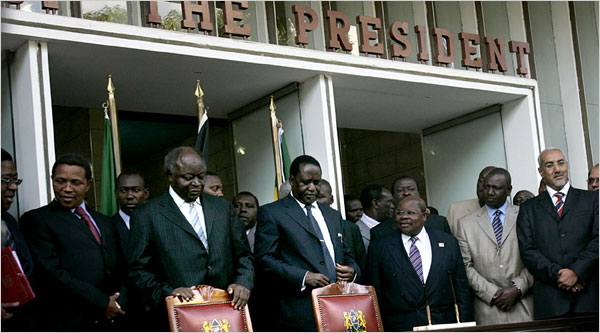
29kenya-span-600.jpgNAIROBI, Kenya — Kenya’s rival leaders broke their tense standoff on Thursday, agreeing to share power in a deal that may end the violence that has engulfed this nation but could be the beginning of a long and difficult political relationship.

The country seemed to let out a collective cheer as Mwai Kibaki, the president, and Raila Odinga, the top opposition leader, sat down at a desk in front of the president’s office, with a bank of television cameras rolling, and signed an agreement that creates a powerful prime minister position for Mr. Odinga and splits cabinet posts between the government and the opposition.

The two sides, which have been bitterly at odds for the past two months, will now be fused together in a government of national unity.

But there are still many thorny issues to resolve, starting with how the new government will function with essentially two bosses who have tried unsuccessfully to work together before. The government must also deal with the delicate business of reassigning the choice positions already given to Mr. Kibaki’s allies.

When we get back from the spring break, in intro to comparative we will analyze the political systems of several democracies around the world and you’ll realize that very few democracies have institutionalized a system that contains a strong Prime Minister and strong President. The most successful example is probably France, with its semi-presidential system. Even in strongly democratic France, however, political stability is often compromised when the President and Prime Minister are members of different political parties, as will be the case in Kenya. It will be interesting to see how the Kenyan version of cohabitation will develop in the coming months and years.

Who Speaks for Islam–a New Book by the Gallup Poll

The Gallup Polling outfit has a new book out based on a massive (over 50,000 respondents) recent poll on attitudes amongst the world’s approximately 1.3 billion Muslims. Let us allow the publishers to describe the content themselves:

islamwld.jpgGallup’s largest study of Muslim populations worldwide challenges conventional wisdom and the inevitability of a global conflict as the wars in Iraq and Afghanistan continue. Despite widespread media coverage of global terrorism from America and Europe to the Middle East and Asia, little is known about what majorities of the world’s Muslims really think and feel. What do Muslims say about violence and terrorist attacks? What do they say about democracy, women, and relations with the West? What are their values, goals, and religious beliefs?

Who Speaks for Islam? What a Billion Muslims Really Think by John L. Esposito and Dalia Mogahed (Gallup Press; March 2008; hardcover) sheds new light into the “increasing hostility” that Archbishop Tutu characterizes.

In the wake of the terrorist attacks on 9/11, U.S. public officials seemed to have no idea whether or not many Muslims supported the bombings. This troubled Gallup Chairman and CEO Jim Clifton, who felt that “no one in Washington had any idea what 1.3 billion Muslims were thinking, and yet we were working on intricate strategies that were going to change the world for all time.” Clifton commissioned his company to undertake the enormous job.

The result is Who Speaks for Islam? What a Billion Muslims Really Think, based on six years of research and more than 50,000 interviews representing 1.3 billion Muslims who reside in more than 35 nations that are predominantly Muslim or have sizable Muslim populations.

Some of the more intriguing findins?

  • Muslims and Americans are equally likely to reject attacks on civilians as morally unjustifiable.
  • Large majorities of Muslims would guarantee free speech if it were up to them to write a new constitution AND they say religious leaders should have no direct role in drafting that constitution.
  • Muslims around the world say that what they LEAST admire about the West is its perceived moral decay and breakdown of traditional values — the same answers that Americans themselves give when asked this question.
  • When asked about their dreams for the future, Muslims say they want better jobs and security, not conflict and violence.
  • Muslims say the most important thing Westerners can do to improve relations with their societies is to change their negative views toward Muslims and respect Islam.

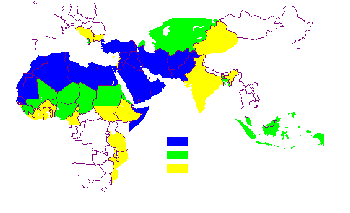
Note: the map above is from Professor Juan Cole.  The colors refer to the percentage of inhabitants of each state who are Muslims.

Leaderless Jihad–the Transformation of Al Qaeda

In PLSC250, we have discussed both Samuel Huntington’s prediction of the nature of the new world order (as outlined in his “Clash of Civlizations” thesis) and Yahya Sadowski’s response (“Political Islam: Asking the Wrong Questions”). David Ignatius has written an op-ed piece in the Washington Post today, which amounts to a book review of former CIA officer Marc Sagerman’s new book, “Leaderless Jihad.” Find some excerpts posted below. How does Sagerman’s view fit with the views expressed by Sadowski in his article?

Sageman has a résumé that would suit a postmodern John le Carré. He was a case officer running spies in Pakistan and then became a forensic psychiatrist. What distinguishes his new book, “Leaderless Jihad,” is that it peels away the emotional, reflexive responses to terrorism that have grown up since Sept. 11, 2001, and looks instead at scientific data Sageman has collected on more than 500 Islamic terrorists — to understand who they are, why they attack and how to stop them.

The heart of Sageman’s message is that we have been scaring ourselves into exaggerating the terrorism threat — and then by our unwise actions in Iraq John McCain, that, as McCain’s Web site puts it, the United States is facing “a dangerous, relentless enemy in the War against Islamic Extremists” spawned by al-Qaeda. making the problem worse. He attacks head-on the central thesis of the Bush administration, echoed increasingly by Republican presidential candidate

The numbers say otherwise, Sageman insists. The first wave of al-Qaeda leaders, who joined Osama bin Laden in the 1980s, is down to a few dozen people on the run in the tribal areas of northwest Pakistan. The second wave of terrorists, who trained in al-Qaeda’s camps in Afghanistan during the 1990s, has also been devastated, with about 100 hiding out on the Pakistani frontier. These people are genuinely dangerous, says Sageman, and they must be captured or killed. But they do not pose an existential threat to America, much less a “clash of civilizations.”

It’s the third wave of terrorism that is growing, but what is it? By Sageman’s account, it’s a leaderless hodgepodge of thousands of what he calls “terrorist wannabes.” Unlike the first two waves, whose members were well educated and intensely religious, the new jihadists are a weird species of the Internet culture. Outraged by video images of Americans killing Muslims in Iraq, they gather in password-protected chat rooms and dare each other to take action. Like young people across time and religious boundaries, they are bored and looking for thrills.

“It’s more about hero worship than about religion,” Sageman said in a presentation of his research last week at the New America Foundation, a liberal think tank here. Many of this third wave don’t speak Arabic or read the Koran. Very few (13 percent of Sageman’s sample) have attended radical madrassas.

Design a site like this with WordPress.com
Get started