The Political Economy of Assassination

Today in intro to IR, we discussed the role of individuals in international politics.  On Friday, we’ll look at the policy debate on page 152 of Mingst, where the debate question is “Should ‘bad’ or ‘corrupt’ leaders be forcibly removed by the international community?  Mingst provides arguments for and against.  What about not only removing them, but having them assassinated?  Two economists–Ben Olken and Ben Jones–have decided to take a look at the link between assassinations and other factors such as democratization and economic growth.  What have they found?

Olken wonders whether economic devel­opment and the path to democratization are shaped more by broad historical forces or by the actions of specific leaders—be they demo­cratically elected prime ministers or thuggish authoritarians…

…In “Hit or Miss? The Effect of Assassinations on Institutions and War,” Olken and Jones looked at the effects of political assassination, using a strict empirical methodology that takes into account economic conditions at the time of the killing and what Olken calls a “novel data set” of assas­sination attempts, successful and unsuccessful, between 1875 and 2004.

Olken and Jones discovered that a country was “more likely to see democratization follow­ing the assassination of an autocratic leader,” but found no substantial “effect following assassinations—or assassination attempts—on democratic leaders.” They concluded that “on average, successful assassinations of autocrats produce sustained moves toward democracy.”

…In “Do Leaders Matter? National Leadership and Growth since World War II,” Olken and Jones explored whether “individual political leaders make a difference in economic growth.” This is tricky business for the researcher because, as Olken explains, a country’s economic situa­tion can affect the election of a leader: when the economic outlook is good, for instance, presi­dents are more likely to be reelected. [This is the problem of endogeneity–JD] So Olken and Jones looked at 57 leaders who died in office from accidents or natural causes and “found big changes in growth when autocratic leaders die in office—both positive and negative,” but no sub­stantial change when democratic leaders died in office. “The results suggest,” they write, “that individual leaders can play crucial roles in shap­ing the growth of nations,” provided they are ruling with minimal or nonexistent checks and balances to their power (think Augusto Pinochet or Robert Mugabe).
 

What Does One Have to do to Become Irish?

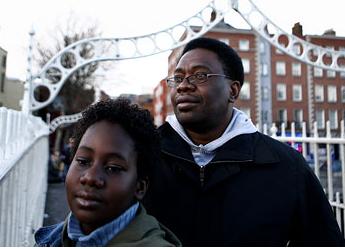
We had a (sometimes spirited) discussion in intro to comparative yesterday about patriotism, nationalism, citizenship and immigration. You may, therefore, find today’s story in the New York Times about a young 11-year-old lad who was born in Ireland and is about as culturally Irish as they come, except for the fact that his African born parents are illegal citizens in Ireland. As a result, his parents face the prospect of being exiled back to Africa, which would force the boy to go also. Quoting the NYT:

nigerian_irish_boy.jpgDUBLIN — Cork-born and proud of it, George-Jordan Dimbo is top to toe the Irish lad. He studies Gaelic, eats rashers, plays hurling, prays to the saints, papers his walls with parochial school awards, and spends Saturdays at the telly watching Dustin the Turkey, a wisecracking puppet, mock the powerful.

If the Irish government has its way, he may soon be living in Africa.

George, 11, is an Irish citizen and has been since his birth when Ireland, alone in Europe, still gave citizenship to anyone born on its soil. [Do you remember what the legal term for this is?] His mother and father, Ifedinma and Ethelbert Dimbo, are illegal immigrants from Nigeria, who brought him back to Ireland three years ago, judging it the best place to raise him.

Since then, the unusual trio — the Irish schoolboy and his African parents — have shared a single room in a worn Dublin hostel while facing a prospect dreaded by children on both sides of the Atlantic, a parent’s deportation.

“Dear justice minister,” George wrote when he was 9. “I heard my Mommy and Daddy whispering about deportation. Please do not deport us.”

“Remember,” he added, “I am also an Irish child.”

P.S. Bonus points for anyone who can tell me what rashers are!

Calvin and Hobbes and IR Theory

Which theory of IR immediately comes to mind upon reading this Calvin and Hobbes cartoon? Why? One of the more clever students in Intro to IR noticed that one of the character’s names gives us an obvious clue.

calvin_hobbes_modern_threats.jpg

The answer is below the fold…

Continue reading “Calvin and Hobbes and IR Theory”

Personality Characteristics of Individual Leaders–Hugo Chavez and George W. Bush

In class on Wednesday, we’ll be analyzing the individual level of analysis in international relations. Do individuals matter? In other words, do they have an effect independent of the state and systemic levels, or do individuals lie at the periphery of international relations? Margaret Hermann–a political psychologist–has found that that leaders can be characterized based on a host of personality characteristics. Some of these are nationalism, need for power, need for affiliation, distrust of others, etc. On the basis of a composite of these characteristics, Hermann believed that leaders were more likely to have one or the other of two foreign policy orientations–independent leader, participatory leader. Watch these two clips and think about how you would characterize Chávez’s and Bush’s foreign policy orientations, respectively.

The Global Perspectives box on p. 146 in Mingst, asks the following questions:

  1. Is it personality or policies that have made Chavez popular and powerful? Using Herman’s personality characteristics, how would you classify Chavez?
  2. How has the person of Chavez augmented the power of the Venezuelan state?

The same could be asked of President Bush:

  1. Is it personality or policies that have made President Bush popular and powerful? Using Herman’s personality characteristics, how would you classify Bush?
  2. How has the person of Bush augmented the power of the US state?

The Fluid Religious Marketplace in the United States

The New York Times reports on a new poll released by the Pew Forum on Religion and Public Life, which shows a relatively high level of fluidity in the religious identities of residents here in the United States. Analysts and scholars of the role of religion in public life have long understood the US exceptionalism with respect to the important role and place of religion in public life. This has occurred despite (although some would argue because of) the official church-state separation in US society. Most other states with developed economies are much more secular than is the United States, even though some of these states (such as Great Britain and Germany) do not have state/church separation.

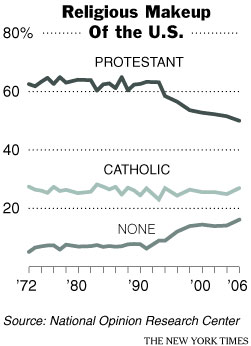
The main take-home message of this new Pew Poll, I think, is the fluidity of religious identity here in the United States, where religion is more individualized and personalized and really becomes a type of individual identity. (Remember in Chapter 3 of O’Neil where we differentiated between individual and group identity and discussed whether religious identity could be both.) Conversely, in countries like France, Great Britain, Germany, etc., religion is much more a social–i.e., group–(rather than a religious) identity and is, therefore, much more immutable. Here is an excerpt from the article, with a graphic:

us_religious_makeup.jpgWASHINGTON — More than a quarter of adult Americans have left the faith of their childhood to join another religion or no religion, according to a survey of religious affiliation by the Pew Forum on Religion and Public Life.

The report, titled “U.S. Religious Landscape Survey,” depicts a highly fluid and diverse national religious life. If shifts among Protestant denominations are included, then it appears that 44 percent of Americans have switched religious affiliations.

For at least a generation, scholars have noted that more Americans are moving among faiths, as denominational loyalty erodes. But the survey, based on telephone interviews with more than 35,000 Americans, offers one of the clearest views yet of that trend, scholars said. The United States Census does not track religious affiliation.

It shows, for example, that every religion is losing and gaining members, but that the Roman Catholic Church “has experienced the greatest net losses as a result of affiliation changes.” The survey also indicates that the group that had the greatest net gain was the unaffiliated. Sixteen percent of American adults say they are not part of any organized faith, which makes the unaffiliated the country’s fourth-largest “religious group.”

That 44 percent of Americans have switched religious affiliation is astounding. What are the implcations of this? I can think of two immediately…

You can find the Pew Forum on Religion and Public Life here. Here is a link to a video interview with Pew Forum Director Luis Lugo who talks about the next step in data analysis. Lugo characterizes the United States as having a dynamic “religious marketplace.” Here is a link to an interview with Neela Bannerjee, the New York Times journalist, who wrote the article.

The World Health Organization on Drug-Resistant From of Tuberculosis

The Vancouver Sun reports on the most recent announcement of the World Health Organization (WHO) regarding the dangerous multi-drug resistant strain of tuberculosis (MDR-TB) .

A report published Tuesday, Anti-Tuberculosis Drug Resistance in the World, is the largest survey to date on the scale of drug resistance in tuberculosis. It is based on information collected between 2002 and 2006 on 90,000 TB patients in 81 countries.

The organization [WHO] estimates there are nearly half a million new cases of multi-drug resistant TB every year.

“TB drug resistance needs a frontal assault. If countries and the international community fail to address it aggressively now we will lose this battle,” said WHO spokesman, Dr. Mario Raviglione. “In addition to specifically confronting drug-resistant TB and saving lives, programs worldwide must immediately improve their performance in diagnosing all TB cases rapidly and treating them until cured, which is the best way to prevent the development of drug resistance.”

The report also found that extensively drug-resistant tuberculosis (XDR-TB), a virtually untreatable form of the respiratory disease, has been recorded in 45 countries.

But the true scale of the problem, internationally, remains unknown. Only six countries in Africa – the region with the highest incidence of TB in the world – were unable to provide drug resistance data.

We’ll take a look at the global challenge posed by diseases such as TB in the last week of the semester.

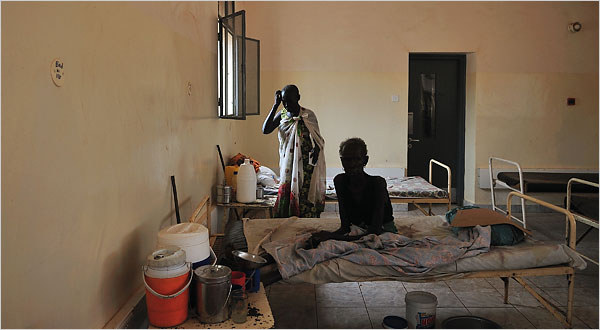
UPDATE: The New York Times also has this story on its front page, with a photograph of a TB clinic in Sudan.

tb_sudan.jpg

Map of Economic Freedom

We’ll be comparing countries today based on their respective approaches to political economy; that is, on how the economic systems apportion the relative influences of the market, state, and civil society sector in the economy. Often, work on political economy tends to focus on the state/market nexus at the expense of civil society. We saw earlier in the course (Alesina and Guiliano) that attitudes and ideologies in the civil society sector can have a dramatic impact on economic patterns within society.

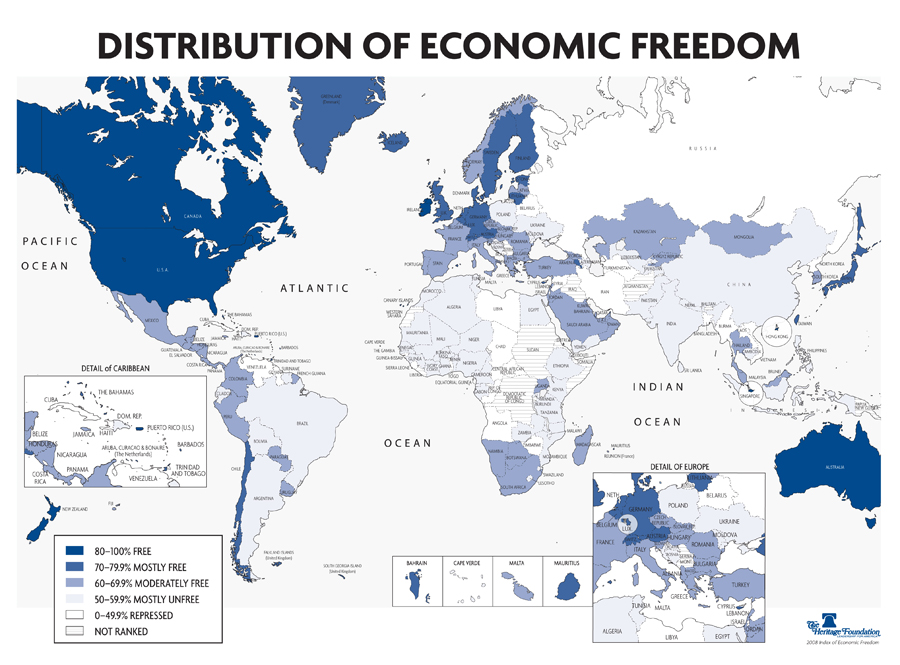
At the end of the lecture today, we’ll look at trends in economic liberalization worldwide over the last decade or so by means of a report from the US Federal Reserve Bank of Dallas, and this map from the Heritage Foundation annual report on economic freedom around the world.

(The darker the color, the more economically free is that country’s economy.)

index2008_econfreedommap.jpg

Violin Diplomacy in North Korea

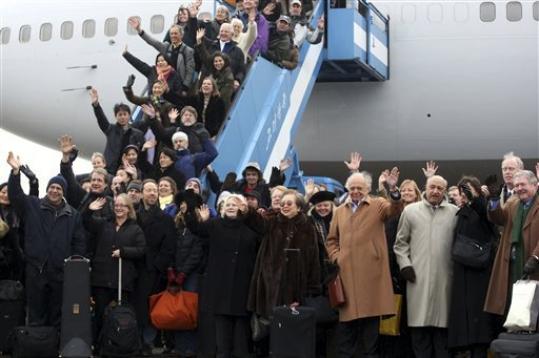
You remember the “ping-pong diplomacy” of the Nixon years? Well, get ready for a little bit of “violin diplomacy”, with news that the New York Philharmonic Orchestra has landed in Pyongyang, the capital of the most politically isolated state on earth, North Korea. The Boston Globe reports and uses the occasion to look back at other episodes of cultural diplomacy:

539w.jpg
Members of the New York Philharmonic orchestra wave as they arrive at the airport in Pyongyang for a two day visit to North Korea on Monday, Feb. 25, 2008. (AP Photo/David Guttenfelder)
Some other noteworthy episodes of cultural diplomacy, according to the Boston Globe:
CHINAApril 1971 — The U.S. Table Tennis Team accepts a surprise invitation from China, making the group the first American non-communist delegation allowed into China since the communist takeover in 1949. This “pingpong diplomacy” helps lay the path for President Richard Nixon’s historic trip to China the following year.1979 — Acclaimed violinist Isaac Stern embarks on a cultural tour of China in which he performs and mentors young Chinese musicians, encounters that are chronicled in an Oscar-winning documentary, “Mozart to Mao.”IRAN Continue reading “Violin Diplomacy in North Korea”

Patriotism–What is it? How can we Measure it?

As budding “social scientists” (the scare quotes are legitimate), it is good form to not only define concepts that are malleable but also to provide qualitative and/or quantitative evidence regarding their existence. A recent brouhaha in American politics centers around the political concept patriotism. What is it? How do we know it exists? Can it be measured? These are all important questions, so important, in fact, that they could determine the outcome of the next US presidential election.

In intro to comparative, we’ve been analyzing social identities, ethnic, national, etc. As we know from reading O’Neil, patriotism is based on the idea of citizenship–an individual’s relationship to the state in which s/he lives. O’Neil defines patriotism as “pride in one’s state.”

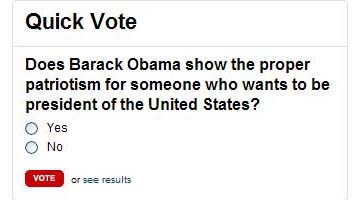
As near as I can tell, some opponents of Barack Obama’s candidacy have based some of their resistance on what they view as his lack of patriotism. If I’m reading this correctly, the base their argument on the fact that Obama does not (in fact, may even refuse to) wear a lapel pin in the shape of an American flag. This is interesting since it also touches upon issues of national identity; remember that we tried to determine just what is meant to be American. Does one have to wear an American flag lapel pin to be considered patriotic? If any of you think that this is an issue of negligible import, I refer you to this screen shot of the CNN website:

cnn-obama-patriotism.jpg

Given that I’m not a citizen of the United States, I’ll leave that for others to answer. I am, however, a citizen of the Republic of Croatia and this episode does remind me of an incident from the mid 1990s, which I, then working for the Helsinki Committee for Human Rights, witnessed. Join me after the jump.

hrvatska-zastava.jpgThe Croatian flag is a tri-color, with horizontal fields of red, white, and blue (from top to bottom), which contains the coat of arms–the “Šahovnica“–in the middle field. The šahovnica has been used in various guises throughout Croatian history as a symbol of Croatian nationhood. While Croats have lived under many different types of regime–Communist Yugoslavia, the Fascist Ustasa regime during WWII, the unitarist, Serb-dominated inter-war regime, the Austro-Hungarian monarchy (you get the point!)–the šahovnica has remained a constant expression and symbol of the Croatian people.

Continue reading “Patriotism–What is it? How can we Measure it?”

Design a site like this with WordPress.com
Get started