Cuba’s Human Welfare Indicators

Recent news regarding Fidel Castro’s plans to step aside in favor of his brother have returned Cuba to the news headlines here in the United States.  It has prompted some to take stock of Castro’s tenure as Cuba’s leader of nearly five decades.  Unfortunately, much of what we are likely to read will be ideologically-driven and devoid of much empirical substance.  For a comparative look at Castro’s and Batista’s regimes, we turn to Cal-Berkeley economist Brad DeLong:

ist2_64313_vintage_1950s_cars_in_havana_cuba.jpgThe hideously depressing thing is that Cuba under Battista [sic]–Cuba in 1957–was a developed country. Cuba in 1957 had lower infant mortality than France, Belgium, West Germany, Israel, Japan, Austria, Italy, Spain, and Portugal. Cuba in 1957 had doctors and nurses: as many doctors and nurses per capita as the Netherlands, and more than Britain or Finland. Cuba in 1957 had as many vehicles per capita as Uruguay, Italy, or Portugal. Cuba in 1957 had 45 TVs per 1000 people–fifth highest in the world. Cuba today has fewer telephones per capita than it had TVs in 1957.

You take a look at the standard Human Development Indicator variables–GDP per capita, infant mortality, education–and you try to throw together an HDI for Cuba in the late 1950s, and you come out in the range of Japan, Ireland, Italy, Spain, Israel. Today? Today the UN puts Cuba’s HDI in the range of Lithuania, Trinidad, and Mexico. (And Carmelo Mesa-Lago thinks the UN’s calculations are seriously flawed: that Cuba’s right HDI peers today are places like China, Tunisia, Iran, and South Africa.)

Thus I don’t understand lefties who talk about the achievements of the Cuban Revolution: “…to have better health care, housing, education, and general social relations than virtually all other comparably developed countries.” Yes, Cuba today has a GDP per capita level roughly that of–is “comparably developed”–Bolivia or Honduras or Zimbabwe, but given where Cuba was in 1957 we ought to be talking about how it is as developed as Italy or Spain.

This week in intro to comparative, we’ll discuss various indicators of well-being and welfare, such as GDP per capita and the HDI, comparing the indicators themselves and comparing different countries.

US Missile Test–Sign of an Arms Race in Space?

The United States military has shot down a stray satellite via sea-launched missile. While the Pentagon insists that the episode was meant to prevent the falling satellite from becoming a potential hazard upon its descent to earth, military analysts are not persuaded. It will be difficult to disabuse those with a realist mindset that the exercise was not in response to China’s similar missile exercise in January 2007. Time Magazine’s Jeffrey Kluger writes:

sm3_missle_0220.jpgThis week, the Pentagon tried something different. On Wednesday evening, it announced that it successfully launched a sea-based missile and shot down a crippled satellite gliding 150 miles overhead, in a $60 million effort to blast it out of the sky before it could tumble home and hurt someone. It’s been a neat little feat on the part of the military planners — but that doesn’t mean they’re telling the whole truth about why they bothered in the first place.

The clay pigeon in the military’s cross hairs was an unnamed, 5,000-lb. spy satellite that was launched in 2006 and never quite got its purchase in space, suffering a malfunction almost immediately upon its arrival in orbit. Comparatively low-orbiting craft like this one tumble back to Earth faster than high-orbiting ones, as the upper wisps of the planet’s atmosphere produce increasing amounts of drag, pulling the object lower and lower. This one was on a trajectory that would have caused it to begin its terminal plunge sometime in March, sending it on a fiery descent that should have entirely — or at least mostly — incinerated it.

So why make the effort at such a complicated bit of sharpshooting just to bag a target that was coming down anyway? The Pentagon says it’s all about safety. Five thousand pounds of out-of-control satellite can do an awful lot of damage if it drops on the wrong spot. What’s more, this particular satellite is carrying a 500-lb. tank of frozen hydrazine fuel — nasty stuff if you’re unlucky enough to inhale it. Striking the ground at reentry speed, the gas could immediately disperse over a patch of ground as big as two football fields…

The more believable explanation for the duck hunt is that it’s been an exercise in politics rather than safety. Washington was none too pleased in January of 2007 when China shot down one of its own weather satellites after it had outlived its usefulness, a bit of technological sword-rattling that proved it could target any other nation’s orbiting hardware with equal ease. Beijing too made vague claims of worrying about the public weal, but Washington saw the act more as the political statement it probably was, and concluded — correctly — that American spy satellites are not quite as safe as they once were. An American shootdown would be one way to return the gesture. The timing is particularly suspicious since Russia and China issued a joint condemnation of the militarization of space only days before the Pentagon went public with its plans. While Beijing’s sudden pacifism is hardly credible after it own exercise in cosmic skeet-shooting, neither is the Washington’s insistence that there is no linkage between the two events.

Another possibility is that the Pentagon was indeed nervous about something aboard the satellite, but not the tank of fuel. Spy satellites are, by definition, made of secret hardware, and nothing so pleases one military power as the chance to seize and pick over the technology of another. Should American camera and communications components fall into the wrong hands, whatever tactical advantage was gained in developing them would be lost.

Serbian President Reacts to Yesterday’s Violence in Belgrade

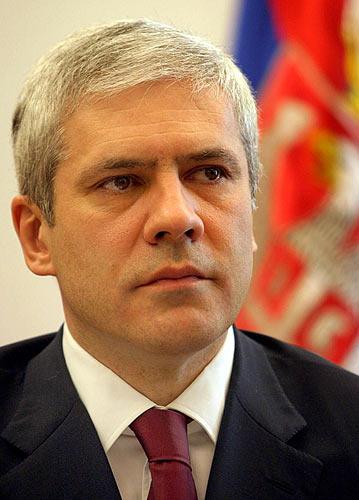
Recently elected Serbian President, Boris Tadić, has responded to yesterday evening’s violence in Belgrade, which involved the torching of the US Embassy by an unruly mob numbering hundreds.  The mob was but a tiny minority of the crowd of hundreds of thousands, which had gathered earlier in the day to peacefully protest Kosovo’s declaration of independence on Monday of this week.  Tadić, a the leader of the moderate Democratic Party in Serbia, had this to say about the events:

tadic.jpg Tadić, who was in Romania Thursday, today said he has “asked all relevant institutions for reports on yesterday’s unrest in Belgrade”.
For the same reason, he was called a session of the Council for National Security…

…Tadić is also strongly condemning the violence, looting and burning, that ended in one death and nearly 200 injured, as well as huge material damage to the city.

“There is no justification for violence, no one must dare to justify it with a single word,” his press service said in a statement…

…Tadić went on to say that “this is not Serbia and Serbia will never be like this”.

“The state must have law and order and such violence must never happen again, anywhere,” Tadić said.

Turkish Military in Northern Iraq

While Iraq still maintains legal sovereignty over the majority Kurdish areas in the north of the country, the Kurds in that region have been enjoying de facto autonomy/independence since the end of the first Gulf War in 1991.  A direct result of United Nations Security Council resolutions mandating, above all else, the establishment of a no-fly zone in northern Iraq, Saddam Hussein’s regime had no presence there from 1991 on.  The ouster of Saddam’s regime has only made Kurdish control of the territory more secure.  It’s not inconceivable that a Kosovo-type situation could obtain here as well.   A crucial difference in the Kurdish situation is the presence of a large group of ethnic Kurds living in neighboring Turkey, who have waged a sporadic, decades-long campaign (using various tactics, including terrorism) to pressure the Turkish government into granting the Kurds more autonomy, if not outright independence.  The situation has become even more serious, as this report from the New York Times illustrates:

ISTANBUL — Turkey’s military said on Friday that it had sent ground troops into northern Iraq on Thursday night, in an operation aimed at weakening Kurdish militants there, but it was unclear how many or how long they would stay.

The Turkish General Staff, in an announcement on its Web site, gave no details on the size of the incursion. An American military spokesman in Baghdad said the ground offensive would be of “limited duration.”

The Turkish offensive appears to be aimed at dealing a surprise blow to the Kurdish militants, the Kurdistan Workers’ Party, before the snow along the mountainous border between the two countries melts and the guerrillas make their traditional spring advance into Turkey.

The militants, known as the P.K.K., want greater autonomy for Turkey’s Kurdish minority and have fought the Turkish military for decades. Some of their hide-outs are in Turkey, but some are in northern Iraq, and the rebels have crossed the border into Turkey repeatedly to attack.

It was not clear what role the United States had played in the incursion. But the operation sets two of its closest allies in a troubled region against each other. Turkey is a NATO member that borders Iran, Iraq and Syria; the Iraqi Kurds, who control northern Iraq, are the most important American partners in the Iraq war.

The United States has been wary of Turkish efforts to stamp out the Kurdish militants, with Turkish officials chafing at what they view as a double-standard, escalation tension between the NATO allies.

Human Trafficking–Katia’s Story

A confluence of events–globalization, technological and communications advances, and halting (or no) democratization–has led to an unprecedented rise in global human trafficking. States and governments have been unable to make a dent in this growing trade, where human beings are sold like cattle to be used as indentured servants and sex slaves. Here is a documentary about one such person, Katia from Ukraine, whose husband’s friend kidnapped and sold her in Turkey, whence she was moved to western Europe where she was forced into prostitution. (The documentary is in five parts. Here is part one.)

Samuel Huntington of “Clash of Civilizations” fame, Interviewed

Charlie Rose interviews Huntington on the ideas in his oft-cited and even more criticized “Clash of Civilizations” thesis. Rose calls the clash thesis “provocative.”  What do you think about the logic of the clash thesis.  Given that you’ve read Amartya Sen’s response to Huntington, what kinds of questions would you have asked Huntington that Rose failed to?  (The Huntington interview runs from 1:55 until about 21:00.  No, Professor Huntington is not a dead-ringer for John Cleese.  That is, in fact, John Cleese, who is interviewed in the middle segment; hence, the screen shot of Cleese.)

Serb Demonstrators Attack US and Croatian Embassies in Belgrade

The Washington Post reports that following a massive (upwards of 150,000 participants) and peaceful demonstration in the Serbian capital of Belgrade, with the theme “Kosovo is Serbia”, a group numbering a few thousand at most has attacked the US and (neighboring) Croatian embassies, setting the US embassy on fire. The demonstrations were held in the aftermath of Albanian Kosovars’ official declaration of independence on Monday. The US is one of many countries to have officially recognized Kosovo as the newest ex-Yugoslav independent state, setting off a public and official outcry on the part of Serbs, for whom Kosovo is the historical birthplace of their nation.

Politicians in Belgrade are caught between their rhetoric to do what it takes (short of violence) to prevent Kosovo from achieving full-fledged independence and the lack of many good non-violent options to do so, given the Serb leadership’s openly declared goal of one day joining the European Union. One possibility would be to energize (or otherwise entice) the Serbs in neighboring Bosnia and Herzegovina to agitate for higher levels of autonomy, or outright independence, stressing the similarities of the situations. This would certainly raise the ire of European leaders and would not earn the Serbs any bonus points in their quest for further integration into European political and economic institutions.

Here is footage from the Belgrade independent media outlet B92:

From the “About Video” (translated by me): Beograd — Stotine nasilnih demonstranata nakon završetka mitinga napalo američku i hrvatsku ambasadu. U 19:13 intervenisala policija.

“Upon the conclusion of the [official] demonstration, undreds of violent demonstrators attacked the American and Croatian embassies. The police intervened at 7:13 pm.”

You can find a gallery of photographs from the day in Belgrade at B92’s website here.

Playing the Dominant Strategy in a Prisoner’s Dilemma Situation

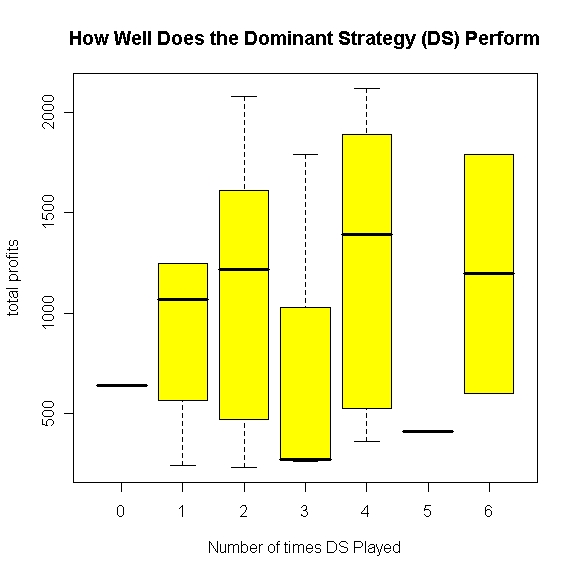
As you’ll see in lecture tomorrow, instrumentally rational players will also choose to “defect” in a priosoner’s dilemma type situation even though they could be much better off absolutely if they and their opponents could learn to cooperate.  The chart below has been created using data from the simulation of yesterday.  What is take-home message from the chart?  Why is the relationship between the phenomena displayed not completely linear?  Think about the nature (i.e., the specific rules) of the oil game we played yesterday. (The plot below is a box plot, which is a way of summarizing the means, range, and certain percentiles of the values of a single variable based on another variable.)

oil_game_dominant_strategy.jpeg

Results from a Prisoner’s Dilemma Simulation–The Oil Game

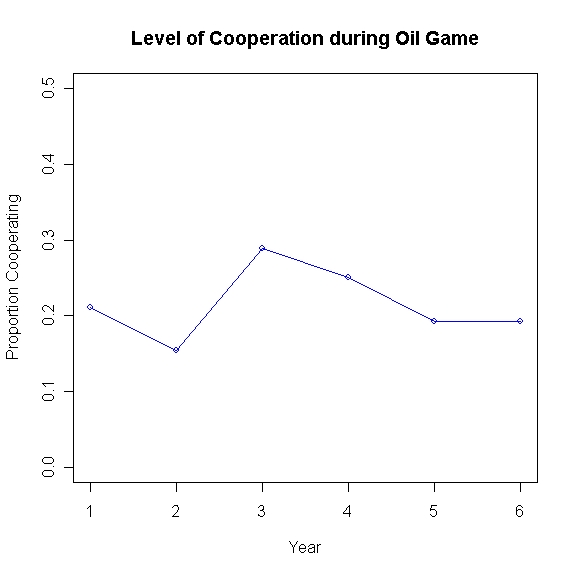
Today in class, you competed in groups to maximize total profits in a simulation called “the Oil Game.” You represented one of two competing oil producers–Iraz and Sabia–trying to maximize profits selling oil to a net importer of oil–ESYUVI (the names were created using a random letter-generator–I swear!). Most of you recognized very quickly, if not immediately, that the simulation was a modified Prisoner’s Dilemma situation. As I’ll discuss on Friday, in a Prisoner’s Dilemma situation, players acting in an instrumentally rational manner will always choose not to cooperate (i.e., “defect”), because it is a dominant strategy. What makes the situation a dilemma is that the players could do much better were they able to cooperate and trust one another.

oil_game_results.jpeg

The compelling logic of the prisoner’s dilemma, along with some strong empirical evidence, is used by realists to support their arguments regarding the nature of interaction in the international world. Liberals, on the other hand, argue that there is much more cooperation in the world than realists would predict. Thus, despite the structure of the prisoner’s dilemma, players are able to cooperate in international politics. What factors do you think make cooperation more likely? Less likely? Why?

The results from our simulation today are in graphical form above. You’ll note that communication was not allowed for Years 1, 2, and 4; communication was allowed for Year 3, and communication (to decide what to do for Years 5 and 6) was allowed prior to Year 5. The results from this class are consistent with the expectations. I would note the relatively low level of cooperation throughout, rising only initially after the first episode of communication.

A Good Resource for Information on “Eurasia”

eurasianet.jpg

Eurasianet.org has a very informative website that offers news from Eurasia. Here is a snippet from their about page (when you find a source online always read their “about” or “description” page to get an idea of what the organization is, if they have any political biases, etc.):

EurasiaNet provides information and analysis about political, economic, environmental and social developments in the countries of Central Asia and the Caucasus, as well as in Russia, the Middle East, and Southwest Asia. The web site also offers additional features, including newsmaker interviews and book reviews.

Based in New York, EurasiaNet advocates open and informed discussion of issues that concern countries in the region. The web site presents a variety of perspectives on contemporary developments, utilizing a network of correspondents based both in the West and in the region. The aim of EurasiaNet is to promote informed decision making among policy makers, as well as broadening interest in the region among the general public.

EurasiaNet is operated by the Central Eurasia Project of the Open Society Institute.

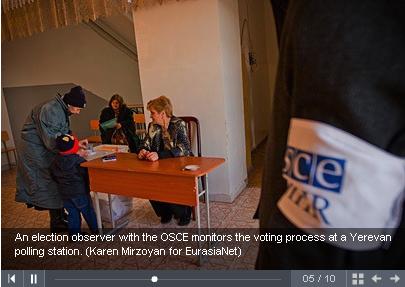
Today, they report on contested presidential elections in Armenia, where opposition supporters claim fraud has taken place while supporters of current Prime Minister (and declared winner) Serzh Sarkisian believe that their candidate has won with more than 50% of the vote, obviating the need for a run-off election (in many electoral systems, for a candidate to be declared the official winner, s/he must have received a majority (i.e., 50%) of votes cast. If no candidate passes that threshold, a run-off election is held where the two leaders go head-to-head.) You can read the Washington Post’s report here, with a snippet below:

armenia_elections.jpgYEREVAN, Armenia — Thousands of opposition supporters marched through Armenia’s capital Wednesday after an election official said complete results showed that the prime minister had won the presidential election.

Allegations of fraud and threats of mass protests have raised concerns about the stability of the volatile, strategic country, located at the juncture of the energy-rich Caspian Sea region and southern Europe and bordering Iran.

An initial count of the ballots showed Prime Minister Serge Sarkisian had nearly 53 percent of the vote in Tuesday’s election, Central Election Commission chief Garegin Azarian said _ enough to win outright and avoid a runoff. Top opposition candidate Levon Ter-Petrosian had 21.5 percent, Azarian said.

Ter-Petrosian’s backers have alleged widespread fraud, and a crowd gathered in central Yerevan to protest the results, swelling to some 20,000 as riot police with truncheons guarded the election commission building a five-minute walk away.

The protesters then marched to the government headquarters in a broad central square, many shouting “Levon!” and raising a clenched fist _ Ter-Petrosian’s campaign symbol. Helmeted police blocked the building, and the protesters moved on, marching toward the election commission building.

I have no doubt that the authorities have falsified the election and I will protest with all those who also feel cheated,” Simon Grigorian, a 38-year-old engineer, said at the protest.

Design a site like this with WordPress.com
Get started