The face of Statelessness–Canadian Style

Last week I asked if all the world’s residents have citizenship. We discovered that the answer is `no’ and that there are approximately 15 million  stateless persons worldwide.  On the way to work this morning, I was listening to the CBC program The Current, which reported on the peculiar story of a young girl living in Belgium, whose father is a Canadian citizen, but who is currently not a citizen of any country. She does not fulfill the requirements of Belgian citizenship (which does not have universal jus soli citizenship rules), and as of last year falls through a loophole in Canadian citizenship law as of changes in the law that were enacted last year.

From the program:

Citizens of Nowhere – Ian Goldring

Chloe Goldring is 15 months old. She lives in Brussels, Belgium. And she has no citizenship. She is officially stateless. She has ended up in this situation because of a change made to the Canadian Citizenship Act in April of 2009.

Since then Canadians who were born abroad, in this case her father, are no longer able to pass on Canadian citizenship to their children, unless those children are born in Canada. The change was brought in to target parents born outside Canada who come here, obtain citizenship, and then return to their country of origin and pass along Canadian citizenship to children who may never have any intention of coming to Canada.

You may remember this became an issue in the summer of 2006 when there was a public outcry over Canada’s move to rescue Lebanese Canadians during the Israeli bombardment of Lebanon that summer. Well that is the change that Chloe Goldring has been swept up in.

Chloe’s father Ian Goldring is a Canadian who lives in Brussels.

Citizenship and Statelessness

Do all persons have citizenship?

No. It has been estimated that there are currently about 15 million stateless persons worldwide. From the Nubian people of Kenya to residents of the Dominican Republic of Haitian descent, statelessness is a global phenomenon affecting the health, economic well-being, and human security of the individuals, families, and groups involved.

The Open Society Justice Initiative has produced a series of documentaries on the issue, the introduction to which can be viewed below. From the description:

Although some stateless people are refugees, many have never crossed a border or left their country of birth. Although the problems related to statelessness may manifest themselves differently, at the root is a group of people who have been denied a legal identity.

A stateless person is not recognized as a citizen by any state. Citizenship enables you not only to vote, hold public office, and exit and enter a country freely, but also to obtain housing, health care, employment, and education. Citizenship is necessary in order to live a decent human life. Stateless people are denied that right.

For more information, visit http://www.soros.org/stateless

Does Africa Need a New Map?

In a recent article in Foreign Policy magazine, G. Pascal Zachary argues that it’s time to redraw Africa’s political borders, which are “unnatural” and a legacy of 19th and 20th-century colonialism. As is well-known the newly independent states that comprised the Organisation for African Unity met in 1964 and agreed that the extant international borders in Africa were sacrosanct, believing that this would best guarantee stability on the continent. It worked, to a degree. While there have certainly been very few international (i.e. inter-state) wars in Africa in the intervening 45 years, the continent has been ravaged by intra-state (i.e., internal, or “civil”) wars during the same period. What are the potential benefits of redrawing Africa’s borders to make them more coterminous with ethnic boundaries (as has been done recently in, amongst other places, the Balkans and the former Soviet Union)? Zachary’s claim:

Borders created through some combination of ignorance and malice are today one of the continent’s major barriers to building strong, competent states. No initiative would do more for happiness, stability, and economic growth in Africa today than an energetic and enlightened redrawing of these harmful lines.

How important is for for state strength and stability for ethnic and political border to be coterminous? The redrawing of borders–and it is obvious that the mechanism would be military force–would almost certainly lead to tremendous suffering and bloodshed, with competing campaigns of ethnic cleansing. But, as Zachary notes, since the start of the post-colonial era millions of Africans have died in internal conflicts, and:

Rethinking the borders could go far to quelling some of these conflicts. Countries could finally be framed around the de facto geography of ethnic groups. The new states could use their local languages rather than favoring another ethnicity’s or colonial power’s tongue. Rebel secessionist movements would all but disappear, and democracy could flourish more easily when based upon policies, rather than simple identity politics. On top of that, new states based on ethnic lines would by default be smaller, more compact, and more manageable for governments on a continent with a history of state weakness.

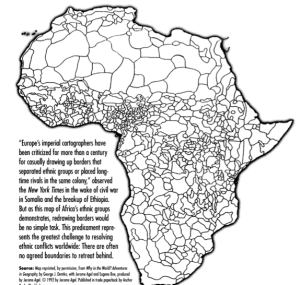
Assuming that the political will to achieve this goal were to evolve, what would be the best mechanism? What would Herbst’s argument be? Is this even feasible? Where would one draw the new boundaries? How would one define an ethnic group? Refer to these two maps to get a sense of the near impossibility of the task at hand. While there are about 50-odd states in Africa, there are literally hundreds of geographically-concentrated ethnic groups. In addition, there is a tremendous amount of inter-mingling of ethnic groups as well.


Failed States and the Fund for Peace’s Failed States Index 2010

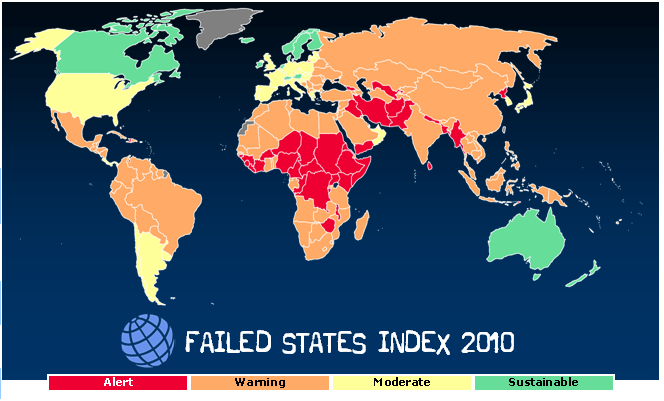
On Thursday, September 23rd we will begin to analyse the exceptionally important concept–the state. It will become strikingly obvious that a strong state is a necessary–but not sufficient–condition for political stability, political and personal liberty, democracy, and economic well-being. Conversely, citizens living in weak, failing, or failed states face lives of economic destitution, personal insecurity (think of Hobbes’ state of nature, where life is nasty, brutish, and short), and lack of basic rights and freedoms. The Fund for Peace publishes an annual index of failed and failing states. A quick look at the results over the last decade or so finds that the same dozen or so states are continually at the top of the list of failed/failing states. Here is a map depicting the results of the most recent index:

Notice the geographical concentration of failed states (in red). Why are the vast majority of the world’s failed states found in central Africa and southwest Asia?

What are the characteristics of failed states that distinguish them from more stable states? Maybe this video of life in Somalia will provide some clues:

Citizenship, Jus Soli, and “Anchor Babies”

As we learned in Chapter 3 of O’Neil, there are two (main) types of citizenship (remember that citizenship describes the nature of one’s relationship to the state): jus sanguinis and jus soli.  Like many states, the United States of America grants citizenship to individuals on the basis of both (and also on the basis of naturalization).  The principle of jus soli gives persons citizenship status on the basis of being born on territory that the state formally controls.  

The legitimacy, efficacy of jus soli has increasingly become questioned in some political circles in the United States (and in other countries that grant citizenship on that basis.  Watch the clip below on the “anchor baby” phenomenon between U.S. Representative Virgil Goode (R-VA) and his challenger:

Would you pass the U.S. Citizenship Test?

Were you not born in this country and had to take the citizenship test, would you pass?  Remember that citizenship is a concept that defines one’s relationship to the state.  There are essentially three types of citizenship–jus sanguinis, jus soli, and naturalization.  Craig Ferguson is now a naturalized US citizen.  On what basis did you receive your US citizenship?  Were you born on U.S. soil?  Were you born outside of the United States, but (at least) one of your parents was a US citizen at the time?

Political Ideology/Attitudes and Happiness

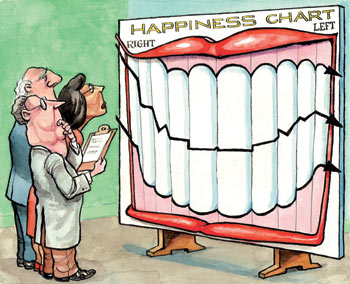
Are individuals of a certain political attitude orientation more likely to be happy than those with competing political attitudes?  The short answer, in the United States at least, may be yes; moreover, self-defined conservatives seem to be much happier (or at least claim they are) than are liberals, and extremists of either group are happier than moderates.  From the Economist:

economist_happiness.jpgIn 2004 Americans who called themselves “conservative” or “very conservative” were nearly twice as likely to tell pollsters they were “very happy” as those who considered themselves “liberal” or “very liberal” (44% versus 25%). One might think this was because liberals were made wretched by George Bush. But the data show that American conservatives have been consistently happier than liberals for at least 35 years.

This is not because they are richer; they are not. Mr Brooks thinks three factors are important. Conservatives are twice as likely as liberals to be married and twice as likely to attend church every week. Married, religious people are more likely than secular singles to be happy. They are also more likely to have children, which makes Mr Brooks confident that the next generation will be at least as happy as the current one.

When religious and political differences are combined, the results are striking. Secular liberals are as likely to say they are “not too happy” as to say they are very happy (22% to 22%). Religious conservatives are ten times more likely to report being very happy than not too happy (50% to 5%). Religious liberals are about as happy as secular conservatives.

Why should this be so? Mr Brooks proposes that whatever their respective merits, the conservative world view is more conducive to happiness than the liberal one (in the American sense of both words). American conservatives tend to believe that if you work hard and play by the rules, you can succeed. This makes them more optimistic than liberals, more likely to feel in control of their lives and therefore happier. American liberals, at their most pessimistic, stress the injustice of the economic system, the crushing impersonal forces that keep the little guy down and what David Mamet, a playwright, recently summed up as the belief that “everything is always wrong”. Emphasising victimhood was noble during the 1950s and 1960s, says Mr Brooks. By overturning Jim Crow laws, liberals gave the victims of foul injustice greater control over their lives. But in as much as the American left is now a coalition of groups that define themselves as the victims of social and economic forces, and in as much as its leaders encourage people to feel helpless and aggrieved, he thinks they make America a glummer place.

SKY News Report on Situation in Tibet

Here is an interesting video, which captures the events surrounding an organized (by the Chinese authorities) visit of non-Chinese journalists to the capital city of Tibet, Lhasa.  It seems as though events conspired against the Chinese authorities just a little bit:

Ethnic Conflict and Strife

A couple of days ago all blog posts seemed to be related to the theme “the social logic of politics”. Today, there seems to be a surge in episodes of inter-ethnic conflict worldwide. First, we learn from the Washington Post, that there is unrest and violence in the Tibetan capital of Lhasa, where a week of increasing confrontations between native Tibetans and the Chinese government have turned violent, with native Tibetans battling with Chinese police and troops and also attacking ethnic Han Chinese, which is either unprecedented or extremely rare.

BEIJING, March 14 — A week of tense confrontations over Chinese rule in Tibet erupted in violence Friday, as hundreds of protesters clashed with police and set fire to shops in the center of Lhasa. Doctors reported dozens of wounded streaming into area hospitals, and one witness said the downtown area was “in a state of siege.”

The rare breakout of violence, the worst in 20 years in the capital city of a remote mountainous region that is the heart of Tibetan Buddhism, posed a challenge to the Chinese government as it prepares to host the 2008 Olympic Games in August. Seeking to make the Games a worldwide celebration of its swift economic progress during the past three decades, the Chinese government has steadfastly attempted to project an image of harmony and stability, even while tightening its grip over the restive region.

“This spiraling unrest has triggered the scenario the Chinese prayed would not happen,” said Robbie Barnett, director of modern Tibetan studies at Columbia University. “Now we’re just watching the clock tick until people get off the street or the Chinese open fire.”

In a different part of the world, Malaysia, in which once again ethnic Chinese are involved, the New York Times reports on post-electoral tension on the island of Penang:

PENANG, Malaysia — Chanting “Long Live the Malays!” several hundred members of Malaysia’s largest ethnic group gathered Friday on this largely Chinese island, defying a police ban on protests and raising communal tensions after sharp electoral losses by the country’s governing party.

Newly elected state governments have moved rapidly to abolish some of the long-held privileges of ethnic Malays. Those efforts have challenged the core of Malaysia’s ethnic-based political system and inflamed the sensibilities of Malays. Until the March 8 elections, Malays thoroughly dominated politics through the country’s largest party, the United Malays National Organization, known by its initials, U.M.N.O.

The opposition parties that beat U.M.N.O. and its partners in five states say affirmative action should be based on need rather than ethnicity. But the opposition, too, is struggling to contain fissures along ethnic lines as a Chinese opposition party competes with its Malay counterpart.

“We’re living in very sensitive times,” said Tricia Yeoh, director of the Center for Public Policy Studies, an independent research center in Kuala Lumpur, the capital.

The affirmative action program favoring the Malays has been in place for more than three and a half decades and gives Malays everything from discounts on new houses to 30 percent quotas in initial public offerings of companies. It is known as the New Economic Policy.

Finally, in Iraq, where in the last four years the minority Christian community has been decimated, either through targeted killings or ethnic cleansing, we hear news of the killing of a prominent Catholic Bishop:
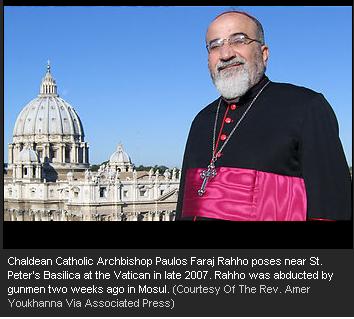
bishop_rahro.jpg BAGHDAD, March 13 — The body of a senior Christian cleric was found Thursday in the northern city of Mosul, two weeks after gunmen abducted him there and killed three of his associates.

The death of Paulos Faraj Rahho, 65, archbishop of Mosul’s Chaldean community, prompted expressions of remorse and condemnation from the Iraqi government and Christian leaders.

Pope Benedict XVI, in a message to the Chaldean patriarch in Iraq, called the killing an “act of inhuman violence that offends the dignity of the human person and seriously harms the cause of fraternal coexistence among the beloved Iraqi people.”

Iraqi Prime Minister Nouri al-Maliki said it was a crime of “aggression aimed at inciting sedition among” Iraqis.


How do you Prove You’re a Jew?

Gershon Gorenberg has written a new article in the New York Times Sunday Magazine
on the difficulties some Israeli Jews are having proving their Jewishness before rabbinic courts in that country.  The article is interesting and touches upon many of the issues we discussed in intro to comparative that deal with concepts of identity–nationhood, ethnicity, citizenship, etc.  In fact, I think I’ll be including this article in the syllabus during future iterations of this course.  In addition, I did not know that there is no civil marriage ceremony (marriage ceremonies are purely a religious affair in Israel) in Israeli law, but upon further reflection, I probably should have guessed that would be the case.

The story is particularly significant for American Jews, to which the accompanying snippets below attest:

02jewish1-500.jpgOne day last fall, a young Israeli woman named Sharon went with her fiancé to the Tel Aviv Rabbinate to register to marry. They are not religious, but there is no civil marriage in Israel. The rabbinate, a government bureaucracy, has a monopoly on tying the knot between Jews. The last thing Sharon expected to be told that morning was that she would have to prove — before a rabbinic court, no less — that she was Jewish. It made as much sense as someone doubting she was Sharon, telling her that the name written in her blue government-issue ID card was irrelevant, asking her to prove that she was she…

…In recent years, the state’s Chief Rabbinate and its branches in each Israeli city have adopted an institutional attitude of skepticism toward the Jewish identity of those who enter its doors. And the type of proof that the rabbinate prefers is peculiarly unsuited to Jewish life in the United States. The Israeli government seeks the political and financial support of American Jewry. It welcomes American Jewish immigrants. Yet the rabbinate, one arm of the state, increasingly treats American Jews as doubtful cases: not Jewish until proved so.

More than any other issue, the question of Who is a Jew? has repeatedly roiled relations between Israel and American Jewry. Psychologically, it is an argument over who belongs to the family. In the past, the casus belli was conversion: Would the Law of Return, which grants automatic citizenship to any Jew coming to Israel, apply to those converted to Judaism by non-Orthodox rabbis? Now, as Sharon’s experience indicates, the status of Jews by birth is in question. Equally important, the dividing line is no longer between Orthodox and non-Orthodox. The rabbinate’s handling of the issue has placed it on one side of an ideological fissure within Orthodox Judaism itself, between those concerned with making sure no stranger enters the gates and those who fear leaving sisters and brothers outside.

The story reminds me of a friend of mine who–of Croatian parentage but born in Canada– upon her arrival in Croatia (she had decided to move there during the middle of the war in the 1990s) had gone to the local police station with the aim of registering her presence (at that time, all foreigners were required to report to police within 24 hours of their arrival).  When she took out her Canadian passport, a clerk at the Ministry of Internal Affairs asked her the names of her parents.  After my friend responded, the clerk refused to allow her to register as a foreigner and insisted that she take out Croatian citizenship on the spot.  When my friend insisted that she was a Canadian citizen, the clerk responded “your father is ours, your mother is ours, that makes you  one of us also.”


Design a site like this with WordPress.com
Get started