India–an “exceptional” Country with Democratic Deficit

In comparative politics, there are two countries that are truly exceptional–the USA and India.  By “exceptional”, I mean just that; they are both exceptions to general rules that have solid support, empirically and theoretically.  For example, when looking cross-nationally there is a strong negative relationship between religiosity and economic development.  That is, the richer a country, the less religious (ceteris paribus) are its residents.  Except for the United States.  The USA is exceptional in many regards; i.e., it doesn’t behave like all other advanced industrial democracies.

India is also exceptional, but in different ways from the US.  For example, there is strong support for hypotheses about democracy and social (ethnic/religious) heteroeneity, which suggest that there is no way that India should still be (after more than 60 years) a fairly well functioning democracy.  Many observers keep waiting for the other shoe to drop as India’s democracy has lurched from crisis-to-crisis, and has to contend with endemic levels of corruption, particularly in its judiciary (as we see in this excerpted report–written by the Asian Human Rights Commission and which I found at the Human Security Gateway, a great source for information about security issues in world politics).  Somehow, though, India’s democracy hangs on.

By recommending the impeachment of a High Court judge, the Chief Justice of India has revived a dead debate concerning the Indian judiciary. On August 2, 2008 in a letter addressed to the Prime Minister, the Chief Justice recommended the impeachment of judge Soumitra Sen of Calcutta High Court. Judge Sen is accused of having been involved in financial misappropriation before he was appointed as a judge. It is reported that in 1984 while judge Sen was practising as a lawyer he was appointed as the receiver in a dispute concerning the Steel Authority of India. It is alleged that in the capacity of the receiver he misappropriated a sum of INR 2,500,000 [USD 59523], which judge Sen reportedly paid back on orders from the court. Later, he was appointed a judge at the Calcutta High Court in 2003. A judge accused of corruption facing impeachment, a process by which a sitting judge could be removed from service in India, is nothing special. A corrupt public servant is not worthy of continuing in service and is least desirable to serve as a judge in a court of law, a public office that demands scrupulous impartiality and untainted personality. Anyone accused of a crime must be prosecuted and the crime investigated into. The fact that the accused is a judge must not provide the person with any immunity. Judge Sen being the first person recommended for impeachment by a Chief Justice of India does not mean that the judiciary is immune from corruption and other vicious practices. There are similar allegations against some judges in India. But not a single judicial officer was impeached so far. The only exception was the case of judge V. Ramaswami who faced impeachment in 1991, an attempt that failed due to the absence of a political consensus. It is expected that history will not be repeated. If it is repeated it would be a shame upon the Indian judiciary and its accountability. The accountability of judges, particularly in the context of increasing allegations of malpractices resorted to by judges is a grave concern in India. As of now there is no open process for the selection, promotion and if required the dismissal of High Court or Supreme Court judges in the country. The entire process is retained within the whims of the Supreme Court. All attempts so far to enforce accountability on the judiciary were vetoed by the judiciary itself. There is also the absence of a political consensus over this issue.

Is there a causal link between Natural Resources and Conflict?

The “resource curse” is the name given to the alleged causal links between a country’s abundance of natural resourcee and the existence of all sorts of “bad things”, such as authoritarianism, economic stagnation and/or outright economic decline, increased probability of attempted coups d’etat, etc.  In our session on political economy we read Jensen and Wantchekon’s article on the link between natural resource wealth and authoritarianism, specifically, and we also looked at Richard Snyder’s article on the putative link between the existence of what he calls “lootable wealth” and political (in)stability in a state.  Their conclusions were at times complementary but at times divergent.  What matters (at least for political stability), according to Snyder, is the ability of the rulers (i.e., the government) to partake of the rents/riches accrued by the exploitation of the particular “lootable” resource.

Snyder’s is, of course, not the final word on the topic and there is an avalanche of published research on this very topic.  A new resource that can be used to find data on the link between natural resources and conflict–political, civil, etc.–is the Resource Conflcit Monitor, maintained by the Bonn International Center for Conversion.  From their web site:

Many developing countries rich in natural resources, such as diamonds and oil, have been plagued by poverty, environmental degradation and violent conflicts. In many of these countries, the natural wealth has not led to sustainable development. On the contrary, in some instances resource wealth has provided the funding and reasons for sustaining civil wars. This so-called ‘resource curse’ brought a lot of attention to the link between resources and conflict over the past decade. ’Governance’ has been identified as key factor for understanding the resource-conflict dynamic and for mitigating its negative impact in developing countries. ‘Resource governance’ in the present context describes the way in which governments regulate and manage the use of natural resources as well as the redistribution of costs and revenues deriving from those resources

The Resource Conflict Monitor (RCM) monitors how resource-rich countries manage, administer and govern their natural resources and illustrates the impact of the quality of resource governance on the onset, intensity and duration of violent conflict. The RCM serves as a tool for identifying and supporting viable resource governance and contributes to conflict prevention, post-conflict reconstruction and sustainable development….

There is an informative, and user-friendly, application that provides historical annual information on conflict and resources in individual countries.  Here is the result for Sierra Leone, the specifics of which should be familiar to those of you who watched Cry Freetown.  For an explanation of “resource governance” and “resource regime compliance, go here and scroll down.

There’s an additional methodological point that is crying out to be made here.  Notice that the level of conflict intensity first decreases rather significantly between 1996 and 1997, then increases dramatically between 1997-1999, to then fall just as dramatically between 2000 and 2002, while at the same time “resource governance” and “resource regime compliance” do not change much at all.  This means that we have to be very careful about attributing the level of conflict to the two afore-mentioned phenomena.  Maybe the causal link between these two and conflict intensity is not monotonic, maybe there is a threshold effect at work, or maybe the existence of an abundance of natural resources is a sufficient (under certain conditions) cause of conflict intensity.  On the whole, though, there certainlly doesn’t seem to be a clear linear, and/or monotonic relationship between resources and conflict (at least in Sierra Leone,  between 1996-2006)

The State and Democratization

The Polity IV data set code book, has a section entitled Indicators of Democracy and Autocracy (Composite Indicators), the authors write about the development of the state and the evolution of political participation as a corollary.  If you read it in tandem with this post on Max Weber’s view of the state and state legitimacy, you’ll begin to understand the nature of the state and why it has become the dominant contemporary form of political organization.

Three broad processes have reshaped the global landscape of state structures during the last two centuries One is an extraordinary expansion in the absolute and relative power of the state, a process that began i Europe. The new states created by the American and French revolutions marked the threshold between political world dominated by monarchies, whose claims to absolutism were belied by the fact that most social and economic life was autonomous from state control or extraction, and a political world in which state power was based on ever-widening control and mobilization of human and material resources exchange for broadened rights of popular participation. An integral part of this process was the development of bureaucracies with high capacities to regulate, tax, and mobilize people in the service of state policy. 

The second process was the transformation of the structures of political participation and legitimation. This transformation followed one of two paths, toward plural democracy or mass-party autocracy. The popular side of the bargain by which most West European rulers built state power in the nineteenth century was to acknowledge the right of widespread participation in policy making.  That right was given institutional expression in elected assemblies which could review, and sometimes initiate, public policy; in elections direct or indirect, of chief ministers; and in recognition of citizens’ rights to voice and act on political opinions. The concept of bargain is a metaphor for sequences of political crises and reforms in which these rulers granted rights for participation, however limited, to all significant social classes and groups, while simultaneously extending the state’s right and capacity to regulate, tax, and mobilize the human and material bases of state power. 

The process of political democratization had its own logic and dynamic which, in most of Western Europe, eroded all but a few symbolic vestiges of traditional autocracy (see for example Bendix 1978). Nonetheless, pressures to extend democratization have always contended with the self-interested desire of rulers to preserve and enhance their autonomy from political constraints. Theempires of Central and Eastern Europe–Germany, Russia, Austro-Hungary–implemented thetrappings but not the substance of effective democratic participation in the late nineteenth and early

Israel and Syria once again Negotiating over Golan Heights

In intro to IR on Wednesday we addressed global environmental issues and we went over this chart outlining Thomas Homer-Dixon’s overview regarding the link between environmental scarcity and security. According to Homer-Dixon, environmental degradation is not only an important economic, social, and health issue, it is crucially an issue of importance for global security.

We see the important link between increased environmental scarcity and social effects (like ethnic conflicts, deprivation conflicts and coups d’etat), facilitated indirectly at times by the conditions of weakened states.

Homer-Dixon argues that these environmentally-driven conflicts will increase the more the environment degrades. Moreover, it is just those places in the world that have the least capacity to deal with the potentially negative effects of environmental degradation whose environments will be most likely to suffer.

In the far left column is “unequal resource access”. One of the most important resources to humankind is water. The conflict between Syria and Israel over the Golan Heights is crucially linked to water. As we learn from the New York Times:

JERUSALEM — Peace overtures between Israel and Syria moved up a gear on Wednesday when a Syrian cabinet minister said that Prime Minister Ehud Olmert of Israel had sent a message to President Bashar al-Assad to the effect that Israel would be willing to withdraw from all the Golan Heights in return for peace with Syria.

The Syrian expatriate affairs minister, Buthaina Shaaban, told Al Jazeera television, “Olmert is ready for peace with Syria on the grounds of international conditions; on the grounds of the return of the Golan Heights in full to Syria.” She said that Turkey had conveyed the message.

Israeli officials did not deny the statement from Damascus but would not confirm it either, offering a more general, positive reaction. “Israel wants peace with Syria; we are interested in a negotiated process,” said Mark Regev, a spokesman for Mr. Olmert. “The Syrians know well our expectations, and we know well their expectations…”

“…Withdrawal from the Golan Heights is a contentious issue in Israel. The territory is a strategic plateau that overlooks a large swath of northern Israel. Israel has objected to past Syrian demands for access to the shore of the Sea of Galilee, a main water source for Israel.

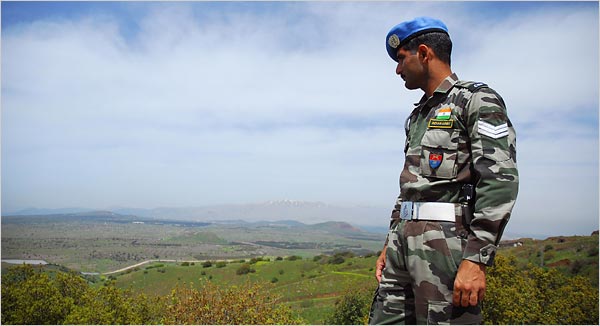
Yehuda Raizner/Agence France-Presse — Getty Images

An Indian member of the United Nations force in the Golan Heights, a strategic

plateau that overlooks a swath of northern Israel.

Barack Obama on the Financial System, Uncertainty and Risk

In my post below, I linked to an article by Thomas Homer-Dixon in which, among other things, he argued that the problem with the contemporary financial system is that the arcane machinations and lack of transparency (Level-III assets, anyone?)  have transformed the market from one of risk–which can form the basis for a stable financial system–to uncertainty–which cannot.  So the question then, is how to create the conditions under which banks and other financial institutions, and investors can adequately assess risk.  The lack of transparency is the reason that the credit markets have currently seized up and the Federal Reserve has had to come to the rescue of Bear Stearns. (Ben Bernanke–the Chairman of the Federal Reserve–himself has argued that “banks will fail” over the next couple of years.  Indeed, a couple of small regional American banks have already failed.)

By coincidence, Democratic Presidential candidate Barack Obama gave a speech at Cooper Union in New York setting out his vision of how his policies would help the engine  of the American (and international) financial system become more transparent and a solid foundation for the US and world economy.  I encourage you to watch the speech, wherein Obama presents his view of the nature of the relationship between the market and state (government).

“It’s worth taking a moment to reflect on the role that the market has played in the development of the American story.  The great task before our founders was putting into practice the ideal that government could simultaneously serve liberty and advance the common good.  For Alexander Hamilton, the young Secretary of the Treasury, that task was bound to the vigor of the American economy.  Hamilton had a strong belief in the power of the market, but he balanced that belief with the conviction that human enterprise, ‘may be beneficially stimulated by prudent aids and encouragements on the part of the government [state]'”

Resource Dependent Regimes in Sub-Saharan Africa

Jensen and Wantchekon (2000) have created an index of resource dependence and determined the level of the same for the states of sub-Sarahan Africa.  The scores range from 1 (no resource dependence) to 4 (extreme resource dependence).  They use this as an important independent variable in determining democratic transition, consolidation, and government effectiveness.  How much of an effect does resource dependence have on each of these dependent variables?  You’ll have to read the paper to find out, or attend my class in intro to comparative tomorrow.

resource_dependence_scores.jpg

Kenyan Leaders Sign Peace Agreement

Kenya’s political leaders have finally reached an agreement that Kenyans hope will signal the end of the recent instability and inter-ethnic bloodshed, which resulted from disputed elections in late December of last year. The New York Times reports that the structure of the political system in Kenya has been altered as a result of an agreement between President Mwai Kibaki and opposition leader Raila Odinga:

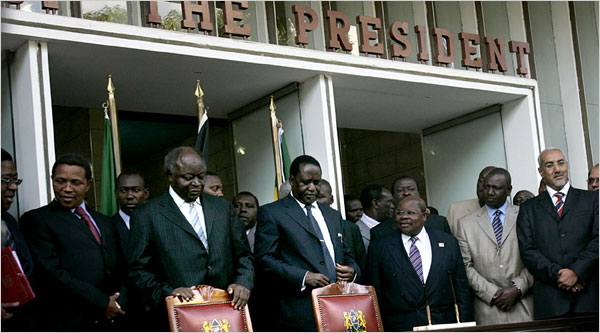
29kenya-span-600.jpgNAIROBI, Kenya — Kenya’s rival leaders broke their tense standoff on Thursday, agreeing to share power in a deal that may end the violence that has engulfed this nation but could be the beginning of a long and difficult political relationship.

The country seemed to let out a collective cheer as Mwai Kibaki, the president, and Raila Odinga, the top opposition leader, sat down at a desk in front of the president’s office, with a bank of television cameras rolling, and signed an agreement that creates a powerful prime minister position for Mr. Odinga and splits cabinet posts between the government and the opposition.

The two sides, which have been bitterly at odds for the past two months, will now be fused together in a government of national unity.

But there are still many thorny issues to resolve, starting with how the new government will function with essentially two bosses who have tried unsuccessfully to work together before. The government must also deal with the delicate business of reassigning the choice positions already given to Mr. Kibaki’s allies.

When we get back from the spring break, in intro to comparative we will analyze the political systems of several democracies around the world and you’ll realize that very few democracies have institutionalized a system that contains a strong Prime Minister and strong President. The most successful example is probably France, with its semi-presidential system. Even in strongly democratic France, however, political stability is often compromised when the President and Prime Minister are members of different political parties, as will be the case in Kenya. It will be interesting to see how the Kenyan version of cohabitation will develop in the coming months and years.

The Relationship Between Wealth and Health

The BBC reports on fascinating new research, which concludes that “economic growth does not necessarily translate into improvements in child mortality.” There are two points I wish to make about this: First, it illustrates an important trend in the development literature regarding the correct metric to use to determine, and compare, levels of well-being worldwide. Historically, well-being has been captured by the crude instrument of Gross National Product (GDP) per capita, but the realization that, for many reasons, the measure was too crude to be a satisfactory indicator of well-being development led to the introduction of other measures, the most useful of which is the Human Development Index (HDI) put out by the United Nations Development Program (UNDP). (Why might GDP per capita be a misleading indicator of well-being?)

The second point follows from the first; one’s policy prescriptions vis-a-vis issues of development are to a large extent determined by just which indicator of well-being one believes best captures the essential nature of that elusive concept. As such, IGOs such as the World Bank, have focused attention on overall economic growth, while scholars such as Amartya Sen (who champions the “capabilities approach”) do not view growth tout court as a magical anti-poverty elixir.

From the BBC article:

Ten million children still die every year before their fifth birthday, 99% of them in the developing world, according to Save the Children.

A study comparing economic performance with child mortality reveals that some countries have not translated wealth into improvements across society.

Survival is too often just a “lottery”, said Save the Children’s David Mepham.

He said that even the poorest countries can cut child mortality by following simple policies, but at the moment “a child’s chance of making it to its fifth birthday depends on the country or community it is born into”.

Lagging behind

Angola comes at the bottom of a new “Wealth and Survival” league table drawn up by the UN Development Programme (UNDP).

The figures for child mortality in India are shocking
Shireen Miller
Save the children India

There are few countries in the world where there are such stark wealth contrasts as there are between the wealth of oil-rich coastal strip around the Angolan capital Luanda, and the war-ravaged interior.

UNDP statisticians calculate that more than half of the babies who die in Angola could be saved were the country to spread its wealth more fairly.

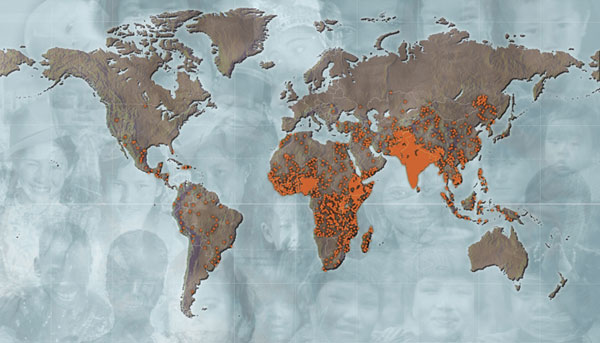
child_mortality_map.jpg

Click on the map to be taken to the Johns Hopkins Bloomberg School of Public Health’s Magazine for an article on child mortality.

[Each orange dot is equivalent to 5,000 child deaths.]


Transparency International Corruption Perceptions Index for 2007

Economists, political scientists and practitioners have long been aware of the deleterious effects of corruption. Transparency International, an international NGO, has been playing a lead role since its inception in 1993 in the fight to highlight the problem of corruption and in creating a forceful international anti-corruption movement. What is corruption?

Corruption is the abuse of entrusted power for private gain. It hurts everyone whose life, livelihood or happiness depends on the integrity of people in a position of authority.

What are some of the effects of corruption, but obvious and hidden?

Corruption hurts everyone, and it harms the poor the most. Sometimes its devastating impact is obvious:

* A father who must do without shoes because his meagre wages are used to pay a bribe to get his child into a supposedly free school.

* The unsuspecting sick person who buys useless counterfeit drugs, putting their health in grave danger.

* A small shop owner whose weekly bribe to the local inspector cuts severely into his modest earnings.

* The family trapped for generations in poverty because a corrupt and autocratic leadership has systematically siphoned off a nation’s riches.

Other times corruption’s impact is less visible:

* The prosperous multinational corporation that secured a contract by buying an unfair advantage in a competitive market through illegal kickbacks to corrupt government officials, at the expense of the honest companies who didn’t.

* Post-disaster donations provided by compassionate people, directly or through their governments, that never reach the victims, callously diverted instead into the bank accounts of criminals.

* The faulty buildings, built to lower safety standards because a bribe passed under the table in the construction process that collapse in an earthquake or hurricane.

Corruption has dire global consequences, trapping millions in poverty and misery and breeding social, economic and political unrest.

Corruption is both a cause of poverty, and a barrier to overcoming it. It is one of the most serious obstacles to reducing poverty.

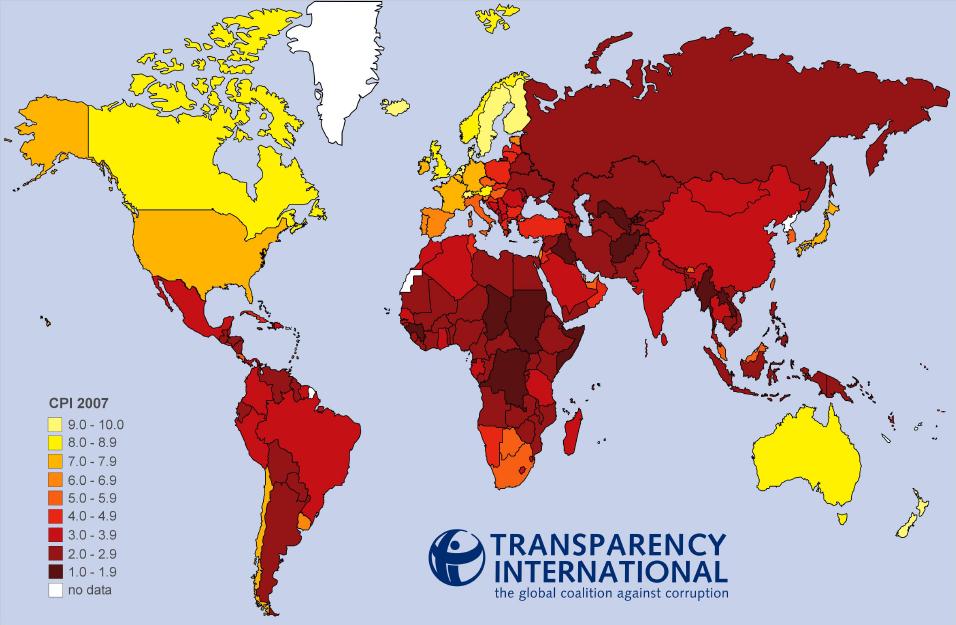
Here is a chart comparing corruption levels around the world in 2007. The higher the cpi score, the higher the level of perceived corruption.

transparency_corruption_world_map_2007.jpg

Worldwide Governance Indicators from the World Bank

Probably the best compilation of data related to governance can be found here .  The data can be viewed interactively (this is how I created the world map above that is being used as the page header for my website) here. The data include measures for most of the world’s countries on the following:

The Worldwide Governance Indicators (WGI) project
reports aggregate and individual governance indicators for 212 countries and territories over the period 1996–2006, for six dimensions of governance:

Voice and Accountability

Political Stability and Absence of Violence

Government Effectiveness

Regulatory Quality

Rule of Law

Control of Corruption

The aggregate indicators combine the views of a large number of enterprise, citizen and expert survey respondents in industrial and developing countries. The individual data sources underlying the aggregate indicators are drawn from a diverse variety of survey institutes, think tanks, non-governmental organizations, and international organizations.

The six aggregate indicators and the underlying data sources can be viewed interactively on the Governance Indicators webpage of this site. Documentation of the latest update of the WGI can be found in “Governance Matters VI: Governance Indicators for 1996–2006.” Further documentation and research using the WGI is available on the Resources page of this website or at www.worldbank.org/wbi/governance.

What is governance? From the website we find this definition of governance:

Governance consists of the traditions and institutions by which authority in a country is exercised. This includes the process by which governments are selected, monitored and replaced; the capacity of the government to effectively formulate and implement sound policies; and the respect of citizens and the state for the institutions that govern economic and social interactions among them.

Design a site like this with WordPress.com
Get started