Yale’s Elizabeth Wood to give lecture on sexual violence in war

I wanted to make all of you aware of a lecture by one of the world’s leading experts on the topic of sexual violence during war, Elizabeth Wood from the Department of Political Science at Yale University. The lecture is open to the public. Here are the details:

Simons Lectures in the Social Dynamics

of Peace and Conflict

Guest Speaker:  Professor Elisabeth Jean Wood

Elisabeth Wood is Professor of Political Science at Yale University and
Professor at the Santa Fe Institute.

Monday, 18 October 2010

Public Lecture: ‘Sexual Violence During War: Rape Is Not Inevitable’
1600 – 1730
Room 7000 (Earl & Jennie Lohn Policy Room)
Simon Fraser University, Harbour Centre, (7th floor),
515 West Hastings Street, Vancouver

Worse Than War

In IS 302 today, we viewed the first 2/3 of the PBS documentary, Worse than War, based on the work of genocide (note: not genocidal) scholar Daniel Goldhagen , who is probably known best for his book Hitler’s Willing Executioners. Many of the issues raised by Goldhagen in the documentary were relevant to the readings of this week by Kaldor, et al.

New and Old Wars Reading Questions

Here are some questions that we will try to answer in class, based on the Mueller, Kalyvas, Collier & Hoeffler, and Kaldor readings:

Thematic Questions:

  1. How has the nature of warfare changed (or has it) over the course of the last 70 years or so? Provide evidence from at least four sources.
  2. Comparatively assess the arguments of Collier & Hoeffer, Kalyvas, Mueller, and Kaldor. What are some commonalities? Divergence of opinion?
  3. What are the policy implications–from a humanitarian perspective–of taking each of the authors’ arguments seriously? Discuss.

Collier & Hoeffler (2004) “Greed and Grievance in Civil War

  1. De fine `greed’ and `grievance’ in the context of the analysis of rebellion/civil war.
  2. What are the types of causal mechanisms that each term implies?
  3. What do C & L mean by `opportunity’?
  4. Based on the statistical results, what conclusion do C & L draw regarding the causes of the onset of rebellion?
  5. What is the analytical importance of diaspora communities?
  6. How important are ethnic grievances in fomenting rebellion?

. Mueller (2000) The Banality of `Ethnic War’

  1. Why does Mueller put the words ethnic war in scare quotes in the title?
  2. What does Mueller mean when he says that ethnic war is `banal?’
  3. What evidence does Mueller use to support his main argument(s)?
  4. According to Mueller, what are the stages of ethnic war and ethnic cleansing?
  5. What is `ethnic cleansing’?
  6. Did ethnicity play any role in the inter-ethnic violence in Yugoslavia and Rwanda? Continue reading “New and Old Wars Reading Questions”

The “New Humanitarianism” and Rule vs. Act Utilitarianism (Consequentialism)

In chapter 3 of Humanitarian Intervention Weiss analyses “new wars” and “new humanitarianisms.”  The changing nature of humanitarian work is characterized by many things, but I’d like to focus on one particularly, which will lead us to a discussion of the importance of neutrality and the concepts of rule and act utilitarianism.

Weiss argues that humanitarian responses, by NGOs particularly,  are becoming more ambitious in scope and thereby shifting from a focus on short-term emergency relief to “attacking the root causes and post-conflict peacebuilding.” He continues,

“rather than provide band-aids, they [humanitarians] wish to use assistance and protection as levers. Many aid agencies desire to spread development, democracy, and human rights and create stable, effective, and legitimate states.” (76)

This has led, concomitantly, to a change in the humanitarian principles of neutrality and impartiality. These principles, Weiss notes, “made sense if the objective was to provide relief and gain access to affected populations.” These principles, it is argued, foundered upon the reality that contemporary wars–“new wars”–were creating “unanticipated and unintended negative consequences.” Moreover, in a world in which the combatants are state militaries, neutrality and impartiality retained some internal logic. However, as genocidaires and other ty[es of rebel groups become the main combatants in civil wars and the predominant perpetrators of crimes against humanity, the principles of neutrality and impartiality come to be seen increasingly as relics of a bygone era.

A few students took issue with this argument, insisting that there are also likely to be unintended consequences of humanitarian organizations repudiating the principles of neutrality and impartiality. They mentioned some of these in class. This prompted a quick excursion by me into the difference between act and rule utilitarianism/consequentialism. I’ll explain below the fold:

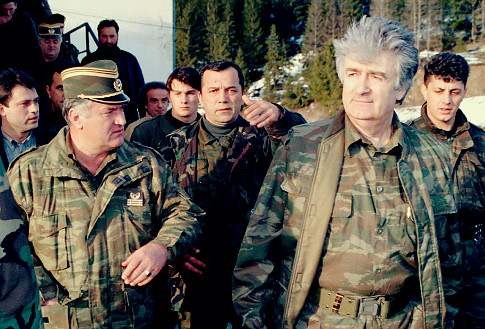
Bosnia Muslim leaders argued that the neutrality policy allowed Messrs. Karadzic and Mladic free reign in their campaign to ethnically cleanse large swaths of Bosnia of (well-fed) Muslims.

Continue reading “The “New Humanitarianism” and Rule vs. Act Utilitarianism (Consequentialism)”

Michael Ignatieff and Humanitarian Intervention

Current leader of the Canadian Federal Liberal Party, Michael Ignatieff has long been involved in the issue of human rights–as a historian, journalist, public intellectual, and as the former Carr Professor and Director of the Carr Center for Human Rights Policy at the Kennedy School of Government.

In the aftermath of the contentious NATO military intervention in Kosovo (1999), Ignatieff sat down with WBUR’s Chris Lydon to assess what had gone right (and wrong) during the intervention. A self-identified member of the “something must be done [to stop alleged Serbian war crimes against the Kosovar Albanians]”, Ignatieff stands by his support for the intervention, claiming that, on the whole, the benefits outweighed the costs.

Events/Lectures that may be of Interest

I’ll use this blog to keep you informed about lectures and events that may be of interest to you that are taking place on campus or in the greater Vancouver area. There are two events this week that are relevant.

This evening, Monday September 13th, at 7:00pm the Philosophers’ Cafe is kicking off the first event of its fall series at the Shadbolt Centre for the Arts at Deer Lake in Burnaby. This evening’s discussion is titled “Mixed Up: Is Canada’s cultural mix more like a melting pot, mosaic or matrix?” We’ll be addressing issues of identity and culture in about two weeks time in IS 210. The admission is $5, and the event will be moderated by Randall Mackinnon, who has served as a president, board member, executive and consulting staff for a diversity of community service organizations since 1970. For more information about tonight’s event and directions to the venue, click here.

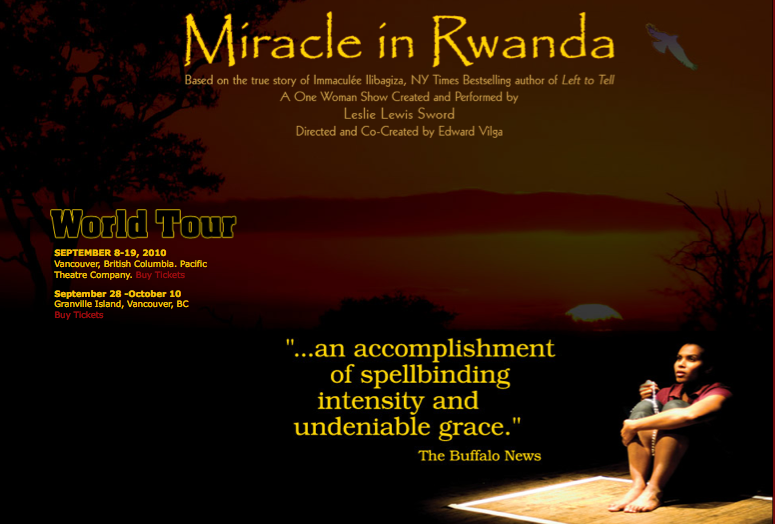
The second event is a one-woman show entitled Miracle in Rwanda, which is showing all of this week at Pacific Theatre Company and will also have a two-week run on Granville Island beginning later this month. To learn more about the show, and to purchase tickets, go here.

Update: The website I linked to above links to the wrong page. Miracle in Rwanda is part of this year’s Vancouver Fringe Festival. Here’s the correct link to information regarding show times and tickets.

SKY News Report on Situation in Tibet

Here is an interesting video, which captures the events surrounding an organized (by the Chinese authorities) visit of non-Chinese journalists to the capital city of Tibet, Lhasa.  It seems as though events conspired against the Chinese authorities just a little bit:

It’s Spring, so how is your Bracket Doing?

pakistan_gilani.jpg
Well, it’s that time of year again. Has your bracket been busted? How many of you can honestly claim that you predicted the upset of Yousaf Raza Gilani becoming Pakistan’s new Prime Minister? Now I realize that most of you were predicting a victory for Ma Ying-jeou in Taiwan’s recent presidential elections. But did you honestly think that he would win by 15! (He won 57.5% of the vote.) Mr. Gilani almost busted my bracket, but I think that I may be able to redeem myself with my pick for the winner of the upcoming Serbian Parliamentary elections (given that the Balkan Conference is a mid-major, that group of countries has not been followed very closely and I have a little bit of an advantage in prognosticating the outcome there).
taiwan_ying_jeou.jpg
Current Prime Minister, Vojislav Koštunica, disbanded his coalition government on March 13 due to tensions within the governing coalition as a result of the declaration of independence by the former Serbian province of Kosovo. New elections are slated to be held on May 11 of this year, with Koštunica’s conservative and nationalistic Democratic Party of Serbia will find its strongest challenge from Serbian President Boris Tadić‘s bloc of pro-democratic and pro-Western parties and the ultra-nationalist Serbian Radical Party. It will be interesting to observe how much the apparent loss of the Kosovo (the “Serbian Jerusalem”) will help the ultra-nationalists and hurt Koštunica.
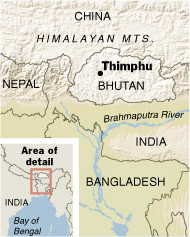
And finally, my surprise pick to get to the Final Four from the East Region is the tiny Himalayan state of Bhutan, which has been flying under the radar but has been getting its democratic game together. As Agence-France Presse reports, democracy is marching inexorably onward in a fit of Fukuyaman glee:
0324-web-bhutanmap.jpgTHIMPHU, Bhutan (Agence France-Presse) — Bhutan stands poised to become the world’s newest democracy on Monday with elections ordered by its revered royal family to end its absolute rule.
The tiny Buddhist state, wedged in the Himalayas between India and China, will elect members for a lower house, ending the century-long rule of the hugely popular Wangchuck dynasty.Bhutan’s Oxford-educated ruler, King Jigme Khesar Namgyel Wangchuck, 28, made a forceful last-minute appeal over the weekend to his subjects — some of whom were initially reluctant to bring in democracy — to vote.

“As you approach the duty of voting at the elections that will bring democracy, do so with pride and confidence of a people that have achieved so much,” he said in a statement published in the nation’s newspapers. “First and foremost, you must vote. Every single person must exercise his or her franchise.”

The king is the fifth ruler in the dynasty, in power since 1907. The path to democracy began in 2001, when the former king, Jigme Singye Wangchuck, handed over the day-to-day tasks of government to a council of ministers, and finally stepped down in favor of his son in late 2006.

Since then, father and son have traveled the country to explain to its 670,000 people why the nation should embrace democracy.

Wow! I think we have one of those rare instances of enlightened despotism.

UN Peacekeeping Mission in Darfur Failing?

A couple of weeks ago we watched the National Film Board of Canada documentary film, The Peacekeepers, in introduction to IR.   It was a fascinating behind-the-scenes look at the enterprise of UN peacekeeping operations, demonstrating the successes and failures of the UN in attempting to create and keep the pace amongst Congo’s warring factions.  We saw the clash between realist views of international sovereignty, security, and power and the liberal ideal of multinational cooperation.  The New York Times reports today on the potential failure of a relatively new UN peacekeeping operation before it has even started.  Those who have been following the atrocities in the Darfur region of Sudan know that it has taken four years to get a UN peacekeeping force on the ground.  It may already be doomed to failure.  It is uncanny how much of this report sounds like it was taken directly from the documentary about Sudan.

un_darfur.jpg ABU SUROUJ, Sudan — As Darfur smolders in the aftermath of a new government offensive, a long-sought peacekeeping force, expected to be the world’s largest, is in danger of failing even as it begins its mission because of bureaucratic delays, stonewalling by Sudan’s government and reluctance from troop-contributing countries to send peacekeeping forces into an active conflict.

The force, a joint mission of the African Union and the United Nations, officially took over from an overstretched and exhausted African Union force in Darfur on Jan. 1. It now has just over 9,000 of an expected 26,000 soldiers and police officers and will not fully deploy until the end of the year, United Nations officials said.

Even the troops that are in place, the old African Union force and two new battalions, lack essential equipment, like sufficient armored personnel carriers and helicopters, to carry out even the most rudimentary of peacekeeping tasks. Some even had to buy their own paint to turn their green helmets United Nations blue, peacekeepers here said.

The peacekeepers’ work is more essential than ever. At least 30,000 people were displaced last month as the government and its allied militias fought to retake territory held by rebel groups fighting in the region, according to United Nations human rights officials.

Ethnic Conflict and Strife

A couple of days ago all blog posts seemed to be related to the theme “the social logic of politics”. Today, there seems to be a surge in episodes of inter-ethnic conflict worldwide. First, we learn from the Washington Post, that there is unrest and violence in the Tibetan capital of Lhasa, where a week of increasing confrontations between native Tibetans and the Chinese government have turned violent, with native Tibetans battling with Chinese police and troops and also attacking ethnic Han Chinese, which is either unprecedented or extremely rare.

BEIJING, March 14 — A week of tense confrontations over Chinese rule in Tibet erupted in violence Friday, as hundreds of protesters clashed with police and set fire to shops in the center of Lhasa. Doctors reported dozens of wounded streaming into area hospitals, and one witness said the downtown area was “in a state of siege.”

The rare breakout of violence, the worst in 20 years in the capital city of a remote mountainous region that is the heart of Tibetan Buddhism, posed a challenge to the Chinese government as it prepares to host the 2008 Olympic Games in August. Seeking to make the Games a worldwide celebration of its swift economic progress during the past three decades, the Chinese government has steadfastly attempted to project an image of harmony and stability, even while tightening its grip over the restive region.

“This spiraling unrest has triggered the scenario the Chinese prayed would not happen,” said Robbie Barnett, director of modern Tibetan studies at Columbia University. “Now we’re just watching the clock tick until people get off the street or the Chinese open fire.”

In a different part of the world, Malaysia, in which once again ethnic Chinese are involved, the New York Times reports on post-electoral tension on the island of Penang:

PENANG, Malaysia — Chanting “Long Live the Malays!” several hundred members of Malaysia’s largest ethnic group gathered Friday on this largely Chinese island, defying a police ban on protests and raising communal tensions after sharp electoral losses by the country’s governing party.

Newly elected state governments have moved rapidly to abolish some of the long-held privileges of ethnic Malays. Those efforts have challenged the core of Malaysia’s ethnic-based political system and inflamed the sensibilities of Malays. Until the March 8 elections, Malays thoroughly dominated politics through the country’s largest party, the United Malays National Organization, known by its initials, U.M.N.O.

The opposition parties that beat U.M.N.O. and its partners in five states say affirmative action should be based on need rather than ethnicity. But the opposition, too, is struggling to contain fissures along ethnic lines as a Chinese opposition party competes with its Malay counterpart.

“We’re living in very sensitive times,” said Tricia Yeoh, director of the Center for Public Policy Studies, an independent research center in Kuala Lumpur, the capital.

The affirmative action program favoring the Malays has been in place for more than three and a half decades and gives Malays everything from discounts on new houses to 30 percent quotas in initial public offerings of companies. It is known as the New Economic Policy.

Finally, in Iraq, where in the last four years the minority Christian community has been decimated, either through targeted killings or ethnic cleansing, we hear news of the killing of a prominent Catholic Bishop:
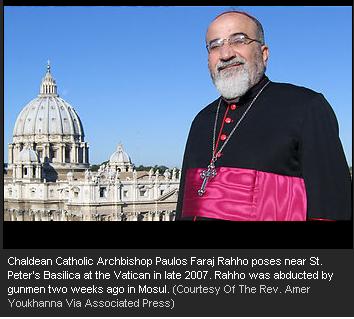
bishop_rahro.jpg BAGHDAD, March 13 — The body of a senior Christian cleric was found Thursday in the northern city of Mosul, two weeks after gunmen abducted him there and killed three of his associates.

The death of Paulos Faraj Rahho, 65, archbishop of Mosul’s Chaldean community, prompted expressions of remorse and condemnation from the Iraqi government and Christian leaders.

Pope Benedict XVI, in a message to the Chaldean patriarch in Iraq, called the killing an “act of inhuman violence that offends the dignity of the human person and seriously harms the cause of fraternal coexistence among the beloved Iraqi people.”

Iraqi Prime Minister Nouri al-Maliki said it was a crime of “aggression aimed at inciting sedition among” Iraqis.

Design a site like this with WordPress.com
Get started