The History of the Recall in BC Provincial Politics

As we noted in POLI 1100 earlier today, the recall mechanism is one of the tools of direct democracy that citizens can use to influence the political process. A student asked whether any provincial politician (in BC) had ever been recalled. The answer is that since the passage of The Recall and Initiative Act (1996), of 24 attempts at recall, not a single one of them proved successful. (Of course, we witnessed the successful recall effort last year of the HST legislation brought in by the Campbell government.) In 23 of these efforts not enough valid signatures were collected, while in one effort the MLA–Paul Reitsma (Lib–Parskville-Qualicum)–resigned prior to the process reaching its conclusion.

Here is an overview of the recall process, from Elections BC:

Recall is a process that allows registered voters to petition for the removal of a Member of the Legislative Assembly between elections.

Any registered voter can apply to have a petition issued for the recall of their MLA (the elected Member representing their electoral district in the Legislative Assembly). A registered voter who wants to start a recall petition must obtain an application form from the Chief Electoral Officer. The completed application form must be submitted to the Chief Electoral Officer with a non-refundable processing fee of $50 and include a statement of 200 words or less of why, in the opinion of the applicant, the Member should be recalled. A Member cannot be recalled during the first 18 months after their election.

If the application is complete and meets the requirements of the Recall and Initiative Act, a petition is issued to the applicant (called a “proponent”) within seven days. The proponent then has 60 days to collect signatures from more than 40% of the voters who were registered to vote in the Member’s electoral district in the last election, and who are currently registered as voters in B.C. The proponent may be helped by volunteers when canvassing for signatures.

When all the signed petition sheets are submitted, the Chief Electoral Officer has 42 days to verify that enough eligible individuals have signed the petition. If enough valid signatures are on the petition, and the financing rules have been met by the proponent, the Member ceases to hold office and a by-election must be called within 90 days. A recalled Member can run as a candidate in the by-election.


Proportional Representation versus First-Past-the-Post

As we learned in POLI 1100 today, Canada is one of small number of countries that continues to have a first-past-the-post system for national elections. What this means is that we divide the country up into 308 single-member districts (divided principally on the basis of the “representation by population” principle), from each of which exactly one individual is elected to represent that district in the House of Commons in Ottawa. In our case, a winner only has to have a plurality of the vote in that district to be elected the winner. What this does is it tends to give larger parties overrepresentation in parliament based on their actual electoral strength. It also gives regionally-concentrated parties (like the Bloc Quebecois) overrepresentation in parliament vis-a-vis parties whose electoral support is more diffuse geographically.

As we can see from the 2008 federal election results, the Green Party received almost 7% of the total national vote, yet because the vote was dispersed across the whole of the country, did not receive a single mandate in the House of Commons. The Bloc Quebecois, meanwhile, gained 50 seats in parliament with a slightly larger percentage of the vote than the Greens! Why? Because the BQ’s votes were geographically concentrated within a minority of ridings in the province of Quebec.

Turning now to the 2011 federal election, in which Stephen Harper’s Conservative Party won a majority in the House of Commons with 166 seats (and 39.6% of the vote). See the results below.

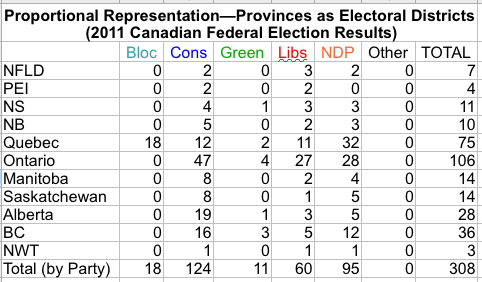
What if, on the other hand, Canada had a proportional representation system in which each province was its own electoral district and seats for the House of Commons were apportioned on the basis of the relative proportion of votes won by each party in each province? What would the results look like? With the help of my students, we were able to calculate the hypothesized makeup of the House of Commons were Canada to have such an electoral system.

Notice that the total number of MPs for the Conservative Party has dropped considerably such that the party no longer has a majority in the House of Commons. In fact, no single party has a majority! In order to form a relatively stable government, the Conservatives would have to find willing coalition partners. Unfortunately for them, however, other than the BQ, there is no immediately suitable coalition partner, given the respective ideological stances of the parties in parliament. Even with the BQ, the Conservatives could not get a governing majority, coming up 15 seats short. An NDP/Liberal?Green coalition, on the other hand, would work both ideologically and in terms of numbers (166 seats, exactly the same number as the Conservatives have today).

Note also how much a proportional representation system would help the Green Party–from only 1 seat in the House to 11 seats!

Which system would you prefer? Do you think that we should maintain the status quo? Should we change to PR? What are some of the advantages and disadvantages of each?

Writing to your MP in Support of a Bill in the House of Commons

In POLI 1100, we have been discussing the concept and structure of legislatures. Near the end of Chapter 8 we looked at the path a bill has to traverse in Parliament before it becomes law (see Figure 8.2 of the Dyck textbook, p. 235). We viewed a video clip of MP Ruby Dhalla introducing a bill to amend the residency provisions of the OAS act. (If you don’t know what OAS stands for, watch the short video.)

We have learned in the past couple of weeks that most of the contact that you, as a Canadian citizen, have with the government is via the political executive, whether at the provincial or federal level. Apart from voting for your MP (MLA), there is very little contact between you and the legislative branch of our government. This week’s blog assignment can help change that. As I’ve noted on Blackboard, for this week’s blog assignment you can choose to write on anything to do with “legislatures”. You may, however, choose to write a letter to your MP (or any MP) in support (or opposition to) any bill that is currently in middle of the legislative process in Parliament. Here are the steps:

1. Go to http://www.parl.gc.ca (and select your language of choice):

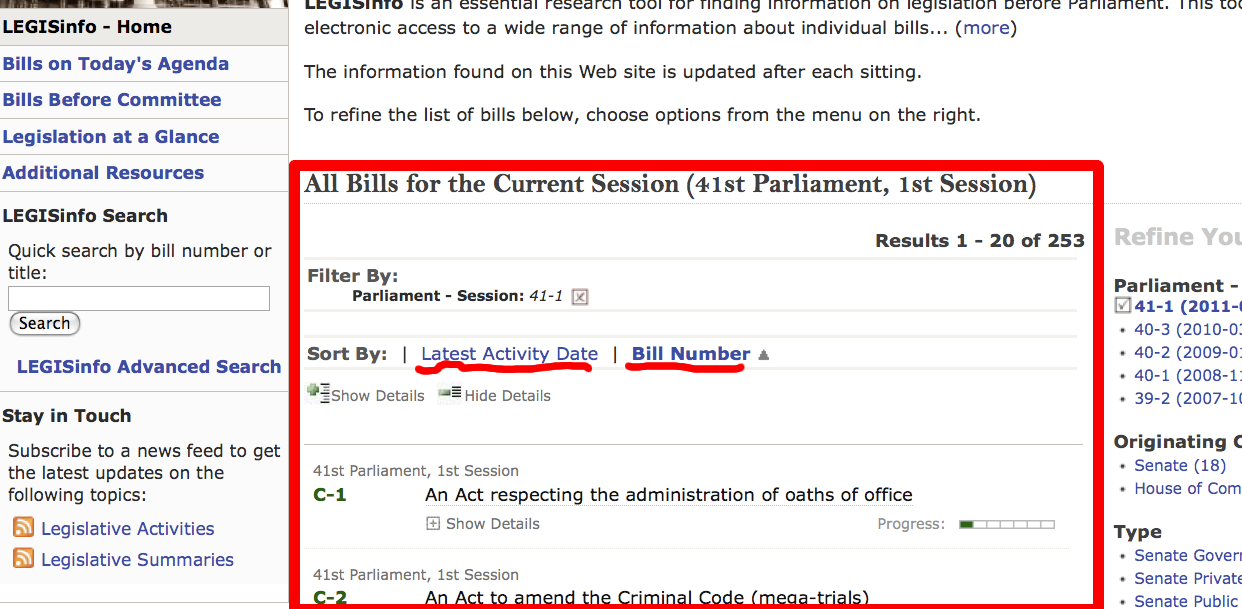
2. Click on “Bills before Parliament” on the left (see the screenshot below). (“Projets de loi a l’etude au Parliament”, en francais)

3. On the next page, you will see, amongst other things, a list of the “All Bills for the Current Session (41st Parliament, 1st Session). The Bills can be sorted by number (as seen below), or by “Latest Activity Date”.

4. Find a Bill that interests you, and write a letter to the MP who is sponsoring the bill. Here’s an example of a letter I wrote below:

Mr. Jean Rousseau, M.P. House of Commons
Ottawa, Ontario
K1A 0A6

Cher Monsieur Rousseau:

I am writing to you in support of Bill C-312, The Democratic Representation Act, which is currently at the Second Reading state of the legislative process in the House of Commons. As I understand it, the bill is meant to assuage the concerns of the Quebecois regarding the province of Quebec’s decreasing population, as a share of Canadian population as a whole. Bill C-312, should it be adopted into law, would maintain proportional representation of Quebec’s delegation in the House of Commons at 2006 levels, regardless of the relative proportion of Quebec’s population in the future.

While some might see this as anti-democratic in that this law would mandate a divergence from the idea that every citizen’s vote should be counted equally, I believe that the the violation of this core principle is justified in this case. (Indeed, in many areas of politics and public policy, debates centre around clashes of competing (and contradictory), fundamentally legitimate–morally and politically–principles.) In this case, the competing principle is the protection of a strong Quebec, and Quebecois society, which I believe is of inestimable value to Canadian society as a whole.

In the view of this Canadian citizen, who since immigrating to this wonderful country as an infant, has lived in the western province of British Columbia (when not living outside the country), Canada’s French heritage is an indispensable part of our country’s unique heritage and is part of the basis for the creation of what is today (though we know it hasn’t always been) a tolerant multicultural society, which is the envy of many around the world.

Sincerely,
Josip (Joseph) Dasovic
Dept of History, Latin, and Political Science
Langara College
Vancouver, BC

Do you agree with my position? Should we violate the principle of “one-person, one-vote” in the way intended by Bill C-312?


Functions of Constitutions

In a response to a story that I blogged about yesterday, New Yorker Magazine Senior Editor, Hendrik Hertzberg, takes issue with the claim that the US Constitution has become increasingly irrelevant as a model for constitution-builders worldwide. Hertzberg writes:

The problem is that the study focusses almost exclusively on rights—the individual and civil rights that are specified in written constitutions. But it almost totally ignores structures—the mundane mechanisms of governing, the nuts and bolts, which is mainly what constitutions, written and unwritten, are about, and which determine not only whether rights are truly guaranteed but also whether a government can truly function in accordance with democratic norms. Or function at all with any semblance of efficiency, effectiveness, and accountability.

In Chapter 6 of the Dyck text, we learn that there are five main functions of any constitution, the first one of which “to define the structure of major institutions of government.” Other major functions are:

  • To divide powers and responsibilities among the various institutions of government
  • To regulate relations between the citizen and the state (this is where rights–civil, legal, political, sometimes economic, social and cultural–are enumerated)
  • To serve as a political symbol
  • To specify a method for amending the constitution

What does the study in question say about whether the US Constitution is being used as a template in these other areas? You’ll have to wait until the study is published in June of this year to find out.


Countries no longer look to US Constitution as Template

Via the New York Times, we learn of the waning popularity of the US constitution as a guide for constitution-makers worldwide. A study in the New York University Law Review, which will be published in June, shows that whereas in 1987 a vast majority of the world’s countries had “written charters modeled directly or indirectly on the U.S. version”, today the ” U.S. Constitution appears to be losing its appeal as a model for constitutional drafters elsewhere,” According to recently retired US Supreme Court justice, Ruth Bader Ginsburg [it was Sandra Day O’ Connor, of course, who recently retired from the SCOTUS], who was interviewed on Egyptian television last week (see video below), had this to say:

“I would not look to the United States Constitution if I were drafting a constitution in the year 2012,” she said. She recommended, instead, the South African Constitution, the Canadian Charter of Rights and Freedoms or the European Convention on Human Rights.

Two reasons that this many constitutional scholars agree with Bader Ginsburg is that i) the US constitution guarantees relatively few rights, and particularly guarantees none of the “second-” and “third-generation” rights, such as social and economic rights, and group-based cultural rights, and ii) the US constitution is notoriously difficult to amend. It is, in fact, the most difficult to amend of any constitution today. The Times wryly notes that Yugoslavia used to hold that distinction. Yugoslavia, as we know, no longer exists today.

The US constitution, however, was plenty good enough for Captain Kirk!

My Tribe is my Pain

Here is a very interesting and personal account of a Ugandan’s views about identity–tribal, ethnic, national. I encourage you to read it, but here are some snippets:

If you live in Uganda you must come across these sentiments. My last name begins with Kag-Kagumire. My blog is not under that name for many reasons but this is one of them. When I say my last name to people sometimes they will say: Kaguta, so you’re from the west, Museveni’s relative etc. Even if it’s a slight joke it evokes a feeling that I can’t describe. To associate me with someone that is increasingly becoming negative makes me mad and in my tribe most times it’s okay to be mad and show it. I take time to explain to friends, sometimes gently other times with some emotion that I am from Bushenyi and I have never been to Rwakitura and that my father doesn’t own a single head of cattle. I am a private person but for the sake of clarity I am forced to talk about all these things and now i am writing about them.

Here’s another piece that implies the shifting nature of identities:

But this kind of view is not limited to the ‘uneducated’ Ugandans. A friend once told me that his Ugandan female friend hates ‘westerners’ so much that at her work place when job applications are brought in, she sorts out the west first.  This personal level of disdain for a group of people  is unfathomable. Others point out how rich you’re and how many opportunities you get. Many times I tell the people about my life which is not the most difficult one but is not any better than that of an educated person from the east, north or central.

Support for Capital Punishment

On Thursday in POLI 1100, a general discussion about the distinctions between democratic and non-democratic regimes focused on the use(s) of violence by governments as a means of control. This led to a discussion of the use of, and support for, the death penalty. As many of my students knew, the death penalty is not used in Canada or Europe (with the exception of Belarus) but is used in the United States. Most of the class, however, was surprised to learn that, despite the differences in policy, until quite recently a majority of both Canadians and Americans supported the death penalty. The graphic below shows the supports of a Gallup-Ipsos survey carried out in 2004, in which Canadians just barely oppose the death penalty (although, as you can see, it is not a majority), while Great Britons (55%) and US Americans (64%) both have majorities supporting the death penalty.

Although support for capital punishment is decreasing in many countries, in many European countries a majority of the population still is in favour of the death penalty for those convicted of murder. What about Japan? In a poll released in February 2010, a record 85% of Japanese supported the death penalty!

What do you think about these results? Are they as you expected? What does this say about the political culture of the countries in question?

2012–The year for Democracy?

Here’s an example of a good post for the POLI 1100 blog assignment for this week. This took about 20-25 minutes to complete.

As noted in Chapter 2 of the Dyck textbook, the number of democracies worldwide has risen dramatically over the last couple of decades, to the point that currently a majority of the world’s population lives in more-or-less democratic states. More-or-less since democracies vary in character from one to the next. Some democracies fully respect human rights, whereas others are less stringent in this regard.

In a recent article in Foreign Policy magazine, Christian Caryl claims that “2012 could be a great year for democracy.” In all, almost 1/3 of the world’s countries will be heading to the polls this year to elect leaders at the national, regional, and local levels.* As for whether this is a sign of deepening democratization, Caryl is more equivocal:

That may be true. But it hardly means that the triumph of democracy is ensured. If history has taught us anything, it is that nothing in human affairs is inevitable. Most people undoubtedly yearn for freedom. In our imperfect world, however, the political choices actually facing most citizens are messy, risky, or morally fraught. There is no straight line to an open society.

Egypt is illustrative. What happens there, in the largest Arab country, is likely to have broad repercussions for the other countries of the Middle East. Yet Egyptians face many obstacles as they strive to assert their political rights. The military stubbornly refuses to yield power. The weakness of the economy, if allowed to continue, could easily sow doubt about the desirability of representative government. Then there is the possibility of sectarian or factional conflict. Already the two Islamist parties that have emerged victorious from the country’s first post-Mubarak parliamentary elections have begun feuding among themselves. And that’s not even to mention the lingering disquiet among Egypt’s large Christian population after last year’s pogroms.

Elections are a vital prerequisite of democracy. Yet, as many examples this year will remind us, elections alone do not a democracy make.

I think that the bolded part  above (my emphasis) is the key part of the story here. We can think about this in terms of necessary and sufficient conditions. While having elections is necessary for a political system to be considered a democracy, elections are not sufficient for democracy. Other institutions, such as a free press, respect for human and civil rights, the freedom of assembly, etc., are needed as well.

For a list of countries that will be holding elections this year, this page is maintained by the Consortium for Elections and Political Process Strengthening. We see that Finland will be the first to have elections this year–Sunday, January 22–with the first round of Presidential elections. (is Sami Salo running?)

Here is an interview with Croatia’s new Foreign Affairs Minister, Vesna Pusic, with EUObserver.com about the upcoming referendum in Croatia on whether to join the European Union. (In the interview, which was held in early December 2011, Minister Pusic speculates that the referendum would take place in February 2012. In fact, the elections will be held this Sunday, 22 January 2012.

*N.B.: Just as an aside. Is it really striking (statistically, that is) that in any given year 1/3 of the world’s countries will have citizens go to election polls to elect representatives?

Globalization is good…or is it?

Is globalization good for those in developing countries? What is the link between globalization and poverty? What about globalization and democracy? Today in IS210 we watched a documentary in which the narrator argued that more globalization is good for the poor in developing countries. He argued that countries that have (and are) globalizing, such as Taiwan and Vietnam,  have become richer, more democratic, and poverty levels have plummeted. On the other hand, countries that haven’t democratized, regardless of whether this is the result of domestic or external policy, have done poorly. They’re less democratic and poorer than they otherwise could be.

Here’s a link to the documentary, and some questions that you may want to think about:

  1. Has globalization been beneficial or detrimental to Taiwan’s economic development? Explain.
  2. What role, according to the narrator, do multi-national corporations (MNCs) play in globalization? Should LDCs embrace the arrival of MNCs into their economies? How can the example of Vietnam inform our answers to these questions? Is there a link between MNCs and worker productivity?
  3. According to the narrator, what was the role of sweatshops in the development of Taiwan’s economy? Were they necessary?
  4. What is the link between globalization and democracy? What is the process that causes this empirical link?
  5. What is the reason for Africa’s slow growth, according to the narrator? Which of Collier and Gunning’s [from Chapter 9 of Essential Readings) four categories would apply? How does the situation of Kenya inform our answers to this question?
  6. What is the e ect of developing countries trade policies on economic outcomes in Kenya and in other parts of the developing world?

Does Globalization Cause Ethnic Conflict?

Today’s session in IS 309 addressed the link between globalization and ethnic conflict. Our main reading material came from Amy Chu’s book, World On Fire, the thesis of which is that the twin phenomena of economic globalization and the spread of liberal democracy cause ethnic conflict in countries that have “market-dominant minorities.” Cynthia Olzak’s recently published article in the Journal of Conflict Resolution answers the same question in this way:

This article examines how different components of globalization affect the death toll from internal armed conflict. Conventional wisdom once held that the severity of internal conflict would gradually decline with the spread of globalization, but fatalities still remain high. Moreover, leading theories of civil war sharply disagree about how different aspects of globalization might affect the severity of ethnic and nonethnic armed conflicts. Using arguments from a variety of social science perspectives on globalization, civil war, and ethnic conflict to guide the analysis, this article finds that (1) economic globalization and cultural globalization significantly increase fatalities from ethnic conflicts, supporting arguments from ethnic competition and world polity perspectives, (2) sociotechnical aspects of globalization increase deaths from
ethnic conflict but decrease deaths from nonethnic conflict, and (3) regime corruption increases fatalities from nonethnic conflict, which supports explanations suggesting that the severity of civil war is greater in weak and corrupt states.

Chua’s book was received with some praise but also with a fair amount of criticism. Here are some links to videos that may be of interest to you:

Design a site like this with WordPress.com
Get started