Ethnic (cultural) diversity and public spending

We talked a little bit in class today about the link between ethnic (cultural) diversity and public spending. The empirical record seems to find that the more ethnic diversity in a polity, the less public spending–health, education, etc.–there is. A recent article in the American Political Science Review (Habyarimana et al. 2007) addresses the theoretical mechanisms that may underlie this empirical association:

A large and growing literature links high levels of ethnic diversity to low levels of public goods provision. Yet although the empirical connection between ethnic heterogeneity and the underprovision of public goods is widely accepted, there is little consensus on the specific mechanisms through which this relationship operates. We identify three families of mechanisms that link diversity to public goods provision—what we term “preferences,” “technology,” and “strategy selection” mechanisms—and run a series of experimental games that permit us to compare the explanatory power of distinct mechanisms within each of these three families. Results from games conducted with a random sample of 300 subjects from a slum neighborhood of Kampala, Uganda, suggest that successful public goods provision in homogenous ethnic communities can be attributed to a strategy selection mechanism: in similar settings, co-ethnics play cooperative equilibria, whereas non-co-ethnics do not. In addition, we find evidence for a technology mechanism: co-ethnics are more closely linked on social networks and thus plausibly better able to support cooperation through the threat of social sanction. We find no evidence for prominent preference mechanisms that emphasize the commonality of tastes within ethnic groups or a greater degree of altruism toward co-ethnics, and only weak evidence for technology mechanisms that focus on the impact of shared ethnicity on the productivity of teams. (my emphasis)

Thus, what the experimenters found was that (at least in their experiment) co-ethnics were more likely to co-operate in a strategic setting than non-co-ethnics. An additional important factor is the ability of the threat of social sanction to be stronger within a homogenous social group, presumably due to more closely linked social networks. (“I’ll tell your mother on you!” as a threat has more of a potential enforcement effect if you think the person making the threat may actually know your mother. And the likelihood of that person knowing your mother increases, other things being equal, if s/he shares the same ethnicity as your mother.

Chapter 1 or Chapter 2 Post–Global Military Expenditures

As I noted in POLI 1140 today, your blog assignment for this week is to write a post related to anything in Chapters 1 or 2 of the Mingst and Arreguin-Toft textbook. You have until midnight, Friday January 20 to publish your post. Here is an example of what I would consider to be a good post–format, content, and length.

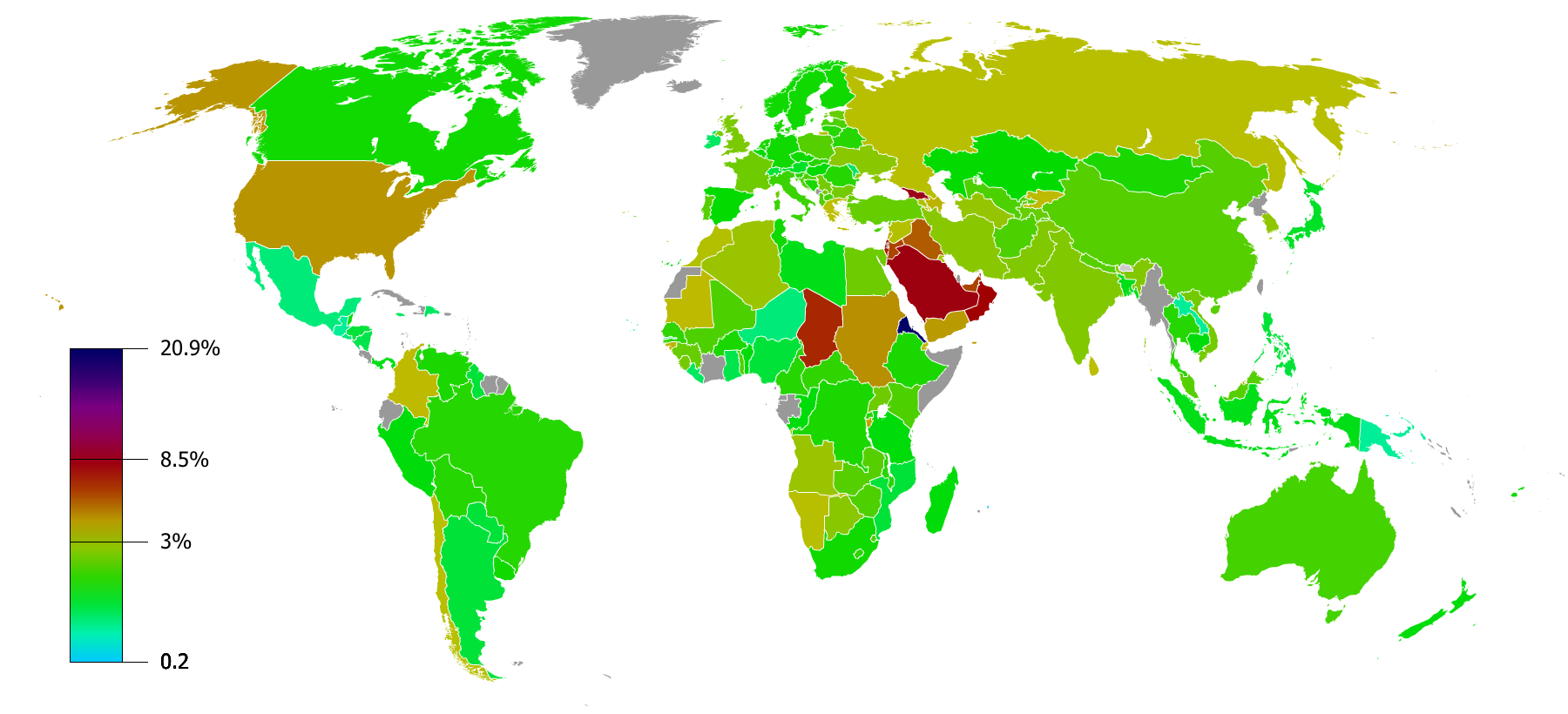
Military Expenditures as percentage of GDP

On p. 3 of Chapter 1 of the text (in the Thinking Theoretically section), the authors write:

In brief, realism posits that states exist in an anarchic international system. Each state bases its policies on an interpretation of national interest defined in terms of power.

While there are many types of power–economic, political, prestige, etc.,–the most important source of power and the one which states generally seek to increase as much as possible, is military power. Because of anarchy, realists believe that states are constantly concerned about their security. States that feel more insecure seek to increase their power, thereby increasing the sizes of their military, all else being equal. It would be interesting to find out which states spend a lot on their military, and which states spend less. Fortunately, Globalsecurity.org has compiled the data for us. In their most recent summary of global military expenditures (from 2011), we find some interesting data. I have copied the top 20 (in terms of absolute dollars spent) in the table below. For a list of all countries, click on the link above.

WORLD Gross Domestic Product Military Spending
State GDP rank % GDP
mil
rank Military spending
WORLD $70,155,374,950,000.00


$2,157,172,000,000.00
United States $14,120,000,000,000.00 2 5.20% 25 $741,200,000,000.00
China $8,818,000,000,000.00 3 4.30% 23 $380,000,000,000.00
India $3,680,000,000,000.00 5 2.50% 62 $92,000,000,000.00
Russia $2,116,000,000,000.00 8 3.90% 27 $82,500,000,000.00
Saudi Arabia $590,900,000,000.00 23 10.00% 3 $59,090,000,000.00
France $2,094,000,000,000.00 9 2.60% 57 $54,444,000,000.00
United Kingdom $2,123,000,000,000.00 7 2.40% 63 $50,952,000,000.00
Turkey $879,900,000,000.00 17 5.30% 16 $46,634,700,000.00
Germany $2,815,000,000,000.00 6 1.50% 102 $42,225,000,000.00
Korea, South $1,362,000,000,000.00 13 2.70% 53 $36,774,000,000.00
Brazil $2,010,000,000,000.00 10 1.70% 89 $34,170,000,000.00
Japan $4,149,000,000,000.00 4 0.80% 150 $33,192,000,000.00
Italy $1,737,000,000,000.00 11 1.80% 86 $31,266,000,000.00
Indonesia $960,200,000,000.00 16 3.00% 47 $28,806,000,000.00
Iran $825,900,000,000.00 19 2.50% 60 $20,647,500,000.00
Spain $1,359,000,000,000.00 14 1.20% 122 $16,308,000,000.00
Taiwan $734,300,000,000.00 20 2.20% 68 $16,154,600,000.00
Israel $206,900,000,000.00 51 7.30% 6 $15,103,700,000.00
Greece $332,900,000,000.00 35 4.30% 24 $14,314,700,000.00
Canada $1,277,000,000,000.00 15 1.10% 127 $14,047,000,000.00

Continue reading “Chapter 1 or Chapter 2 Post–Global Military Expenditures”

What is the link between Globalization and Poverty?

In my previous post, I noted that the narrator of the Globalization is Good documentary claimed that there was a strong correlation between how globalized a country is and poverty. Specifically, those countries that are globalized are likely to have less poverty. How does this claim stand up to empirical scrutiny? Well, one answer comes from the National Bureau of Economic Research (NBER) in Cambridge, Massachusetts.

“The evidence strongly suggests that export growth and incoming foreign investment have reduced poverty everywhere from Mexico to India to Poland. Yet at the same time currency crises can cripple the poor.”

Does globalization, as its advocates maintain, help spread the wealth? Or, as its critics charge, does globalization hurt the poor? In a new book titled Globalization and Poverty, edited by NBER Research Associate Ann Harrison, 15 economists consider these and other questions. In Globalization and Poverty (NBER Working Paper No. 12347), Harrison summarizes many of the findings in the book. Her central conclusion is that the poor will indeed benefit from globalization if the appropriate complementary policies and institutions are in place.

Harrison first notes that most of the evidence on the links between globalization and poverty is indirect. To be sure, as developing countries have become increasingly integrated into the world trading system over the past 20 years, world poverty rates have steadily fallen. Yet little evidence exists to show a clear-cut cause-and-effect relationship between these two phenomena.

Many of the studies in Globalization and Poverty in fact suggest that globalization has been associated with rising inequality, and that the poor do not always share in the gains from trade. Other themes emerge from the book. One is that the poor in countries with an abundance of unskilled labor do not always gain from trade reform. Another is that the poor are more likely to share in the gains from globalization when workers enjoy maximum mobility, especially from contracting economic sectors into expanding sectors (India and Colombia). Gains likewise arise when poor farmers have access to credit and technical know-how (Zambia), when poor farmers have such social safety nets as income support (Mexico) and when food aid is well targeted (Ethiopia).

The evidence strongly suggests that export growth and incoming foreign investment have reduced poverty everywhere from Mexico to India to Poland. Yet at the same time currency crises can cripple the poor. In Indonesia, poverty rates increased by at least 50 percent after the 1997 currency crisis in that country, and the poor in Mexico have yet to recover from the pummeling of the peso in 1995.

Without doubt, Harrison asserts, globalization produces both winners and losers among the poor. In Mexico, for example, small and medium corn growers saw their incomes halved in the 1990s, while larger corn growers prospered. In other countries, poor workers in exporting sectors or in sectors with foreign investment gained from trade and investment reforms, while poverty rates increased in previously protected areas that were exposed to import competition. Even within a country, a trade reform may hurt rural agricultural producers and benefit rural or urban consumers of those farmers’ products.

The relationship between globalization and poverty is complex, Harrison acknowledges, yet she says that a number of persuasive conclusions may be drawn from the studies in Globalization and Poverty. One conclusion is that the relationship depends not just on trade or financial globalization but on the interaction of globalization with the rest of the economic environment: investments in human capital and infrastructure, promotion of credit and technical assistance to farmers, worthy institutions and governance, and macroeconomic stability, including flexible exchange rates. The existence of such conditions, Harrison writes, is emerging as a critical theme for multilateral institutions like the World Bank.

The Age of Global (In)equality?

Many of the readings from Chapter 9 of O’Neil’s Essential Readings address the issue of global divergence/convergence in economic growth and/or inequality over the last few decades (and even further back than that–i.e., the Pritchett reading). The question comes down to whether there has been more or less inequality over time. Which is it? Well, the answer depends to a large extent on how one chooses to measure inequality. I’ll begin my response to this by quoting a student’s e-mail I received earlier today:

Hello, below is a link to a video showing one aspect or area of convergence.

I don’t know if I agree that countries are converging in regards to wealth and health; after all, Africa still seems very far behind.  I general, yes, countries today are healthier (longer life spans) and wealthier (not looking at inequality) than they were 200 years ago…

…For our purposes, what is the meaning of convergence and divergence?  From Pritchett, he seems to be measuring growth in terms of GDP and concluding that there is divergence between developed and developing nations (i.e. the levels of growth are not coming together, but separating).  What about China and India, who experienced faster or “larger growth” than some developed nations in the 80’s to mid 90’s?  Then with Milanovic, he is talking about inequality – how it is decreasing at the world level (when Indian and China are included) and this shows convergence.  To me, O’Neil seems to be trying to present two sides of an issue; however, I see two separate issues.  One is divergence in economic growth and the other is convergence in equality. I suppose that China’s and India’s economic growth can explain or at least correlate to lower inequality at the world level, but is that the correct way of interpreting Milanovic?  Is he saying that there’s a convergence of equality (or lower inequality gap worldwide), because countries (when including China and India) are converging in regards to economic growth?

Thank you.

This student is essentially correct in his reading of the respective arguments. As I mentioned earlier, which view one takes on the question of the recent direction of inequality convergence/divergence depends upon how one chooses to measure inequality. To put it differently, it depends upon whether your unit-of-analysis is the country or the individual. A Gini Index score that is calculated on the basis of mean levels of national income (or wealth) may not be the same as one calculated on the basis of comparing the wealth of individuals worldwide. In fact, Milanovic tells us that the values are indeed different, and the difference is due mainly to what has happened in China and India over the last two decades or so.


How Big is Africa?

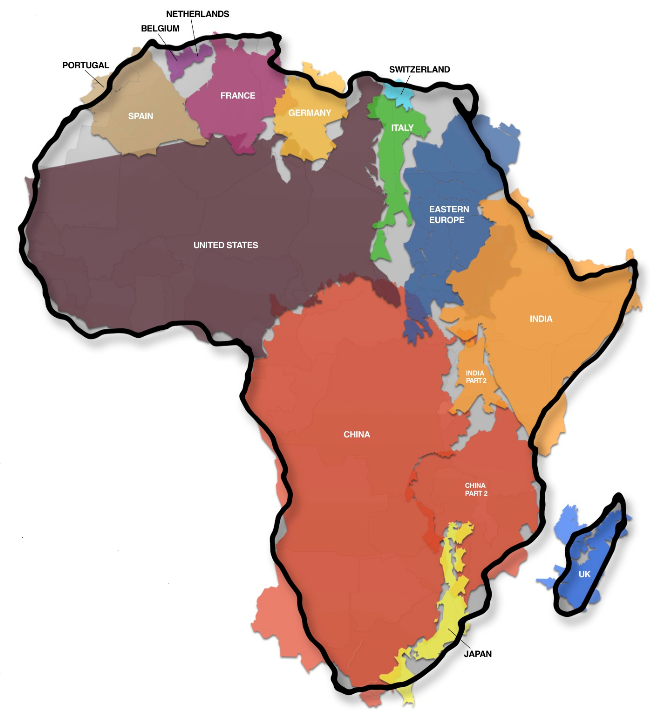
In the second half of the Comparative World Government course we’ll be analysing issues and concepts that will allow us to learn more about the many countries located on the diverse continent of Africa. In addition to being very diverse, Africa is a very large continent. Many of us have little idea about just how big the continent is. Here’s a revealing graphic by Kai Krause, that will hopefully cure us of a little bit of our immapancy–insufficient geographical knowledge. Click on the link above to view a larger picture, with more information.

What does the HDI measure?

This post is prompted by an e-mail from one of the students in my Comparative World Government class. Here’s the e-mail message:

I’m just studying and going through my notes, and had a quick question. In topic 4 when you were talking about GDPs and the Gini Index you said that there actually was a correlation between countries with a high GDP and a low Gini index, but isn’t GDP used in calculating the gini index? So wouldn’t it kind of skew the data, forcing the gini index to be more likely to follow the same pattern as the GDP?

Just curious

Here is my response:

Thanks for the question. I’m almost certain that I didn’t say that, since there’s generally no correlation between the Gini Index and the GDP. Some rich countries have relatively high equality (Sweden, for example) and some have high inequality (USA). Conversely, some poor countries have high levels of equality (India), while some poor countries have very high levels of inequality (Central African Republic).

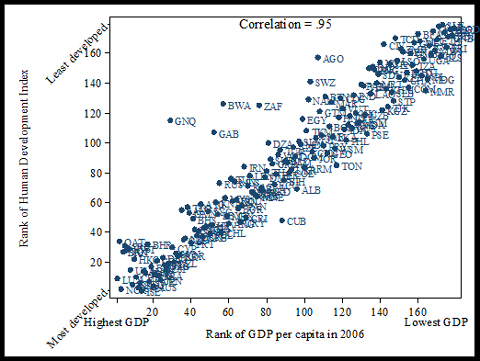
What I most likely said was that there was a very high correlation between a country’s GDP and is score on the Human Development Index (HDI). Just a bit of research…turns up this interesting bit of analysis by Justin Wolfers at the NY Times Freakonomics blog, showing a correlation of 0.95 between a country’s HDI rank and GDP rank (2006). That’s an exceptionally high correlation, suggesting that the HDI isn’t measuring much more than the country’s level of GDP.

Wolfers created a graph using the 2006 data for GDP rank and HDI rank, while I provide for your viewing pleasure below.

Resources for First Paper (IS 210)–Risk Assessment

Here are some data resources that may be helpful to you while researching and writing your first paper assignment. I’ll be showing you how to use/access some of these sources in class on Thursday, September 23rd.

Continue reading “Resources for First Paper (IS 210)–Risk Assessment”

Is there a causal link between Natural Resources and Conflict?

The “resource curse” is the name given to the alleged causal links between a country’s abundance of natural resourcee and the existence of all sorts of “bad things”, such as authoritarianism, economic stagnation and/or outright economic decline, increased probability of attempted coups d’etat, etc.  In our session on political economy we read Jensen and Wantchekon’s article on the link between natural resource wealth and authoritarianism, specifically, and we also looked at Richard Snyder’s article on the putative link between the existence of what he calls “lootable wealth” and political (in)stability in a state.  Their conclusions were at times complementary but at times divergent.  What matters (at least for political stability), according to Snyder, is the ability of the rulers (i.e., the government) to partake of the rents/riches accrued by the exploitation of the particular “lootable” resource.

Snyder’s is, of course, not the final word on the topic and there is an avalanche of published research on this very topic.  A new resource that can be used to find data on the link between natural resources and conflict–political, civil, etc.–is the Resource Conflcit Monitor, maintained by the Bonn International Center for Conversion.  From their web site:

Many developing countries rich in natural resources, such as diamonds and oil, have been plagued by poverty, environmental degradation and violent conflicts. In many of these countries, the natural wealth has not led to sustainable development. On the contrary, in some instances resource wealth has provided the funding and reasons for sustaining civil wars. This so-called ‘resource curse’ brought a lot of attention to the link between resources and conflict over the past decade. ’Governance’ has been identified as key factor for understanding the resource-conflict dynamic and for mitigating its negative impact in developing countries. ‘Resource governance’ in the present context describes the way in which governments regulate and manage the use of natural resources as well as the redistribution of costs and revenues deriving from those resources

The Resource Conflict Monitor (RCM) monitors how resource-rich countries manage, administer and govern their natural resources and illustrates the impact of the quality of resource governance on the onset, intensity and duration of violent conflict. The RCM serves as a tool for identifying and supporting viable resource governance and contributes to conflict prevention, post-conflict reconstruction and sustainable development….

There is an informative, and user-friendly, application that provides historical annual information on conflict and resources in individual countries.  Here is the result for Sierra Leone, the specifics of which should be familiar to those of you who watched Cry Freetown.  For an explanation of “resource governance” and “resource regime compliance, go here and scroll down.

There’s an additional methodological point that is crying out to be made here.  Notice that the level of conflict intensity first decreases rather significantly between 1996 and 1997, then increases dramatically between 1997-1999, to then fall just as dramatically between 2000 and 2002, while at the same time “resource governance” and “resource regime compliance” do not change much at all.  This means that we have to be very careful about attributing the level of conflict to the two afore-mentioned phenomena.  Maybe the causal link between these two and conflict intensity is not monotonic, maybe there is a threshold effect at work, or maybe the existence of an abundance of natural resources is a sufficient (under certain conditions) cause of conflict intensity.  On the whole, though, there certainlly doesn’t seem to be a clear linear, and/or monotonic relationship between resources and conflict (at least in Sierra Leone,  between 1996-2006)

The State and Democratization

The Polity IV data set code book, has a section entitled Indicators of Democracy and Autocracy (Composite Indicators), the authors write about the development of the state and the evolution of political participation as a corollary.  If you read it in tandem with this post on Max Weber’s view of the state and state legitimacy, you’ll begin to understand the nature of the state and why it has become the dominant contemporary form of political organization.

Three broad processes have reshaped the global landscape of state structures during the last two centuries One is an extraordinary expansion in the absolute and relative power of the state, a process that began i Europe. The new states created by the American and French revolutions marked the threshold between political world dominated by monarchies, whose claims to absolutism were belied by the fact that most social and economic life was autonomous from state control or extraction, and a political world in which state power was based on ever-widening control and mobilization of human and material resources exchange for broadened rights of popular participation. An integral part of this process was the development of bureaucracies with high capacities to regulate, tax, and mobilize people in the service of state policy. 

The second process was the transformation of the structures of political participation and legitimation. This transformation followed one of two paths, toward plural democracy or mass-party autocracy. The popular side of the bargain by which most West European rulers built state power in the nineteenth century was to acknowledge the right of widespread participation in policy making.  That right was given institutional expression in elected assemblies which could review, and sometimes initiate, public policy; in elections direct or indirect, of chief ministers; and in recognition of citizens’ rights to voice and act on political opinions. The concept of bargain is a metaphor for sequences of political crises and reforms in which these rulers granted rights for participation, however limited, to all significant social classes and groups, while simultaneously extending the state’s right and capacity to regulate, tax, and mobilize the human and material bases of state power. 

The process of political democratization had its own logic and dynamic which, in most of Western Europe, eroded all but a few symbolic vestiges of traditional autocracy (see for example Bendix 1978). Nonetheless, pressures to extend democratization have always contended with the self-interested desire of rulers to preserve and enhance their autonomy from political constraints. Theempires of Central and Eastern Europe–Germany, Russia, Austro-Hungary–implemented thetrappings but not the substance of effective democratic participation in the late nineteenth and early

Cross-National Comparisons in Alcohol Consumption amongst Adults

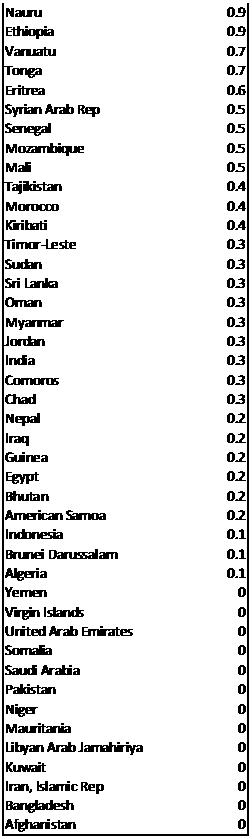
In response to a short assignment on the process of modeling social phenomena, one of my students (thanks, EE!) has chosen to try to understand why the residents of some countries consume (on average) more alcohol per capita than the residents of other countries. She argued that it may have something to do with the cultural acceptance of drinking alcohol as children. That’s seems to be a plausible hypothesis. You can find data on annual drinking rates from the EarthTrends website (which I’ve used on many previous occasions; it’s a fantastic resource!). Here is a link to 2003 data (the most recent year for which they have data) and here is a table, which I have created from the data. What do you think accounts for the difference in consumption across these countries?

Design a site like this with WordPress.com
Get started