
The Sectarian Division in the Middle East

The revolutions in Tunisia and Egypt have prompted similar uprisings in many other countries of the Middle East and North Africa. Though the vast majority of the populations in each of these countries are Muslim, the societies are far from homogeneous. In addition, to social class and ethnic cleavages, Brian Ulrich–Assistant Professor of Middle East History–notes the Sunni/Shi’a sectarian split within Islam:

The sectarian split between a Shi’ite majority and Sunni monarchy and minority matters, but not in a straightforward way. The country’s rulers have played a game of divide and rule, one which seems to have accelerated over the past few years which have seen an increase in anti-Shi’ite discrimination. Presumably hoping to keep smaller the popular base to which they must dispense patronage while tying that base to them ideologically, the Al Khalifa dynasty has portrayed Shi’ites as potential Iranian catspaws and pointed to Iraq as an example of the negative consequences of Shi’ite democratic empowerment. What you see in the government’s rhetoric is an attempt to cast the Shi’ites themselves as the sectarian ones primarily on the grounds of their Shi’ism, much like the Mubarak and Ben Ali regime claimed to suppress Islamic extremism.

Bahrain has also seen major protests before, with a 1990’s “intifada” almost exclusively Shi’ite demographically. During that period, the key to the uprisings’ longevity was a social base in the winding narrow streets of the Shi’ite neighborhoods in and around Manama that the mostly South Asian police had trouble penetrating.

Here’s the video of an interesting debate on the Shi’a/Sunni division in Islam, with some very interesting guests, including U. of Michigan Professor of Middle Eastern History, Juan Cole, who has a very informative blog on Islam and Middle East politics.
Rwandan Journalists Jailed for Stirring up Ethnic Tensions

Last week in IS 302, we addressed the issue of how governments should approach the existence of ethnic division in a post-conflict setting. We saw that Rwanda and Burundi have chosen different approaches. Burundi’s leaders have decided to address ethnic grievances via assuring ethnic balance in important institutions such as the military. Rwanda’s government has chosen a different approach, endeavouring to make the society as ethnicity-blind as possible. As such, there has been a zero-tolerance policy with respect to any demonstration or acknowledgement of ethnic particularism. As a recent Amnesty International report states unequivocally:

Rwanda’s laws banning “genocide ideology” and “sectarianism” are vague and sweeping, and have been used to silence legitimate dissent. The laws were designed to encourage unity and restrict speech that could lead to hatred. However, they have had dangerous and chilling effect on Rwandan society.”

The most recent example of this “dangerous and chilling effect on Rwandan society” is news of the conviction of two Rwandan journalists of having “stirred up ethnic divisions.” As this BBC article makes clear, it seems highly likely that President Paul Kagame has been using the role of “hate media” during the Rwandan genocide to silence legitimate opposition:

Editor Agnes Nkusi was sentenced to 17 years, while reporter Saidath Mukakibibi was imprisoned for seven. Among several articles, the judge referred to one saying some Rwandans were unhappy with the country’s rulers. Prosecutors said this was “meant to stir [up] hatred and fury against the government”.

President Paul Kagame came to power in 1994, ending the genocide in which some 800,000 ethnic Tutsis and moderate Hutus were slaughtered. He has recently been accused of intolerance and harassing anyone who criticises him. His government defends its tough media laws, pointing to the role of “hate media” ahead of the genocide.

The newspaper was suspended for six months last year, just ahead of elections which saw Mr Kagame re-elected by a landslide. Nkusi was found guilty of disrupting state freedom, propagating ethnic division, genocide revisionism and libel.

Two Opportunities for Summer Study Abroad

Via the polcan listserv (Canadian Political Science Association) comes word about two opportunities for study abroad in the area of (ethnic) conflict. The first is a course offered in Kenya by the University of Toronto. The course, PCS361Y–Special Topics in Peace and Conflict Studies: Conflict in Africa: Causes, Consequences, and Responses–is described as “an intensive inquiry into the causes, consequences, and especially possible to conflict in Africa.” The course will be taught in Nairobi, Masai Mara, and Mombasa from May 13 through June 6. For more information, go here.

The second course will be taught as part of the American University in Kosovo summer program. Here is a description of the program:

American University in Kosovo is now accepting applications for the Summer of 2011 to study Peacebuilding, Post-conflict Transformation, and Development in the fun and safe ‘living laboratory’ of the Balkans. This four-week program offers a wide selection of courses in related areas from an impressive array of global scholars, diplomats, retired military officers, ex-combatants, practitioners, and representatives of international organizations. The goal of the program is to bridge the gap between theory and practice. Last year’s program included about 60 students from over 30 countries — including 6 Canadians. About 2/3 of the students were undergraduates — the remaining graduate students. Undergraduate course credits are transferrable. Several participants from 2010 referred to their experiences in the program as ‘life transforming.’

For more about this program, go here.

Links to Articles and other Sources on State Capacity

For your first paper assignment (IS 210) you will be required to compare the nature of the state in two countries. One of the dimensions across which you will compare is state capacity. To help you out, here are some interesting sources:

First, here is the link to a presentation at the World Bank building state capacity in Africa. Here is a description:

If Africa is to have a well-functioning public sector there needs to be a paradigm shift in how to analyze and build state capacity. This is the core message in a new book from the World Bank, Building State Capacity in Africa: New Approaches, Emerging Lessons. Specifically, African governments and their partners should move from a narrow focus on organizational, technocratic, and public management approaches, to a broader perspective that incorporates both the political dynamics and the institutional rules of the game within which public organizations operate.BUILDING STATE CAPACITY IN AFRICA presents and analyzes recent experiences with supply-side efforts to build administrative capacity (administrative reform, pay policies, budget formulation), and demand-side efforts to strengthen government accountability to citizens (role and impact of national parliaments, dedicated anticorruption agencies, political dynamics of decentralization, education decentralization).

The second source is a paper by Mauricio of the Brookings Institution on “State Capacity in Latin America”. Cardenas writes:

State capacity is exceptionally low in Latin America, even when compared to other former colonies. This paper analyzes four possible factors that could potentially explain this troubling feature: political inequality, inequality, interstate conflict and civil war. With the exception of external war, these variables have a negative effect on state-building in models where the accumulation of state capacity is analogous to investment under uncertainty. These analytical predictions are then tested with cross-country data, paying special attention to Latin America. Democracy’s impact on state capacity is quite positive, as is the effect of the frequency of external wars when data for the last century is used. However, in the data for the last half century, external wars have little effect, but the negative effects of internal wars and income inequality become highly significant. The model explains why Latin America has failed to develop its state, despite the improvement in the various measures of democracy. In fact, both the theoretical model and the empirical evidence suggest that the effects of democracy are undermined in the presence of high economic inequality.


Egypt’s Mubarak Seeks Dissolution of Government Amidst Mass Protests

In today’s session of IS 210 we analysed the concept of the state and also talked about the related political concepts of regime and government. We noted that they were conceptually distinct political phenomena with differing levels of institutionalisation–with the state being the most institutionalised, and the government being the least.

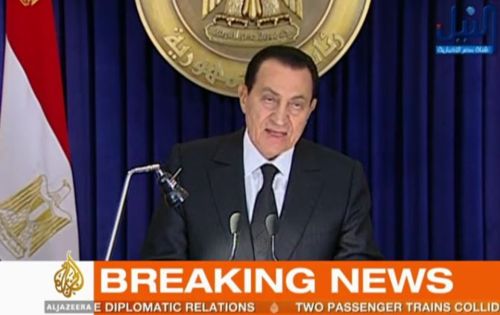
In the midst of continuing mass demonstrations against his rule in Egypt, president Hosni Mubarak has asked the government to resign. Mubarak seemingly hopes that the government’s resignation will appease the demonstrators. What’s interesting from our perspective–as students of comparative government–is that Mubarak hopes to maintain his regime at the expense of the government. It is accurate to call the current leadership of Mubarak a regime, since the norms/rules associated with political authority at the national level have been institutioinalised over the course of the almost three-decade reign by Mubarak as Egypt’s president. The question then becomes will the protesters be satisfied with a change in government alone, or will they insist on a change in the nature of this authoritarian regime, which will obviously not be effected without the removal from office of Mubarak himself. As in the case of many authoritarian regimes, in Egypt it is also true that the autocrat is the regime himself.

Here’s more from the CBC on Mubarak’s latest moves:

Egyptian President Hosni Mubarak says he has asked the government to resign and promised reforms as protests engulf his country.

In a televised speech broadcast early Saturday local time, Mubarak used his first public comments since the unrest began to defend the security crackdown on demonstrations.

“I assure you … I’m working for the people…. as long as you’re respecting the law,” Mubarak said.

“We have to be careful of anything that would allow chaos,” he said.

At the same, Mubarak tried to speak to the demonstrators who have filled Egypt’s streets for days.

“I’ll always be on the side of the poor,” he said. “I am with bettering the economy.”

Mubarak, who has ruled Egypt for three decades, has been facing the biggest pressure of his tenure.

Before the president spoke, tens of thousands of anti-government protesters defied a night curfew and some reportedly set fire to Mubarak’s party headquarters in Cairo. Flames were seen licking at the National Democratic Party headquarters shortly after 6 p.m. local time, though it was not immediately confirmed how the fire began.

The best real-time coverage of the political events in Egypt is, in my opinion, Al-Jazeera. You can watch live streaming coverage of Al-Jazeera here.

A Wave of Protests across North Africa and the Middle East

Following closely in the aftermath of the dramatic changes that have taken place in Tunisia recently, the political unrest seems to have swept its way across northern Africa, with the situation in Egypt now drawing most of the attention. Alan Cowell of the New York Times writes:

After days of protests that have toppled one president and shaken many others, governments across the Middle East braced on Friday for http://www.guardian.co.uk/global/blog/http://www.guardian.co.uk/global/blog/2011/jan/25/middleeast-tunisia://www.guardian.co.uk/global/blog/2011/jan/25/middleeast-tunisia/jan/25/middleeast-tunisia outbursts of rage and discontent directed at entrenched regimes confronting an exceptional clamor for democracy.

The immediate epicenter of the protests was Egypt, where Internet and cellphone connections were closed or restricted in Cairo, Alexandria and other places. Riot police took to the streets of Cairo before the Friday noon prayers that in http://www.guardian.co.uk/global/blog/2011/jan/25/middleeast-tunisia parts of the Islamic world have been a prelude to unrest as worshippers pour onto the streets.

The protests have underscored the blistering pace of events that have transformed the visage of the Arab world, particularly among regimes that have traditionally enjoyed the support of successive administrations in Washington.

Note the words that I have changed to red in the quote above. Is this author using these words as synonyms? If so, is he using them as precisely as he could be? Is he using them incorrectly?

For more information, here’s a useful set of reports, with myriad links to video and audio, from the UK Guardian’s Jack Shenker reporting in Cairo. In addition, the CBC website has an interesting flash-type graphic showing how the geographical extent of the spread of the protests.

Theories of Ethnic Identity Formation and Ethnic Violence & Ivory Coast

In IS 309 this evening, we assessed the strengths and weaknesses of three competing theories of ethnic identity (and ethnic violence)–constructivism, primordialism, and instrumentalism. We read the following:

  • Fearon, James D. and David D. Laitin. 2000. Review: Violence and the Social Construction of
    Ethnic Identity,” International Organization, 54:4, pp. 845-877
  • Harvey, Frank P. 2000. Primordialism, Evolutionary Theory and Ethnic Violence in the Balkans:
    Opportunities and Constraints for Theory and Policy,” Canadian Journal of Political Science, 33:1,
    pp. 37-65
  • Collett, Moya. 2006. Ivoirian identity constructions: ethnicity and nationalism in the prelude to
    civil war,” Nations and Nationalism, 12(4), 613-629
  • Kaplan, Robert. D. 1993. Balkan Ghosts: A Journey through history Part I and One Chapter from each of Parts II, III, and IV.
  • Hechter, Michael. 1995. Explaining Nationalist Violence,” Nations and Nationalism, Vol 1(1), 53-68.
  • We then viewed a video on the breakdown of political life in the Ivory Coast and the descent of that once relatively prosperous west African state into civil war. The civil war was characterised as a battle between the “Muslim-populated north and the Christian-dominated south.” How accurate is this characterisation of the ethnic character of Cote D’Ivoire’s civil war?

    http://www.youtube.com/watch?v=UOjgiPMs7nc

    For information about the current political situation, in the wake of the refusal of former(?) President Laurent Gbagbo to acknowledge having lost power in elections held several weeks ago, watch these.

    Independence Referendum in Southern Sudan

    The most important international political event occurring this week is arguably the independence referendum in southern Sudan. Despite clashes a couple of days ago along the border separating the north and south, which left dozens dead, the New York Times reports that voting is peaceful. As The Globe and Mail’s Geoffrey York notes, while the referendum may ultimately lead to a new state being created in the south, the cost “has been horrific.”

    Southern Sudan has been consumed by devastating wars for most of the past half-century. An estimated 2.5 million people have perished in those wars, with atrocities on all sides that were shocking in their cruelty.

    After decades of indifference by most of the world, the irony is that Southern Sudan suddenly became a fashionable cause over the past decade. Its oil exports became lucrative, forcing the north and south to try to settle their conflict in order to protect their revenue flows. Simultaneously, there was a rapid escalation of U.S. diplomatic pressure on both sides, including the threat of sanctions – partly because evangelical Christian lobbyists had persuaded Congress that it needed to protect the south’s Christians from Muslim persecution.

    Here’s a fascinating set of maps creating by the BBC to show that the north and south of Sudan differ in more than simply ethnicity and oil wealth.

    Here’s a report from Al Jazeera about some of the important issues related to the referendum:

    ICG Report–Diamonds and the Central African Republic (CAR)

    The International Crisis Group (ICG) has just released a new report on the influence of diamonds on the political situation in the Central African Republic (CAR). We’ve read various papers on the link between resource wealth (“lootable resources”) and political outcomes, such as regime type and economic outcomes. This report analyses the link between the presence of large stores of diamond wealth in CAR, the level of political instability (it’s essentially a failing state) and the existence of endemic conflict.  From the executive summary of the report:

    In the diamond mines of the Central African Republic (CAR), extreme poverty and armed conflict put thousands of lives in danger. President François Bozizé keeps tight control of the diamond sector to enrich and empower his own ethnic group but does little to alleviate the poverty that drives informal miners to dig in perilous conditions. Stringent export taxes incentivise smuggling that the mining authorities are too few and too corrupt to stop. These factors combined – a parasitic state, poverty and largely unchecked crime – move jealous factions to launch rebellions and enable armed groups to collect new recruits and profit from mining and selling diamonds illegally. To ensure diamonds fuel development not bloodshed, root and branch reform of the sector must become a core priority of the country’s peacebuilding strategy.

    Nature scattered diamonds liberally over the CAR, but since colonial times foreign entrepreneurs and grasping regimes have benefited from the precious stones more than the Central African people. Mining companies have repeatedly tried to extract diamonds on an industrial scale and largely failed because the deposits are alluvial, spread thinly across two large river systems. Instead, an estimated 80,000-100,000 mostly unlicensed miners dig with picks and shovels for daily rations and the chance of striking it lucky. Middlemen, mostly West Africans, buy at meagre prices and sell at a profit to exporting companies. The government lacks both the institutional capacity to govern this dispersed, transient production chain and the will to invest diamond revenues in the long-term growth of mining communities.

    Chronic state fragility has ingrained in the political elite a winner-takes-all political culture and a preference for short-term gain. The French ransacked their colony of its natural resources, and successive rulers have treated power as licence to loot. Jean-Bédel Bokassa, the CAR’s one-time “emperor”, created a monopoly on diamond exports, and his personal gifts to French President Giscard d’Estaing, intended to seal their friendship, became symbols of imperial excess. Ange-Félix Patassé saw nothing wrong in using his presidency to pursue business interests and openly ran his own diamond mining company. Bozizé is more circumspect. His regime maintains tight control of mining revenues by means of a strict legal and fiscal framework and centralised, opaque management.

    The full report can be accessed here. Here is a Al-Jazeera English news report on the situation in CAR.

    “Ghosts of Rwanda” Documentary

    As a video supplement to the Rwanda chapter from Samantha Power’s book on genocide, and the Gourevitch book, we viewed the first part of the PBS Frontline documentary “Ghosts of Rwanda” in class today. Please view the remaining hour or so sometime before next Friday’s class as we will use the first portion of that session to continue our discussion on the international community’s failure to halt the slaughter of more than 800,000 Tutsis by the Hutu-led Rwandan government.Here’s the first part of the documentary. Click on the video to take yourself to Youtube, where you will easily find the remaining parts.


    Design a site like this with WordPress.com
    Get started