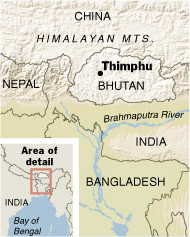
THIMPHU, Bhutan (Agence France-Presse) — Bhutan stands poised to become the world’s newest democracy on Monday with elections ordered by its revered royal family to end its absolute rule.
The tiny Buddhist state, wedged in the Himalayas between India and China, will elect members for a lower house, ending the century-long rule of the hugely popular Wangchuck dynasty.Bhutan’s Oxford-educated ruler, King Jigme Khesar Namgyel Wangchuck, 28, made a forceful last-minute appeal over the weekend to his subjects — some of whom were initially reluctant to bring in democracy — to vote.“As you approach the duty of voting at the elections that will bring democracy, do so with pride and confidence of a people that have achieved so much,” he said in a statement published in the nation’s newspapers. “First and foremost, you must vote. Every single person must exercise his or her franchise.”
The king is the fifth ruler in the dynasty, in power since 1907. The path to democracy began in 2001, when the former king, Jigme Singye Wangchuck, handed over the day-to-day tasks of government to a council of ministers, and finally stepped down in favor of his son in late 2006.
Since then, father and son have traveled the country to explain to its 670,000 people why the nation should embrace democracy.
International Relations–Paper One Assignment
Academic use theories as a lens/filter through which to analyze and discuss important events in international relations. In that way, we can understand more about the event and compare it to other events, which we believe may have similar characteristics and causes. We’ll be using IR theories profusely in this course so it is important that the student has a strong understand of the main theories used in IR.
Introduction to International Relations Paper 1–Using Theory to
Understand StuffAs Mingst notes in the conclusion of Chapter 3, the theoretical lens/filter through which one views the world determines to a large extent what one sees. Realists look at the Iraq war and see and understand it in a particular way, whereas radicals/Marxists see the same event and interpret it very differently. For this first paper assignment, I would like you to select an important event in international politics (it could be as grand as the Second World War, or less grand–the US decision to boycott the Olympic Games in Moscow in 1980) and critically analyze from the perspective of two competing
IR theories. Some of the elements of the paper should be:
- A description of the basic tenets/principles of the competing IR theories.
- Reference to any levels-of-analysis that are important in understanding the event.
- A short description of the event itself (i.e., the who, what, where, when).
- An assessment of the event from a theoretical perspective, including an evaluation of which of the theories provides more support for understanding why the event occurred, or why it developed in the manner in which it did.
You will obviously use Chapter 3 of the Mingst book (Essentials of International Relations) as a source for the paper. For information related to your specific states, you will have to consult at least 3 other academically reputable sources. Note that this means Google is not your friend here!! This will entail a trip down to the library by foot, or a virtual trip to the library’s electronic resources. Finally, use the course page at the Library’s web-site for further sources to use.
Your paper should be 4 − 5 pages long (maximum!!), double-spaced on 8.5X11 − inch paper, with 1-inch margins on the top, bottom, and the sides. The paper must be written in Times Roman 12pt. font, with a separate title page and works cited page.3 The paper is due electronically via Digital Dropbox in Blackboard by the beginning of class on Wednesday, February 20th4. Finally, I
will also require that you electronically append a “paper evaluation sheet to the end of your paper, which I’ll use as a rubric to evaluate the paper. (Once again, I’ll show you exactly how to do this next week.)
Comparative Politics–Paper One Assignment
Here is the prompt for the first paper in Comparative. The state is an extremely important concept in comparative politics and we will refer to it and its characteristics again and again over the course of the semester. As such, it is important to develop a strong understanding of the state as a concept, and it is, therefore, the topic of the first paper assignment.
Introduction to Comparative Politics Paper 1O’Neil writes that while many different types of political organization have existed throughout orld history, the
globe is now clearly demarcated by only one type of political organization–the state–that over the past few hundred years has displaced vitually all other political structures. Almost no inhabitable territory or people on the face of the earth is not claimed by some state.
For this paper, please select two states as the subject of your paper, one of which is s developed state and the other of which is a “Top-40” state on the Failed States Index (i.e. it falls in either the red or orange categories). Your task is to comparatively analyze the nature of the state in each of these two states. I want you to mostly describe (i.e., what, where, when, etc.), but also explain (how, why) the similarities and differences between the state in these two states by answering the following questions:
- When was the state formed? How was it formed? That is, was it formed through revolution, secession, de-colonization, etc.
- What is the nature of the current ruling regime (democratic, authoritarian), how long has this regime been in place, and does this state have a tendency to rotate types of regime frequently?
- The nature of the government? Do governments tend to last? Are they replaced democratically?
- Assess the nature of the legitimacy of the regime. Is the regime seen as legitimate? On which of the three Weberian ideal-types of legitimacy does the legitimacy of the regimes mostly rest?
- Is this state centralized or decentralized?
- Is the state strong and does it have high capacity? What kinds of evidence have you used to support the previous claim?
- Lastly, is state autonomy high or low? Please explain.
Please use chapter 2 of the O’Neil book (Essentials of Comparative Politics) as a source for the paper. For information related to your specific states, you will have to consult at least 3 other academically reputable sources. Note that this means Google1 is not your friend here!! This will entail a trip down to the library by foot, or a virtual trip to the library’s electronic resources. In addition, pleaes avail yourself of the many posts on my link to resources that collect data on different aspects of the state. Finally, use the course page at the Library’s website for further sources to use, such as Country Watch.
Your paper should be 4 − 5 pages long, double-spaced on 8.5X11 − inch paper, with 1-inch margins on the top, bottom, and the sides. The paper must be written in Times Roman 12pt. The paper is due electronically via Digital Dropbox in Blackboard by the beginning of class on…
UN Peacekeeping Mission in Darfur Failing?
A couple of weeks ago we watched the National Film Board of Canada documentary film, The Peacekeepers, in introduction to IR. It was a fascinating behind-the-scenes look at the enterprise of UN peacekeeping operations, demonstrating the successes and failures of the UN in attempting to create and keep the pace amongst Congo’s warring factions. We saw the clash between realist views of international sovereignty, security, and power and the liberal ideal of multinational cooperation. The New York Times reports today on the potential failure of a relatively new UN peacekeeping operation before it has even started. Those who have been following the atrocities in the Darfur region of Sudan know that it has taken four years to get a UN peacekeeping force on the ground. It may already be doomed to failure. It is uncanny how much of this report sounds like it was taken directly from the documentary about Sudan.
ABU SUROUJ, Sudan — As Darfur smolders in the aftermath of a new government offensive, a long-sought peacekeeping force, expected to be the world’s largest, is in danger of failing even as it begins its mission because of bureaucratic delays, stonewalling by Sudan’s government and reluctance from troop-contributing countries to send peacekeeping forces into an active conflict.
The force, a joint mission of the African Union and the United Nations, officially took over from an overstretched and exhausted African Union force in Darfur on Jan. 1. It now has just over 9,000 of an expected 26,000 soldiers and police officers and will not fully deploy until the end of the year, United Nations officials said.
Even the troops that are in place, the old African Union force and two new battalions, lack essential equipment, like sufficient armored personnel carriers and helicopters, to carry out even the most rudimentary of peacekeeping tasks. Some even had to buy their own paint to turn their green helmets United Nations blue, peacekeepers here said.
The peacekeepers’ work is more essential than ever. At least 30,000 people were displaced last month as the government and its allied militias fought to retake territory held by rebel groups fighting in the region, according to United Nations human rights officials.
Russian Journalist found Murdered
Freedom House, a prominent NGO that monitors and assesses the level of civil and political rights and freedoms in the world, downgraded Russia’s status in 2004 from Partly Free to Not Free. This is part of the legacy of Vladimir Putin’s rule in Russia. Another part of the legacy has been the dramatic number of journalists killed in Russia over the last decade. Most of these journalists had either been working on, or had reported stories about, corruption in the government and business elite.
Here is the report from Euronews about the latest Russian journalist to be killed:
A Russian journalist has been assassinated in Moscow. Ilias Shurpaiev, who worked for the state-run Channel One, was found dead in his flat. He had apparently being strangled with a belt and suffered stab wounds. Shurpaeiv, a native of the mostly Muslim Dagestan province, was the author of several reports on the Caucusus region.
More than a dozen journalists have been killed in contract-style killings in Russia since 2000.
My (winning) NCAA Bracket
Here it is…viewprintbracket1.pdf
What is the take-home message? The SEC is not very good this year, and the PAC10 and Big East are the best conferences, and will each place 4 teams in the Sweet 16. The BIG12 is decent, and the BIG10 (11) is lousy. Take my word for it.
Resource Dependent Regimes in Sub-Saharan Africa
Jensen and Wantchekon (2000) have created an index of resource dependence and determined the level of the same for the states of sub-Sarahan Africa. The scores range from 1 (no resource dependence) to 4 (extreme resource dependence). They use this as an important independent variable in determining democratic transition, consolidation, and government effectiveness. How much of an effect does resource dependence have on each of these dependent variables? You’ll have to read the paper to find out, or attend my class in intro to comparative tomorrow.

Learning Objectives for Intro to Comparative
Here are the learning objectives for my introduction to comparative politics course. In other words, students who have taken that course should have developed the following competencies:
Understand and use the tools of both qualitative and quantitative analysis to ask and answer questions about substantive issues in comparative politics.
- Identify the strengths and weaknesses of the comparative method and its variants.
- Effectively discuss the development of comparative politics as a sub-discipline in the field of political science.
- To be able to understand and effectively critique a state-of-the art scholarly article in the field of comparative politics.
- Discuss competently the merits of empirical and statistical evidence that is used in the field of comparative politics.
- Analyze various substantive issues in comparative politics from culturalist, institutionalist, and rational choice perspectives.
- Express fundamental concepts in comparative politics both verbally and in written form.
- Use extant on-line cross-national databases to access and find data appropriate to comparing countries across the world with respect to basic political attitudes and ideologies.
- Describe and understand the tri-partite structure of society–state, civil society, and market–and understand the interactions amongst them.
- Assess the nature of democracy–its causes, consequences and how democratic regimes vary across the world.
- Develop a broad understanding of the nature of contemporary states across the world, from the most developed states to the least developed.
- Acquire the ability and the tools to effectively compare the states of the world on a broad range of issues, from economic development, to state strength, to governance, and social diversity.
- Write an effective critical paper on a topic related to comparative politics.
- Effectively use the electronic educational tool, Blackboard, to upload and download materials, make use of discussion-type tools facilitating online discussion and interaction with class members outside of class sessions.
- Locate appropriate library resources, both printed and electronic, to aid in the writing of critical papers.
- Learn to find, assess the legitimacy and veracity of, and use online resources related to comparative politics.
- Demonstrate a strong understanding of these aforementioned concepts in examination format, working under the pressure of a time limit.
- Develop the skills necessary to effectively critically evaluate and discuss the production of political knowledge.
- Develop the ability to become discerning and thoughtful consumers of political knowledge, whether that knowledge is created by politicians and other political leaders, the media, other citizens, or the students themselves.
No Torture. No Exceptions.
The above sketch by Thomas V. Curtis, a former Reserve M.P. sergeant, is of an Afghan detainee, Dilawar, who was taken into U.S. custody on December 5, 2002, and died five days later. Dilawar was deprived of sleep and chained to the ceiling of his cell—techniques that the Bush administration has refused
to outlaw for use by the CIA. Further, his legs were, according to a coroner, “pulpified” by repeated blows. Later evidence showed that Dilawar had no connection to the rocket attack for which he’d been apprehended.
One of the most important tenets of my teaching philosophy is to make the classroom a safe forum for diverse and competing points of view. In order to facilitate this, I believe that it is necessary, as much as is humanly possible, to refrain from promoting my own views and importing my personal biases into what I teach. I will temporarily put that tenet aside in order to address the topic of torture.
The United States government tortures. That’s a difficult sentence for me to write. The human rights organization for which I worked in Croatia during the 1990s–the Croatian Helsinki Committee–was at the forefront of the effort in that country to stop human rights abuses, such as torture, that the Tudjman-led regime was committing during those years. I would often find myself in debate with individuals–soldiers, police officers, government officials, religious leaders, and average citizens–about the human rights abuses the government was committing. My argument was basically, “we (in Croatia) are being hypocritical if, on the one hand, we claim that we are superior–in some civilizational sense (this is argument that was made, though I don’t adhere to it)–to the Serbs because we are more “Western” and more democratic, yet we allow our government (with our support) to commit absolutely horrific human rights abuses. We should try to mimic the behavior, then, of Western democracies such as Canada and the United States rather than the abhorrent policies of the Milosevic regime.”
My interlocutors would usually reply, “but, Canada’s, and America’s government would be doing the same thing if 1/3 of their territory was under foreign occupation.” I replied that they would not. I have to apologize to every single one of those people, because they were right and I was wrong. And it didn’t even take foreign occupation for the US government to begin to undermine the fundamental tenets upon which democracy and the respect for human dignity are based. My attitude towards torture is nicely captured by the title of a recent series on torture put out by the magazine Washington Monthly–“No Torture. No Exceptions.”
We’ll take a look at the debate on torture near the end of the semester (in intro to IR) and we’ll see that the strongest moral claim for torture comes from a consequentialist (or utilitarian) perspective; this is why the “ticking bomb scenario” is customarily trotted out to refute deontological arguments. I will argue (and I encourage you to try to prove me wrong) that there are consequentialist reasons for not torturing. I encourage you to read the essays in “No Torture. No Exceptions.” (In fact, if you’re in intro to IR, you’ll have to.)
Economic Growth and Pollution in Budapest
In intro to comparative, in a few weeks time, we’ll cover developments in the post-communist world of Eastern Europe. Here is an interesting report from one of my home towns (I lived and studied in Budapest for a year in the late 1990s) that looks at the effects of economic growth on first lowering and now raising levels of pollution in the majestic Hungarian capital.
Budapest, Hungary – Climb into the Buda Hills and look back at the flatlands of Pest and the pollution is obvious: a yellow-gray cloud that blankets the Hungarian capital much of the time.
Indeed, 19 years after the collapse of communism, Budapest’s air quality has become a problem again. Pollution exceeded recommended levels 115 days last year, 80 days more than permitted under European Union (EU) guidelines. [of which Hungary is a member.] In late December and early January, the capital experienced one of its most prolonged smog events in a decade.
When communism imploded in 1989, Budapest’s air was atrocious. With their two-cycle engines, fleets of Trabant automobiles spewed black clouds of lead-laden exhaust, while city busses and industrial facilities pumped eye-stinging emissions into the air. During the 1990s the air cleared as factories installed pollution controls, leaded gasoline was banned, and newer, cleaner Western cars replaced dirty Soviet ones.
But in recent years, those gains have been reversed as many Hungarians now drive to work from increasingly far-flung suburban areas. Lead and sulfur dioxide have been replaced by dangerous concentrations of tiny exhaust particles.
“We’ve exchanged [Victorian-era] London-type smog for Los Angles-type smog,” laments Janos Zlinszky of the Regional Environmental Center for Central and Eastern Europe. “The nature of our environmental problems is shifting.”
Across east-central Europe, a region once blighted by Communist-era pollution, economic development is bringing on a new set of environmental problems and, in some cases, bringing back old ones.


You must be logged in to post a comment.