Risk, Uncertainty–From Governor Weld to the Modern Financial System

Canadian academic Thomas Homer-Dixon (we will read one of his papers this semester in Intro to IR) has written a piece for Canada’s “paper of record”–the Globe and Mail, which is titled “From Risk to Uncertainty.”  Those of you in my intro to comparative politics class will surely recognize immediately the difference between the tho concepts.

Remember when we read the first two chapter of Shepsle and Bonchek on instrumental rationality, the authors used the example of then-Massachusetts Governor Weld.  Weld had to decide whether to run for Governor again, or to commit to challenging Democratic Senator Ted Kennedy’s Senate seat.  A win there would have given him a nice platform for an eventual presidential run.  Weld, as we know, was operating in a world or risk rather than uncertainty when making his decision, given that there were public opinion polls published that estimated his chances of winning in either election.

What is the difference between risk and uncertainty and how does it apply to the contemporary global financial system (which, by the way, for those of you not paying attention is precariously teetering on the edge of meltdown–you heard it here first!)?

So the rules of the game have now fundamentally changed. Our global financial system has become so staggeringly complex and opaque that we’ve moved from a world of risk to a world of uncertainty. In a world of risk, we can judge dangers and opportunities by using the best evidence at hand [what Shepsle and Bonchek call beliefs] to estimate the probability of a particular outcome. But in a world of uncertainty, we can’t estimate probabilities, because we don’t have any clear basis for making such a judgment. In fact, we might not even know what the possible outcomes are. Surprises keep coming out of the blue, because we’re fundamentally ignorant of our own ignorance. We’re surrounded by unknown unknowns.

Introduction to Comparative Politics–Second Paper

Here is the second paper, whose theme is “culture” (or not) and democracy.*”

Introduction to Comparative Politics Paper–Culture and Democracy

“In Islam, God is Caesar,in [Confucianism], Caesar is God; In [Eastern Christian] Orthodoxy, God is Caesar’s junior partner.”

“The underlying problem for the West in not Islamic fundamentalism. It is Islam.”

“Contemporary China’s Confucian heritage, with its emphasis on authority, order, hierarchy, and supremacy of the collectivity over the individual, creates obstacles to democratization.”

The quotes above will serve as the inspiration for your second paper this semester. I would like you to argue in favor or against the claims made by Huntington quoted above. You can argue that they are basically true, essentially false, or some combination thereof2. Regardless, your task is to provide a reasoned, well researched response to the declarative statements above, using Chapters 5 and 6 in O’Neil, and the articles by Fish, Stepan, Perry, Zakaria, and any others we have read, as your starting points.

Assess the arguments in light of what you know about the requirements (institutional, cultural, structural) of democracy and the nature of authoritarianism. Your outside research will most likely focus on understanding more about Islam, “Asian values,” and/or Christian Orthodoxy (as it is practiced in Eastern Europe).

While the main focus of your paper will be in setting up an argument for or against the claims above, I would like you to then use two states–one “predominantly Muslim”, and one Asian (or Eastern Orthodox)–to illustrate your main arguments and to act as supporting evidence for your claims. Please use chapters 5 and 6 of the Essentials and of Readings as the main source for the paper. For information related to your specific states, you will have to consult at least 4 other academically reputable sources. Note that this means Google is not your friend here!! This will entail a trip down to the library by foot, or a virtual trip to the library’s electronic resources.

Your paper should be 4-5 pages long, double-spaced on 8:5X11-inch paper, with 1-inch margins on the top, bottom, and the sides. The paper must be written in Times Roman 12pt. font. In addition, please cut and paste the “Paper Evaluation Sheet” from Blackboard to the end of your paper (after the works cited page). The paper is due electronically via Digital Dropbox in Blackboard by the beginning of class on Tuesday, April 15th.

Good luck, you kings and queens of comparative!!

*Note: See the version of this assignment posted to Blackboard as it has informative (and helpful) footnotes.

SKY News Report on Situation in Tibet

Here is an interesting video, which captures the events surrounding an organized (by the Chinese authorities) visit of non-Chinese journalists to the capital city of Tibet, Lhasa.  It seems as though events conspired against the Chinese authorities just a little bit:

From CSM–In Turkey, Secularists Escalate Fight Against Ruling AKP

Amongst the readings we’ll be addressing tomorrow in introduction to comparative politics is Alfred Stepan’s “The Twin Tolerations”, which analyzes the necessary mutual respect between religious society and political society that democracy demands. Please read this recent article from the Christian Science Monitor on the battle between Turkish secularists and the Islamic-oriented ruling party in Turkey, the Justice and Development Party (AKP), which is headed to Turkey’s court system. The secularists argue that the Turkish Constitution’s strict separation of church and state has been violated by the religious nature of the ruling party. Please bring this article to class tomorrow. Be prepared to discuss how well the “twin tolerations” are working here. Here are some excerpts:

Under scrutiny: Prime Minister Recep Tayyip Erdogan and his ruling party are facing heightened criticism for straying from the Constitution’s secular principles.
Umit Bektas/Reuters

turkey.jpg

After protesting the AKP’s presidential candidate, precipitating new elections, and then losing out to the AKP at the polls last year, hard-line secularists are now taking a new tack: trying to shut down the party for “expunging” the Constitution’s secular principles.

Turkey’s highest court is set to decide in the coming days whether to allow the motion, filed by the country’s top prosecutor on March 14, to go forward. If the Constitutional Court decides to allow the case to proceed, it could plunge Turkey into a deep crisis, threatening the country’s emerging political and economic stability and further jeopardizing its already troubled bid for European Union membership.

“This would definitely hinder the government in many ways. There are so many things to be done, such as issues relating to the EU, Cyprus, and the economy, and the government would no longer be in a position of authority,” says Sahin Alpay, a political science professor at Istanbul’s Bahcesehir University. “What the people going after the party are doing is really shooting the country in its own feet.”

EU officials have criticized the closure move, calling it antidemocratic.

“In a normal European democracy, political issues are debated in parliament and decided in the ballot box, not in the courtroom,” said EU Enlargement Commissioner Olli Rehn in response to the prosecutor’s unexpected call to shut down the AKP. “It is difficult to see that this lawsuit respects the democratic principles of a normal European society.”

24 parties closed since 1963

Turkish law gives the judiciary broad powers to shut political parties down. The Constitutional Court has closed 24 parties since it was established in 1963. The court is currently deciding on a motion to close the pro-Kurdish Democratic Society Party (DTP), accused of promoting ethnic separatism.

Join Me in Welcoming the World’s Newest Democracy

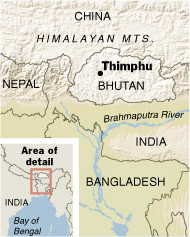
The Himalayan state of Bhutan has become the world’s newest democracy, upon the completion of elections there on Monday. As this Washington Post story notes, the change from monarchical to democratic rule was initiated by the benevolent monarchy. Bhutanese were reticent about what this would mean for Bhutan’s social cohesiveness and some lamented the potential danger of faction, with various political parties competing for the political allegiance of the newly-minted voters:

TOKTOKHA, Bhutan, March 24 — Without revolution or bloodshed, this tiny Himalayan kingdom became the world’s newest democracy Monday, as wildflower farmers, traditional healers, Buddhist folk artists and computer engineers voted in their country’s first parliamentary elections, ending a century of royal rule.

In a historic event for the country of 700,000, entire families took to winding mountainous roads, traveling sometimes for days in minivans, on horseback and on foot to cast their ballots, marking Bhutan’s transition to a constitutional monarchy.

Despite concerns that Bhutanese would be turned off by the rough-and-tumble world of politics, more than 79 percent of the estimated 318,000 registered voters turned out at polling places.

It was the king, as well as his father and predecessor, who ordered the subjects to vote, in the belief that democracy would foster stability in a geographically vulnerable country wedged between China and India and known as the Land of the Thunder Dragon.

Here’s an informative news report from the Canadian Broadcasting Corporation (CBC) on politics in Bhutan.

Afghan Aid Money Spent on High Salaries

After class today I spoke with a student who is interested in working in the humanitarian field after graduation.  Given that I had acquired some experience working for humanitarian organizations before heading to graduate school, I was able to impart some words of wisdom.  While I enjoyed my time working for humanitarian NGOs, I did find that it was very easy to get frustrated and become cynical.  Here’s a story from the Associated Press that reminded me of some of the reasons that I stopped working for humanitarian organizations (I encourage you to read the whole report):

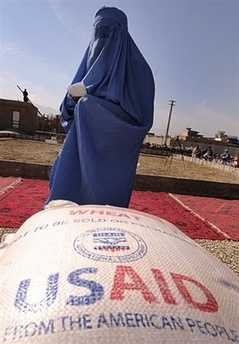
afghan_woman_usaid.jpg KABUL, Afghanistan – Too much money meant for Afghanistan aid is wasted, with a vast amount spent on foreign workers’ high salaries, security and living arrangements, according to a report from humanitarian groups published Tuesday.

The prospects for peace in Afghanistan are being undermined because Western countries are failing to deliver on aid promises — and because much of the aid money they do send is going to expatriate workers, according to the Agency Coordinating Body for Afghan Relief, an alliance of 94 international aid agencies.

Since 2001, the international community has pledged $25 billion in help but has delivered only $15 billion, the alliance said. Of that $15 billion, some 40 percent of it — or $6 billion — goes back to donor countries in corporate profits and consultant salaries, the report found.

“A vast amount of aid is absorbed by high salaries, living, security, transport and accommodation costs for expatriates working for consulting firms or contractors,” the report said. The costs are increasing with a recent deterioration in security, it said.

The cost of a full-time expatriate consultant working in Afghanistan is around $250,000, according to the group.

This is some 200 times the average annual salary of an Afghan civil servant, who is paid less than $1,000″ per year, the report said.

Amy Frumin, an international affairs fellow with the Council on Foreign Relations who spent a year in Afghanistan as an officer on a U.S. Agency for International Development reconstruction team, said blaming high expat salaries is unfair.

“You have to pay them good money to do that. They’re still having trouble finding people to fill these positions. It’s a dangerous place. Not many people are willing to risk their limbs,” she said.

Nicolae Ceausescu and the Cult of Personality

Today in introduction to comparative we discussed various coercive tactics available and generally used by authoritarian and dictatorial leaders.  One of them is the cultivation of a “cult of personality.”  Nobody was better at it than the late (executed) Romanian Communist dictator Nicolae Ceausescu.  This clip from youtube is a treasure as it shows the dictator’s last public speech; within hours both he and his equally loathsome spouse, Elena, had been executed.

Note a couple of things; first, the dramatic banners, huge photographs of the ruling couple, and other similar accoutrements of the public celebrations of a totalitarian regime.  Note also the massive crowds. In totalitarian systems (as opposed to authoritarian ones), every thing is politicized and one’s presence at events such as this would be expected.  Apathy is not allowed, and it is considered reactionary.

The second fascinating phenomenon is when the crowd (or portions thereof) begins to whistle and jeer its disapproval while Ceausescu is speaking.  The voice on his face as he realizes that he has lost the crowd is absolutely fascinating.  Rarely in history is an event like this captured for posterity.

40th Anniversary of the Prague Spring and Soviet Invasion of Czechoslovakia

 This Spring marks the 40th anniversary of the Prague Spring–a domestic, Czech-led liberalization and democratization movement in the former Czechoslovakia–and the subsequent Soviet military invasion of that former communist state.  As Czechs sang and wrote their way towards a regime Czechs would describe as “Communism with a human face”, Leonid Brezhnev–the leader of the Soviet Union–rolled Soviet tanks onto the streets of Prague to put an end to Alexander Dubcek’s reforms.  This was the first concrete foreign policy manifestation of the “combating of anti-socialist forces,” which came to be known as the Brezhnev Doctrine.

Euronews has an interesting report on the commemoration of the Prague Spring, which has been uploaded to youtube.  I encourage you to take a look.

It’s Spring, so how is your Bracket Doing?

pakistan_gilani.jpg
Well, it’s that time of year again. Has your bracket been busted? How many of you can honestly claim that you predicted the upset of Yousaf Raza Gilani becoming Pakistan’s new Prime Minister? Now I realize that most of you were predicting a victory for Ma Ying-jeou in Taiwan’s recent presidential elections. But did you honestly think that he would win by 15! (He won 57.5% of the vote.) Mr. Gilani almost busted my bracket, but I think that I may be able to redeem myself with my pick for the winner of the upcoming Serbian Parliamentary elections (given that the Balkan Conference is a mid-major, that group of countries has not been followed very closely and I have a little bit of an advantage in prognosticating the outcome there).
taiwan_ying_jeou.jpg
Current Prime Minister, Vojislav Koštunica, disbanded his coalition government on March 13 due to tensions within the governing coalition as a result of the declaration of independence by the former Serbian province of Kosovo. New elections are slated to be held on May 11 of this year, with Koštunica’s conservative and nationalistic Democratic Party of Serbia will find its strongest challenge from Serbian President Boris Tadić‘s bloc of pro-democratic and pro-Western parties and the ultra-nationalist Serbian Radical Party. It will be interesting to observe how much the apparent loss of the Kosovo (the “Serbian Jerusalem”) will help the ultra-nationalists and hurt Koštunica.
And finally, my surprise pick to get to the Final Four from the East Region is the tiny Himalayan state of Bhutan, which has been flying under the radar but has been getting its democratic game together. As Agence-France Presse reports, democracy is marching inexorably onward in a fit of Fukuyaman glee:
0324-web-bhutanmap.jpgTHIMPHU, Bhutan (Agence France-Presse) — Bhutan stands poised to become the world’s newest democracy on Monday with elections ordered by its revered royal family to end its absolute rule.
The tiny Buddhist state, wedged in the Himalayas between India and China, will elect members for a lower house, ending the century-long rule of the hugely popular Wangchuck dynasty.Bhutan’s Oxford-educated ruler, King Jigme Khesar Namgyel Wangchuck, 28, made a forceful last-minute appeal over the weekend to his subjects — some of whom were initially reluctant to bring in democracy — to vote.

“As you approach the duty of voting at the elections that will bring democracy, do so with pride and confidence of a people that have achieved so much,” he said in a statement published in the nation’s newspapers. “First and foremost, you must vote. Every single person must exercise his or her franchise.”

The king is the fifth ruler in the dynasty, in power since 1907. The path to democracy began in 2001, when the former king, Jigme Singye Wangchuck, handed over the day-to-day tasks of government to a council of ministers, and finally stepped down in favor of his son in late 2006.

Since then, father and son have traveled the country to explain to its 670,000 people why the nation should embrace democracy.

Wow! I think we have one of those rare instances of enlightened despotism.

International Relations–Paper One Assignment

Academic use theories as a lens/filter through which to analyze and discuss important events in international relations. In that way, we can understand more about the event and compare it to other events, which we believe may have similar characteristics and causes.  We’ll be using IR theories profusely in this course so it is important that the student has a strong understand of the main theories used in IR.

Introduction to International Relations Paper 1–Using Theory to
Understand Stuff

As Mingst notes in the conclusion of Chapter 3, the theoretical lens/filter through which one views the world determines to a large extent what one sees. Realists look at the Iraq war and see and understand it in a particular way, whereas radicals/Marxists see the same event and interpret it very differently. For this first paper assignment, I would like you to select an important event in international politics (it could be as grand as the Second World War, or less grand–the US decision to boycott the Olympic Games in Moscow in 1980) and critically analyze from the perspective of two competing
IR theories. Some of the elements of the paper should be:

  • A description of the basic tenets/principles of the competing IR theories.
  • Reference to any levels-of-analysis that are important in understanding the event.
  • A short description of the event itself (i.e., the who, what, where, when).
  • An assessment of the event from a theoretical perspective, including an evaluation of which of the theories provides more support for understanding why the event occurred, or why it developed in the manner in which it did.

You will obviously use Chapter 3 of the Mingst book (Essentials of International Relations) as a source for the paper. For information related to your specific states, you will have to consult at least 3 other academically reputable sources. Note that this means Google is not your friend here!! This will entail a trip down to the library by foot, or a virtual trip to the library’s electronic resources. Finally, use the course page at the Library’s web-site for further sources to use.
Your paper should be 4 − 5 pages long (maximum!!), double-spaced on 8.5X11 − inch paper, with 1-inch margins on the top, bottom, and the sides. The paper must be written in Times Roman 12pt. font, with a separate title page and works cited page.3 The paper is due electronically via Digital Dropbox in Blackboard by the beginning of class on Wednesday, February 20th4. Finally, I
will also require that you electronically append a “paper evaluation sheet to the end of your paper, which I’ll use as a rubric to evaluate the paper. (Once again, I’ll show you exactly how to do this next week.)

Design a site like this with WordPress.com
Get started