Is there a causal link between Natural Resources and Conflict?

The “resource curse” is the name given to the alleged causal links between a country’s abundance of natural resourcee and the existence of all sorts of “bad things”, such as authoritarianism, economic stagnation and/or outright economic decline, increased probability of attempted coups d’etat, etc.  In our session on political economy we read Jensen and Wantchekon’s article on the link between natural resource wealth and authoritarianism, specifically, and we also looked at Richard Snyder’s article on the putative link between the existence of what he calls “lootable wealth” and political (in)stability in a state.  Their conclusions were at times complementary but at times divergent.  What matters (at least for political stability), according to Snyder, is the ability of the rulers (i.e., the government) to partake of the rents/riches accrued by the exploitation of the particular “lootable” resource.

Snyder’s is, of course, not the final word on the topic and there is an avalanche of published research on this very topic.  A new resource that can be used to find data on the link between natural resources and conflict–political, civil, etc.–is the Resource Conflcit Monitor, maintained by the Bonn International Center for Conversion.  From their web site:

Many developing countries rich in natural resources, such as diamonds and oil, have been plagued by poverty, environmental degradation and violent conflicts. In many of these countries, the natural wealth has not led to sustainable development. On the contrary, in some instances resource wealth has provided the funding and reasons for sustaining civil wars. This so-called ‘resource curse’ brought a lot of attention to the link between resources and conflict over the past decade. ’Governance’ has been identified as key factor for understanding the resource-conflict dynamic and for mitigating its negative impact in developing countries. ‘Resource governance’ in the present context describes the way in which governments regulate and manage the use of natural resources as well as the redistribution of costs and revenues deriving from those resources

The Resource Conflict Monitor (RCM) monitors how resource-rich countries manage, administer and govern their natural resources and illustrates the impact of the quality of resource governance on the onset, intensity and duration of violent conflict. The RCM serves as a tool for identifying and supporting viable resource governance and contributes to conflict prevention, post-conflict reconstruction and sustainable development….

There is an informative, and user-friendly, application that provides historical annual information on conflict and resources in individual countries.  Here is the result for Sierra Leone, the specifics of which should be familiar to those of you who watched Cry Freetown.  For an explanation of “resource governance” and “resource regime compliance, go here and scroll down.

There’s an additional methodological point that is crying out to be made here.  Notice that the level of conflict intensity first decreases rather significantly between 1996 and 1997, then increases dramatically between 1997-1999, to then fall just as dramatically between 2000 and 2002, while at the same time “resource governance” and “resource regime compliance” do not change much at all.  This means that we have to be very careful about attributing the level of conflict to the two afore-mentioned phenomena.  Maybe the causal link between these two and conflict intensity is not monotonic, maybe there is a threshold effect at work, or maybe the existence of an abundance of natural resources is a sufficient (under certain conditions) cause of conflict intensity.  On the whole, though, there certainlly doesn’t seem to be a clear linear, and/or monotonic relationship between resources and conflict (at least in Sierra Leone,  between 1996-2006)

Political Terror Scale

Authoritarian regimes use both “carrots” and “sticks” in order to control their citizens. The “sticks” approach encompasses everything from surveillance to outright physical brutality.  While the use of physical terror to undermine the bodily integrity of their citizens by authoritarian regimes is fairly well known, it is also evident that democracies are not immune to using this form of control over their populations.  Almost by definition, authoritarian regimes terror-prone, but how much more so than democracies. You can fine the answers to this at the Political Terror Scale website, where they have a set of interesting interactive maps.

How is “political terror” defined?  Well, they have created a scale (from 1-5) which is an indicator of the level of political terror citizens in a country face in any given year. The definitions for each of the categories is below.

El Salvador during the 1980s was ruled by a military regime, which used to death squads to “disappear” its internal opponents.  U2 took note:

rating scale Political Terror Scale Levels
Level 5 : Terror has expanded to the whole population. The leaders of these societies place no limits on the means or thoroughness with which they pursue personal or ideological goals.
Level 4 : Civil and political rights violations have expanded to large numbers of the population. Murders, disappearances, and torture are a common part of life. In spite of its generality, on this level terror affects those who interest themselves in politics or ideas.
Level 3 : There is extensive political imprisonment, or a recent history of such imprisonment. Execution or other political murders and brutality may be common. Unlimited detention, with or without a trial, for political views is accepted.
Level 2 : There is a limited amount of imprisonment for nonviolent political activity. However, few persons are affected, torture and beatings are exceptional. Political murder is rare.
Level 1 : Countries under a secure rule of law, people are not imprisoned for their view, and torture is rare or exceptional. Political murders are extremely rare.

Totalitarianism and 1984

This week we are addressing authoritarianism and totalitarianism.  As mentioned in the textbook, totalitarian regimes are extremely odious, but fortunately are also relatively rare.  There are a couple of regimes today than can safely be characterized as totalitarian–North Korea and Burma.

Totalitarian regimes are characterized by the desire on the part of rulers for complete control of all of the state, civil society and economy.  There is much overt violence and other forms of both cooptation and coercive control.  Take a look at these two video clips of the film adaptation of George Orwell’s famous novel, 1984, and see if you can think of how many characteristics of a totalitarian regime you notice.

Israel and Syria once again Negotiating over Golan Heights

In intro to IR on Wednesday we addressed global environmental issues and we went over this chart outlining Thomas Homer-Dixon’s overview regarding the link between environmental scarcity and security. According to Homer-Dixon, environmental degradation is not only an important economic, social, and health issue, it is crucially an issue of importance for global security.

We see the important link between increased environmental scarcity and social effects (like ethnic conflicts, deprivation conflicts and coups d’etat), facilitated indirectly at times by the conditions of weakened states.

Homer-Dixon argues that these environmentally-driven conflicts will increase the more the environment degrades. Moreover, it is just those places in the world that have the least capacity to deal with the potentially negative effects of environmental degradation whose environments will be most likely to suffer.

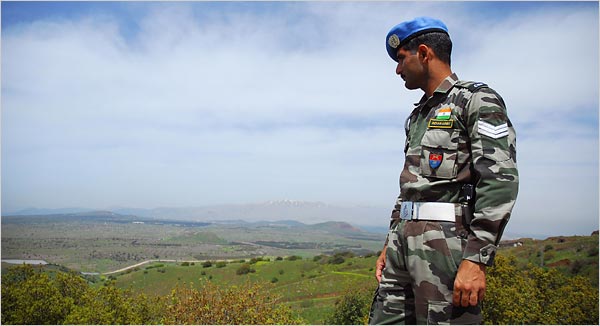
In the far left column is “unequal resource access”. One of the most important resources to humankind is water. The conflict between Syria and Israel over the Golan Heights is crucially linked to water. As we learn from the New York Times:

JERUSALEM — Peace overtures between Israel and Syria moved up a gear on Wednesday when a Syrian cabinet minister said that Prime Minister Ehud Olmert of Israel had sent a message to President Bashar al-Assad to the effect that Israel would be willing to withdraw from all the Golan Heights in return for peace with Syria.

The Syrian expatriate affairs minister, Buthaina Shaaban, told Al Jazeera television, “Olmert is ready for peace with Syria on the grounds of international conditions; on the grounds of the return of the Golan Heights in full to Syria.” She said that Turkey had conveyed the message.

Israeli officials did not deny the statement from Damascus but would not confirm it either, offering a more general, positive reaction. “Israel wants peace with Syria; we are interested in a negotiated process,” said Mark Regev, a spokesman for Mr. Olmert. “The Syrians know well our expectations, and we know well their expectations…”

“…Withdrawal from the Golan Heights is a contentious issue in Israel. The territory is a strategic plateau that overlooks a large swath of northern Israel. Israel has objected to past Syrian demands for access to the shore of the Sea of Galilee, a main water source for Israel.

Yehuda Raizner/Agence France-Presse — Getty Images

An Indian member of the United Nations force in the Golan Heights, a strategic

plateau that overlooks a swath of northern Israel.

Rice Prices Surge 30% in one Day

I think I’ll start eating more quinoa.

The Financial Times reports that “fears of unrest rise across Asia as rice price surges 30% in a day.”  In a BBC interview, the director of the International Rice Research Institute (IRRI–don’t tell me you didn’t know one existed) bluntly states why this could be a major problem.

“Rice is the staple food for about half the world’s population, and over half the world’s poor.”

As the FT reports, many events has transpired to cause such a dramatic, sudden rise in the price of this extremely important food staple and the potential political effects.

Rice prices jumped 30 per cent to a record high yesterday, raising fears of fresh outbreaks of social unrest across Asia, where the grain is a staple food for more than 2.5bn people.

The increase came after Egypt, a leading exporter, imposed a formal ban on selling rice abroad to keep local prices down and the Philippines announced plans for a major purchase of the grain in the international market to boost supplies.

Global rice stocks are at their lowest since 1976. While prices of wheat, corn and other agricultural commodities have surged since late 2006, the rice prices increase started in January.

The Egyptian export ban formalises a previous poorly enforced curb and follows similar restrictions imposed by Vietnam and India, the world’s second and third-largest exporters.

Cambodia, a small seller, also announced an export ban.

These foreign sales restrictions have removed about a third of the rice traded in the international market.

Chookiat Ophaswongse, president of the Thai Rice Exporters Association, said: “I have no idea how importing countries will get rice.” He forecast prices would rise further.

Here is the BBC interview with the head of the IRRI:

Unrest in Egypt due to Inflation

The Financial Times reports a rise in social unrest in Egypt, which has been attributed to inflation, rising food costs in particular. Inflation is soaring in most parts of the Middle East, from the affluent enclaves of the United Arab Emirates to the more distressed countries, such as Egypt. The main culprit is the record-level price of oil.

A wave of discontent has been sweeping through Egypt in response to mounting food prices and the return of long queues in front of bakeries selling subsidised bread – the only food item that has not recently risen in price.

Civil servants, industrial workers and even groups considered privileged such as doctors and university lecturers have been staging strikes and demanding higher pay to meet price increases of up to 50 per cent for some basic foods.

State university lecturers have gone on strike this week, bringing many classes to a halt for a day. “Faculty members in Egypt are normally a very conservative group who do not want to expose themselves to trouble,” said Hany Al Husseini, one of the strike organisers. “But now the economic situation has become so bad that people are prepared to do anything.”

UN Peacekeeping Mission in Darfur Failing?

A couple of weeks ago we watched the National Film Board of Canada documentary film, The Peacekeepers, in introduction to IR.   It was a fascinating behind-the-scenes look at the enterprise of UN peacekeeping operations, demonstrating the successes and failures of the UN in attempting to create and keep the pace amongst Congo’s warring factions.  We saw the clash between realist views of international sovereignty, security, and power and the liberal ideal of multinational cooperation.  The New York Times reports today on the potential failure of a relatively new UN peacekeeping operation before it has even started.  Those who have been following the atrocities in the Darfur region of Sudan know that it has taken four years to get a UN peacekeeping force on the ground.  It may already be doomed to failure.  It is uncanny how much of this report sounds like it was taken directly from the documentary about Sudan.

un_darfur.jpg ABU SUROUJ, Sudan — As Darfur smolders in the aftermath of a new government offensive, a long-sought peacekeeping force, expected to be the world’s largest, is in danger of failing even as it begins its mission because of bureaucratic delays, stonewalling by Sudan’s government and reluctance from troop-contributing countries to send peacekeeping forces into an active conflict.

The force, a joint mission of the African Union and the United Nations, officially took over from an overstretched and exhausted African Union force in Darfur on Jan. 1. It now has just over 9,000 of an expected 26,000 soldiers and police officers and will not fully deploy until the end of the year, United Nations officials said.

Even the troops that are in place, the old African Union force and two new battalions, lack essential equipment, like sufficient armored personnel carriers and helicopters, to carry out even the most rudimentary of peacekeeping tasks. Some even had to buy their own paint to turn their green helmets United Nations blue, peacekeepers here said.

The peacekeepers’ work is more essential than ever. At least 30,000 people were displaced last month as the government and its allied militias fought to retake territory held by rebel groups fighting in the region, according to United Nations human rights officials.

Ethnic Conflict and Strife

A couple of days ago all blog posts seemed to be related to the theme “the social logic of politics”. Today, there seems to be a surge in episodes of inter-ethnic conflict worldwide. First, we learn from the Washington Post, that there is unrest and violence in the Tibetan capital of Lhasa, where a week of increasing confrontations between native Tibetans and the Chinese government have turned violent, with native Tibetans battling with Chinese police and troops and also attacking ethnic Han Chinese, which is either unprecedented or extremely rare.

BEIJING, March 14 — A week of tense confrontations over Chinese rule in Tibet erupted in violence Friday, as hundreds of protesters clashed with police and set fire to shops in the center of Lhasa. Doctors reported dozens of wounded streaming into area hospitals, and one witness said the downtown area was “in a state of siege.”

The rare breakout of violence, the worst in 20 years in the capital city of a remote mountainous region that is the heart of Tibetan Buddhism, posed a challenge to the Chinese government as it prepares to host the 2008 Olympic Games in August. Seeking to make the Games a worldwide celebration of its swift economic progress during the past three decades, the Chinese government has steadfastly attempted to project an image of harmony and stability, even while tightening its grip over the restive region.

“This spiraling unrest has triggered the scenario the Chinese prayed would not happen,” said Robbie Barnett, director of modern Tibetan studies at Columbia University. “Now we’re just watching the clock tick until people get off the street or the Chinese open fire.”

In a different part of the world, Malaysia, in which once again ethnic Chinese are involved, the New York Times reports on post-electoral tension on the island of Penang:

PENANG, Malaysia — Chanting “Long Live the Malays!” several hundred members of Malaysia’s largest ethnic group gathered Friday on this largely Chinese island, defying a police ban on protests and raising communal tensions after sharp electoral losses by the country’s governing party.

Newly elected state governments have moved rapidly to abolish some of the long-held privileges of ethnic Malays. Those efforts have challenged the core of Malaysia’s ethnic-based political system and inflamed the sensibilities of Malays. Until the March 8 elections, Malays thoroughly dominated politics through the country’s largest party, the United Malays National Organization, known by its initials, U.M.N.O.

The opposition parties that beat U.M.N.O. and its partners in five states say affirmative action should be based on need rather than ethnicity. But the opposition, too, is struggling to contain fissures along ethnic lines as a Chinese opposition party competes with its Malay counterpart.

“We’re living in very sensitive times,” said Tricia Yeoh, director of the Center for Public Policy Studies, an independent research center in Kuala Lumpur, the capital.

The affirmative action program favoring the Malays has been in place for more than three and a half decades and gives Malays everything from discounts on new houses to 30 percent quotas in initial public offerings of companies. It is known as the New Economic Policy.

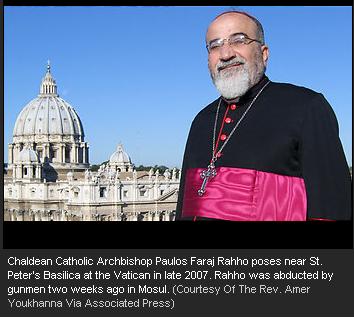
Finally, in Iraq, where in the last four years the minority Christian community has been decimated, either through targeted killings or ethnic cleansing, we hear news of the killing of a prominent Catholic Bishop:

bishop_rahro.jpg BAGHDAD, March 13 — The body of a senior Christian cleric was found Thursday in the northern city of Mosul, two weeks after gunmen abducted him there and killed three of his associates.

The death of Paulos Faraj Rahho, 65, archbishop of Mosul’s Chaldean community, prompted expressions of remorse and condemnation from the Iraqi government and Christian leaders.

Pope Benedict XVI, in a message to the Chaldean patriarch in Iraq, called the killing an “act of inhuman violence that offends the dignity of the human person and seriously harms the cause of fraternal coexistence among the beloved Iraqi people.”

Iraqi Prime Minister Nouri al-Maliki said it was a crime of “aggression aimed at inciting sedition among” Iraqis.

Leaderless Jihad–the Transformation of Al Qaeda

In PLSC250, we have discussed both Samuel Huntington’s prediction of the nature of the new world order (as outlined in his “Clash of Civlizations” thesis) and Yahya Sadowski’s response (“Political Islam: Asking the Wrong Questions”). David Ignatius has written an op-ed piece in the Washington Post today, which amounts to a book review of former CIA officer Marc Sagerman’s new book, “Leaderless Jihad.” Find some excerpts posted below. How does Sagerman’s view fit with the views expressed by Sadowski in his article?

Sageman has a résumé that would suit a postmodern John le Carré. He was a case officer running spies in Pakistan and then became a forensic psychiatrist. What distinguishes his new book, “Leaderless Jihad,” is that it peels away the emotional, reflexive responses to terrorism that have grown up since Sept. 11, 2001, and looks instead at scientific data Sageman has collected on more than 500 Islamic terrorists — to understand who they are, why they attack and how to stop them.

The heart of Sageman’s message is that we have been scaring ourselves into exaggerating the terrorism threat — and then by our unwise actions in Iraq John McCain, that, as McCain’s Web site puts it, the United States is facing “a dangerous, relentless enemy in the War against Islamic Extremists” spawned by al-Qaeda. making the problem worse. He attacks head-on the central thesis of the Bush administration, echoed increasingly by Republican presidential candidate

The numbers say otherwise, Sageman insists. The first wave of al-Qaeda leaders, who joined Osama bin Laden in the 1980s, is down to a few dozen people on the run in the tribal areas of northwest Pakistan. The second wave of terrorists, who trained in al-Qaeda’s camps in Afghanistan during the 1990s, has also been devastated, with about 100 hiding out on the Pakistani frontier. These people are genuinely dangerous, says Sageman, and they must be captured or killed. But they do not pose an existential threat to America, much less a “clash of civilizations.”

It’s the third wave of terrorism that is growing, but what is it? By Sageman’s account, it’s a leaderless hodgepodge of thousands of what he calls “terrorist wannabes.” Unlike the first two waves, whose members were well educated and intensely religious, the new jihadists are a weird species of the Internet culture. Outraged by video images of Americans killing Muslims in Iraq, they gather in password-protected chat rooms and dare each other to take action. Like young people across time and religious boundaries, they are bored and looking for thrills.

“It’s more about hero worship than about religion,” Sageman said in a presentation of his research last week at the New America Foundation, a liberal think tank here. Many of this third wave don’t speak Arabic or read the Koran. Very few (13 percent of Sageman’s sample) have attended radical madrassas.

More Trouble in East Timor–President shot in coup attempt

In a previous post, I used the current political situation in the relatively new state of East Timor as an illustration of the importance of having a strong state to facilitate political and economic development.  The situation in that country has become even more dire as we hear that East Timor’s President, Jose Ramos-Horta–a former winner of the Nobel Peace Prize–has been shot in an attempted assassination attempt.  From the BBC:

East Timor’s President Jose Ramos-Horta is in a critical condition and has been put into an induced coma, after being shot by rebel soldiers.

Mr Ramos-Horta was shot in a pre-dawn attack on his Dili home, and later airlifted to Australia for treatment.

Later Prime Minister Xanana Gusmao declared a 48-hour state of emergency, including a night-time curfew.

Mr Gusmao, who was targeted in a separate incident but was unharmed, described the events as a coup attempt.

Rebel leader Alfredo Reinado and another rebel died in the attack on Mr Ramos-Horta.

Australian PM Kevin Rudd pledged to send more peacekeepers to East Timor.

He said the “attempt to assassinate the democratically elected leadership of a close friend and neighbour of Australia’s is a deeply disturbing development”.

Here’s more from the New York Times, and according to this report from Australia’s ABC, UN police failed to help the injured President:

East Timor’s Government says United Nations forces failed to help President Jose Ramos Horta after he was shot in an assassination attempt in Dili this morning.

He was shot in the arm and stomach after fugitive rebel leader Alfredo Reinado launched a pre-dawn raid on his home.

Mr Ramos Horta is now in a serious but stable condition in Royal Darwin Hospital after being evacuated on a Careflight plane this afternoon.

He was sedated on the flight from Dili to Darwin and the hospital says he is suffering three gunshot wounds – two to the upper chest and one to the abdomen.

East Timor Prime Minister Xanana Gusmao, who was also attacked but escaped unharmed, has confirmed that Reinado was shot dead during the raid.

The country’s Foreign Ministry has issued a statement which said that UN police stayed about 300 metres away from where Mr Ramos Horta was shot.

Design a site like this with WordPress.com
Get started