Universal Jurisdiction

Today in POLI 1140, we discussed and debated the topic of universal jurisdiction. What is universal jurisdiction? Universal jurisdiction is

a legal concept that permits states to claim legal authority beyond their national territory for the purpose of punishing a particularly heinous criminal that violates the laws of all states or protecting human rights. Mingst and Arreguin-Toft (222)

The most celebrated case in this relatively new area of international jurisprudence is that of former Chilean military dictator Gen. Augusto Pinochet, about whom the New York Times editorial board wrote in 2004:

Thanks to a Chilean court ruling on Monday, the day at last seems to be approaching when Gen. Augusto Pinochet, the former military dictator, will go on trial for crimes committed decades ago. General Pinochet is now a very old man, but normal feelings of sympathy would be misplaced. This trial should have begun years ago.

The long delay is entirely the result of General Pinochet’s effort to evade legal accountability. The charges concern one of the most chilling crimes of his nearly 17-year rule, an international conspiracy to hunt down and murder opponents of Latin America’s military dictatorships in the 1970’s. That plot got under way in the days when Henry Kissinger was running American foreign policy for Richard Nixon, and the the United States did too little to discourage it, even though one of the resulting murders was carried out on the streets of Washington.

Gen.Pinochet would die (at age 91) before facing his accusers.

What has prompted the recent emergence, and codification into both international–for example, Article 49 of the First Geneva Convention–and domestic–Canada’s Crimes Against Humanity and War Crimes Act–law, of the concept of universal jurisdiction? According to one of the world’s leading human rights NGOs–Amnesty International–it is because

As genocide, crimes against humanity, war crimes, torture, extrajudicial executions and enforced disappearances are crimes under international law, all states should investigate and prosecute the crimes before their national courts.

Recognizing that impunity exists mainly when the national authorities of countries affected by the crimes fail to act, it is important that the national criminal and civil justice systems of all countries can step in to prosecute the crimes on behalf of the international community and award reparations to victims.

Of course, there are many detractors to the use of the concept of universal jurisdiction. The aforementioned Henry Kissinger has argued the concept not only risks “judicial tyranny” and cases like that of Gen. Pinochet set a “dangerous precedent” (though Kissinger is certainly less than a disinterested figure in this case!), but that

The danger [in pushing for universal jurisdiction] lies in pushing the effort to extremes that risk substituting the tyranny of judges for that of governments; historically, the dictatorship of the virtuous has often led to inquisitions and even witch-hunts.

In class, we viewed the first ten minutes of the video below in which advocates and opponents of the concept of universal jurisdiction debated the relative merits of the idea with respect to the potential arrest of Israeli diplomats on visits to Great Britain for alleged war crimes in Israel/the Occupied Territories.

In the video, Professor Dan Scheuftan, of the University of Haifa notes

[although] International Relations is political…[the increasing use of universal jurisdiction will] politicize the legal system as well. again by radicals, usually from the extreme left using it [universal jurisdiction] as a propaganda ploy.

What do you think? Is the concept a valid tool in the fight to bring perpetrators of heinous human rights abuses and war crimes to justice, or is it more likely to be abused (than used) in the politicization and propagandization (is that a word?) of international justice?


Globalization and the Nation-State

In a previous blog assignment, my POLI 1100 students were asked to answer the question: “is globalization the death-knell of the nation-state’? Here are some representative responses

This is from the bordersandwalls blog:

Professor Chomsky suggests that defining globalization is ideological, the definition depends on how you look at it. By looking at globalization from the perspective of Adam Smith and the free movement of people, one could suggest that globalization is on the decline. Militarized borders have stopped the free movement of people and agreements like NAFTA, which was suppose to increase globalization, have actually led to increased nationalism at the expense of the people of Mexico.

And here is an opposing view, from langarafalcons blog:

In my opinion, the answer is yes. An interesting article (which can be found here) from the New York Times quotes MIT’s head of  Media Laboratory Joichi Ito as saying that the Middle East is going to be the next Silicon Valley. Ito believes that the region will become a technological hub, with promising investment opportunities to attract North American technological investors. While this an economic issue, I believe it relates to the topic of globalization and nationalism as well.,, The way technology shapes our lives, is a threat to traditional Middle East cultures. With social networks like Twitter and Facebook, the Middle East is constantly more exposed to North American society.

In a recent post on the same topic, Dani Rodrik (from Harvard) mused about the re-birth of the nation-state. He calls the conventional view that globalization has condemned the nation-state “to irrelevance” one of the foundational myths of our times. Rodrik notes:

The revolution in transport and communications, we hear, has vaporized borders and shrunk the world. New modes of governance, ranging from transnational networks of regulators to international civil-society organizations to multilateral institutions, are transcending and supplanting national lawmakers. Domestic policymakers, it is said, are largely powerless in the face of global markets. The global financial crisis has shattered this myth. Who bailed out the banks, pumped in the liquidity, engaged in fiscal stimulus, and provided the safety nets for the unemployed to thwart an escalating catastrophe? Who is re-writing the rules on financial-market supervision and regulation to prevent another occurrence? Who gets the lion’s share of the blame for everything that goes wrong? The answer is always the same:

I’m fairly certain that you know the answer to the question already, but have a look at Rodrik’s piece for his insight into the renaissance of the nation-state.

My Tribe is my Pain

Here is a very interesting and personal account of a Ugandan’s views about identity–tribal, ethnic, national. I encourage you to read it, but here are some snippets:

If you live in Uganda you must come across these sentiments. My last name begins with Kag-Kagumire. My blog is not under that name for many reasons but this is one of them. When I say my last name to people sometimes they will say: Kaguta, so you’re from the west, Museveni’s relative etc. Even if it’s a slight joke it evokes a feeling that I can’t describe. To associate me with someone that is increasingly becoming negative makes me mad and in my tribe most times it’s okay to be mad and show it. I take time to explain to friends, sometimes gently other times with some emotion that I am from Bushenyi and I have never been to Rwakitura and that my father doesn’t own a single head of cattle. I am a private person but for the sake of clarity I am forced to talk about all these things and now i am writing about them.

Here’s another piece that implies the shifting nature of identities:

But this kind of view is not limited to the ‘uneducated’ Ugandans. A friend once told me that his Ugandan female friend hates ‘westerners’ so much that at her work place when job applications are brought in, she sorts out the west first.  This personal level of disdain for a group of people  is unfathomable. Others point out how rich you’re and how many opportunities you get. Many times I tell the people about my life which is not the most difficult one but is not any better than that of an educated person from the east, north or central.

What is the link between Globalization and Poverty?

In my previous post, I noted that the narrator of the Globalization is Good documentary claimed that there was a strong correlation between how globalized a country is and poverty. Specifically, those countries that are globalized are likely to have less poverty. How does this claim stand up to empirical scrutiny? Well, one answer comes from the National Bureau of Economic Research (NBER) in Cambridge, Massachusetts.

“The evidence strongly suggests that export growth and incoming foreign investment have reduced poverty everywhere from Mexico to India to Poland. Yet at the same time currency crises can cripple the poor.”

Does globalization, as its advocates maintain, help spread the wealth? Or, as its critics charge, does globalization hurt the poor? In a new book titled Globalization and Poverty, edited by NBER Research Associate Ann Harrison, 15 economists consider these and other questions. In Globalization and Poverty (NBER Working Paper No. 12347), Harrison summarizes many of the findings in the book. Her central conclusion is that the poor will indeed benefit from globalization if the appropriate complementary policies and institutions are in place.

Harrison first notes that most of the evidence on the links between globalization and poverty is indirect. To be sure, as developing countries have become increasingly integrated into the world trading system over the past 20 years, world poverty rates have steadily fallen. Yet little evidence exists to show a clear-cut cause-and-effect relationship between these two phenomena.

Many of the studies in Globalization and Poverty in fact suggest that globalization has been associated with rising inequality, and that the poor do not always share in the gains from trade. Other themes emerge from the book. One is that the poor in countries with an abundance of unskilled labor do not always gain from trade reform. Another is that the poor are more likely to share in the gains from globalization when workers enjoy maximum mobility, especially from contracting economic sectors into expanding sectors (India and Colombia). Gains likewise arise when poor farmers have access to credit and technical know-how (Zambia), when poor farmers have such social safety nets as income support (Mexico) and when food aid is well targeted (Ethiopia).

The evidence strongly suggests that export growth and incoming foreign investment have reduced poverty everywhere from Mexico to India to Poland. Yet at the same time currency crises can cripple the poor. In Indonesia, poverty rates increased by at least 50 percent after the 1997 currency crisis in that country, and the poor in Mexico have yet to recover from the pummeling of the peso in 1995.

Without doubt, Harrison asserts, globalization produces both winners and losers among the poor. In Mexico, for example, small and medium corn growers saw their incomes halved in the 1990s, while larger corn growers prospered. In other countries, poor workers in exporting sectors or in sectors with foreign investment gained from trade and investment reforms, while poverty rates increased in previously protected areas that were exposed to import competition. Even within a country, a trade reform may hurt rural agricultural producers and benefit rural or urban consumers of those farmers’ products.

The relationship between globalization and poverty is complex, Harrison acknowledges, yet she says that a number of persuasive conclusions may be drawn from the studies in Globalization and Poverty. One conclusion is that the relationship depends not just on trade or financial globalization but on the interaction of globalization with the rest of the economic environment: investments in human capital and infrastructure, promotion of credit and technical assistance to farmers, worthy institutions and governance, and macroeconomic stability, including flexible exchange rates. The existence of such conditions, Harrison writes, is emerging as a critical theme for multilateral institutions like the World Bank.

The Political Economy of Revolution–Egypt

In our last session of IS 210 we looked at the topic, political economy. O’Neil defines political economy as “the study of the role of economic processes in shaping society and history.” The recent overthrow of the Mubarak regime in Egypt is a good case study with which to highlight some of the links between political revolution and political economy. Anybody who has taken a political economy course in political science at the graduate level in the last 15 years or so has almost certainly read Stephen Haggard and Robert R. Kaufman’s influential work, The Political Economy of Democratic Transitions. The authors attempt to answer a series of inter-related questions related to the politics/economics nexus as it appeared to them in the early 1990s:

“What role have economic crises played in the near-global wave of political liberalization and democratization? Can new democracies manage the daunting political challenges posed by economic crises and reform efforts? Under what economic and institutional conditions is democracy most likely to be consolidated?”

Haggard and Kaufman ultimately eschew both liberal theories of modernization and (neo)-Marxist theories of dependency and turn to a rational choice framework that focuses on the strategic actions of political elites–especially presidents and military leaders–under conditions of economic and institutional constraint. In addition, the authors make a few key assumptions, one of which I will highlight here: “…the 0pportunities for political elites to mobilize political support or opposition will depend on how economic policy and performance affect the income of different social groups.” (6) The empirical evidence draws from countries such as Uruguay, Brazil, Argentina, Philippines, Peru, and Bolivia. There argument certainly has relevance for the situation in Egypt today and for the potential for the Egyptian polity to make a successful transition toward consolidated democracy.

Jake Caldwell, Director of Policy for Agriculture, Trade, and Energy at American Progress, and coauthor of The Coming Food Crisis, has written recently about the daunting economic challenges facing any new government with respect to food security. In the midst of rapidly increasing global commodity prices–especially foodstuffs–the government must find a way to continue to feed its people, many of whom live on less than $2/day in income. Caldwell writes:

“Egypt has spent $4 billion a year, or 1.8% of GDP, on its bread subsidization program in an attempt to insulate the 40% of Egyptians living on less than $2 a day from inflation. But prices continue to rise…

…Egypt faces daunting challenges as it prepares for broad presidential and parliamentary elections within a year. Ongoing volatility in global food prices will strain resources during this critical transitional period.

As the world’s largest importer of wheat, Egypt is acutely vulnerable to any surge in food prices. Wheat prices have risen 47 percent over the last year and other staples are rapidly approaching dangerously high levels.

Food price inflation and volatility strike hard at the household budgets of average Egyptian families. Many of them spend 40 percent of their monthly income on food. As prices rise, purchasing power is eroded, and the recovery of Egypt’s fragile economy during the transition is slowed.”

How much time will the new Egyptian government have to provide food security for the Egyptian people before the polity’s patience with democracy is compromised? Or is the public yearning for democracy and liberty so strong that economic crisis will have little effect on democratization in Egypt going forward?

Social Network Media and Revolution

In the wake of the revolutionary changes that have (hopefully) taken place in Tunisia and Egypt, much has been made about the role of social media–particularly Facebook–in facilitating the participatory aspect of the revolutionary end-game. (A Google search of `Facebook AND Egypt revolution’ turns up over 22 million hits.) The Globe and Mail’s  Chrystia Freeland is the latest journalist to address the phenomenon, quoting economists Daron Acemoglu and Matthew Jackson.

Freeland notes that social network media have helped resolve what social scientists refer to as the collective action problem.

“It is a question of co-ordinating people’s beliefs,” said Daron Acemoglu, a professor of economics at the Massachusetts Institute of Technology, who, with Matthew Jackson of Stanford University in California, is working on a paper about the effect of social networks on collective action problems.

Protesting against an authoritarian regime is a prime example of this issue, Mr. Acemoglu said, because opponents of a dictator need to know that their views are widely shared and that a sufficient number of their fellow citizens are willing to join them to make opposition worthwhile.

“I need to know if other people agree with me and are willing to act,” he said. “What really stops people who are oppressed by a regime from protesting is the fear that they will be part of an unsuccessful protest. When you are living in these regimes, you have to be extremely afraid of what happens if you participate and the regime doesn’t change.”

That makes publicly protesting an oppressive regime a classic collective action problem: If everyone who wants regime change takes to the streets, the group will achieve its shared goal. But if too few protest, they will fail and be punished. Even if an overwhelming majority wants change, it is smart for individuals to speak out only if enough compatriots do, too.

To Freeland’s characterisation of the collective action problem I would add that the reason it is “smart for individuals to speak out only if enough compatriots do, too” is because each individual reasons in the following manner:

  • I am only one person; my individual marginal contribution to the probability of having a successful revolution is infinitesimally small.
  • Thus, my taking part or not will not be determinative. That is, the revolution will succeed or fail regardless with or without my participation.
  • Given the above, and given potential costs of participating, it is rational for me to not participate.

Social media, however, can help to change the calculus of participation by assuring the would-be participant that millions of others will also participate, thereby decreasing the potential costs of participation to any one individual. I do have an issue, however, with Freeland’s use of the Groupon analogy, which is based on the difference between the types of private goods Groupon specialises in and the truly public good that is a revolution.

Links to Articles and other Sources on State Capacity

For your first paper assignment (IS 210) you will be required to compare the nature of the state in two countries. One of the dimensions across which you will compare is state capacity. To help you out, here are some interesting sources:

First, here is the link to a presentation at the World Bank building state capacity in Africa. Here is a description:

If Africa is to have a well-functioning public sector there needs to be a paradigm shift in how to analyze and build state capacity. This is the core message in a new book from the World Bank, Building State Capacity in Africa: New Approaches, Emerging Lessons. Specifically, African governments and their partners should move from a narrow focus on organizational, technocratic, and public management approaches, to a broader perspective that incorporates both the political dynamics and the institutional rules of the game within which public organizations operate.BUILDING STATE CAPACITY IN AFRICA presents and analyzes recent experiences with supply-side efforts to build administrative capacity (administrative reform, pay policies, budget formulation), and demand-side efforts to strengthen government accountability to citizens (role and impact of national parliaments, dedicated anticorruption agencies, political dynamics of decentralization, education decentralization).

The second source is a paper by Mauricio of the Brookings Institution on “State Capacity in Latin America”. Cardenas writes:

State capacity is exceptionally low in Latin America, even when compared to other former colonies. This paper analyzes four possible factors that could potentially explain this troubling feature: political inequality, inequality, interstate conflict and civil war. With the exception of external war, these variables have a negative effect on state-building in models where the accumulation of state capacity is analogous to investment under uncertainty. These analytical predictions are then tested with cross-country data, paying special attention to Latin America. Democracy’s impact on state capacity is quite positive, as is the effect of the frequency of external wars when data for the last century is used. However, in the data for the last half century, external wars have little effect, but the negative effects of internal wars and income inequality become highly significant. The model explains why Latin America has failed to develop its state, despite the improvement in the various measures of democracy. In fact, both the theoretical model and the empirical evidence suggest that the effects of democracy are undermined in the presence of high economic inequality.


Egypt’s Mubarak Seeks Dissolution of Government Amidst Mass Protests

In today’s session of IS 210 we analysed the concept of the state and also talked about the related political concepts of regime and government. We noted that they were conceptually distinct political phenomena with differing levels of institutionalisation–with the state being the most institutionalised, and the government being the least.

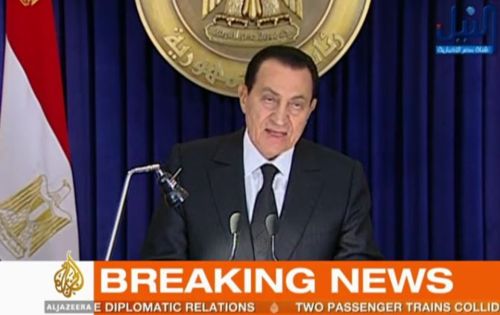
In the midst of continuing mass demonstrations against his rule in Egypt, president Hosni Mubarak has asked the government to resign. Mubarak seemingly hopes that the government’s resignation will appease the demonstrators. What’s interesting from our perspective–as students of comparative government–is that Mubarak hopes to maintain his regime at the expense of the government. It is accurate to call the current leadership of Mubarak a regime, since the norms/rules associated with political authority at the national level have been institutioinalised over the course of the almost three-decade reign by Mubarak as Egypt’s president. The question then becomes will the protesters be satisfied with a change in government alone, or will they insist on a change in the nature of this authoritarian regime, which will obviously not be effected without the removal from office of Mubarak himself. As in the case of many authoritarian regimes, in Egypt it is also true that the autocrat is the regime himself.

Here’s more from the CBC on Mubarak’s latest moves:

Egyptian President Hosni Mubarak says he has asked the government to resign and promised reforms as protests engulf his country.

In a televised speech broadcast early Saturday local time, Mubarak used his first public comments since the unrest began to defend the security crackdown on demonstrations.

“I assure you … I’m working for the people…. as long as you’re respecting the law,” Mubarak said.

“We have to be careful of anything that would allow chaos,” he said.

At the same, Mubarak tried to speak to the demonstrators who have filled Egypt’s streets for days.

“I’ll always be on the side of the poor,” he said. “I am with bettering the economy.”

Mubarak, who has ruled Egypt for three decades, has been facing the biggest pressure of his tenure.

Before the president spoke, tens of thousands of anti-government protesters defied a night curfew and some reportedly set fire to Mubarak’s party headquarters in Cairo. Flames were seen licking at the National Democratic Party headquarters shortly after 6 p.m. local time, though it was not immediately confirmed how the fire began.

The best real-time coverage of the political events in Egypt is, in my opinion, Al-Jazeera. You can watch live streaming coverage of Al-Jazeera here.

A Wave of Protests across North Africa and the Middle East

Following closely in the aftermath of the dramatic changes that have taken place in Tunisia recently, the political unrest seems to have swept its way across northern Africa, with the situation in Egypt now drawing most of the attention. Alan Cowell of the New York Times writes:

After days of protests that have toppled one president and shaken many others, governments across the Middle East braced on Friday for http://www.guardian.co.uk/global/blog/http://www.guardian.co.uk/global/blog/2011/jan/25/middleeast-tunisia://www.guardian.co.uk/global/blog/2011/jan/25/middleeast-tunisia/jan/25/middleeast-tunisia outbursts of rage and discontent directed at entrenched regimes confronting an exceptional clamor for democracy.

The immediate epicenter of the protests was Egypt, where Internet and cellphone connections were closed or restricted in Cairo, Alexandria and other places. Riot police took to the streets of Cairo before the Friday noon prayers that in http://www.guardian.co.uk/global/blog/2011/jan/25/middleeast-tunisia parts of the Islamic world have been a prelude to unrest as worshippers pour onto the streets.

The protests have underscored the blistering pace of events that have transformed the visage of the Arab world, particularly among regimes that have traditionally enjoyed the support of successive administrations in Washington.

Note the words that I have changed to red in the quote above. Is this author using these words as synonyms? If so, is he using them as precisely as he could be? Is he using them incorrectly?

For more information, here’s a useful set of reports, with myriad links to video and audio, from the UK Guardian’s Jack Shenker reporting in Cairo. In addition, the CBC website has an interesting flash-type graphic showing how the geographical extent of the spread of the protests.

Failed States and the Fund for Peace’s Failed States Index 2010

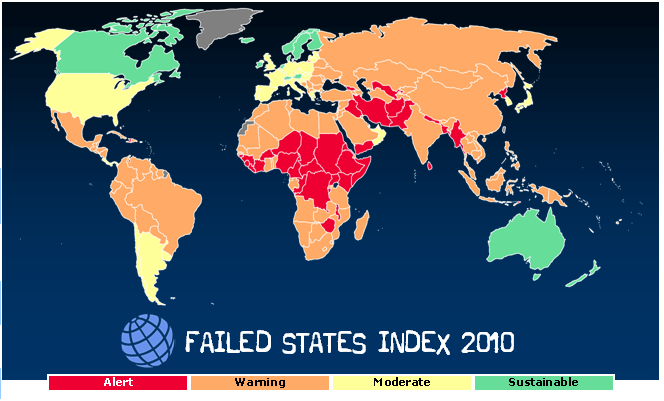
On Thursday, September 23rd we will begin to analyse the exceptionally important concept–the state. It will become strikingly obvious that a strong state is a necessary–but not sufficient–condition for political stability, political and personal liberty, democracy, and economic well-being. Conversely, citizens living in weak, failing, or failed states face lives of economic destitution, personal insecurity (think of Hobbes’ state of nature, where life is nasty, brutish, and short), and lack of basic rights and freedoms. The Fund for Peace publishes an annual index of failed and failing states. A quick look at the results over the last decade or so finds that the same dozen or so states are continually at the top of the list of failed/failing states. Here is a map depicting the results of the most recent index:

Notice the geographical concentration of failed states (in red). Why are the vast majority of the world’s failed states found in central Africa and southwest Asia?

What are the characteristics of failed states that distinguish them from more stable states? Maybe this video of life in Somalia will provide some clues:

Design a site like this with WordPress.com
Get started