ICG Report–Diamonds and the Central African Republic (CAR)

The International Crisis Group (ICG) has just released a new report on the influence of diamonds on the political situation in the Central African Republic (CAR). We’ve read various papers on the link between resource wealth (“lootable resources”) and political outcomes, such as regime type and economic outcomes. This report analyses the link between the presence of large stores of diamond wealth in CAR, the level of political instability (it’s essentially a failing state) and the existence of endemic conflict.  From the executive summary of the report:

In the diamond mines of the Central African Republic (CAR), extreme poverty and armed conflict put thousands of lives in danger. President François Bozizé keeps tight control of the diamond sector to enrich and empower his own ethnic group but does little to alleviate the poverty that drives informal miners to dig in perilous conditions. Stringent export taxes incentivise smuggling that the mining authorities are too few and too corrupt to stop. These factors combined – a parasitic state, poverty and largely unchecked crime – move jealous factions to launch rebellions and enable armed groups to collect new recruits and profit from mining and selling diamonds illegally. To ensure diamonds fuel development not bloodshed, root and branch reform of the sector must become a core priority of the country’s peacebuilding strategy.

Nature scattered diamonds liberally over the CAR, but since colonial times foreign entrepreneurs and grasping regimes have benefited from the precious stones more than the Central African people. Mining companies have repeatedly tried to extract diamonds on an industrial scale and largely failed because the deposits are alluvial, spread thinly across two large river systems. Instead, an estimated 80,000-100,000 mostly unlicensed miners dig with picks and shovels for daily rations and the chance of striking it lucky. Middlemen, mostly West Africans, buy at meagre prices and sell at a profit to exporting companies. The government lacks both the institutional capacity to govern this dispersed, transient production chain and the will to invest diamond revenues in the long-term growth of mining communities.

Chronic state fragility has ingrained in the political elite a winner-takes-all political culture and a preference for short-term gain. The French ransacked their colony of its natural resources, and successive rulers have treated power as licence to loot. Jean-Bédel Bokassa, the CAR’s one-time “emperor”, created a monopoly on diamond exports, and his personal gifts to French President Giscard d’Estaing, intended to seal their friendship, became symbols of imperial excess. Ange-Félix Patassé saw nothing wrong in using his presidency to pursue business interests and openly ran his own diamond mining company. Bozizé is more circumspect. His regime maintains tight control of mining revenues by means of a strict legal and fiscal framework and centralised, opaque management.

The full report can be accessed here. Here is a Al-Jazeera English news report on the situation in CAR.

The Age of Global (In)equality?

Many of the readings from Chapter 9 of O’Neil’s Essential Readings address the issue of global divergence/convergence in economic growth and/or inequality over the last few decades (and even further back than that–i.e., the Pritchett reading). The question comes down to whether there has been more or less inequality over time. Which is it? Well, the answer depends to a large extent on how one chooses to measure inequality. I’ll begin my response to this by quoting a student’s e-mail I received earlier today:

Hello, below is a link to a video showing one aspect or area of convergence.

I don’t know if I agree that countries are converging in regards to wealth and health; after all, Africa still seems very far behind.  I general, yes, countries today are healthier (longer life spans) and wealthier (not looking at inequality) than they were 200 years ago…

…For our purposes, what is the meaning of convergence and divergence?  From Pritchett, he seems to be measuring growth in terms of GDP and concluding that there is divergence between developed and developing nations (i.e. the levels of growth are not coming together, but separating).  What about China and India, who experienced faster or “larger growth” than some developed nations in the 80’s to mid 90’s?  Then with Milanovic, he is talking about inequality – how it is decreasing at the world level (when Indian and China are included) and this shows convergence.  To me, O’Neil seems to be trying to present two sides of an issue; however, I see two separate issues.  One is divergence in economic growth and the other is convergence in equality. I suppose that China’s and India’s economic growth can explain or at least correlate to lower inequality at the world level, but is that the correct way of interpreting Milanovic?  Is he saying that there’s a convergence of equality (or lower inequality gap worldwide), because countries (when including China and India) are converging in regards to economic growth?

Thank you.

This student is essentially correct in his reading of the respective arguments. As I mentioned earlier, which view one takes on the question of the recent direction of inequality convergence/divergence depends upon how one chooses to measure inequality. To put it differently, it depends upon whether your unit-of-analysis is the country or the individual. A Gini Index score that is calculated on the basis of mean levels of national income (or wealth) may not be the same as one calculated on the basis of comparing the wealth of individuals worldwide. In fact, Milanovic tells us that the values are indeed different, and the difference is due mainly to what has happened in China and India over the last two decades or so.


New and Old Wars Reading Questions

Here are some questions that we will try to answer in class, based on the Mueller, Kalyvas, Collier & Hoeffler, and Kaldor readings:

Thematic Questions:

  1. How has the nature of warfare changed (or has it) over the course of the last 70 years or so? Provide evidence from at least four sources.
  2. Comparatively assess the arguments of Collier & Hoeffer, Kalyvas, Mueller, and Kaldor. What are some commonalities? Divergence of opinion?
  3. What are the policy implications–from a humanitarian perspective–of taking each of the authors’ arguments seriously? Discuss.

Collier & Hoeffler (2004) “Greed and Grievance in Civil War

  1. De fine `greed’ and `grievance’ in the context of the analysis of rebellion/civil war.
  2. What are the types of causal mechanisms that each term implies?
  3. What do C & L mean by `opportunity’?
  4. Based on the statistical results, what conclusion do C & L draw regarding the causes of the onset of rebellion?
  5. What is the analytical importance of diaspora communities?
  6. How important are ethnic grievances in fomenting rebellion?

. Mueller (2000) The Banality of `Ethnic War’

  1. Why does Mueller put the words ethnic war in scare quotes in the title?
  2. What does Mueller mean when he says that ethnic war is `banal?’
  3. What evidence does Mueller use to support his main argument(s)?
  4. According to Mueller, what are the stages of ethnic war and ethnic cleansing?
  5. What is `ethnic cleansing’?
  6. Did ethnicity play any role in the inter-ethnic violence in Yugoslavia and Rwanda? Continue reading “New and Old Wars Reading Questions”

Washington Post Reports that China no longer as Attractive an “Outsourcing” Target

The average person may not know the difference between “offshoring” and “outsourcing”, but one would think that it would be a condition of employment for someone who writes for the business section of the Washington Post. In an otherwise informative story on the decreasing attractiveness of China as an “outsourcing” location for US companies, we are witness to another example of a member of the traditional media seemingly uninformed of basic facts.

Outsourcing is simply the idea that a company chooses to have another company produce a good or service rather than produce that same good or service in-house.  Outsourcing has been happening for a long time, and an example is when the Ford Motor Company decided that it would be better to use their productive capacity to produce engines, and outsource the task of making tires to a different company rather than make tires itself.  This helped increase productivity by allowing Ford to concentrate on the making of engines, and have the other company (Goodyear, Bridgestone) focus on making better tires.

Offshoring simply means sending work beyond one’s national boundaries.  Notice that not all offshoring is also outsourcing.  In fact, I have previously read (but I can’t find the source) that most offshoring is, in fact, not also outsourcing.  How can this be?  Well, what happens when General Motors decides to close down a car factory in Flint and make begin producing vehicles in Windsor, Ontario instead?  That production (and the jobs accopanying it) has been offshored (moved to a different country–Canada) but it hasn’t been outsourced, since GM is still producing the vehicles.  Here’s a little chart that will help you understand the difference.

As for the article itself, it demonstrates that rising fuel costs have increased the cost of shipping to such an extent that the potential savings for a US company of producing in China are completely eliminated.  One such company has repatriated production to the US from China (I suppose that’s called “onshoring”?)   We read:

SHANGHAI — Harry Kazazian built his business on sleeping bags that are made in China and shipped across the ocean to the United States, but he realized recently that the math doesn’t work anymore.

With fuel prices at record highs, the cost of sending a standard 40-foot container of goods has gone from $3,000 in 2000 to about $8,000 today, squeezing profit.

So this summer Kazazian, chief executive of Exxel Outdoors, a Los Angeles-based maker of recreational equipment, did something radical: He moved the manufacturing back to Haleyville, Ala.

Soaring energy costs, the falling dollar and inflation are cutting into what U.S. manufacturers call the “China price”– the 40 to 50 percent cost advantage once offered by Chinese producers.

The export model that has powered China and other Asian countries for three decades will be compromised if fuel prices continue to rise, said Stephen Jen, a managing director for Morgan Stanley.

“Globalization has gone a little bit too far. It has overshot,” Jen said. “We’re not saying Asia is going to crumble, but we are saying Asia enjoyed extraordinary conditions in the past. Now the conditions are changing very quickly because of the energy shock, and Asia is coming under pressure.”

The ripple effects have been far-reaching. The trade imbalance between the United States and China — a source of political tension for years — is beginning to right itself as Chinese exports fall and U.S. exports rise. Global trade routes are being transformed, suggesting a possible return to a less integrated world economy.

Israel and Syria once again Negotiating over Golan Heights

In intro to IR on Wednesday we addressed global environmental issues and we went over this chart outlining Thomas Homer-Dixon’s overview regarding the link between environmental scarcity and security. According to Homer-Dixon, environmental degradation is not only an important economic, social, and health issue, it is crucially an issue of importance for global security.

We see the important link between increased environmental scarcity and social effects (like ethnic conflicts, deprivation conflicts and coups d’etat), facilitated indirectly at times by the conditions of weakened states.

Homer-Dixon argues that these environmentally-driven conflicts will increase the more the environment degrades. Moreover, it is just those places in the world that have the least capacity to deal with the potentially negative effects of environmental degradation whose environments will be most likely to suffer.

In the far left column is “unequal resource access”. One of the most important resources to humankind is water. The conflict between Syria and Israel over the Golan Heights is crucially linked to water. As we learn from the New York Times:

JERUSALEM — Peace overtures between Israel and Syria moved up a gear on Wednesday when a Syrian cabinet minister said that Prime Minister Ehud Olmert of Israel had sent a message to President Bashar al-Assad to the effect that Israel would be willing to withdraw from all the Golan Heights in return for peace with Syria.

The Syrian expatriate affairs minister, Buthaina Shaaban, told Al Jazeera television, “Olmert is ready for peace with Syria on the grounds of international conditions; on the grounds of the return of the Golan Heights in full to Syria.” She said that Turkey had conveyed the message.

Israeli officials did not deny the statement from Damascus but would not confirm it either, offering a more general, positive reaction. “Israel wants peace with Syria; we are interested in a negotiated process,” said Mark Regev, a spokesman for Mr. Olmert. “The Syrians know well our expectations, and we know well their expectations…”

“…Withdrawal from the Golan Heights is a contentious issue in Israel. The territory is a strategic plateau that overlooks a large swath of northern Israel. Israel has objected to past Syrian demands for access to the shore of the Sea of Galilee, a main water source for Israel.

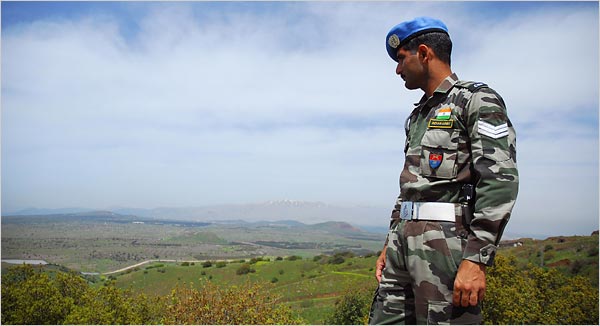
Yehuda Raizner/Agence France-Presse — Getty Images

An Indian member of the United Nations force in the Golan Heights, a strategic

plateau that overlooks a swath of northern Israel.

Flu Viruses’ Global Pathways Largely Predictable

We’ll be addressing globalizing issues in intro to IR on Monday and this interesting story in the Washington Post from a couple of days ago illustrates some of the important concepts raised in Chapter 10 of Mingst.

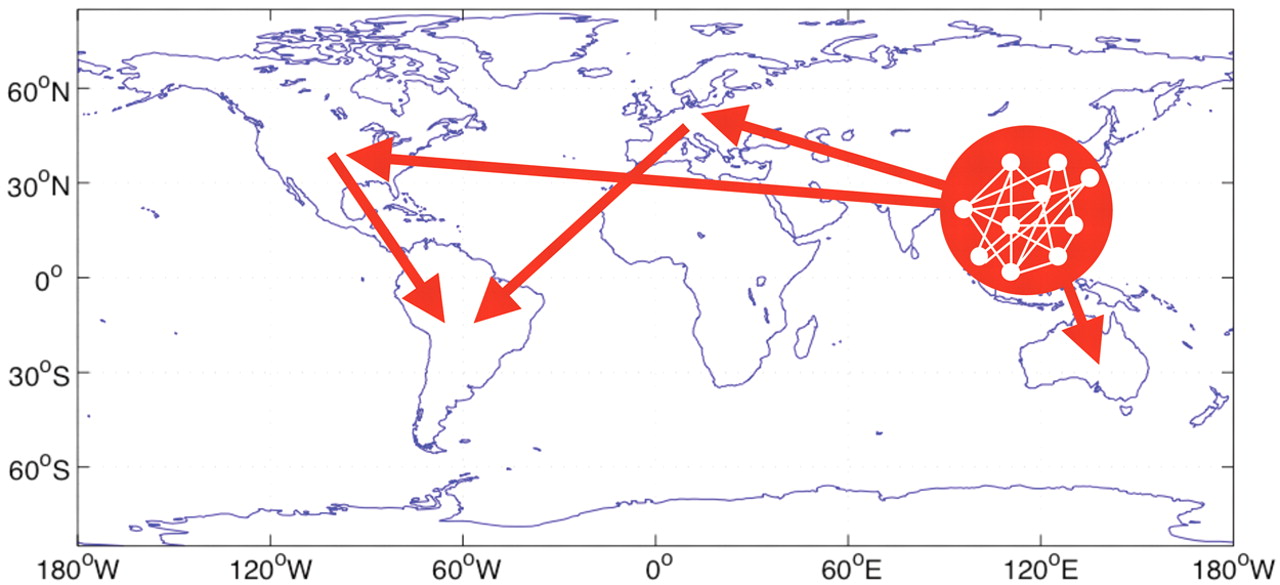
New strains of seasonal influenza virus all arise in East or Southeast Asia and take a largely predictable route around the world before dying out for good in South America, the global glue-trap for the pathogen.

That is the conclusion reported yesterday by a large team of researchers who analyzed the genetic ancestry of about 13,000 virus samples collected from six continents over a five-year period to answer long-standing questions about the flu’s life cycle.

The findings help explain the biological mechanisms that underlie two long-held observations about flu: New strains tend to appear first somewhere near China, and Australia’s flu season is a preview of what will happen in North America six months later. They also help explain why one winter’s flu is always at least a little bit different from the previous winter’s, even though the virus disappears over the summer…

But why is East-Southeast Asia always the starting point? The researchers believe it’s because of the unusual concentration of different climates there. The region has both tropical environments, where flu flourishes during the rainy season, and temperate zones. There are places that are relatively close — Russell cited Bangkok and Kuala Lumpur, Malaysia, 700 miles apart — that have totally different flu seasons.

This effectively allows new strains to be passed around the region like a baton in a relay race, even though in each climate zone the virus completely dies out once a year.

The reason new variants don’t cause epidemics if they are carried back to East Asia from elsewhere is because people already have immunity to them. They’re old news. At least that’s the theory.

Here, from Science magaizine (subscription only) is a chart demonstrating the global spread of flu viruses.

So What does the Price of Soybeans have to do with Smog in Buenos Aires?

When I was younger, my friend’s father would often respond to our childhood rantings with the question, “but what’s that got to do with the price of tea in China?”  I still don’t really understand what it means, but in this increasingly globalized world, there is a direct causal link bewtween the price of soybeans and smog in the Argentinian capital city of Buenos Aires.  The causal mechanism is outlined in this Bloomberg news report:
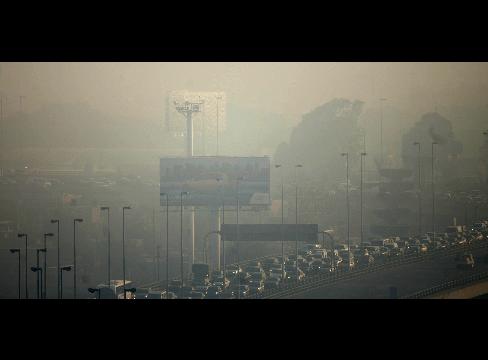
April 17 (Bloomberg) — Smoke from fires set by farmers to clear fields for grazing covered the city of Buenos Aires and shut down some highways leading into the Argentine capital.

Interior Minister Florencio Randazzo called the smoke a “disaster” and said 292 separate fires covering 70,000 hectares (173,000 acres) had been detected in the provinces of Buenos Aires and neighboring Entre Rios.

Farmers are burning more land as they create pastures for cattle that previously grazed fields now dedicated to soybeans, said Randazzo.  An 89 percent increase in soybean futures prices in the past year, part of a global explosion in food costs, has prompted Argentine farmers to increase the area sown to the oilseed by 10 percent, according to the Agriculture Secretariat.

“Those responsible are farmers who are burning their meadows to cut costs and maximize profits without considering the consequences,” said Randazzo in a news conference at the Presidential Palace. “We are conducting investigations to find those responsible.”

Notice this chart of soybean prices below and the fact that many farmers are moving into the soybean growing business and I think we could have the potential for an intermediate-term top in the soybean market.  As in many speculative markets, many would-be speculators rush in just at (or even just after) the top has been set for that particularly stock or commodity.  It’s not a surprise the the record number of sales transactions for US real estate occurred in the month (around Summer 2005) as a top was setting in.  If I had to bet, I’d wager that many of those new soybean farmers will wish they had remained cattle farmers.

How Your Mortgage Payment Funds Norwegian Town’s Workforce

On the first day of class, I made the argument that in order for me to fulfill my pedagogical goals this semester, I need your help. I needed you to understand that what you choose to do (or not to do) in the classroom (and on your blog) will affect not only the grade you receive and how much you learn in this course, but will also affect the learning and grades of your peers sitting beside you in class. We live in societies, in which we all–to a greater or lesser extent–have an effect on those with whom we come into contact, with whom we share work places, roads, stadia, and class rooms. We all understand that if your neighbor’s house is unkempt and the lawn is overgrown, this will have a detrimental effect on your own property values.

Since we’re talking about property and the effects of social interaction, how is it that the town of Narvik, Norway (on the Arctic Circle) has had to miss a payroll for its municipal workers as the result of residents of Stockton (CA), Miami (FL), Flint(MI), and Worcester (MA), no longer being able to pay their residential mortgages? This New York Times article helps explain, and so does Jon Stewart’s guest, CNN Personal Finance editor Gerri Willis:

— At this time of year, the sun does not rise at all this far north of the Arctic Circle. But Karen Margrethe Kuvaas says she has not been able to sleep well for days.

What is keeping her awake are the far-reaching ripple effects of the troubled housing market in sunny Florida, California and other parts of the United States.

Ms. Kuvaas is the mayor of Narvik, a remote seaport where the season’s perpetual gloom deepened even further in recent days after news that the town — along with three other Norwegian municipalities — had lost about $64 million, and potentially much more, in complex securities investments that went sour.

”I think about it every minute,” Ms. Kuvaas, 60, said in an interview, her manner polite but harried. ”Because of this, we can’t focus on things that matter, like schools or care for the elderly.”

Norway’s unlucky towns are the latest victims — and perhaps the least likely ones so far — of the credit crisis that began last summer in the American subprime mortgage market and has spread to the farthest reaches of the world, causing untold losses and sowing fears about the global economy.

Where all the bad debt ended up remains something of a mystery, but to those hit by the collateral damage, it hardly matters.

Tiny specks on the map, these Norwegian towns are links in a chain of misery that stretches from insolvent homeowners in California to the state treasury of Maine, and from regional banks in Germany to the mightiest names on Wall Street. Citigroup, among the hardest hit, created the investments bought by the towns through a Norwegian broker…

…But Narvik has $34.5 million in a second Citigroup-devised investment, known as a collateralized debt obligation, which has also lost value as a result of the broader market turmoil. The town stands to lose at least some of that money, too.

Those investments represent a quarter of Narvik’s annual budget of $163 million, and covering the losses would necessitate taking out a long-term loan, which the town could only pay off by cutting back on services.

”You can calculate this in terms of places for schoolchildren or help for the elderly,” said Mr. Hermansen, a soft-spoken man who sat in his office in near-darkness, the lights switched off…

…In 2004, Narvik and a number of other towns took out a large loan, using future energy revenue as collateral. They invested the money, through Terra Securities, in the Citigroup debt vehicle, which offered a better return than traditional investments. In June 2007, as the subprime problems were brewing, Narvik shifted some money from that investment into an even more complex one, again through Terra Securities.

Do read the whole thing as it is interesting. Note, however, the really key part of the whole story in bold in the paragraph above and use the experience of Narvik to learn a very important lesson about investing. There is a clear immutable relationship in the investing world: the higher the expected return, the higher the level of risk associated with that return. If you expect to receive outsized returns, be prepared to accept outsized risk. Period. There may have been fraud perpetrated here (and it’s difficult to know without reading the signed agreements), but caveat emptor would have been valid advice in this situation.

What is the general link between subprime mortgages and other collateralized debt obligations (CDOs)–such as auto loans, student loans, and credit card debt–and the international political economy. Is there a general systemic risk to the global economy from new financial instruments, which Warren Buffett has referred to as “financial weapons of mass destruction?” Here is a panel at the 2008 World Economic Forum in Davos, which will shed more light on the financial industry.

Poor Countries, Agriculture, and IMF Policies

There has been a rapid increase in food prices over the last couple of years, seen most dramatically in the recent 30% one-day rise in the price of rice worldwide.  This is putting tremendous pressure on the poor and is leading to instability in countries around the world.  There have been violent demonstrations–and equally violent government responses–to food rioting in Egypt and Haiti in the last couple of weeks.  They may be but a harbinger of the economic and political instability to come.  Here is a report from the BBC, in which an expert argues that IMF policies have contributed to the rise in food prices:

“Poor countries need to invest heavily in agriculture to feed their people.  There’s been a dearth of investment in agriculture in poor countries, mainly because of IMF and World Bank policies…”

The Bretton Woods System and the International Financial System

Anticipating the end of World War II, world leaders gathered in the New Hampshire town of Bretton Woods to create the financial architecture of the post-war global financial system.  The three main pillars were the World Bank, the IMF (both of which were created) and the International Trade Organization (this was never built but the governing philosophy behind it eventually gave rise to the General Agreement and Trade and Tariffs (GATT), which morphed into the World Trade Organization (WTO).  We’ll discuss these institutions in much more detail beginning Monday.

Here is an excerpt from a newsreel describing the meetings at Bretton Woods in 1944:

Design a site like this with WordPress.com
Get started