Social Impact and the Decision to Vote

In continuing with today’s theme of the impact of the “social” in political science, we note that political parties the world over have spent a lot of money and developed various ideas and hypotheses regarding what motivates voters to go to the polls and exercise their most basic democratic right. In the most recent issue (which is behind a pay wall) of the American Political Science Review–the flagship journal of the American Political Science Association–a group of political scientists, led by Donald Green at Yale, has demonstrated that social shaming may be a way to increase overall voter turnout.* Here is the abstract, with a sample of the letters sent below:

Voter turnout theories based on rational self-interested behavior generally fail to predict significant turnout unless they account for the utility that citizens receive from performing their civic duty. We distinguish between two aspects of this type of utility, intrinsic satisfaction from behaving in accordance with a norm and extrinsic incentives to comply, and test the effects of priming intrinsic motives and applying varying degrees of extrinsic pressure. A large-scale field experiment involving several hundred thousand registered voters used a series of mailings to gauge these effects. Substantially higher turnout was observed among those who received mailings promising to publicize their turnout to their household or their neighbors. These findings demonstrate the profound importance of social pressure as an inducement to political participation.

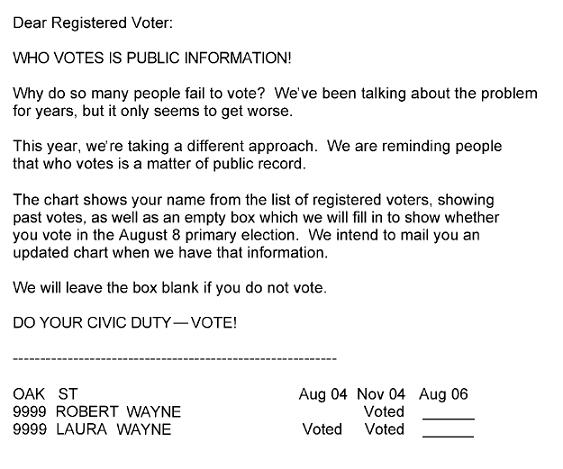
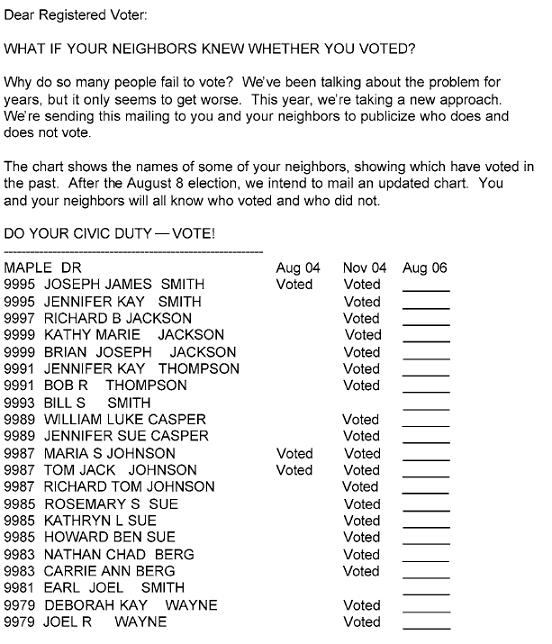
Would you be susceptible to being shamed into voting? Well, the authors find that the overall impact of threatening to publicize your (non)-voting behavior to your neighbors was to increase turnout by 8.1 percentage points. That’s an astounding impact. Here are the letters:
social_pressure_vote.jpg

This letter increased the rate of voter turnout by 4.9 percentage points, a much stronger effect than appeals to civic duty alone (which raised turnout from between 1.8 and 2.5 percentage points.
social_pressure_vote2.jpg

This is the letter that produced an 8.1 percentage point increase in voter turnout.

*For a web site that tracks voter turnout rates worldwide, please see this post.
Serbian Electorate Must Choose–Stomach or Heart?

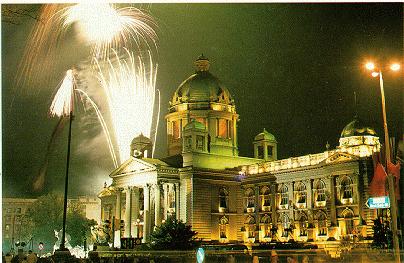
narodna_skupstina_srbije.jpgThe Serbian coalition government, with moderate nationalist Vojislav Koštunica as Prime Minister–has collapsed following dissension within the multi-party governing coalition over the “loss of Kosovo.” Voters will go to the polls to elect a new government on May 11th having to make a stark choice in the polling booth: whether to side with the nationalists in their struggle to forestall Kosovar independence, or to vote in a more moderate pro-European government, thereby placating not only members of the European Union but calming the nerves of wary international investors, who have become the life-blood of the Serbian economic system. As reports reports:

…The coalition government collapsed at the weekend, with nationalist Prime Minister Vojislav Koštunica blaming disunity over the conflicting goals of pursuing European Union membership versus defending Kosovo, the province which seceded last month with EU backing.

“Right now, around 1.0 billion euros worth of investments have been put on hold,” [Deputy Prime Minster Božidar] Djelić said. “There is a growing risk perception considering that some parties want to halt Serbia’s road to Europe. The elections will be a choice between Europe and investors are extremely careful.”

Heavily reliant on foreign investment for growth, Serbia is believed to need between 3.0 billion and 5.0 billion euros a year to ensure solid economic growth, single digit inflation and financing of its current account gap of 16 percent of GDP.

“In the absence of the required level of foreign investment, foreign creditors could also decide to put on hold lending to Serbian companies,” said Pavle Petrović of the FREN/CEVES thinktank said.

“The resulting crisis would lead to forcible reduction in external gaps through inflation, currency depreciation, a fall in output and wages. In that case, the central bank could soothe and postpone, but not eliminate the crisis,” he said.

Comparative Political Party and Electoral Systems

In a few weeks, we will conduct an in-class exercise that simulates a German national election.  This will give you a good idea of the specifics of the German political party and electoral systems, which you will then be able to compare to other systems around the world.  The German system is fairly complicated in that each citizen casts two votes, one for a member running in a single-member district, while the other is cast for a party via a proportional system.

Elections are, of course, the conditio sine qua non–and the minimal institutional requirement–of democratic political systems.   A great web site dedicated to keeping track of elections around the world is electionguide.org They do not as of yet have the results from the most recent national elections in Spain, (they will shortly) but they do have election results for countries around the world going back decades for some countries.  You should check them out.

The Christian Science Monitor  on the incumbent Spanish government’s re-election this past week:

oresults_p1.jpgAided by a near-record turnout, José Luis Rodríguez Zapatero and the Socialist Party won the Spanish national elections – suggesting further changes toward diversity in a young democracy whose older generations cut their teeth on the Franco dictatorship and the moral authority of the Roman Catholic church.

The Socialist victory suggests Mr. Zapatero’s party has broken out of the longtime secondary status it has labored under, despite winning the last election in 2004.

Now, say analysts, the Socialists’ more liberal appeal to young people, women, and immigrants – along with its contemporary style of campaigning – must be taken seriously by the conservative Popular Party (PP), which ran on an older message of Spanish traditionalism and antipathy toward the feisty Basque and Catalonia regions.

Do the cited paragraphs remind you of any other electorate?

First, Conflict Diamonds; now, Junta Jade?

I know; the j in junta is pronounced like an h. Regardless, The Christian Science Monitor asks “Who’s buying Burma’s gems?: Laura Bush’s campaign for a global boycott is being undone by China’s appetite for Olympic souvenirs made of Burmese jade.” The US First Lady argues that those of you purchasing precious gems from Burma are indirectly supporting the rule of the brutal military dictatorship in that southeast Asian country.

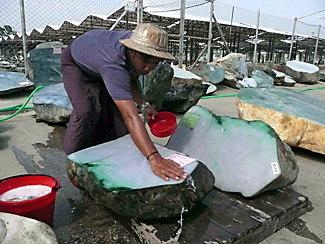
burma_jade.jpgIt’s the last hour of the last day of the gems auction in Rangoon, and tired buyers are fanning themselves with worn auction catalogs, and making their final bids.

Over the past five days, jade, rubies, sapphires, and close to $150 million have passed hands here, according to the Union of Myanmar Economic Holdings Ltd., the consortium that dominates Burma’s gemstone trade and is owned by the defense ministry and a clutch of military officers.

Who’s buying? China, India, Singapore, and Thailand are scooping up Burma’s stones. US first lady Laura Bush’s efforts at a global boycott of Burma’s gems seem to have done little to reduce China’s appetite for Burmese jade to make trinkets and souvenirs to sell at the Summer Olympics.

At this recent auction, 281 foreigners attended, leaving behind much-needed foreign currency and generally turning the auction into a resounding success, according to the state-run New Light of Myanmar newspaper.

Mrs. Bush – and human rights campaigners – would not be pleased.

The first lady has taken on the military regime in Burma (Myanmar), urging jewelers not to buy gems from a country where the undemocratic rulers and their cronies amass fortunes selling off the country’s stones, as well as many of the county’s other natural resources – such as minerals, timber, gold, oil, and gas – but keep Burma’s citizens in abject poverty.

She has urged UN Secretary General Ban Ki Moon to act more forcibly on Burma and stood beside President Bush on several occasions recently as he announced the growing list of US sanctions on the country. And, on International Human Right’s Day this past December, Mrs. Bush added her voice to those seeking a global boycott on gems from Burma.

“Consumers throughout the world should consider the implications of their purchase of Burmese gems,” she said in a statement from the White House. “Every Burmese stone bought, cut, polished, and sold sustains an illegitimate, repressive regime.”

Earlier in the semester, we read an article [which he has made available to the general publilc on his web site] by Richard Snyder on the link between “lootable wealth” and political stability. In fact, the final section of his paper deals explicitly with the Burmese tropical timber trade and its role in funding rebel groups. What are the implications of Snyder’s argument for how we–as potential consumers of junta jade–should respond to Laura Bush’s plea? Of course the two phenomena are not exactly the same (Snyder is seeking to understand the link between “lootable wealth” political stability, while Laura Bush is arguing that “lootable wealth” supports dictatorial rule.) Here is the abstract to Snyder’s article:

This article proposes a political economy of extraction framework that explains political order and state collapse as alternative outcomes in the face of lootable wealth. Different types of institutions of extraction can be built around lootable resources – with divergent effects on political stability. If rulers are able to forge institutions of extraction that give them control over revenues generated by lootable resources, then these resources can contribute to political order by providing the income with which to govern. In contrast, the breakdown or absence of such institutions increases the risk of civil war by making it easier for rebels to organize. The framework is used to explain two puzzling cases that experienced sharply contrasting political trajectories in the face of lootable resources: Sierra Leone and Burma. A focus on institutions of extraction provides a stronger understanding of the wide range of political possibilities – from chaos, to dictatorship, to democracy – in resource-rich countries.

Oil, Islam, and Women

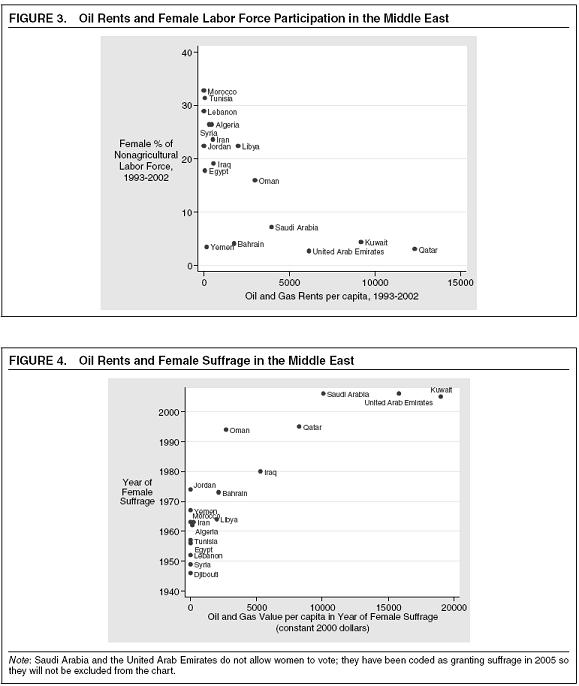
There is a new article [paywall] in the most recent issue of the American Political Science Review written by Michael L. Ross entitled “Oil, Women, and Islam.” Ross has written a lot about the nexus between resources and regime type, the so-called “resource curse” phenomenon. In this article, Ross argues that the well-known empirial link between lack of women’s rights and Islam washes away once controls related to oil production are incorporated into statistical models. (Note that the analysis is restricted to the Middle East.)

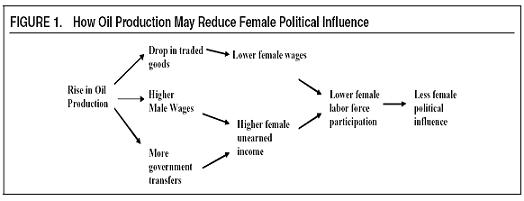
Here is the abstract and a couple of his charts:

Women have made less progress toward gender equality in the Middle East than in any other region. Many observers claim this is due to the region’s Islamic traditions. I suggest that oil, not Islam, is at fault; and that oil production also explains why women lag behind in many other countries. Oil production reduces the number of women in the labor force, which in turn reduces their political influence. As a result, oil-producing states are left with atypically strong patriarchal norms, laws, and political institutions. I support this argument with global data on oil production, female work patterns, and female political representation, and by comparing oil-rich Algeria to oil-poor Morocco and Tunisia. This argument has implications for the study of the Middle East, Islamic culture, and the resource curse.

ross_oil_women_1.jpg

ross_oil_women_2.jpg

Islam Democracy, and Authoritarianism and Paper Assignment

The topic for the next paper assignment in PLSC240  is “Democracy and Culture”.  You will be required to assess the democratic potential of various cultural orientations for democracy, using the Diamond and Morlino volume as a guide.  In Assessing the Quality of Democracy, various essential components of democracy are analyzed, including responsiveness, equality, freedom and accountability.  Your task will be to comparatively assess the quality of democracy in two countries, one of which is “Western” in its cultural orientation, the other of which is “non-Western.”  I’ll have more information for you on the specifics of the assignment when you get back from break on the 18th.

For now, I’ll remind you that on Thursday, those of you who did not leave early for spring break watched a Frontline documentary on Muslims and the democratic potential of Islam. You were shown the diversity in the manner in which Islam is practiced across five different countries–Egypt, Iran, Malaysia, and Turkey, and Nigeria. You were also able to begin to understand the varied roles and treatment of women across all of these predominantly Muslim countries.  This tied in well with the Steven Fish article [you have to be on campus to access the article] that you were assigned to read in advance of viewing the video.  What is Fish’s argument about the link between women in Islamic societies and democracy?  I’ve attached a preview of the documentary below. You can watch the whole documentary online, by clicking here.

Kenyan Leaders Sign Peace Agreement

Kenya’s political leaders have finally reached an agreement that Kenyans hope will signal the end of the recent instability and inter-ethnic bloodshed, which resulted from disputed elections in late December of last year. The New York Times reports that the structure of the political system in Kenya has been altered as a result of an agreement between President Mwai Kibaki and opposition leader Raila Odinga:

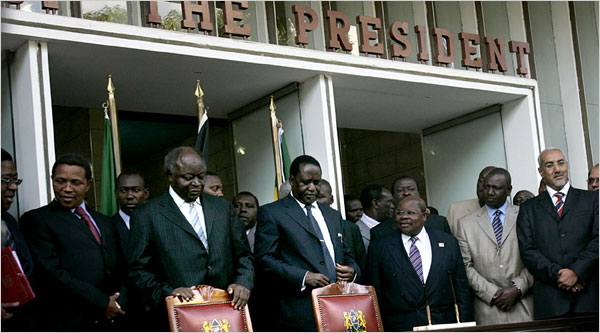
29kenya-span-600.jpgNAIROBI, Kenya — Kenya’s rival leaders broke their tense standoff on Thursday, agreeing to share power in a deal that may end the violence that has engulfed this nation but could be the beginning of a long and difficult political relationship.

The country seemed to let out a collective cheer as Mwai Kibaki, the president, and Raila Odinga, the top opposition leader, sat down at a desk in front of the president’s office, with a bank of television cameras rolling, and signed an agreement that creates a powerful prime minister position for Mr. Odinga and splits cabinet posts between the government and the opposition.

The two sides, which have been bitterly at odds for the past two months, will now be fused together in a government of national unity.

But there are still many thorny issues to resolve, starting with how the new government will function with essentially two bosses who have tried unsuccessfully to work together before. The government must also deal with the delicate business of reassigning the choice positions already given to Mr. Kibaki’s allies.

When we get back from the spring break, in intro to comparative we will analyze the political systems of several democracies around the world and you’ll realize that very few democracies have institutionalized a system that contains a strong Prime Minister and strong President. The most successful example is probably France, with its semi-presidential system. Even in strongly democratic France, however, political stability is often compromised when the President and Prime Minister are members of different political parties, as will be the case in Kenya. It will be interesting to see how the Kenyan version of cohabitation will develop in the coming months and years.

Life, Liberty, and the Pursuit of Happiness

We hold these truths to be self-evident, that all men are created equal, that they are endowed by their Creator with certain unalienable Rights, that among these are Life, Liberty and the pursuit of Happiness.

All of us immediately recognize these powerful sentences as being part of the Declaration of Independence of the United States of America. Happiness is an important concept and has been the object of increased study in political science and comparative politics. Ronald Inglehart (he of World Values Survey fame) argues that there is a strong relationship between happiness and democracy across countries. Inglehart writes:

Correlation is not causation, and this linkage could reflect any of the following things: (1) living under democratic institutions makes people much happier than living under authoritarian institutions; or (2) high levels of subjective well-being are conducive to democratic institutions; or (3) the correlation could be spurious, due to the fact that both subjective well-being and democracy are strongly correlated with some other variable such as high levels of economic development.

Solving this puzzle has far-reaching implications. If the linkage is not spurious and democracy makes people happy, this provides a strong additional argument on behalf of democracy; while if high levels of happiness are conducive to democracy, this can lead to a better understanding of how democracy emerges and flourishes. Using World Values Survey data on happiness levels from 1981 to 2006, and the Freedom House measures of democracy levels from 1972 to 2005, this paper analyzes the relationships between happiness and democracy in order to determine what is causing what.

How happy are Americans? How happy are Germans, Chinese, or Brazilians, for that matter? Who are the happiest people on earth? According to the new World Database of Happiness, it’s the Danes, Swiss and Maltese. Is this a political cultural trait, as Inglehart assumes, or are there structural and institutional factors at work? All three countries are rather small, and European. (Malta and Denmark are, additionally, amongst the most homogeneous states in the world, and this could be having an effect, given new research by Robert Putnam on the potential socially, politically, and economically detrimental effects of ethnic diversity.) Americans, by the way, are ranked #25 in level of happiness.

The Economist’s Diary on Kenya

The eminent British magazine, The Economist, currently has a correspondent in Kenya writing up daily reports in the Internet edition, which can be viewed here. There is, of course, much to be concerned about in Kenya these days, but as an academic I found the latest dispatch especially interesting:

Morning, Professor Alan Ogot’s office, Kisumu

ALAN Ogot (pictured below), one of Kenya’s leading historians, is the chancellor of Moi University in Eldoret. Like me, he graduated from St Andrew’s University in Scotland, but he was there in the 1950s, and his life before and since has been colourful and consequential.

Mr Ogot spends the first part of our interview delving into Luo history. Contrary to their reputation among some Kikuyus and white Kenyans as agitators, he says the Luo have always done the jobs no one else wanted to do. For a thousand years they have aspired to “fairness” and “reciprocity”. He gives examples of religious and political movements to argue that Luoland was the most progressive part of Kenya. That changed with independence in 1963 and the rise of a Kikuyu elite who mistrusted Luos.

Mr Ogot had lunch with Tom Mboya on the day Mboya was shot dead in 1969. Mboya was one of several Luo politicians tipped for the presidency and Mr Ogot thinks the Luo have never recovered from his death. “What followed was a police state. We were not allowed to speak our mind.”

 Then Mr Ogot moves on to the damage done to academia in Kenya by the post-election violence. He wonders what the future of research is in the country. Some of Africa’s best research institutions are located around Nairobi. Most are closed, he says, some burned, and the best minds driven out.

He points out that Maseno, the local university in Luoland, was over half Kikuyu. “Most of these people are not coming back. Who will provide them with security?” Other universities across the country are being similarly ethnically cleansed. “You call these universities? They’ll be worse than primary schools…”

…Since the election he has hardly left his house. A woman and child were shot dead outside his front gate. The police mistakenly killed a caretaker in a neighbouring house. “They have apologised, but what will that do?”

I’ve highlighted what I think are the interesting parts of the snippet I posted. First, contrary to what I have been reading in the newspapers lately, inter-ethnic relations between the Kukuyu and Luo, specifically, have not been as tolerant and peaceful and many have led us to believe. Second is the horrific damage that is being done to Kenya’s post-secondary educational system as a result of the current political situation there. A Boston Globe column that was published before the elections held out hope for Africa, and pointed to Kenya’s potential role as a leader for the rest of the continent. Now what?

Democracy in Russia

From the Chronicle of Higher Education, we learn that Russian President Vladimir Putin’s government has shut down a university that offers “politically sensitive” courses.

A Russian court has ordered a university that receives support from Western organizations and had offered courses in election monitoring to shut down immediately, in what professors said was the first time an entire university had been closed for political reasons under President Vladimir V. Putin.

The ruling, issued by a court in St. Petersburg on Friday, shut down the European University of St. Petersburg just as a new semester was about to start and after many of the 170 students who were scheduled to attend had arrived in the city.

Mr. Putin had criticized the university last fall, accusing it of meddling in Russian politics, according to news reports, and a highly placed government official raised similar concerns in late December, a professor told The Chronicle.

What a terrible offense!  Meddling in Russian politics!  The nerve! We in the West take for granted far too often the nature of the liberties we enjoy.  We in the academic world, in particular, are often unaware of the great dangers that academics in many parts of the world face in trying to perform tasks and research that to us in the West seem mundane.  To increase awareness about the lack of academic freedom in many parts of the world, a group of like-minded individuals has created the Scholars at Risk Network.

Design a site like this with WordPress.com
Get started