Failed States and the Fund for Peace’s Failed States Index 2010

On Thursday, September 23rd we will begin to analyse the exceptionally important concept–the state. It will become strikingly obvious that a strong state is a necessary–but not sufficient–condition for political stability, political and personal liberty, democracy, and economic well-being. Conversely, citizens living in weak, failing, or failed states face lives of economic destitution, personal insecurity (think of Hobbes’ state of nature, where life is nasty, brutish, and short), and lack of basic rights and freedoms. The Fund for Peace publishes an annual index of failed and failing states. A quick look at the results over the last decade or so finds that the same dozen or so states are continually at the top of the list of failed/failing states. Here is a map depicting the results of the most recent index:
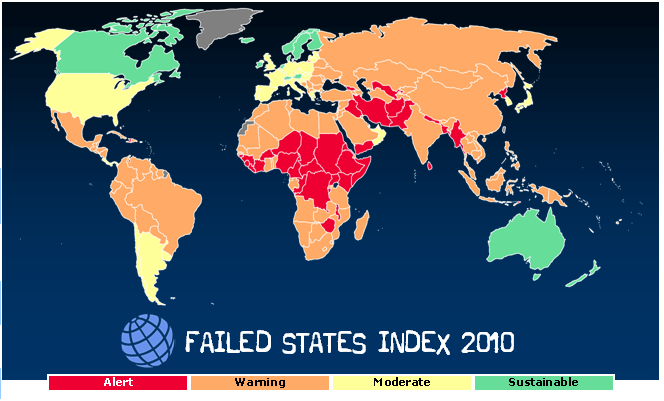
Notice the geographical concentration of failed states (in red). Why are the vast majority of the world’s failed states found in central Africa and southwest Asia?

What are the characteristics of failed states that distinguish them from more stable states? Maybe this video of life in Somalia will provide some clues:
The “New Humanitarianism” and Rule vs. Act Utilitarianism (Consequentialism)

In chapter 3 of Humanitarian Intervention Weiss analyses “new wars” and “new humanitarianisms.”  The changing nature of humanitarian work is characterized by many things, but I’d like to focus on one particularly, which will lead us to a discussion of the importance of neutrality and the concepts of rule and act utilitarianism.

Weiss argues that humanitarian responses, by NGOs particularly,  are becoming more ambitious in scope and thereby shifting from a focus on short-term emergency relief to “attacking the root causes and post-conflict peacebuilding.” He continues,

“rather than provide band-aids, they [humanitarians] wish to use assistance and protection as levers. Many aid agencies desire to spread development, democracy, and human rights and create stable, effective, and legitimate states.” (76)

This has led, concomitantly, to a change in the humanitarian principles of neutrality and impartiality. These principles, Weiss notes, “made sense if the objective was to provide relief and gain access to affected populations.” These principles, it is argued, foundered upon the reality that contemporary wars–“new wars”–were creating “unanticipated and unintended negative consequences.” Moreover, in a world in which the combatants are state militaries, neutrality and impartiality retained some internal logic. However, as genocidaires and other ty[es of rebel groups become the main combatants in civil wars and the predominant perpetrators of crimes against humanity, the principles of neutrality and impartiality come to be seen increasingly as relics of a bygone era.

A few students took issue with this argument, insisting that there are also likely to be unintended consequences of humanitarian organizations repudiating the principles of neutrality and impartiality. They mentioned some of these in class. This prompted a quick excursion by me into the difference between act and rule utilitarianism/consequentialism. I’ll explain below the fold:

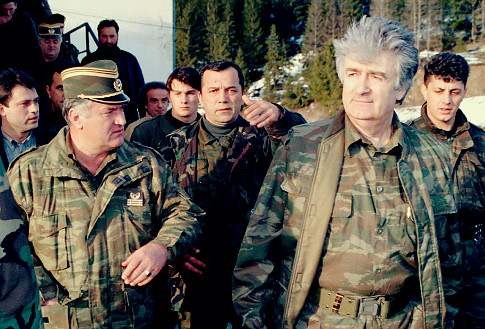
Bosnia Muslim leaders argued that the neutrality policy allowed Messrs. Karadzic and Mladic free reign in their campaign to ethnically cleanse large swaths of Bosnia of (well-fed) Muslims.

Continue reading “The “New Humanitarianism” and Rule vs. Act Utilitarianism (Consequentialism)”

List of All UN Peacekeeping Operations

Here’s an exhaustive list of the peacekeeping operations established by the UN since its inception.Notice how long some of the operations have lasted (and continue to last). The longest continuing peacekeeping operation is UNMOGIP, which continues to the present and was established in 1949! For the complete list, click here.

Acronym Mission name Start date Closing date
UNTSO United Nations Truce Supervision Organization May 1948 Present
UNMOGIP United Nations Military Observer Group in India and Pakistan January 1949 Present
UNEF I First United Nations Emergency Force November 1956 June 1967
UNOGIL United Nations Observation Group in Lebanon June 1958 December 1958
ONUC United Nations Operation in the Congo July 1960 June 1964
UNSF United Nations Security Force in West New Guinea October 1962 April 1963
UNYOM United Nations Yemen Observation Mission July 1963 September 1964
UNFICYP United Nations Peacekeeping Force in Cyprus March 1964 Present
DOMREP Mission of the Representative of the Secretary-General in the Dominican Republic May 1965 October 1966

Current United Nations Peacekeeping Operations

We discussed Tom Weiss’ book–Humanitarian Intervention–in IS 302 today. We spent some time on the changing nature, and number, of peacekeeping operations since the end of the Cold War. Below is a map listing the 16 current UN peacekeeping operations. You can find the source image, which is clickable, here.  How many of these operations are proceeding under the auspices of Chapter VII of the UN Charter?

Here is part of the textof the UNSC resolution, authorizing the establishment of MONUSCO in the Democratic Republic of the Congo:

Resolution 1925 (2010)
Adopted by the Security Council at its 6324th meeting, on 28 May 2010

The Security Council,

Continue reading “Current United Nations Peacekeeping Operations”

Michael Ignatieff and Humanitarian Intervention

Current leader of the Canadian Federal Liberal Party, Michael Ignatieff has long been involved in the issue of human rights–as a historian, journalist, public intellectual, and as the former Carr Professor and Director of the Carr Center for Human Rights Policy at the Kennedy School of Government.

In the aftermath of the contentious NATO military intervention in Kosovo (1999), Ignatieff sat down with WBUR’s Chris Lydon to assess what had gone right (and wrong) during the intervention. A self-identified member of the “something must be done [to stop alleged Serbian war crimes against the Kosovar Albanians]”, Ignatieff stands by his support for the intervention, claiming that, on the whole, the benefits outweighed the costs.

Events/Lectures that may be of Interest

I’ll use this blog to keep you informed about lectures and events that may be of interest to you that are taking place on campus or in the greater Vancouver area. There are two events this week that are relevant.

This evening, Monday September 13th, at 7:00pm the Philosophers’ Cafe is kicking off the first event of its fall series at the Shadbolt Centre for the Arts at Deer Lake in Burnaby. This evening’s discussion is titled “Mixed Up: Is Canada’s cultural mix more like a melting pot, mosaic or matrix?” We’ll be addressing issues of identity and culture in about two weeks time in IS 210. The admission is $5, and the event will be moderated by Randall Mackinnon, who has served as a president, board member, executive and consulting staff for a diversity of community service organizations since 1970. For more information about tonight’s event and directions to the venue, click here.

The second event is a one-woman show entitled Miracle in Rwanda, which is showing all of this week at Pacific Theatre Company and will also have a two-week run on Granville Island beginning later this month. To learn more about the show, and to purchase tickets, go here.

Update: The website I linked to above links to the wrong page. Miracle in Rwanda is part of this year’s Vancouver Fringe Festival. Here’s the correct link to information regarding show times and tickets.

Munk Debate on Humanitarian Intervention

In IS 302 today, we watched the opening statements of four distinguished panelists debating the merits of humanitarian intervention, which was held at the Munk Centre of the University of Toronto in 2008. Two panelists–Gareth Evans and Mia Farrow–took the pro-intervention side, while the other two–John Bolton and General Rick Hillier–argued in support of the anti-interventionist position.

Here are just some of the issues that were discussed in class following the viewing:

  • Evans’ reformulation of the concept of “the national interest.” Why did he do this? Were you convinced?
  • Bolton’s admonition that if you want to intervene militarily to prevent humanitarian crises, do it with your soldiers, not mine.
  • Farrow’s claim that states currently have the responsibility–as a result of international conventions and treaties–to do everything within their means to stop humanitarian disasters and genocides such as those occurring in Sudan.
  • Hillier’s claim that if the international community were truly serious about intervening in a manner consistent with the rhetoric, governments in countries such as Canada and Australia would have to double the size and capabilities of their militaries. That they don’t is a sign, Hillier asserts, of the lack of will on the part of these countries specifically, and the broader humanitarian world more generally.
  • A link to the whole video can be found here. Note that you’ll have to register with the Munk Centre website in order to be able to watch the video.

    An Alternative to GDP as a Measure of Welfare

    Over the course of the semester, we’ll address the issue of economic growth and economic well-being. We’ll ask–and attempt to answer–question such as “why are most African countries still so poor?”, “why has there been an economic miracle in many parts of east Asia?”, etc. As we’ll see, the most widely used measure of economic welfare (or well-being) is gross domestic product (GDP), which is a measure of the total goods and services produced in a country in a given year.

    Evidence suggests that the higher a country’s GDP, the better that country’s residents live; that is, they are better off. Recently, there has been increasing criticism of the focus on GDP as a measure of societal welfare. Think of the recent oil spill of the US coast in the Gulf of Mexico. The money spent to (attempt to) clean the waters and beaches served to increase the GDP in this area during the clean-up. It doesn’t take too much imagination to understand that this increase in GDP was probably not a boost in the general welfare of the individuals living in the region.

    Robert Kennedy, at the start of his ill-fated run for the US presidency in 1968, remarked about GDP:

    “The GDP* measures everything except that which makes life worthwhile.”

    In a recent TED talk, statistician Nic Marks tackles some of the issues of using the GDP as a measure of a society’s “success.” From the abstract:

    Statistician Nic Marks asks why we measure a nation’s success by its productivity — instead of by the happiness and well-being of its people. He introduces the Happy Planet Index, which tracks national well-being against resource use (because a happy life doesn’t have to cost the earth). Which countries rank highest in the HPI? You might be surprised.

    Forget What You Know About Good Study Habits

    That is the title of a recent article in the New York Times, which, as the title suggests, takes aim at some of our most entrenched myths regarding the nature of study habits. Before reading ask yourself these questions: Is it more conducive to effective learning to i) try to study in the same place all the time, or ii) to study in different spaces/places? Should you use a single study session to i) focus on a single topic/task, or ii) study many topics/tasks?

    Yet there are effective approaches to learning, at least for those who are motivated. In recent years, cognitive scientists have shown that a few simple techniques can reliably improve what matters most: how much a student learns from studying.

    The findings can help anyone, from a fourth grader doing long division to a retiree taking on a new language. But they directly contradict much of the common wisdom about good study habits, and they have not caught on.

    For instance, instead of sticking to one study location, simply alternating the room where a person studies improves retention. So does studying distinct but related skills or concepts in one sitting, rather than focusing intensely on a single thing…

    …But individual learning is another matter, and psychologists have discovered that some of the most hallowed advice on study habits is flat wrong. For instance, many study skills courses insist that students find a specific place, a study room or a quiet corner of the library, to take their work. The research finds just the opposite. In one classic 1978 experiment, psychologists found that college students who studied a list of 40 vocabulary words in two different rooms — one windowless and cluttered, the other modern, with a view on a courtyard — did far better on a test than students who studied the words twice, in the same room. Later studies have confirmed the finding, for a variety of topics.

    The brain makes subtle associations between what it is studying and the background sensations it has at the time, the authors say, regardless of whether those perceptions are conscious. It colors the terms of the Versailles Treaty with the wasted fluorescent glow of the dorm study room, say; or the elements of the Marshall Plan with the jade-curtain shade of the willow tree in the backyard. Forcing the brain to make multiple associations with the same material may, in effect, give that information more neural scaffolding.

    Have a look at the whole piece, which is not only informative but may make you a better student. Good luck this semester!

    Excellent blog on Chinese Politics/Political Economy

    Victor Shih, currently an assistant professor of political science at Northwestern University, keeps a blog at which he addresses issues related to Chinese politics. The blog deals mainly with topics related to Chinese political economy (an increasingly important topic as the rate for your car/home/student loan is intimately connected to the amount of US Treasury bonds purchased by the Chinese Central Bank) and elite politics in China.

    Design a site like this with WordPress.com
    Get started