One of the most frightening events happening today is a piece of legislature that is currently being debated in U.S. Congress. The Stop Online Piracy Act or “SOPA” combined with the Protect IP Act (“PIPA”) have the ability to drastically change the face of the internet as we know it. To put it simply, it would give the Attorney General of the United States and other “Qualifying plaintiffs” (copyright holders) the ability to immediately censor any website that it deems to have committed copyright infringement whether it is a domestic or foreign domain. This in turn would cripple many widely used social networking sites (Youtube, Reddit, Blogs, even Facebook could be severely affected) but would also severely hinder many smaller scale developers, artists and designers.
Of course, it may not be apparent to all how SOPA/PIPA relates to IR, or more specifically the IR theory referred to as “Realism” (as…
Here’s a pretty good example of what I am looking for in your blog posts, with respect to what I want you to write. The post would be better with some links to contemporary stories/news clips illustrating the point.
For this post i have chosen to comment on an article found in Foreign Affairs entitled, “Democratization and War” written by Edward D. Mansfield and Jack Snyder. I have chosen to write on this topic because of our discussion regarding the argument that democracies do not make war upon each other. After reading the article this thesis has its limits. The authors start their argument by mentioning that this idea is the “law” in international relations, only because the United States used it to further their aggressive foreign policy of promoting democracies across the globe. They also bring into the argument of history playing an important factor, in saying that after the Napoleonic wars, the elite halted the rise of democracy and nationalism and there was a time of relative peace until the Crimean War. What does this mean to us today? While we see the creations of democracies outside of…
Here is a very interesting and personal account of a Ugandan’s views about identity–tribal, ethnic, national. I encourage you to read it, but here are some snippets:
If you live in Uganda you must come across these sentiments. My last name begins with Kag-Kagumire. My blog is not under that name for many reasons but this is one of them. When I say my last name to people sometimes they will say: Kaguta, so you’re from the west, Museveni’s relative etc. Even if it’s a slight joke it evokes a feeling that I can’t describe. To associate me with someone that is increasingly becoming negative makes me mad and in my tribe most times it’s okay to be mad and show it. I take time to explain to friends, sometimes gently other times with some emotion that I am from Bushenyi and I have never been to Rwakitura and that my father doesn’t own a single head of cattle. I am a private person but for the sake of clarity I am forced to talk about all these things and now i am writing about them.
Here’s another piece that implies the shifting nature of identities:
But this kind of view is not limited to the ‘uneducated’ Ugandans. A friend once told me that his Ugandan female friend hates ‘westerners’ so much that at her work place when job applications are brought in, she sorts out the west first. This personal level of disdain for a group of people is unfathomable. Others point out how rich you’re and how many opportunities you get. Many times I tell the people about my life which is not the most difficult one but is not any better than that of an educated person from the east, north or central.
We talked a little bit in class today about the link between ethnic (cultural) diversity and public spending. The empirical record seems to find that the more ethnic diversity in a polity, the less public spending–health, education, etc.–there is. A recent article in the American Political Science Review (Habyarimana et al. 2007) addresses the theoretical mechanisms that may underlie this empirical association:
A large and growing literature links high levels of ethnic diversity to low levels of public goods provision. Yet although the empirical connection between ethnic heterogeneity and the underprovision of public goods is widely accepted, there is little consensus on the specific mechanisms through which this relationship operates. We identify three families of mechanisms that link diversity to public goods provision—what we term “preferences,” “technology,” and “strategy selection” mechanisms—and run a series of experimental games that permit us to compare the explanatory power of distinct mechanisms within each of these three families. Results from games conducted with a random sample of 300 subjects from a slum neighborhood of Kampala, Uganda, suggest that successful public goods provision in homogenous ethnic communities can be attributed to a strategy selection mechanism: in similar settings, co-ethnics play cooperative equilibria, whereas non-co-ethnics do not. In addition, we find evidence for a technology mechanism: co-ethnics are more closely linked on social networks and thus plausibly better able to support cooperation through the threat of social sanction. We find no evidence for prominent preference mechanisms that emphasize the commonality of tastes within ethnic groups or a greater degree of altruism toward co-ethnics, and only weak evidence for technology mechanisms that focus on the impact of shared ethnicity on the productivity of teams. (my emphasis)
Thus, what the experimenters found was that (at least in their experiment) co-ethnics were more likely to co-operate in a strategic setting than non-co-ethnics. An additional important factor is the ability of the threat of social sanction to be stronger within a homogenous social group, presumably due to more closely linked social networks. (“I’ll tell your mother on you!” as a threat has more of a potential enforcement effect if you think the person making the threat may actually know your mother. And the likelihood of that person knowing your mother increases, other things being equal, if s/he shares the same ethnicity as your mother.
An interesting article on the education system in Bosnia, which looks at the effect of a particular view of multiculturalism in that war-scarred country. How does it compare to our system in Canada? What are the advantages/disadvantage of each system?
There was no Santa Claus in the Sarajevo and Bosnia and Herzegovina of my childhood. The white-bearded fat man who assessed the worth of children’s obedience and brought them presents was called Deda Mraz—Grandpa Frost. Having dispatched his proxies to schools and kindergartens in the preceding weeks, he showed up at your home in person (though always unseen) on New Year’s Eve, at midnight or so, just for you. He was non-denominational and non-ideological and delivered presents to all obedient children regardless of their ethnicity or political convictions. The old man was a civic, communal character, someone everyone waited for and was happy to see. He was welcome before the war, even during the war, but, it turns out, not so much after the war.
As for contemporary schooling in Bosnia,
In some parts of Bosnia, children of different ethnicities attend school in the same building, but are meticulously segregated: they go to different classrooms, share no classes, they often have different programs and textbooks, the faculty neither mix nor cooperate. In some schools, classes begin at different times, lest children have any contact or communication before or after school. … The nationalists who represent the constitutive peoples want and expect national subjects, not citizens. They want children to come out of the rickety educational machine equipped to think of themselves exclusively within the framework of their ethnicity.
Interesting post on the collapse of the state in Somalia.
Being my first blog post, I would like to talk about failed states and how corrupt the government has truly become in this world. Failed states are defined as states that have failed to provide the basic elements that are necessary in any sovereign government. Somalia is just one of the many places in the world that have been labeled a “failed state”, however in this post, I will narrow my focus solely on Somalia. “There is no law here, no justice system” says the reporter. I found this quite shocking when I first heard this because I always thought in order to keep any sort of peace between people in a country, a established government should be in order. This country has a population of 9 million and in many parts of the country, “there is no education, as well as no health care”. Most of the aid anyone gets in this…
It’s 2012, and the world in which we live is going through major political changes. Dictatorship after dictatorship fall as the people in authoritarian regimes, such as Egypt and Libya, rise in a drive towards pursuing the “good life,” a phrase associated with Aristotle in his analysis of different forms of government (Dyck, Studying Politics). Aristotle’s classification of governments (The Politics) could just as easily have been done 100 years ago, yet he did so more than 2,000 years before.
Aristotle’s Typology of Governments
True forms Ruled for the common good of all
Perversions Ruled for the good of private interests
Rule by one
Monarchy
Tyranny Governed for the interest of the monarch only
Rule by few
Aristocracy
Oligarchy Governed for the interest of the wealthy only
Rule by many
Polity
Democracy Governed for the interests of the needy only
Today’s observer should have no problem identifying the form of government in most states, with regimes generally falling into…
On Thursday in POLI 1100, a general discussion about the distinctions between democratic and non-democratic regimes focused on the use(s) of violence by governments as a means of control. This led to a discussion of the use of, and support for, the death penalty. As many of my students knew, the death penalty is not used in Canada or Europe (with the exception of Belarus) but is used in the United States. Most of the class, however, was surprised to learn that, despite the differences in policy, until quite recently a majority of both Canadians and Americans supported the death penalty. The graphic below shows the supports of a Gallup-Ipsos survey carried out in 2004, in which Canadians just barely oppose the death penalty (although, as you can see, it is not a majority), while Great Britons (55%) and US Americans (64%) both have majorities supporting the death penalty.
Although support for capital punishment is decreasing in many countries, in many European countries a majority of the population still is in favour of the death penalty for those convicted of murder. What about Japan? In a poll released in February 2010, a record 85% of Japanese supported the death penalty!
What do you think about these results? Are they as you expected? What does this say about the political culture of the countries in question?
Here’s an example of a good post for the POLI 1100 blog assignment for this week. This took about 20-25 minutes to complete.
As noted in Chapter 2 of the Dyck textbook, the number of democracies worldwide has risen dramatically over the last couple of decades, to the point that currently a majority of the world’s population lives in more-or-less democratic states. More-or-less since democracies vary in character from one to the next. Some democracies fully respect human rights, whereas others are less stringent in this regard.
In a recent article in Foreign Policy magazine, Christian Caryl claims that “2012 could be a great year for democracy.” In all, almost 1/3 of the world’s countries will be heading to the polls this year to elect leaders at the national, regional, and local levels.* As for whether this is a sign of deepening democratization, Caryl is more equivocal:
That may be true. But it hardly means that the triumph of democracy is ensured. If history has taught us anything, it is that nothing in human affairs is inevitable. Most people undoubtedly yearn for freedom. In our imperfect world, however, the political choices actually facing most citizens are messy, risky, or morally fraught. There is no straight line to an open society.
Egypt is illustrative. What happens there, in the largest Arab country, is likely to have broad repercussions for the other countries of the Middle East. Yet Egyptians face many obstacles as they strive to assert their political rights. The military stubbornly refuses to yield power. The weakness of the economy, if allowed to continue, could easily sow doubt about the desirability of representative government. Then there is the possibility of sectarian or factional conflict. Already the two Islamist parties that have emerged victorious from the country’s first post-Mubarak parliamentary elections have begun feuding among themselves. And that’s not even to mention the lingering disquiet among Egypt’s large Christian population after last year’s pogroms.
Elections are a vital prerequisite of democracy. Yet, as many examples this year will remind us, elections alone do not a democracy make.
I think that the bolded part above (my emphasis) is the key part of the story here. We can think about this in terms of necessary and sufficient conditions. While having elections is necessary for a political system to be considered a democracy, elections are not sufficient for democracy. Other institutions, such as a free press, respect for human and civil rights, the freedom of assembly, etc., are needed as well.
For a list of countries that will be holding elections this year, this page is maintained by the Consortium for Elections and Political Process Strengthening. We see that Finland will be the first to have elections this year–Sunday, January 22–with the first round of Presidential elections. (is Sami Salo running?)
Here is an interview with Croatia’s new Foreign Affairs Minister, Vesna Pusic, with EUObserver.com about the upcoming referendum in Croatia on whether to join the European Union. (In the interview, which was held in early December 2011, Minister Pusic speculates that the referendum would take place in February 2012. In fact, the elections will be held this Sunday, 22 January 2012.
*N.B.: Just as an aside. Is it really striking (statistically, that is) that in any given year 1/3 of the world’s countries will have citizens go to election polls to elect representatives?
As I noted in POLI 1140 today, your blog assignment for this week is to write a post related to anything in Chapters 1 or 2 of the Mingst and Arreguin-Toft textbook. You have until midnight, Friday January 20 to publish your post. Here is an example of what I would consider to be a good post–format, content, and length.
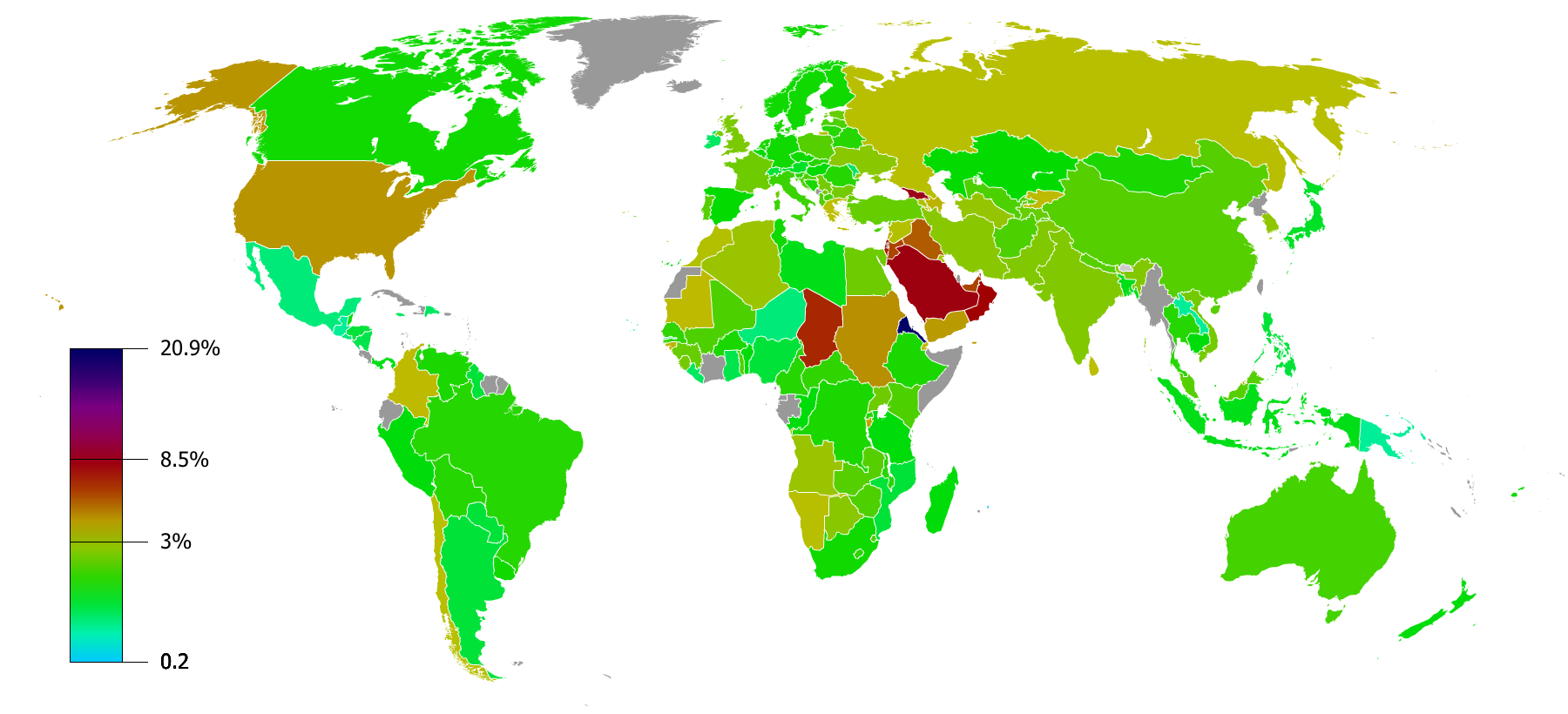
Military Expenditures as percentage of GDP
On p. 3 of Chapter 1 of the text (in the Thinking Theoretically section), the authors write:
In brief, realism posits that states exist in an anarchic international system. Each state bases its policies on an interpretation of national interest defined in terms of power.
While there are many types of power–economic, political, prestige, etc.,–the most important source of power and the one which states generally seek to increase as much as possible, is military power. Because of anarchy, realists believe that states are constantly concerned about their security. States that feel more insecure seek to increase their power, thereby increasing the sizes of their military, all else being equal. It would be interesting to find out which states spend a lot on their military, and which states spend less. Fortunately, Globalsecurity.org has compiled the data for us. In their most recent summary of global military expenditures (from 2011), we find some interesting data. I have copied the top 20 (in terms of absolute dollars spent) in the table below. For a list of all countries, click on the link above.



 Clouds, Clocks, and Sitting at Tables
You must be logged in to post a comment.