Has Poverty in India Really Dropped?

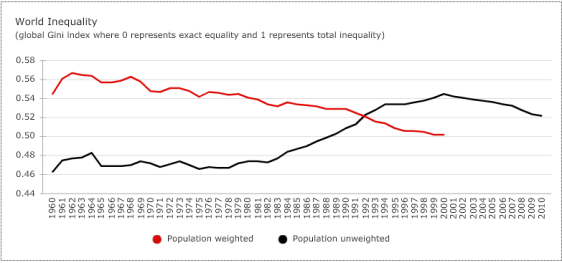
In POLI 1100 yesterday, we analyzed the topic of development and underdevelopment and noted that, according to some estimates, the world has become less unequal (more equal) over the last 10 years or so, primarily (we noted) as the result of the economic rise of China and India. Given that these two countries contain more than 1/3 of the world’s total population, what happens to them (and their citizens) has dramatic global impact. So, if incomes (and wealth) in India and China are rising, then it’s not surprising that the world is becoming a wealthier (and more equal) place. Take a look at the chart below. You’ll notice differences in the two trend lines, which can be accounted for by the rise in income in China and India.
While there have been rumours for many years that official Chinese economic statistics may not be the most reliable, a recent story in the New York Times asks the somewhat surprising question “Has Poverty Really Dropped in India?” It turns out that the answer is most likely yes, though it appears, on the surface, that some of sleight was at work. However, in the end the drop in poverty seems legitimate:

Remember when the public was outraged at the idea that the poverty line should be 32 rupees, or 63 cents, a day in urban areas?

We’ve now learned it should really be 29 rupees. And believe it or not, this is no sleight of hand to show a drop in poverty.

The Planning Commission’s latest poverty estimates, [click on this link for the statistics, which are grouped by caste, religion, and other demographic indicators] released Monday evening, show a 7 percentage-point drop in India’s poor, the largest fall since the figure was first calculated in 1962.

Some critics say the Planning Commission has reduced an already controversially low poverty line even further, using the new thresholds to create the appearance of a large drop in absolute numbers.

By the way, how much is 29 rupees–the poverty threshold in urban areas? About 57 Canadian cents, at today’s exchange rates! So according, to the Indian government, an Indian living in an urban area can earn only 58% of the one dollar/day threshold and still not be considered as officially living in poverty!! Yikes!

Ghosts of Rwanda

In POLI 1140, we have read an excerpt from Rwanda section of Samantha Power’s prize-winning book, A Problem from Hell: America and the Age of Genocide, in which Power assesses the reasons for the lack of response by the Clinton administration in the spring of 1994 to the developing genocide in Rwanda. Power makes many points but one of the most trenchant is that despite the apparently early decision by Clinton that he would not send US troops to Rwanda (fearful that another Somalia could ensue), many other actions–short of sending troops-could have been taken by the US government and military. Something as simple as sending planes with the capability to jam radio frequencies may have slowed down the killing and saved countless lives.

Here is a compelling and very informative documentary by PBS’ Frontline series on the events surrounding the Rwandan genocide, paying special attention to the lack of action on the part of the United Nations and the United States. Many of the ideas in Power’s book are addressed here.

Universal Jurisdiction

Today in POLI 1140, we discussed and debated the topic of universal jurisdiction. What is universal jurisdiction? Universal jurisdiction is

a legal concept that permits states to claim legal authority beyond their national territory for the purpose of punishing a particularly heinous criminal that violates the laws of all states or protecting human rights. Mingst and Arreguin-Toft (222)

The most celebrated case in this relatively new area of international jurisprudence is that of former Chilean military dictator Gen. Augusto Pinochet, about whom the New York Times editorial board wrote in 2004:

Thanks to a Chilean court ruling on Monday, the day at last seems to be approaching when Gen. Augusto Pinochet, the former military dictator, will go on trial for crimes committed decades ago. General Pinochet is now a very old man, but normal feelings of sympathy would be misplaced. This trial should have begun years ago.

The long delay is entirely the result of General Pinochet’s effort to evade legal accountability. The charges concern one of the most chilling crimes of his nearly 17-year rule, an international conspiracy to hunt down and murder opponents of Latin America’s military dictatorships in the 1970’s. That plot got under way in the days when Henry Kissinger was running American foreign policy for Richard Nixon, and the the United States did too little to discourage it, even though one of the resulting murders was carried out on the streets of Washington.

Gen.Pinochet would die (at age 91) before facing his accusers.

What has prompted the recent emergence, and codification into both international–for example, Article 49 of the First Geneva Convention–and domestic–Canada’s Crimes Against Humanity and War Crimes Act–law, of the concept of universal jurisdiction? According to one of the world’s leading human rights NGOs–Amnesty International–it is because

As genocide, crimes against humanity, war crimes, torture, extrajudicial executions and enforced disappearances are crimes under international law, all states should investigate and prosecute the crimes before their national courts.

Recognizing that impunity exists mainly when the national authorities of countries affected by the crimes fail to act, it is important that the national criminal and civil justice systems of all countries can step in to prosecute the crimes on behalf of the international community and award reparations to victims.

Of course, there are many detractors to the use of the concept of universal jurisdiction. The aforementioned Henry Kissinger has argued the concept not only risks “judicial tyranny” and cases like that of Gen. Pinochet set a “dangerous precedent” (though Kissinger is certainly less than a disinterested figure in this case!), but that

The danger [in pushing for universal jurisdiction] lies in pushing the effort to extremes that risk substituting the tyranny of judges for that of governments; historically, the dictatorship of the virtuous has often led to inquisitions and even witch-hunts.

In class, we viewed the first ten minutes of the video below in which advocates and opponents of the concept of universal jurisdiction debated the relative merits of the idea with respect to the potential arrest of Israeli diplomats on visits to Great Britain for alleged war crimes in Israel/the Occupied Territories.

In the video, Professor Dan Scheuftan, of the University of Haifa notes

[although] International Relations is political…[the increasing use of universal jurisdiction will] politicize the legal system as well. again by radicals, usually from the extreme left using it [universal jurisdiction] as a propaganda ploy.

What do you think? Is the concept a valid tool in the fight to bring perpetrators of heinous human rights abuses and war crimes to justice, or is it more likely to be abused (than used) in the politicization and propagandization (is that a word?) of international justice?


Global Debt Crisis and Relief

The issue of the global debt crisis–and particularly the onerous debt levels of developing world (“Southern”) countries–was a topic that we covered in POLI 1100 today. It will allow me to combine two class topics–issues pertaining development and underdevelopment, and interest groups (NGOs)–into one blog post. The interest group, Global Issues, is dedicated to analyzing “social, political, economic, and environmental issues that affect us all” and has a section on debt relief for the developing world. Here are some facts and figures related to the scale of the debt crisis in the developing world:

Consider the following:

  • In 1970, the world’s poorest countries (roughly 60 countries classified as low-income by the World Bank), owed $25 billion in debt.
  • By 2002, this was $523 billion
  • For Africa,
    • In 1970, it was just under $11 billion
    • By 2002, that was over half, to $295 billion
  • Debts owed to the multilateral institutions such as the IMF and World Bank is currently around $153 billion
  • For the poorest countries debts to multilateral institutions is around $70 billion.

$550 billion has been paid in both principal and interest over the last three decades, on $540bn of loans, and yet there is still a $523 billion dollar debt burden.

Here are some remarks by Professor Susan George on how to tackle the debt crisis. Money quote:

…there is no level of human suffering, which in and of itself, is going to change policy. The only way policy changes is because people demand it, and in this case, it has to be the people of the North, because the people of the South have very little political clout.

Thomas Lubanga First Person Convicted by ICC

Wednesday, March 14th, 2012 will stand as a watershed moment in international relations and in international law, specifically. Thomas Lubanga, former militia leader in the eastern Democratic Republic of Congo (DRC) is the first person ever convicted by the recently formed International Criminal Court (ICC). Though there have been dozens of convictions of war crimes suspects from the wars in the former Yugoslavia and Rwanda, these cases were process by temporary courts–the ICTY and the ICTR, respectively–and not the ICC. Lubanga was accused of conscripting, enlisting, and using child soldiers in the conflict in the Ituri region of the DRC. Rather than playing a role in the post-war political process, (which he had hoped) Lubanga was arrested in March 2005 and extradited to the ICC one year later. It is only now, seven years after his arrest, that a verdict on this case has come down.

Lubanga’s conviction is the end of a multi=year trial process, the legitimacy of which was undermined at times by the lack of prosecutorial professionalism, and other issues. For more about the trial, go here, and watch the videos below.

Here’s a great blog post from a student, with videos describing the most common electoral systems. Which do you think we should have in Canada?

whiterangern's avatarNateOrboros

There are many ways of how countries vote for who they want in parliament.

In Canada we use a system called First Past the Post which means who ever has the most votes wins. So Canada is divided into ridings where we vote for a candidate from a party to represent us.

A fun way of learning about the First Past the Post

A less fun explanation of First Past the Post

Another Electoral System is called the Alternative Vote. For the Alternative Vote the voters may list the candidates in order from who they want elected the most to who they are least afraid to be in office. Then the candidate with the least amount of votes is eliminated and the voters of the candidate will have their 2nd vote put in use and so on and so on until 1 candidate has more the 50% of the votes.

a continuation of the animal kingdom but explaining the…

View original post 189 more words

Electoral Systems

Here’s an interesting post by a student on the effect of different electoral systems on the strategic calculations of voters. Would Canadian voters vote differently if our electoral system were PR? The evidence suggests that for a substantial minority, the answer is yes.

Here’s an example: in many (most) ridings, there is no chance that a member of the Green Party would be elected to parliament. Thus, rather than voting for the Green Party, many voters in these ridings who would prefer to vote Green, vote their 2nd preference, meaning that the Liberal Party and the NDP receive more votes during our elections than they otherwise would under a PR system. (Very few voters whose favoured party is the Green Party have the Conservative Party as their 2nd preference). Check out the post…

Electoral Systems.

In POLI 1140 this week, we’ll look at war and conflict (and strife), which, according to Mingst and Arreguin-Toft, “is generally viewed as the oldest, the most prevalent, and in the long term, the most salient” issue in international relations. Indeed, this attention to war and security is warranted given that without at least a minimal degree of security it is difficult to achieve other, worthy values.

As many of you are well aware, the US military, with its NATO allies, has been at war in Afghanistan since just after the terrorist attacks of 9/11. The Canadian military, of course, stood by its NATO ally from the beginning taking a large number of casualties during its time in Afghanistan. Our last combat troops left Afghanistan last summer. While in Afghanistan, the Canadian military was responsible for securing the Kandahar province, which was, by all accounts, the most dangerous province in that war-torn country:

The military first went into Kandahar in 2005, the beginning of the combat mission. The forces are now into a training mission based in Kabul, where they’re teaching Afghan national security forces.

Kandahar was Afghanistan’s most dangerous province, Defence Minister Peter MacKay said in a statement.

Following Canada’s military withdrawal from Kandahar, the US military took over responsibility for the area. Unfortunately, tragedy struck over the weekend as a US soldier allegedly walked off of his military base in Kandahar and killed at least 16 civilians, 9 of which were children, who were all asleep at the time. Those who are familiar with war and its effects on the psychic health of all involved understand that these types of things do happen in war zones. I have personally interviewed soldiers who described to me similar incidents that they either witnessed or in which they were personally involved.

Based on what you’ve read in Chapter 8 of the textbook, which theory of IR best accounts for the war in Afghanistan and for why NATO troops are still in combat there?

More on Representation and Electoral Systems

Prompted by a comment on a previous post regarding how voter representation would be different if Canada had a proportional representation system, I decided to do some reading on the Fair Vote website and stumbled upon some interesting facts. The first is an illuminating quote regarding the difference between decision-making (rule) and representation by somebody named Ernest Haville:

 “In a democratic government, the right of decision belongs to the majority, but the right of representation belongs to all.”

As we noted in class earlier today, many of the votes cast in our elections are wasted as a result of our first-past-the-post system. Below is a screenshot from the website wastedvotes.ca, which shows that in the 2008 federal election in Gatineau, QC, fully 70% of the voters were not represented. This is because the Bloc Quebecois candidate, Richard Nadeau, won a tight four-way battle, garnering a plurality of the vote at 29.2%.

This is just the most egregious example of wasted votes (and, thereby, of non-representation), but every Canadian election and electoral district sees wasted votes. Indeed, the folks at wastedvote.ca have calculated that of the more than 14 million votes cast during Canada’s last federal election (2011) only slightly more than half (50.4%) were effective, while 49.6% were wasted.

Why is this bad for democracy? Well, here is another excerpt from fairvote.ca:

Does Canada actually have representative democracy? In the 2008 federal election:

  • 940,000 voters supporting the Green Party elected no one, while fewer Conservative voters in Alberta alone elected 27 Conservative MPs.
  • In the prairie provinces, Conservatives received roughly twice the votes of the Liberals and NDP combined, but took seven times as many seats.
  • Similar to the last election, a quarter-million Conservative voters in Toronto elected no one and neither did Conservative voters in Montreal.
  • New Democrats: The NDP attracted 1.1 million more votes than the Bloc, but the voting system gave the Bloc 49 seats, the NDP 37.

What about majority rule? Canadians are usually ruled by majority governments that the majority voted against. In some provincial elections, parties coming in second in the popular vote have won majority control of the legislature.

In class, we noted the irony of the part above that is in bold font! The 1988 federal election was fought primarily on the basis of a pending free trade agreement amongst Canada, the United States, and Mexico. In Canada, the Progressive Conservatives (led by Prime Minister Brian Mulroney) were in favour of (what would become) NAFTA, while the NDP and the Liberal Party were against. In the end, a majority of Canadians voted for parties that were against NAFTA, yet the PCs won a majority of seats in parliament, enabling them to push through the necessary legislation.

Current UN Peacekeeping Operations

In POLI 1140, we spent part of last session watching major portions of the documentary, The  Peacekeepers, which explored the role of the UN is setting up and escalating a peacekeeping mission to the Democratic Republic of the Congo (DRC). The documentary used a behind-the-scenes approach to analyze the issues faced by the world’s foremost IGO in implementing its mandate to “protect international peace and security”. The focus of the documentary was on the Ituri region in the eastern DRC province of East Kivu.

As the above map notes, the UN, though the auspices of its Department of Peacekeeping Operations, currently has 16 active peacekeeping missions worldwide. The former DRC mission, known as MONUC, has been transformed, in accordance with UN Security Council Resolution 1925, into MONUSCO.

As of the start of this year, this is the strength of the peacekeeping force in the DRC:

  • 19,070 total uniformed personnel
    • 16,975 military personnel
    • 723 military observers
    • 1,372 police (including formed units)
  • 976 international civilian personnel*
  • 2,868 local civilian staff*
  • 588 United Nations Volunteers

Currently, in 16 DPKO-led peacekeeping operations, there are almost 120,000 personnel (uniformed and civilian) serving from 115 different countries, while approved resources for the 2012 fiscal year are almost $8 billion US.

Mind you, this is only one aspect of the world’s greatest IGO–the United Nations. Remember also that the UN is only as strong and as capable as its members states make it. Thus, when you hear somebody say “the UN did this,” or “the UN didn’t do that”, what you should remind these people is that they should be saying “the member states, which comprise the UN, did (or did not do) this, or that…”


Design a site like this with WordPress.com
Get started