Munk Debate on Humanitarian Intervention

In IS 302 today, we watched the opening statements of four distinguished panelists debating the merits of humanitarian intervention, which was held at the Munk Centre of the University of Toronto in 2008. Two panelists–Gareth Evans and Mia Farrow–took the pro-intervention side, while the other two–John Bolton and General Rick Hillier–argued in support of the anti-interventionist position.

Here are just some of the issues that were discussed in class following the viewing:

  • Evans’ reformulation of the concept of “the national interest.” Why did he do this? Were you convinced?
  • Bolton’s admonition that if you want to intervene militarily to prevent humanitarian crises, do it with your soldiers, not mine.
  • Farrow’s claim that states currently have the responsibility–as a result of international conventions and treaties–to do everything within their means to stop humanitarian disasters and genocides such as those occurring in Sudan.
  • Hillier’s claim that if the international community were truly serious about intervening in a manner consistent with the rhetoric, governments in countries such as Canada and Australia would have to double the size and capabilities of their militaries. That they don’t is a sign, Hillier asserts, of the lack of will on the part of these countries specifically, and the broader humanitarian world more generally.
  • A link to the whole video can be found here. Note that you’ll have to register with the Munk Centre website in order to be able to watch the video.

    What are the Fundamental Tenets of Confucianism…Culture as Destiny?

    Over the past few weeks, we have addressed the debate regarding the relative explanatory power of cultural versus institutional and rational choice approaches to the analysis of political phenomena.  In the book excerpt, “A Brief History of Human Liberty,” Newsweek editor Fareed Zakaria analyzes the cultural argument regarding economic growth and democracy. He quotes the former Singaporean Prime Minister Lee Kuan Yew:

    “…if you want to see how culture works, compare the performance of German workers and Zambian workers anywhere in the world.  You will quickly come to the conclusion that there is something very different in the two cultures that explains the results.”

    Zakaria has some sympathy for this argument, but then argues that it is strange that Lee Kuan Yew is such a strong proponent of cultural arguments* given that while Singapore is culturally very similar to its neighbor, Malaysia, Singapore has been much more effective in its economic policies than has its neighbor.  In fact, I would add that a strong argument against cultural explanations of democracy and economic development are the differences between East Germany and West Germany (in the post-WWII-era until unification) and the present difference between North and South Korea.

    The 38th parallel may be just a line on a map, and the division of the nation of Korea into two separate states may be a historically contingent act, but it demonstrates the tremendously powerful impact of institutions on a society.  South Korea was able to develop good political and economic institutions, while North Korea has not.  The cultural foundation of each state was similar (although I’m not an expert on Korea, so maybe there was a cultural difference between the “north” and the “south” that can account for the vast differences in the two states today–although I’m highly skeptical) before the division and we know, in a methodological sense, that a constant can not explain an outcome that varies.

    Getting back to Zakaria and Lee Yuan Kew, Zakaria writes that

    “the key to Singapore’s success…is Lee Kuan Yew, not Confucius.  The point is not that culture is unimportant; on the contrary it matters greatly…But culture can change…A hundred years ago, when East Asia seemed immutably poor, many scholars–most famously Max Weber [we’ve read his Protestant Ethic argument]–argued that Confucian-based cultures discouraged all the attributes necessary for success in capitalism…A decade ago, when East Asia was booming, scholars had turned this explanation on its head, arguing that Confucianism actually emphasized the traits essential for economic dynamism. Today the wheel has turned again and many see in ‘Asian values’ all the ingredients of crony capitalism.”‘

    What are these Confucian and ‘Asian values’ about which there has been so much discussion.  Well, needless to say Asia is a vast land mass, with exceedingly high levels of diversity–culturally, linguistically, religiously, racially, etc.  So the concept of ‘Asian values’ may be so amorphous as to http://onpoint.wbur.org/2006/08/15/china-and-confucian-democracy http://onpoint.wbur.org/2006/08/http://onpoint.wbur.org/2006/08/15/china-and-confucian-democracy/china-and-confucian-democracy.  Confucianism, however, is a distinct and compact body of ideas that has a comprehensive philosophical foundation.  What are Confucian values, then and do they help or hinder China’s precarious journey towards democracy and economic development?  Well, here’s an answer from political philosopher Daniel Bell, who insists that ultimately, Confucianism is about three core values.  What are these?  Listen to the first ten minutes of the audio podcast from this episode of “On Point.”  Here’s a link to the URL on which you can find an archived version of the show.

    **Here, it should be noted that a reason Lee Kuan Yew is strongly predisposed to arguing on the basis of culture is his contempt for the licentiousness of Western values and his desire to prevent demands for those kinds of freedoms (as long as political liberty) to take root in the strongly authoritarian state of Singapore.  Just read his statements during the infamous Michael Fay incident.

    It wasn’t long before Singapore patriarch Lee Kuan Yew weighed in. He reckoned the whole affair revealed America’s moral decay. “The U.S. government, the U.S. Senate and the U.S. media took the opportunity to ridicule us, saying the sentence was too severe,” he said in a television interview. “[The U.S.] does not restrain or punish individuals, forgiving them for whatever they have done. That’s why the whole country is in chaos: drugs, violence, unemployment and homelessness. The American society is the richest and most prosperous in the world but it is hardly safe and peaceful.”

    Here’s another story on the incident.

    Unrest in Egypt due to Inflation

    The Financial Times reports a rise in social unrest in Egypt, which has been attributed to inflation, rising food costs in particular. Inflation is soaring in most parts of the Middle East, from the affluent enclaves of the United Arab Emirates to the more distressed countries, such as Egypt. The main culprit is the record-level price of oil.

    A wave of discontent has been sweeping through Egypt in response to mounting food prices and the return of long queues in front of bakeries selling subsidised bread – the only food item that has not recently risen in price.

    Civil servants, industrial workers and even groups considered privileged such as doctors and university lecturers have been staging strikes and demanding higher pay to meet price increases of up to 50 per cent for some basic foods.

    State university lecturers have gone on strike this week, bringing many classes to a halt for a day. “Faculty members in Egypt are normally a very conservative group who do not want to expose themselves to trouble,” said Hany Al Husseini, one of the strike organisers. “But now the economic situation has become so bad that people are prepared to do anything.”

    Behind the Scenes fun at the Expense of a News Presenter

    I apologize to those of you who do not speak or understand Croatian/Serbian/Bosnian (the news presenter here, Goran Milic, is speaking Serbian), but I had never seen this and it gave me a good laugh.  The report is from Yugoslav television news in 1991 as the situation (stanje) in Yugoslavia is rapidly deteriorating.  It would seem as though those in charge of the graphics were having a little bit of fun at Milic’s expense as they (intentionally?) misspelled the word stanje on the graphic, which you can see trips Milic up for a moment as he stops speaking for a moment.  I’ll leave it to you to look up the word they used instead using an appropriate dictionary.

    CO2 Emissions in China Increasing Faster than Previously Believed

    In intro to comparative, we have generally compared spatially across countries (or states). There is a lot of explanatory power, however, that can be achieved by modeling and comparing political phenomena at the sub-national level. Maximilian Auffhammer and Richard Carson–two economists–have done this by modeling the rise in Chinese CO2 emissions, using a panel data set at the provincial level in China. Their data set includes 30 provincial-level entities (or provinces) analyzed between 1985 and 2004. See a post I made on China’s pollution problems and economic growth here. I’ve reproduced a slide show from the post below. Here’s a snippet from their paper, which can be accessed here:

    [rockyou id=99737780&w=500&h=350]

    The People’s Republic of China (PRC) has long been seen as the key future participant to an effective agreement limiting the adverse impacts of climate change. It is currently the number two emitter of carbon dioxide (CO2) and is about to overtake the United States, who has held this position since 1890, as the leading emitter. Further, the United States has long preconditioned its adherence to any international agreement such as the Kyoto Protocol on China’s formal concurrence that it would also undertake substantial CO2 reductions. Efforts to reach such an agreement failed in the late 1990’s during the Clinton administration and the Bush administration decided not to pursue policies that would allow it to sign the treaty and have it rati¯ed by the U.S. Senate.

    This paper presents econometric forecasts that strongly suggest that the short to medium term path of Chinese CO2 emissions has increased by a factor of two or more since that time. Our best forecast has China’s CO2 emissions surpassing the United States before the year 2010 rather than 2020 as previously anticipated (Intergovernmental Panel on Climate Change, 2000; Siddiqi, Streets, Wu and He, 1994; Panayotou, Sachs and Zwane, 2002). Our focus in this paper is on exploring alternative econometric specifications for forecasting China’s CO2 emissions using a rich new panel dataset from 1985 to 2004 at the provincial level. The prediction of a dramatic recent increase in the predicted path of China’s CO2 emissions over the short to medium term horizon is shown to be robust to a wide range of alternative specifications. We show, however, that it is possible to strongly reject both the standard engineering specifications that appear in the Intergovernmental Panel on Climate Change (2000), and the recent Stern Report (2006) as well as the popular environmental Kuznets curve specification. All of the “best” models are dynamic in nature employing some type of lag structure, which is consistent with the nature of an installed durable capital stock.

    Serbian Electorate Must Choose–Stomach or Heart?

    narodna_skupstina_srbije.jpgThe Serbian coalition government, with moderate nationalist Vojislav Koštunica as Prime Minister–has collapsed following dissension within the multi-party governing coalition over the “loss of Kosovo.” Voters will go to the polls to elect a new government on May 11th having to make a stark choice in the polling booth: whether to side with the nationalists in their struggle to forestall Kosovar independence, or to vote in a more moderate pro-European government, thereby placating not only members of the European Union but calming the nerves of wary international investors, who have become the life-blood of the Serbian economic system. As reports reports:

    …The coalition government collapsed at the weekend, with nationalist Prime Minister Vojislav Koštunica blaming disunity over the conflicting goals of pursuing European Union membership versus defending Kosovo, the province which seceded last month with EU backing.

    “Right now, around 1.0 billion euros worth of investments have been put on hold,” [Deputy Prime Minster Božidar] Djelić said. “There is a growing risk perception considering that some parties want to halt Serbia’s road to Europe. The elections will be a choice between Europe and investors are extremely careful.”

    Heavily reliant on foreign investment for growth, Serbia is believed to need between 3.0 billion and 5.0 billion euros a year to ensure solid economic growth, single digit inflation and financing of its current account gap of 16 percent of GDP.

    “In the absence of the required level of foreign investment, foreign creditors could also decide to put on hold lending to Serbian companies,” said Pavle Petrović of the FREN/CEVES thinktank said.

    “The resulting crisis would lead to forcible reduction in external gaps through inflation, currency depreciation, a fall in output and wages. In that case, the central bank could soothe and postpone, but not eliminate the crisis,” he said.

    First, Conflict Diamonds; now, Junta Jade?

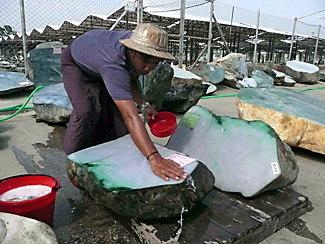
    I know; the j in junta is pronounced like an h. Regardless, The Christian Science Monitor asks “Who’s buying Burma’s gems?: Laura Bush’s campaign for a global boycott is being undone by China’s appetite for Olympic souvenirs made of Burmese jade.” The US First Lady argues that those of you purchasing precious gems from Burma are indirectly supporting the rule of the brutal military dictatorship in that southeast Asian country.

    burma_jade.jpgIt’s the last hour of the last day of the gems auction in Rangoon, and tired buyers are fanning themselves with worn auction catalogs, and making their final bids.

    Over the past five days, jade, rubies, sapphires, and close to $150 million have passed hands here, according to the Union of Myanmar Economic Holdings Ltd., the consortium that dominates Burma’s gemstone trade and is owned by the defense ministry and a clutch of military officers.

    Who’s buying? China, India, Singapore, and Thailand are scooping up Burma’s stones. US first lady Laura Bush’s efforts at a global boycott of Burma’s gems seem to have done little to reduce China’s appetite for Burmese jade to make trinkets and souvenirs to sell at the Summer Olympics.

    At this recent auction, 281 foreigners attended, leaving behind much-needed foreign currency and generally turning the auction into a resounding success, according to the state-run New Light of Myanmar newspaper.

    Mrs. Bush – and human rights campaigners – would not be pleased.

    The first lady has taken on the military regime in Burma (Myanmar), urging jewelers not to buy gems from a country where the undemocratic rulers and their cronies amass fortunes selling off the country’s stones, as well as many of the county’s other natural resources – such as minerals, timber, gold, oil, and gas – but keep Burma’s citizens in abject poverty.

    She has urged UN Secretary General Ban Ki Moon to act more forcibly on Burma and stood beside President Bush on several occasions recently as he announced the growing list of US sanctions on the country. And, on International Human Right’s Day this past December, Mrs. Bush added her voice to those seeking a global boycott on gems from Burma.

    “Consumers throughout the world should consider the implications of their purchase of Burmese gems,” she said in a statement from the White House. “Every Burmese stone bought, cut, polished, and sold sustains an illegitimate, repressive regime.”

    Earlier in the semester, we read an article [which he has made available to the general publilc on his web site] by Richard Snyder on the link between “lootable wealth” and political stability. In fact, the final section of his paper deals explicitly with the Burmese tropical timber trade and its role in funding rebel groups. What are the implications of Snyder’s argument for how we–as potential consumers of junta jade–should respond to Laura Bush’s plea? Of course the two phenomena are not exactly the same (Snyder is seeking to understand the link between “lootable wealth” political stability, while Laura Bush is arguing that “lootable wealth” supports dictatorial rule.) Here is the abstract to Snyder’s article:

    This article proposes a political economy of extraction framework that explains political order and state collapse as alternative outcomes in the face of lootable wealth. Different types of institutions of extraction can be built around lootable resources – with divergent effects on political stability. If rulers are able to forge institutions of extraction that give them control over revenues generated by lootable resources, then these resources can contribute to political order by providing the income with which to govern. In contrast, the breakdown or absence of such institutions increases the risk of civil war by making it easier for rebels to organize. The framework is used to explain two puzzling cases that experienced sharply contrasting political trajectories in the face of lootable resources: Sierra Leone and Burma. A focus on institutions of extraction provides a stronger understanding of the wide range of political possibilities – from chaos, to dictatorship, to democracy – in resource-rich countries.

    Oil, Islam, and Women

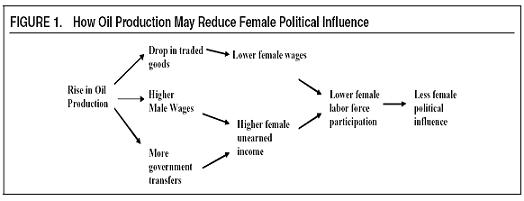
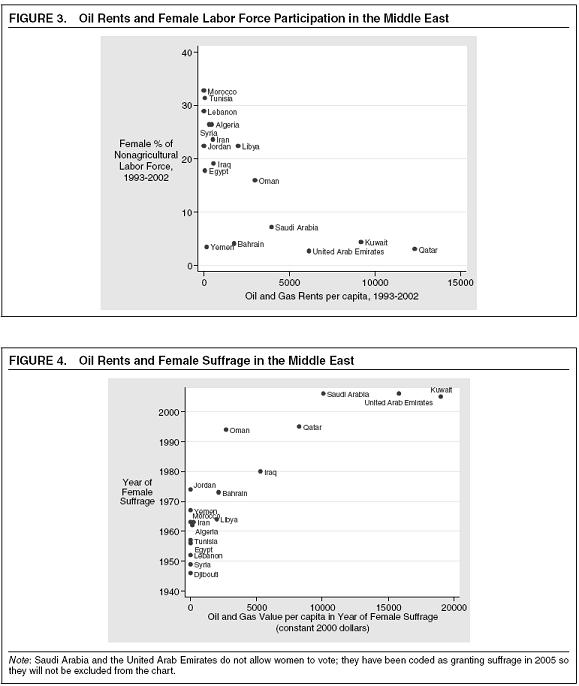
    There is a new article [paywall] in the most recent issue of the American Political Science Review written by Michael L. Ross entitled “Oil, Women, and Islam.” Ross has written a lot about the nexus between resources and regime type, the so-called “resource curse” phenomenon. In this article, Ross argues that the well-known empirial link between lack of women’s rights and Islam washes away once controls related to oil production are incorporated into statistical models. (Note that the analysis is restricted to the Middle East.)

    Here is the abstract and a couple of his charts:

    Women have made less progress toward gender equality in the Middle East than in any other region. Many observers claim this is due to the region’s Islamic traditions. I suggest that oil, not Islam, is at fault; and that oil production also explains why women lag behind in many other countries. Oil production reduces the number of women in the labor force, which in turn reduces their political influence. As a result, oil-producing states are left with atypically strong patriarchal norms, laws, and political institutions. I support this argument with global data on oil production, female work patterns, and female political representation, and by comparing oil-rich Algeria to oil-poor Morocco and Tunisia. This argument has implications for the study of the Middle East, Islamic culture, and the resource curse.

    ross_oil_women_1.jpg

    ross_oil_women_2.jpg

    Design a site like this with WordPress.com
    Get started