Jensen and Wantchekon (2000) have created an index of resource dependence and determined the level of the same for the states of sub-Sarahan Africa. The scores range from 1 (no resource dependence) to 4 (extreme resource dependence). They use this as an important independent variable in determining democratic transition, consolidation, and government effectiveness. How much of an effect does resource dependence have on each of these dependent variables? You’ll have to read the paper to find out, or attend my class in intro to comparative tomorrow.
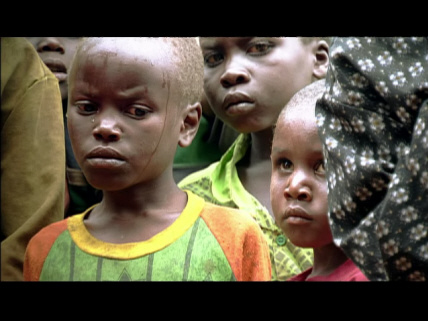
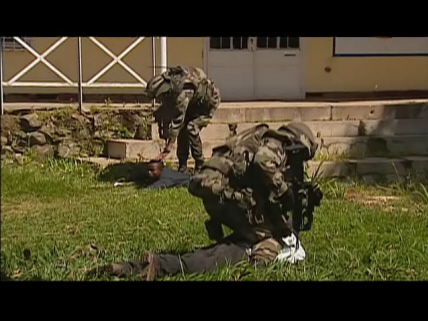
In PLSC250–intro to IR–this week we viewed a documentary made by the National Film Board of Canada, which addresses the UN’s peacekeeping role in Congo. After reading Chapter 7 of Mingst, you should now be aware that the UN in the world’s most important and powerful IGO, and the UN Security Council plays the most prominent global role in the area of international security. Here are a couple of screen shots from the film and the film’s description:
With unprecedented access to the United Nations Department of Peacekeeping, The Peacekeepers provides an intimate and dramatic portrait of the struggle to save “a failed state.” The film follows the determined and often desperate manoeuvres to avert another Rwandan disaster, this time in the Democratic Republic of Congo (the DRC).
Focusing on the UN mission, the film cuts back and forth between the United Nations headquarters in New York and events on the ground in the DRC. We are with the peacekeepers in the ‘Crisis Room’ as they balance the risk of loss of life on the ground with the enormous sums of money required from uncertain donor countries. We are with UN troops as the northeast Congo erupts and the future of the DRC, if not all of central Africa, hangs in the balance.
In the background, but often impinging on peacekeeping decisions, are the painful memory of Rwanda, the worsening crisis in Iraq, global terrorism and American hegemony in world affairs. As Secretary General Kofi Annan tells the General Assembly at the conclusion of The Peacekeepers: “History is a harsh judge. The world will not forgive us if we do nothing.” Whether the world’s peacekeeper did enough remains to be seen.
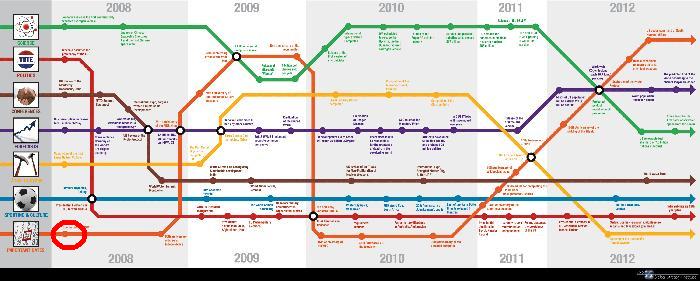
The Center for Strategic and International Studies has a fascinating new subway-style map, which interactively maps the global future on the basis of various themes–construction, sporting and culture, science, politics, etc. Each node of information on the interactive map is a hyperlink that takes the reader to a web page with detailed information about the topic.
Below is a much reduced version of the map. If you click on the word map above, you’ll be taken to the large interactive version of the map. Click on the link (which I’ve indicated using the red circle) and you’ll be taken to a page where you’ll be told the following:
As a result of the internal reorganization of the U.S. military command structure, a new headquarters dedicated exclusively to Africa is expected to become fully operational in 2008. The United States Africa Command, or AFRICOM, will report to the Secretary of Defense on U.S. military relations with 53 African countries, with a focus on war prevention and capacity-building programs. The ultimate stated goal of the program is to enable “a more stable environment in which political and economic growth can take place.” For the fiscal year 2008, AFRICOM is expected to have a $75 billion budget.
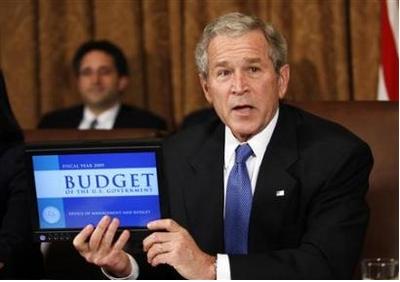
We’re currently discussing and analyzing the state, and its important role in comparative politics. One of the dimensions on which we can compare state power is “capacity.” What is capacity? According to O’Neil (p.38-39), “capacity is the ability of the state to wield power in order to carry out the basic tasks of providing security and reconciling freedom and equality. A state with high capacity is able to formulate and enact fundamental policies and ensure stability and security for both itself and its citizens.” We were presented with evidence today of a demonstration of the high capacity of the United States as President George W. Bush unveiled his new 3.1 trillion-dollar (I’m no mathematician, but that’s at least a couple of gazillion dollars, isn’t it?) budget. Any state that can make its citizens cough up that much money, more or less willingly, has to have high capacity.
The photograph is from Yahoo News, click here to see a video clip of the president submitting this year’s federal budget, the first one in American history to be submitted in electronic form. As the president correctly surmised, “this will save a lot of trees!”
Apropos of an earlier post and discussion in class today about correlation and causality, here is an excerpt from an interview with Transparency International’s Huguette Labelle, where she answers questions about the apparent correlation between corruption levels and GDP, and corruption levels and levels of violent conflict:
Question:
The countries with the best scores in the CPI seem to be some of the world’s richest countries – is higher GDP the key to less corruption? Answer:
I think the difference between the countries at the top and the bottom is not so much due to their relative wealth or poverty, but to the development of their institutions. The top scorers have effective public sectors, with open contracting procedures, strong disclosure rules and access to information.
Labelle is implying here that the correlation between corruption and GDP is not causal; it is spurious(we’ll talk about spurious causation next class).
Question:
Many of the countries with the worst scores in the CPI are victims of violent conflict (Somalia, Myanmar, Iraq, Sudan and Afghanistan). What is the relationship between failed states and corruption? Answer:
In a crisis situation, the institutions of government are weakened, so corruption can more easily take hold and spread. It is not just individuals, but also institutions, that are responsible for maintaining integrity in a country. Many countries at the bottom of the CPI are failed states that are at the intersection of poverty, conflict and corruption.
The International Crisis Group (ICG) has a new report on the situation in Timor Leste. Some of you may be aware that Timor Leste broke away from Indonesia four years ago following a brutal war of secession, during which forces loyal to the Indonesian government were alleged to have committed horrendous crimes against humanity. Thanks to UN intervention, the killing stopped and the small state of Timor Leste gained its independence. Recently, however, the UN-directed nation-building exercise in Timor Leste has imploded, along with domestic order.
According to the ICG.
Four years after Timor-Leste gained independence, its police and army were fighting each other in the streets of Dili. The April-June 2006 crisis left both institutions in ruins and security again in the hands of international forces. The crisis was precipitated by the dismissal of almost half the army and caused the virtual collapse of the police force. UN police and Australian-led peacekeepers maintain security in a situation that, while not at a point of violent conflict, remains unsettled. If the new government is to reform the security sector successfully, it must ensure that the process is inclusive by consulting widely and resisting the temptation to take autocratic decisions. A systematic, comprehensive approach, as recommended by the UN Security Council, should be based on a realistic analysis of actual security and law-enforcement needs. Unless there is a non-partisan commitment to the reform process, structural problems are likely to remain unresolved and the security forces politicised and volatile.
The problems run deep. Neither the UN administration nor successive Timorese governments did enough to build a national consensus about security needs and the kind of forces required to meet them. There is no national security policy, and there are important gaps in security-related legislation. The police suffer from low status and an excess of political interference. The army still trades on its heroism in resisting the Indonesian occupation but has not yet found a new role and has been plagued by regional (east-west) rivalry. There is a lack of transparency and orderly arrangements in political control as well as parliamentary and judicial oversight with respect to both forces.
The situation in Timor Leste illustrates–from the perspective of comparative politics–the importance of the state and its crucial role in facilitating stability by consolidating political power and maintaining, to paraphrase Weber, a monopoly on the legitimate use of political violence. From an IR perspective, we see the difficulty of imposing legitimate order on a society from outside, whether–as is the case here–through intergovernmental organizations (IGOs) like the United Nations, or–as in Iraq–through unilateral, or multilateral means.
Here’s a report from the BBC on the upheavals of April-June 2006.
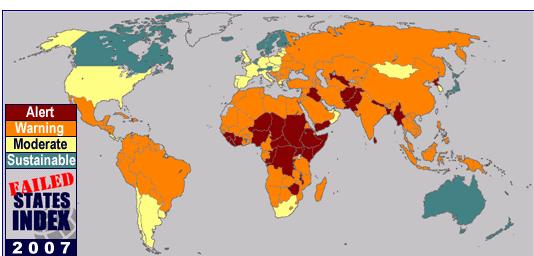
Here is another great resource compiled by the Fund for Peace. The Failed States Index tracks the stability of, at last count (2007) 177 states around the world on the basis of twelve indicators, grouped into social, economic and political categories. Some of the specific indicators are demographic pressures, a legacy of vengeance, uneven economic development and the rise of factionalized elites. Once again, there is a wealth of information and data at the Fund for Peace website, which goes beyond the Failed States Index. Here is a map based on data from 2007:

 Clouds, Clocks, and Sitting at Tables
