From CSM–In Turkey, Secularists Escalate Fight Against Ruling AKP

Amongst the readings we’ll be addressing tomorrow in introduction to comparative politics is Alfred Stepan’s “The Twin Tolerations”, which analyzes the necessary mutual respect between religious society and political society that democracy demands. Please read this recent article from the Christian Science Monitor on the battle between Turkish secularists and the Islamic-oriented ruling party in Turkey, the Justice and Development Party (AKP), which is headed to Turkey’s court system. The secularists argue that the Turkish Constitution’s strict separation of church and state has been violated by the religious nature of the ruling party. Please bring this article to class tomorrow. Be prepared to discuss how well the “twin tolerations” are working here. Here are some excerpts:

Under scrutiny: Prime Minister Recep Tayyip Erdogan and his ruling party are facing heightened criticism for straying from the Constitution’s secular principles.
Umit Bektas/Reuters

turkey.jpg

After protesting the AKP’s presidential candidate, precipitating new elections, and then losing out to the AKP at the polls last year, hard-line secularists are now taking a new tack: trying to shut down the party for “expunging” the Constitution’s secular principles.

Turkey’s highest court is set to decide in the coming days whether to allow the motion, filed by the country’s top prosecutor on March 14, to go forward. If the Constitutional Court decides to allow the case to proceed, it could plunge Turkey into a deep crisis, threatening the country’s emerging political and economic stability and further jeopardizing its already troubled bid for European Union membership.

“This would definitely hinder the government in many ways. There are so many things to be done, such as issues relating to the EU, Cyprus, and the economy, and the government would no longer be in a position of authority,” says Sahin Alpay, a political science professor at Istanbul’s Bahcesehir University. “What the people going after the party are doing is really shooting the country in its own feet.”

EU officials have criticized the closure move, calling it antidemocratic.

“In a normal European democracy, political issues are debated in parliament and decided in the ballot box, not in the courtroom,” said EU Enlargement Commissioner Olli Rehn in response to the prosecutor’s unexpected call to shut down the AKP. “It is difficult to see that this lawsuit respects the democratic principles of a normal European society.”

24 parties closed since 1963

Turkish law gives the judiciary broad powers to shut political parties down. The Constitutional Court has closed 24 parties since it was established in 1963. The court is currently deciding on a motion to close the pro-Kurdish Democratic Society Party (DTP), accused of promoting ethnic separatism.

Ethnic Conflict and Strife

A couple of days ago all blog posts seemed to be related to the theme “the social logic of politics”. Today, there seems to be a surge in episodes of inter-ethnic conflict worldwide. First, we learn from the Washington Post, that there is unrest and violence in the Tibetan capital of Lhasa, where a week of increasing confrontations between native Tibetans and the Chinese government have turned violent, with native Tibetans battling with Chinese police and troops and also attacking ethnic Han Chinese, which is either unprecedented or extremely rare.

BEIJING, March 14 — A week of tense confrontations over Chinese rule in Tibet erupted in violence Friday, as hundreds of protesters clashed with police and set fire to shops in the center of Lhasa. Doctors reported dozens of wounded streaming into area hospitals, and one witness said the downtown area was “in a state of siege.”

The rare breakout of violence, the worst in 20 years in the capital city of a remote mountainous region that is the heart of Tibetan Buddhism, posed a challenge to the Chinese government as it prepares to host the 2008 Olympic Games in August. Seeking to make the Games a worldwide celebration of its swift economic progress during the past three decades, the Chinese government has steadfastly attempted to project an image of harmony and stability, even while tightening its grip over the restive region.

“This spiraling unrest has triggered the scenario the Chinese prayed would not happen,” said Robbie Barnett, director of modern Tibetan studies at Columbia University. “Now we’re just watching the clock tick until people get off the street or the Chinese open fire.”

In a different part of the world, Malaysia, in which once again ethnic Chinese are involved, the New York Times reports on post-electoral tension on the island of Penang:

PENANG, Malaysia — Chanting “Long Live the Malays!” several hundred members of Malaysia’s largest ethnic group gathered Friday on this largely Chinese island, defying a police ban on protests and raising communal tensions after sharp electoral losses by the country’s governing party.

Newly elected state governments have moved rapidly to abolish some of the long-held privileges of ethnic Malays. Those efforts have challenged the core of Malaysia’s ethnic-based political system and inflamed the sensibilities of Malays. Until the March 8 elections, Malays thoroughly dominated politics through the country’s largest party, the United Malays National Organization, known by its initials, U.M.N.O.

The opposition parties that beat U.M.N.O. and its partners in five states say affirmative action should be based on need rather than ethnicity. But the opposition, too, is struggling to contain fissures along ethnic lines as a Chinese opposition party competes with its Malay counterpart.

“We’re living in very sensitive times,” said Tricia Yeoh, director of the Center for Public Policy Studies, an independent research center in Kuala Lumpur, the capital.

The affirmative action program favoring the Malays has been in place for more than three and a half decades and gives Malays everything from discounts on new houses to 30 percent quotas in initial public offerings of companies. It is known as the New Economic Policy.

Finally, in Iraq, where in the last four years the minority Christian community has been decimated, either through targeted killings or ethnic cleansing, we hear news of the killing of a prominent Catholic Bishop:

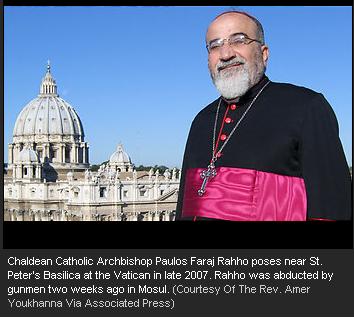
bishop_rahro.jpg BAGHDAD, March 13 — The body of a senior Christian cleric was found Thursday in the northern city of Mosul, two weeks after gunmen abducted him there and killed three of his associates.

The death of Paulos Faraj Rahho, 65, archbishop of Mosul’s Chaldean community, prompted expressions of remorse and condemnation from the Iraqi government and Christian leaders.

Pope Benedict XVI, in a message to the Chaldean patriarch in Iraq, called the killing an “act of inhuman violence that offends the dignity of the human person and seriously harms the cause of fraternal coexistence among the beloved Iraqi people.”

Iraqi Prime Minister Nouri al-Maliki said it was a crime of “aggression aimed at inciting sedition among” Iraqis.

Catholicism and the Social Dimension of Sin

Father James Martin takes the London Times to task for their framing of the story of the Catholic Church’s developing views on the nature of sin. (Click here for my blog post on the Times story.)

Father Martin writes in the America Magazine–the national Catholic weekly–that the Times’ story has confused the issue “unnecessarily.” He writes:

pd_hell_070706_ms.jpgMy guess is that some in the media bobbled this story for two reasons, neither of them malicious. First, a general unfamiliarity with the contemporary Catholic tradition of social sin, even though under Pope John Paul II something like “anti-Semitism” was often referred to in those terms. And, second, the fact that a headline that reads “Seven New Deadly Sins” is undeniably sexier than a headline saying, “Vatican Official Deepens Church’s Reflection on Longstanding Tradition of Social Sin.”

The Vatican’s intent seemed to be less about adding to the traditional “deadly” sins (lust, anger, sloth, pride, avarice, gluttony, envy) than reminding the world that sin has a social dimension, and that participation in institutions that themselves sin is an important point upon which believers needed to reflect.

In other words, if you work for a company that pollutes the environment, you have something more important to consider for Lent than whether or not to give up chocolate.

Comparative Political Party and Electoral Systems

In a few weeks, we will conduct an in-class exercise that simulates a German national election.  This will give you a good idea of the specifics of the German political party and electoral systems, which you will then be able to compare to other systems around the world.  The German system is fairly complicated in that each citizen casts two votes, one for a member running in a single-member district, while the other is cast for a party via a proportional system.

Elections are, of course, the conditio sine qua non–and the minimal institutional requirement–of democratic political systems.   A great web site dedicated to keeping track of elections around the world is electionguide.org They do not as of yet have the results from the most recent national elections in Spain, (they will shortly) but they do have election results for countries around the world going back decades for some countries.  You should check them out.

The Christian Science Monitor  on the incumbent Spanish government’s re-election this past week:

oresults_p1.jpgAided by a near-record turnout, José Luis Rodríguez Zapatero and the Socialist Party won the Spanish national elections – suggesting further changes toward diversity in a young democracy whose older generations cut their teeth on the Franco dictatorship and the moral authority of the Roman Catholic church.

The Socialist victory suggests Mr. Zapatero’s party has broken out of the longtime secondary status it has labored under, despite winning the last election in 2004.

Now, say analysts, the Socialists’ more liberal appeal to young people, women, and immigrants – along with its contemporary style of campaigning – must be taken seriously by the conservative Popular Party (PP), which ran on an older message of Spanish traditionalism and antipathy toward the feisty Basque and Catalonia regions.

Do the cited paragraphs remind you of any other electorate?

Islam Democracy, and Authoritarianism and Paper Assignment

The topic for the next paper assignment in PLSC240  is “Democracy and Culture”.  You will be required to assess the democratic potential of various cultural orientations for democracy, using the Diamond and Morlino volume as a guide.  In Assessing the Quality of Democracy, various essential components of democracy are analyzed, including responsiveness, equality, freedom and accountability.  Your task will be to comparatively assess the quality of democracy in two countries, one of which is “Western” in its cultural orientation, the other of which is “non-Western.”  I’ll have more information for you on the specifics of the assignment when you get back from break on the 18th.

For now, I’ll remind you that on Thursday, those of you who did not leave early for spring break watched a Frontline documentary on Muslims and the democratic potential of Islam. You were shown the diversity in the manner in which Islam is practiced across five different countries–Egypt, Iran, Malaysia, and Turkey, and Nigeria. You were also able to begin to understand the varied roles and treatment of women across all of these predominantly Muslim countries.  This tied in well with the Steven Fish article [you have to be on campus to access the article] that you were assigned to read in advance of viewing the video.  What is Fish’s argument about the link between women in Islamic societies and democracy?  I’ve attached a preview of the documentary below. You can watch the whole documentary online, by clicking here.

The Fluid Religious Marketplace in the United States

The New York Times reports on a new poll released by the Pew Forum on Religion and Public Life, which shows a relatively high level of fluidity in the religious identities of residents here in the United States. Analysts and scholars of the role of religion in public life have long understood the US exceptionalism with respect to the important role and place of religion in public life. This has occurred despite (although some would argue because of) the official church-state separation in US society. Most other states with developed economies are much more secular than is the United States, even though some of these states (such as Great Britain and Germany) do not have state/church separation.

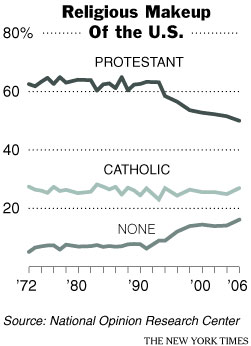
The main take-home message of this new Pew Poll, I think, is the fluidity of religious identity here in the United States, where religion is more individualized and personalized and really becomes a type of individual identity. (Remember in Chapter 3 of O’Neil where we differentiated between individual and group identity and discussed whether religious identity could be both.) Conversely, in countries like France, Great Britain, Germany, etc., religion is much more a social–i.e., group–(rather than a religious) identity and is, therefore, much more immutable. Here is an excerpt from the article, with a graphic:

us_religious_makeup.jpgWASHINGTON — More than a quarter of adult Americans have left the faith of their childhood to join another religion or no religion, according to a survey of religious affiliation by the Pew Forum on Religion and Public Life.

The report, titled “U.S. Religious Landscape Survey,” depicts a highly fluid and diverse national religious life. If shifts among Protestant denominations are included, then it appears that 44 percent of Americans have switched religious affiliations.

For at least a generation, scholars have noted that more Americans are moving among faiths, as denominational loyalty erodes. But the survey, based on telephone interviews with more than 35,000 Americans, offers one of the clearest views yet of that trend, scholars said. The United States Census does not track religious affiliation.

It shows, for example, that every religion is losing and gaining members, but that the Roman Catholic Church “has experienced the greatest net losses as a result of affiliation changes.” The survey also indicates that the group that had the greatest net gain was the unaffiliated. Sixteen percent of American adults say they are not part of any organized faith, which makes the unaffiliated the country’s fourth-largest “religious group.”

That 44 percent of Americans have switched religious affiliation is astounding. What are the implcations of this? I can think of two immediately…

You can find the Pew Forum on Religion and Public Life here. Here is a link to a video interview with Pew Forum Director Luis Lugo who talks about the next step in data analysis. Lugo characterizes the United States as having a dynamic “religious marketplace.” Here is a link to an interview with Neela Bannerjee, the New York Times journalist, who wrote the article.

Islam, Religious Attitudes, and Democracy

There is a lot of ink being spilled on the question of the compatibility of Islam with democracy. Here is a link to a paper by Mark Tessler, published in the journal, Comparative Politics, in 2002.

“Islam and Democracy in the Middle East: The Impact of Religious Orientations on Attitudes Toward Democracy in Four Arab Countries,” Comparative Politics, Vol. 34 (April 2002): 337-354.

If you are on campus, here is a direct link to a pdf version of the article.

From the Abstract:

Continue reading “Islam, Religious Attitudes, and Democracy”

Toward Muslim Democracies–Reading Questions

Professor Saad Eddin Ibrahim, a leading advocate for human rights and democracy in Egypt (and the broader Arab world), and professor of political sociology at the American University of Cairo, delivered the annual Lipset “Lecture on Democracy in the World” in 2006. He makes a couple of interesting points regarding the link between Islam and democracy. Here are some questions related to the reading:

  1. What proportion of the world’s Muslims currently lives in states with democratic regimes? Are these states full liberal democracies?
  2. What does he term the “lagging third”, and where can it be found?
  3. What is ironic about some of the countries in the “lagging third?”
  4. What two historical events, according to Ibrahim, are responsible for putting a halt to democratization in the Middle East?
  5. What, according to Ibrahim, is the link between the creation of Israel and the presence of authoritarian regimes in the Arab world?
  6. Are Arab-Islamic regimes authoritarian due to Arab-Muslim cultural and religious exceptionalism?
  7. How does he characterize the Arab dictators’ “cynical appeal.”
  8. In the battle between “autocrats” and “theocrats” with whom should liberal liberal democrats (such as he) side? Why?
  9. How can the role of the Catholic in Poland during Communism inform the potential role of the mosque in the Arab world?
  10. What does the Arabic shura mean?
  11. How does Ibrahim view the the electoral victories of Hamas (in the Palestinian territory) and radical Shia groups in Iraq? Is the detrimental or beneficial to democracy in these places?
  12. What is the “one person, one vote, one time” phenomenon, and should we be worried about its potential appearance in the Arab world?

Ibrahim, Saad Eddin. 2007. “Toward Muslim Democracies,” Journal of Democracy, Vol. 18, No.2, 5-13.

Design a site like this with WordPress.com
Get started