Comparative Political Party and Electoral Systems

In a few weeks, we will conduct an in-class exercise that simulates a German national election.  This will give you a good idea of the specifics of the German political party and electoral systems, which you will then be able to compare to other systems around the world.  The German system is fairly complicated in that each citizen casts two votes, one for a member running in a single-member district, while the other is cast for a party via a proportional system.

Elections are, of course, the conditio sine qua non–and the minimal institutional requirement–of democratic political systems.   A great web site dedicated to keeping track of elections around the world is electionguide.org They do not as of yet have the results from the most recent national elections in Spain, (they will shortly) but they do have election results for countries around the world going back decades for some countries.  You should check them out.

The Christian Science Monitor  on the incumbent Spanish government’s re-election this past week:

oresults_p1.jpgAided by a near-record turnout, José Luis Rodríguez Zapatero and the Socialist Party won the Spanish national elections – suggesting further changes toward diversity in a young democracy whose older generations cut their teeth on the Franco dictatorship and the moral authority of the Roman Catholic church.

The Socialist victory suggests Mr. Zapatero’s party has broken out of the longtime secondary status it has labored under, despite winning the last election in 2004.

Now, say analysts, the Socialists’ more liberal appeal to young people, women, and immigrants – along with its contemporary style of campaigning – must be taken seriously by the conservative Popular Party (PP), which ran on an older message of Spanish traditionalism and antipathy toward the feisty Basque and Catalonia regions.

Do the cited paragraphs remind you of any other electorate?
Who Speaks for Islam–a New Book by the Gallup Poll

The Gallup Polling outfit has a new book out based on a massive (over 50,000 respondents) recent poll on attitudes amongst the world’s approximately 1.3 billion Muslims. Let us allow the publishers to describe the content themselves:

islamwld.jpgGallup’s largest study of Muslim populations worldwide challenges conventional wisdom and the inevitability of a global conflict as the wars in Iraq and Afghanistan continue. Despite widespread media coverage of global terrorism from America and Europe to the Middle East and Asia, little is known about what majorities of the world’s Muslims really think and feel. What do Muslims say about violence and terrorist attacks? What do they say about democracy, women, and relations with the West? What are their values, goals, and religious beliefs?

Who Speaks for Islam? What a Billion Muslims Really Think by John L. Esposito and Dalia Mogahed (Gallup Press; March 2008; hardcover) sheds new light into the “increasing hostility” that Archbishop Tutu characterizes.

In the wake of the terrorist attacks on 9/11, U.S. public officials seemed to have no idea whether or not many Muslims supported the bombings. This troubled Gallup Chairman and CEO Jim Clifton, who felt that “no one in Washington had any idea what 1.3 billion Muslims were thinking, and yet we were working on intricate strategies that were going to change the world for all time.” Clifton commissioned his company to undertake the enormous job.

The result is Who Speaks for Islam? What a Billion Muslims Really Think, based on six years of research and more than 50,000 interviews representing 1.3 billion Muslims who reside in more than 35 nations that are predominantly Muslim or have sizable Muslim populations.

Some of the more intriguing findins?

  • Muslims and Americans are equally likely to reject attacks on civilians as morally unjustifiable.
  • Large majorities of Muslims would guarantee free speech if it were up to them to write a new constitution AND they say religious leaders should have no direct role in drafting that constitution.
  • Muslims around the world say that what they LEAST admire about the West is its perceived moral decay and breakdown of traditional values — the same answers that Americans themselves give when asked this question.
  • When asked about their dreams for the future, Muslims say they want better jobs and security, not conflict and violence.
  • Muslims say the most important thing Westerners can do to improve relations with their societies is to change their negative views toward Muslims and respect Islam.

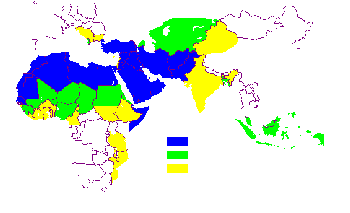
Note: the map above is from Professor Juan Cole.  The colors refer to the percentage of inhabitants of each state who are Muslims.

Serb Demonstrators Attack US and Croatian Embassies in Belgrade

The Washington Post reports that following a massive (upwards of 150,000 participants) and peaceful demonstration in the Serbian capital of Belgrade, with the theme “Kosovo is Serbia”, a group numbering a few thousand at most has attacked the US and (neighboring) Croatian embassies, setting the US embassy on fire. The demonstrations were held in the aftermath of Albanian Kosovars’ official declaration of independence on Monday. The US is one of many countries to have officially recognized Kosovo as the newest ex-Yugoslav independent state, setting off a public and official outcry on the part of Serbs, for whom Kosovo is the historical birthplace of their nation.

Politicians in Belgrade are caught between their rhetoric to do what it takes (short of violence) to prevent Kosovo from achieving full-fledged independence and the lack of many good non-violent options to do so, given the Serb leadership’s openly declared goal of one day joining the European Union. One possibility would be to energize (or otherwise entice) the Serbs in neighboring Bosnia and Herzegovina to agitate for higher levels of autonomy, or outright independence, stressing the similarities of the situations. This would certainly raise the ire of European leaders and would not earn the Serbs any bonus points in their quest for further integration into European political and economic institutions.

Here is footage from the Belgrade independent media outlet B92:

From the “About Video” (translated by me): Beograd — Stotine nasilnih demonstranata nakon završetka mitinga napalo američku i hrvatsku ambasadu. U 19:13 intervenisala policija.

“Upon the conclusion of the [official] demonstration, undreds of violent demonstrators attacked the American and Croatian embassies. The police intervened at 7:13 pm.”

You can find a gallery of photographs from the day in Belgrade at B92’s website here.

Thanks in part to Hillary and “Obama-san”, fresh image of U.S. Abroad

In Chapter 5, Mingst discusses two main categories of the power of states–tangible and intangible. Amongst the intangible sources of power are national image, public (whether domestic or international) support, and leadership. Based on this article in the Christian Science Monitor, the Democratic primary seems to have increased the level of tangible U.S. power.

Regardless of which Democrat pulls ahead as the candidates race toward Nevada and South Carolina, the rapid political rise of a Harvard-educated Illinois senator with a Kenyan father is bringing ripples and some tides of excitement in the near and far corners of a weary world.

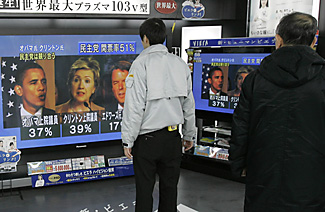
Who’s The One? Japanese watched the results of the New Hampshire Democratic primary in Tokyo Wednesday. Shizuo Kambayashi/APIt’s clear that the buzz around America’s first realistic black candidate has fed the imagination of many non-US observers, who see the controversial superpower as offering something different…

…”[Barack Obama is] what the rest of the world dreams America can be,” says JacquesMistral, a transatlantic specialist and director of economic studies at the French Institute for International Relations in Paris. “He looks like a Kennedy type, and that he’s black is very new. In Europe, the idea that a woman can win is accepted. But for a black person to win would represent a radical change – for the US, and the world.”

It is too early to say that “Obama-mania” is sweeping the planet, particularly after the junior senator’s second place showing in New Hampshire. The public in Europe and Asia have only recently focused on Mr. Obama, though in Africa he’s been news for some time.

But in a world where nearly every poll shows America’s image seriously dragging after the Iraq war onset, and scant interest in Republicans, Obama has made a significant splash, especially among the young…

…In Japan, where US elections are sometimes taken more seriously than the election of the Japanese prime minister, the rise of Obama is as intriguing a subject as the romance between French President Nicolas Sarkozy and the Italian singer Carla Bruni.

“Obama-san is great,” says Azusa Shiraishi, a sophomore at Seinan Gakuin University in Fukuoka. She compares Obama with the Rev. Martin Luther King Jr. and thinks “he could bring different perspectives of the US to us as well as American people. That would be great.”

Do Americans view China as an Emerging Strategic Threat?

China’s miraculous economic growth has become a source of concern for some Americans who hold a realist view of international politics. The argument is that the increase in economic prowess will lead (is leading) to an increase in military power and a heightened strategic threat to the predominance of the United States in global affairs. How concerned is the average American with China’s emergence on the international scene? One of the best places to find the answer to this question, and to all questions related to the public’s views regarding international affairs is the Chicago Council on Global Affairs. The Council has archived on its website reports on public attitudes going all the way back to 1975. An important virtue of these surveys is that they disaggregate elite opinion from the rest of the public.

As for Americans’ views of China, in the 2006 survey slightly more than one-third of Americans viewed China as a strategic threat (click on the chart below for a larger image). Not surprisingly, almost 3/4 of Americans viewed international terrorism as a strategic threat to US interests, putting that issue at number one. Click the link above for the whole report, which polled the public on other issues, such as international trade, immigration, and global warming.

Chicago Council Survey 2006

Islam, Religious Attitudes, and Democracy

There is a lot of ink being spilled on the question of the compatibility of Islam with democracy. Here is a link to a paper by Mark Tessler, published in the journal, Comparative Politics, in 2002.

“Islam and Democracy in the Middle East: The Impact of Religious Orientations on Attitudes Toward Democracy in Four Arab Countries,” Comparative Politics, Vol. 34 (April 2002): 337-354.

If you are on campus, here is a direct link to a pdf version of the article.

From the Abstract:

Continue reading “Islam, Religious Attitudes, and Democracy”

Transparency International Corruption Index

Here’s another excellent source of information from an NGO, Transparency International, that investigates, writes about, and collects data dealing with corruption. This NGO puts out an annual Transparency Index, listing countries around the world with respect to the level of corruption in each.

What is Transparency International?

Transparency International, the global civil society organisation leading the fight against corruption, brings people together in a powerful worldwide coalition to end the devastating impact of corruption on men, women and children around the world.
TI’s mission is to create change towards a world free of corruption.

Transparency International challenges the inevitability of corruption, and offers hope to its victims. Since its founding in 1993, TI has played a lead role in improving the lives of millions around the world by building momentum for the anti-corruption movement. TI raises awareness and diminishes apathy and tolerance of corruption, and devises and implements practical actions to address it.

Here is a link to the Corruption Perceptions Index (CPI), and Bribe Payers Index (BPI), among others. There is a wealth of information on this site related to corruption.

Afrobarometer–Key Findings

The very first Afrobarometer Briefing Paper–here’s the link to a PDF version–(April 2002) presents some key findings regarding the views of African residents in about a dozen African countries on phenomena such as democracy, freedom, governance, etc. Here are a few I found interesting:

  • Corruption is seen as pervasive

Whereas about one-half of survey respondents think that corruption among public officials is common (52 percent), about one-third think it is rare (35 percent). Perceived corruption is highest in Ghana, Nigeria, Tanzania, and Zimbabwe, and lowest in Botswana, Lesotho and Namibia. Generally, however, people perceive more corruption than they themselves have personally experienced. Such perceptions, and the social inequalities they reflect, tend to corrode satisfaction with economic reform policies and with democracy.

In class, I use the module on economic and political development as an opportunity to ask students if they have ever tried to bribe an official for any reason whatsoever. The answer amongst my mostly suburban-bred American students is a unanimous “no.” Generally only I (and sometimes a foreign student) raise our hands to answer in the affirmative. I try to impress upon the students that bribery and corruption is a normal part of life in most non-Western countries. In most citizens’ dealings with official (read: governmental and quasi-governmental) institutions, bribing at least one official is absolutely necessary to get anything done.

Continue reading “Afrobarometer–Key Findings”

Afrobarometer Public Opinion Surveys

The Afrobarometer survey allows public access to its data, with a two-year time lag. From a description found on its home page, the Afrobarometer is “a comparative series of public attitude surveys on democracy, markets, and civil society in Africe.” The site is full of resources, in addition to the data, such as publications (including downloadable working papers), results, news and events.

afrobarometer1.jpg

Here are the countries surveyed and the years for each:

Country
Round 1
Round 2
Round 3
Other
Benin
2005
Botswana
1999
2003
2005
Cape Verde
2002
2005
Ghana
1999
2002
2005
1997
Kenya
2003
2005
Lesotho
2000
2003
2005
Madagascar
2005
Malawi
1999
2003
2005
Mali
2001
2002
2005
Mozambique
2002
2005
Namibia
1999
2003
2006
2002
Nigeria
2000
2003
2005
2001, 2007
Senegal
2002
2005
South Africa
2000
2002
2006
1994, 1995, 1997, 1998, 2004
Tanzania
2001
2003
2005
Uganda
2000
2002
2005
Zambia
1999
2003
2005
1993, 1996
Zimbabwe
1999
2004
2005

Informal Institutions and Democracy in Africa

Using results from the Afrobarometer surveys, Michael Bratton has written an article in a recent issue of Journal of Democracy (you must have access to JoD articles to read this) on the relationship between formal and informal institutions and democracy in a sample of African countries.

This is a blurb from the article about Afrobarometer: “[Bratton] is also founder and director of the Afrobarometer, a collaborative international survey-research project that measures public opinion regarding democracy, markets, and civil society in eighteen African countries.”

Design a site like this with WordPress.com
Get started