No Torture. No Exceptions.

no_torture_no_exceptions.jpg

The above sketch by Thomas V. Curtis, a former Reserve M.P. sergeant, is of an Afghan detainee, Dilawar, who was taken into U.S. custody on December 5, 2002, and died five days later. Dilawar was deprived of sleep and chained to the ceiling of his cell—techniques that the Bush administration has refused
to outlaw for use by the CIA. Further, his legs were, according to a coroner, “pulpified” by repeated blows. Later evidence showed that Dilawar had no connection to the rocket attack for which he’d been apprehended.

One of the most important tenets of my teaching philosophy is to make the classroom a safe forum for diverse and competing points of view. In order to facilitate this, I believe that it is necessary, as much as is humanly possible, to refrain from promoting my own views and importing my personal biases into what I teach. I will temporarily put that tenet aside in order to address the topic of torture.

The United States government tortures. That’s a difficult sentence for me to write. The human rights organization for which I worked in Croatia during the 1990s–the Croatian Helsinki Committee–was at the forefront of the effort in that country to stop human rights abuses, such as torture, that the Tudjman-led regime was committing during those years. I would often find myself in debate with individuals–soldiers, police officers, government officials, religious leaders, and average citizens–about the human rights abuses the government was committing. My argument was basically, “we (in Croatia) are being hypocritical if, on the one hand, we claim that we are superior–in some civilizational sense (this is argument that was made, though I don’t adhere to it)–to the Serbs because we are more “Western” and more democratic, yet we allow our government (with our support) to commit absolutely horrific human rights abuses. We should try to mimic the behavior, then, of Western democracies such as Canada and the United States rather than the abhorrent policies of the Milosevic regime.”

My interlocutors would usually reply, “but, Canada’s, and America’s government would be doing the same thing if 1/3 of their territory was under foreign occupation.” I replied that they would not. I have to apologize to every single one of those people, because they were right and I was wrong. And it didn’t even take foreign occupation for the US government to begin to undermine the fundamental tenets upon which democracy and the respect for human dignity are based. My attitude towards torture is nicely captured by the title of a recent series on torture put out by the magazine Washington Monthly–“No Torture. No Exceptions.”

We’ll take a look at the debate on torture near the end of the semester (in intro to IR) and we’ll see that the strongest moral claim for torture comes from a consequentialist (or utilitarian) perspective; this is why the “ticking bomb scenario” is customarily trotted out to refute deontological arguments. I will argue (and I encourage you to try to prove me wrong) that there are consequentialist reasons for not torturing. I encourage you to read the essays in “No Torture. No Exceptions.” (In fact, if you’re in intro to IR, you’ll have to.)
Social Impact and the Decision to Vote

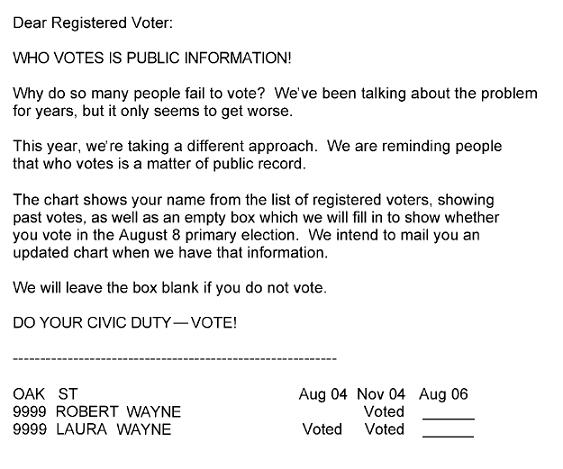
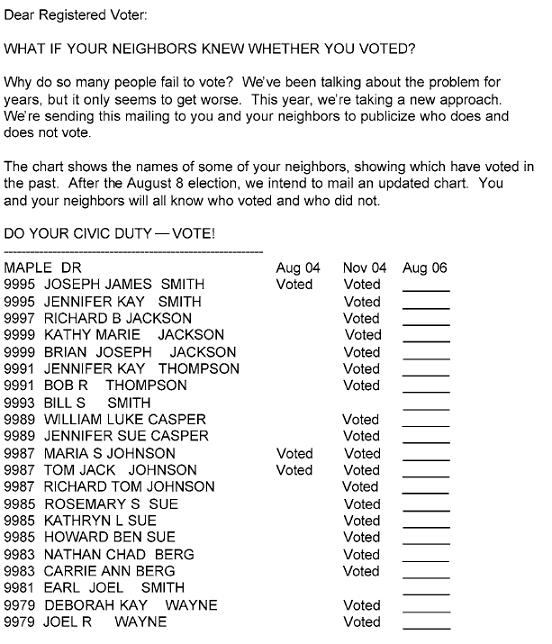
In continuing with today’s theme of the impact of the “social” in political science, we note that political parties the world over have spent a lot of money and developed various ideas and hypotheses regarding what motivates voters to go to the polls and exercise their most basic democratic right. In the most recent issue (which is behind a pay wall) of the American Political Science Review–the flagship journal of the American Political Science Association–a group of political scientists, led by Donald Green at Yale, has demonstrated that social shaming may be a way to increase overall voter turnout.* Here is the abstract, with a sample of the letters sent below:

Voter turnout theories based on rational self-interested behavior generally fail to predict significant turnout unless they account for the utility that citizens receive from performing their civic duty. We distinguish between two aspects of this type of utility, intrinsic satisfaction from behaving in accordance with a norm and extrinsic incentives to comply, and test the effects of priming intrinsic motives and applying varying degrees of extrinsic pressure. A large-scale field experiment involving several hundred thousand registered voters used a series of mailings to gauge these effects. Substantially higher turnout was observed among those who received mailings promising to publicize their turnout to their household or their neighbors. These findings demonstrate the profound importance of social pressure as an inducement to political participation.

Would you be susceptible to being shamed into voting? Well, the authors find that the overall impact of threatening to publicize your (non)-voting behavior to your neighbors was to increase turnout by 8.1 percentage points. That’s an astounding impact. Here are the letters:

social_pressure_vote.jpg

This letter increased the rate of voter turnout by 4.9 percentage points, a much stronger effect than appeals to civic duty alone (which raised turnout from between 1.8 and 2.5 percentage points.

social_pressure_vote2.jpg

This is the letter that produced an 8.1 percentage point increase in voter turnout.

*For a web site that tracks voter turnout rates worldwide, please see this post.

Catholicism and the Social Dimension of Sin

Father James Martin takes the London Times to task for their framing of the story of the Catholic Church’s developing views on the nature of sin. (Click here for my blog post on the Times story.)

Father Martin writes in the America Magazine–the national Catholic weekly–that the Times’ story has confused the issue “unnecessarily.” He writes:

pd_hell_070706_ms.jpgMy guess is that some in the media bobbled this story for two reasons, neither of them malicious. First, a general unfamiliarity with the contemporary Catholic tradition of social sin, even though under Pope John Paul II something like “anti-Semitism” was often referred to in those terms. And, second, the fact that a headline that reads “Seven New Deadly Sins” is undeniably sexier than a headline saying, “Vatican Official Deepens Church’s Reflection on Longstanding Tradition of Social Sin.”

The Vatican’s intent seemed to be less about adding to the traditional “deadly” sins (lust, anger, sloth, pride, avarice, gluttony, envy) than reminding the world that sin has a social dimension, and that participation in institutions that themselves sin is an important point upon which believers needed to reflect.

In other words, if you work for a company that pollutes the environment, you have something more important to consider for Lent than whether or not to give up chocolate.

Globalization, the Catholic Church, and Classroom Pedagogy

A while back I had the opportunity to allow a job candidate to come in and use my intro to IR class to give a her candidate classroom lecture. Following the 40-minute lecture–after the candidate and the rest of the faculty had left the room–I asked my students to anonymously write down their impressions of the teaching style of the job candidate. One of the responses was particularly illuminated and the latest news about the Catholic Church’s efforts to reform the concept of sin reminded me of that student’s response. The student’s response was (and I’m paraphrasing here):

“I didn’t like that she went around the room and made everyone answer her introductory question. I pay $40,000 in tuition annually and I have the right to sit in the classroom and be bored and do nothing if that’s what I want to do.”

I felt sorry for this student, because s/he has forgotten a couple of important rules about life, let alone post-secondary education: first, you only get out of something what you put in. Second, and more important, the whole classroom experience is a social experience, and the outcome of the educational process is not only a function of what the student him/herself is doing, and what the instructor is doing, but what others in the classroom are doing as well.

Apropos of the preceding, here is news from the London Times online, which demonstrates the Catholic Church’s approach to the concept of sin:

seven_poster.jpg…[Bishop Gianfranco Girotti] said that priests must take account of “new sins which have appeared on the horizon of humanity as a corollary of the unstoppable process of globalisation”. Whereas sin in the past was thought of as being an invididual matter, it now had “social resonance”.

“You offend God not only by stealing, blaspheming or coveting your neighbour’s wife, but also by ruining the environment, carrying out morally debatable scientific experiments, or allowing genetic manipulations which alter DNA or compromise embryos,” he said.

Bishop Girotti said that mortal sins also included taking or dealing in drugs, and social injustice which caused poverty or “the excessive accumulation of wealth by a few”.

He said that two mortal sins which continued to preoccupy the Vatican were abortion, which offended “the dignity and rights of women”, and paedophilia, which had even infected the clergy itself and so had exposed the “human and institutional fragility of the Church”.

Maybe it’s time for Brad Pitt and Morgan Freeman to do a sequel to Seven. 🙂

Comparative Political Party and Electoral Systems

In a few weeks, we will conduct an in-class exercise that simulates a German national election.  This will give you a good idea of the specifics of the German political party and electoral systems, which you will then be able to compare to other systems around the world.  The German system is fairly complicated in that each citizen casts two votes, one for a member running in a single-member district, while the other is cast for a party via a proportional system.

Elections are, of course, the conditio sine qua non–and the minimal institutional requirement–of democratic political systems.   A great web site dedicated to keeping track of elections around the world is electionguide.org They do not as of yet have the results from the most recent national elections in Spain, (they will shortly) but they do have election results for countries around the world going back decades for some countries.  You should check them out.

The Christian Science Monitor  on the incumbent Spanish government’s re-election this past week:

oresults_p1.jpgAided by a near-record turnout, José Luis Rodríguez Zapatero and the Socialist Party won the Spanish national elections – suggesting further changes toward diversity in a young democracy whose older generations cut their teeth on the Franco dictatorship and the moral authority of the Roman Catholic church.

The Socialist victory suggests Mr. Zapatero’s party has broken out of the longtime secondary status it has labored under, despite winning the last election in 2004.

Now, say analysts, the Socialists’ more liberal appeal to young people, women, and immigrants – along with its contemporary style of campaigning – must be taken seriously by the conservative Popular Party (PP), which ran on an older message of Spanish traditionalism and antipathy toward the feisty Basque and Catalonia regions.

Do the cited paragraphs remind you of any other electorate?

Oil, Islam, and Women

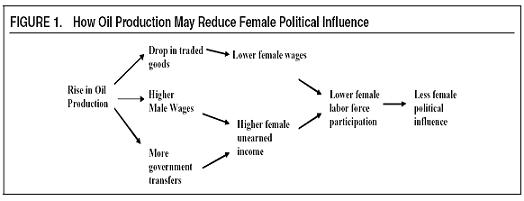
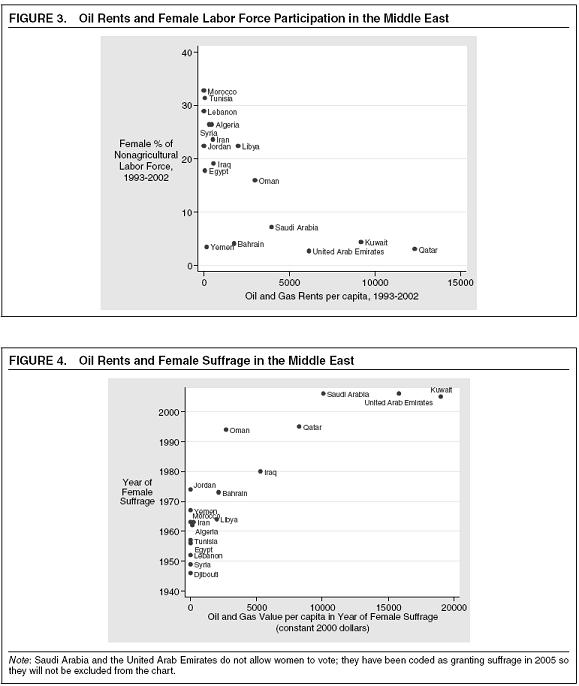
There is a new article [paywall] in the most recent issue of the American Political Science Review written by Michael L. Ross entitled “Oil, Women, and Islam.” Ross has written a lot about the nexus between resources and regime type, the so-called “resource curse” phenomenon. In this article, Ross argues that the well-known empirial link between lack of women’s rights and Islam washes away once controls related to oil production are incorporated into statistical models. (Note that the analysis is restricted to the Middle East.)

Here is the abstract and a couple of his charts:

Women have made less progress toward gender equality in the Middle East than in any other region. Many observers claim this is due to the region’s Islamic traditions. I suggest that oil, not Islam, is at fault; and that oil production also explains why women lag behind in many other countries. Oil production reduces the number of women in the labor force, which in turn reduces their political influence. As a result, oil-producing states are left with atypically strong patriarchal norms, laws, and political institutions. I support this argument with global data on oil production, female work patterns, and female political representation, and by comparing oil-rich Algeria to oil-poor Morocco and Tunisia. This argument has implications for the study of the Middle East, Islamic culture, and the resource curse.

ross_oil_women_1.jpg

ross_oil_women_2.jpg

How do you Prove You’re a Jew?

Gershon Gorenberg has written a new article in the New York Times Sunday Magazine
on the difficulties some Israeli Jews are having proving their Jewishness before rabbinic courts in that country.  The article is interesting and touches upon many of the issues we discussed in intro to comparative that deal with concepts of identity–nationhood, ethnicity, citizenship, etc.  In fact, I think I’ll be including this article in the syllabus during future iterations of this course.  In addition, I did not know that there is no civil marriage ceremony (marriage ceremonies are purely a religious affair in Israel) in Israeli law, but upon further reflection, I probably should have guessed that would be the case.

The story is particularly significant for American Jews, to which the accompanying snippets below attest:

02jewish1-500.jpgOne day last fall, a young Israeli woman named Sharon went with her fiancé to the Tel Aviv Rabbinate to register to marry. They are not religious, but there is no civil marriage in Israel. The rabbinate, a government bureaucracy, has a monopoly on tying the knot between Jews. The last thing Sharon expected to be told that morning was that she would have to prove — before a rabbinic court, no less — that she was Jewish. It made as much sense as someone doubting she was Sharon, telling her that the name written in her blue government-issue ID card was irrelevant, asking her to prove that she was she…

…In recent years, the state’s Chief Rabbinate and its branches in each Israeli city have adopted an institutional attitude of skepticism toward the Jewish identity of those who enter its doors. And the type of proof that the rabbinate prefers is peculiarly unsuited to Jewish life in the United States. The Israeli government seeks the political and financial support of American Jewry. It welcomes American Jewish immigrants. Yet the rabbinate, one arm of the state, increasingly treats American Jews as doubtful cases: not Jewish until proved so.

More than any other issue, the question of Who is a Jew? has repeatedly roiled relations between Israel and American Jewry. Psychologically, it is an argument over who belongs to the family. In the past, the casus belli was conversion: Would the Law of Return, which grants automatic citizenship to any Jew coming to Israel, apply to those converted to Judaism by non-Orthodox rabbis? Now, as Sharon’s experience indicates, the status of Jews by birth is in question. Equally important, the dividing line is no longer between Orthodox and non-Orthodox. The rabbinate’s handling of the issue has placed it on one side of an ideological fissure within Orthodox Judaism itself, between those concerned with making sure no stranger enters the gates and those who fear leaving sisters and brothers outside.

The story reminds me of a friend of mine who–of Croatian parentage but born in Canada– upon her arrival in Croatia (she had decided to move there during the middle of the war in the 1990s) had gone to the local police station with the aim of registering her presence (at that time, all foreigners were required to report to police within 24 hours of their arrival).  When she took out her Canadian passport, a clerk at the Ministry of Internal Affairs asked her the names of her parents.  After my friend responded, the clerk refused to allow her to register as a foreigner and insisted that she take out Croatian citizenship on the spot.  When my friend insisted that she was a Canadian citizen, the clerk responded “your father is ours, your mother is ours, that makes you  one of us also.”


Cross-National Comparisons in Incarceration Rates

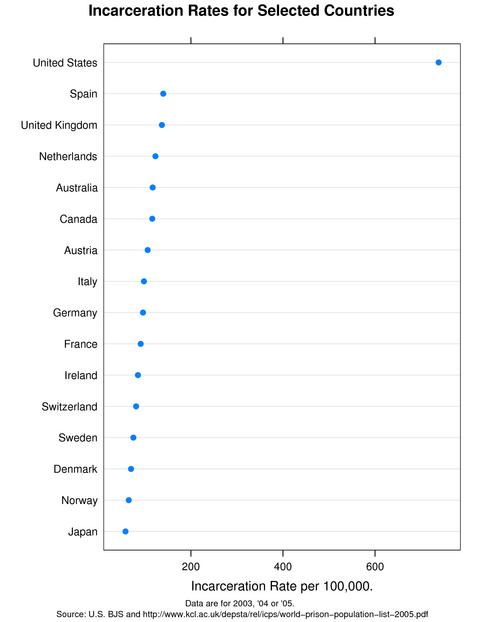
Every time I hear or read about a numerical fact, I always ask myself “is this high, low, average” for this particular phenomenon.  In order to answer this question, I’m required to make at least an implicit comparison.  So when I read today that for the first time ever, 1 in 100 American adults is incarcerated, I wondered how that compared to other countries.  The information is not hard to find.  Here’s a chart for your perusal.  What do you think accounts for the variation in incarceration rates across countries?

Here are some snippets from ABC News:

incarceration-oecd.jpg For the first time in U.S. history, more than one of every 100 adults is in jail or prison, according to a new report documenting America’s rank as the world’s No. 1 incarcerator. It urges states to curtail corrections spending by placing fewer low-risk offenders behind bars.

Using state-by-state data, the report says 2,319,258 Americans were in jail or prison at the start of 2008 one out of every 99.1 adults. Whether per capita or in raw numbers, it’s more than any other nation.

The report, released Thursday by the Pew Center on the States, said the 50 states spent more than $49 billion on corrections last year, up from less than $11 billion 20 years earlier. The rate of increase for prison costs was six times greater than for higher education spending, the report said.

The steadily growing inmate population “is saddling cash-strapped states with soaring costs they can ill afford and failing to have a clear impact either on recidivism or overall crime,” the report said.

Susan Urahn, managing director of the Pew Center on the States, said budget woes are pressuring many states to consider new, cost-saving corrections policies that might have been shunned in the recent past for fear of appearing soft on crime.

Samuel Huntington of “Clash of Civilizations” fame, Interviewed

Charlie Rose interviews Huntington on the ideas in his oft-cited and even more criticized “Clash of Civilizations” thesis. Rose calls the clash thesis “provocative.”  What do you think about the logic of the clash thesis.  Given that you’ve read Amartya Sen’s response to Huntington, what kinds of questions would you have asked Huntington that Rose failed to?  (The Huntington interview runs from 1:55 until about 21:00.  No, Professor Huntington is not a dead-ringer for John Cleese.  That is, in fact, John Cleese, who is interviewed in the middle segment; hence, the screen shot of Cleese.)

Playing the Dominant Strategy in a Prisoner’s Dilemma Situation

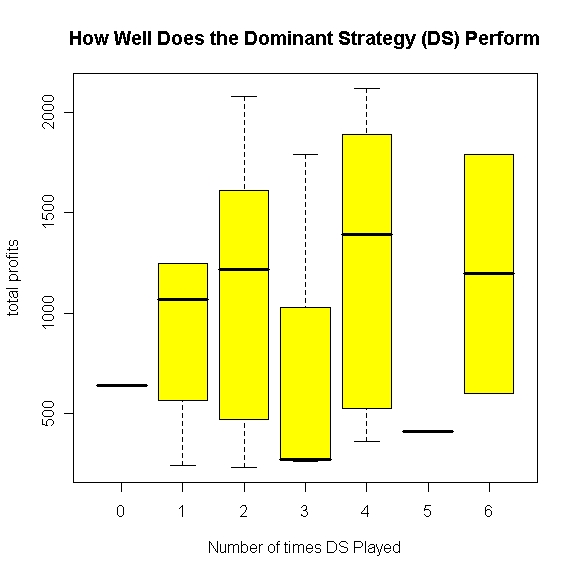
As you’ll see in lecture tomorrow, instrumentally rational players will also choose to “defect” in a priosoner’s dilemma type situation even though they could be much better off absolutely if they and their opponents could learn to cooperate.  The chart below has been created using data from the simulation of yesterday.  What is take-home message from the chart?  Why is the relationship between the phenomena displayed not completely linear?  Think about the nature (i.e., the specific rules) of the oil game we played yesterday. (The plot below is a box plot, which is a way of summarizing the means, range, and certain percentiles of the values of a single variable based on another variable.)

oil_game_dominant_strategy.jpeg

Design a site like this with WordPress.com
Get started