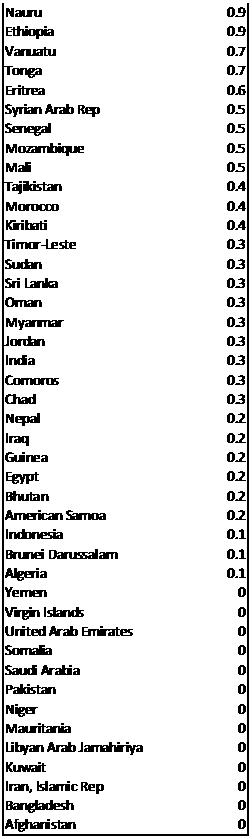
In response to a short assignment on the process of modeling social phenomena, one of my students (thanks, EE!) has chosen to try to understand why the residents of some countries consume (on average) more alcohol per capita than the residents of other countries. She argued that it may have something to do with the cultural acceptance of drinking alcohol as children. That’s seems to be a plausible hypothesis. You can find data on annual drinking rates from the EarthTrends website (which I’ve used on many previous occasions; it’s a fantastic resource!). Here is a link to 2003 data (the most recent year for which they have data) and here is a table, which I have created from the data. What do you think accounts for the difference in consumption across these countries?
Category: Pedagogy
Intro to International Relations–Second Paper–Morality and IR
A major component of the second half of this course was using the theories we learned in the first half to analyze international issues from a moral perspective. The second paper allows students to choose a topic that they find interesting and analyze it from a moral perspective. Here’s the assignment:
PLSC250–Intro to IR–Second Paper–International Ethics
Increasingly, the role of morality has played an important role in the conduct and analysis of
international affairs. For this paper, you will write about a topic in international relations that has an explicitly moral component. You can use the Amstutz book as a guide, or go to the journal Ethics and International Affairs for some other ideas. The choice of topic is wide open except for two conditions:
- You must not write on the same topic as your first paper!
- You may not use specific cases out of the Amstutz text. That is, if Amstutz has written a case about it, you are not allowed to write on that particular topic. Thus, you are free to write about the ethics of intervention, but do not use Kosovo as your case, as Amstutz doesin Case 1.1. You could choose to write on intervention in Somalia, or East Timor, instead.
Given the preceding, here’s what your paper should address:
- A topic that has an explicitly moral/ethical component.
- You should take a side on the issue. In other words, this should be an argumentative piece, in which you set out a clear declarative statement regarding the crux of the moral issue. For example: “In this paper I will argue that the the United States should lead a boycott of Canadian-made products (like hockey players, maple syrup and Celine Dion) as a means of stopping the annual baby seal hunt in Canada’s north (which, by the way, has just begun). I will prove unequivocally that the seal hunt violates basic international moral norms and that the means proposed to end the hunt are themselves morally legitimate.”
- You should argue why you believe the side for which you are arguing is the correct one. Thus, your ethical reasoning should be explicit. (We’ll discuss more about ethical reasoning in class on Monday.)
- The paper should be 4-5 pages in length, 1-inch borders on 8.5X11-inch paper. In addition, the paper should be formatted in the same manner as the first paper. Please also refer to videos I have posted on how to format the paper correctly (with correct page numbering, etc.) and also how to easily create a works cited page using Noodlebib. Remember also to copy and paste the paper evaluation sheet to the end of your paper. Instructions on how to do this are also in one of the videos.
- The paper is due electronically via Digital Dropbox on Monday, April 14th, by the beginning of class.
Good luck!
P.S. 1If you are uncertain whether your proposed topic is appropriate for the assignment, speak with me about it.
Mock German Election Simulation–Government Formation Results
In the second part of our mock German election simulation–the government formation negotiations–we were able to get a new government voted into power by the recently elected Bundestag. (I refer you to this post for more information about the electoral results.)
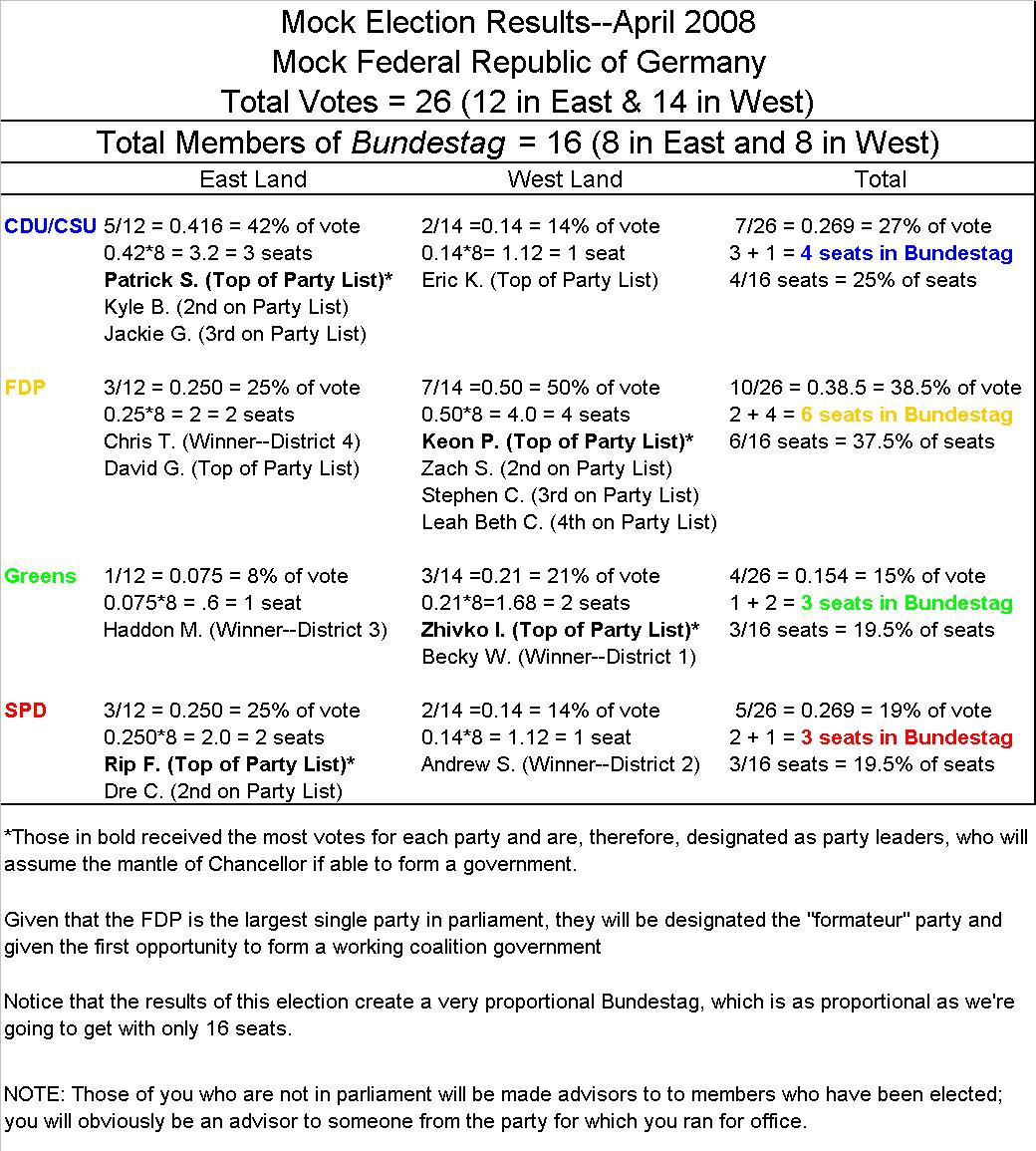
To remind you, following the election, we had the composition of the Bundestag was:
FDP–6 mandate (formateur party)
CDU/CSU–4 mandates
SPD–3 mandates
Greens–3 mandates
In order to have a secure governing coalition, a governing coalition of at least 9 mandates would be needed in this sixteen-member parliament.
The FDP were unable to convince any of the other parties to form a governing coalition with them, and the government that was voted into office, by a majority vote of 10-6 was a three-party coalition of the Greens, CDU/CSU, and the SPD.
In the end, it was the personal ambition of the CDU/CSU leader–Patrick S.–that ruled the day. He wanted to become Chancellor and this steely determination served him well as he, with his fellow party members and advisory committee, was able to effectively forge a rather wieldy three-party governing coalition.
Why did Patrick S. want to become Chancellor so desperately? There have been reports in some of the leading journals that it has been his dream since childhood. But in a sit-down interview with Deutsche Welle following his ascension to the Chancellorship, Chancellor S. claimed that it was because this election was crucial to the future of the German state. According to the Chancellor, he and his party believe that a moral crisis of epic proportions has descended upon Germany and only his party had the necessary moral acuity to set Germany back on the correct path.
The Chancellor and the six-member Cabinet is composed of the following:
Chancellor–Patrick S. (CDU/CSU)
Minister of Education–Becky W. (Greens)
Minister of the Interior–Erick K. (CDU/CSU)
Minister of the Environment–Zhivko I. (Greens)
Minister of Foreign Affairs–Kyle B. (CDU/CSU)
Minister of Health–Rip F. (SPD)
Minister of Labor–Andrew S. (SPD)
One of the advisers to the SPD commented that the SPD actually had refused to sign a coalition agreement offered to them by the FDP, which in retrospect, was better for the SPD than the one they signed ultimately. There seemed to be a consensus within the SPD that the arrogance of the FDP had created friction between the two potential coalition partners.
I look forward to reading your impressions of the simulation exercise on your blogs.
FDP Wins Plularity of Bundestag Seats in Mock German Election–Spring 2008
[UPDATE: I made a mistake when I was initially tabulating results, necessitating a slight change in the composition of the Bundestag. As it now stands, the problem occurred in West Land, where is seems some poll workers had imbibed a little bit too much of that noted Bavarian beverage, bier. A recount (which is easy given that paper ballots were used) results in the following change: one more mandate for the FDP in West Land–I’ve slotted in the 4th candidate from the FDP party list from that Land–and one fewer mandate for the SPD in the same Land. Therefore, the final results are FDP-6; CDU-4; Greens-3; SPD-3. The party leader of FDP will still be given the role of party formateur.]
[UPDATE 2: The aforementioned poll workers have been fired and are now in AA.]
[UPDATE 3: Please see below how the adviser roles have been distributed.]
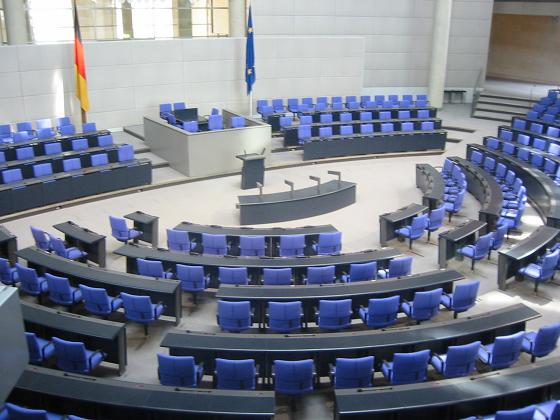
Here are the results from the mock election to the lower house of the German Reichstag held this afternoon. Those of you who were not elected to represent your district or Land in the Bundestag will nonetheless also be actively involved (as advisers to your fellow party members) in the second part of the simulation–negotiations to form a government. I will send more instructions regarding that portion of the simulation later this weekend. As you can see below, the FDP has won a plurality in the Bundestag and will be given first crack at putting together a workable coalition, trying to reach a formal agreement with one of the other parties. Signing coalition agreements with either the CDU/CSU or the SPD are most likely (given that there is a total of 16 seats in our parliament) but don’t count out a coalition with the Greens either.
As I mentioned earlier, I’ll have more information regarding the specifics of the coalition negotiations and also post a sample coalition agreement form on Blackboard later, but in the meantime think about the most important elements of the negotiation process:
- Which party/parties will form the government? Remember you need a majority in parliament to vote the new government into power.
- Who will become the Chancellor (i.e., the Prime Minister)?
- What will be the general orientation of the government’s policy-making agenda? Given the campaign pledges you made (either to your district and/or your Land) can you plausibly vote for a government that is dedicated to carrying out this policy agenda?
- What about some of the policy specifics? Changes to the citizenship law? Higher taxes on carbon emitting industries? Higher (lower) income/consumption taxes? Anything else of importance to you or your district/Land?
- Who will get which Ministerial Portfolios? Who will become Foreign Minister? Minister of the Environment? Minister of Health? Minister of Finance? Minister of Justice? Minister of Labor?
- Which individuals will be given these portfolios?
I will set up a new folder in the Discussion Board section of Blackboard so that you can all begin the “feeling out” process prior to the official negotiations on Tuesday afternoon.
Click here to see the current members of the German Federal Cabinet (which is the Chief Executive), which is made up of the Chancellor (currently Angela Merkel) and 15 Cabinet ministers.
NOTE: You will notice that some of you who ran for election in districts have nonetheless been elected to parliament on the basis of party lists. I had to do this, given the relatively small number of students in the class. In general, the party lists are much larger than the ones you saw on your ballots as there were simply not enough students and I wanted to have four SMDs. Therefore, where it was warranted, I moved non-SMD-winners over to party lists (i.e., when the proportion of votes generated a number of seats for that party in excess of the number of individuals on the party list. Of course, this would never happen in a real German election as the party lists always have many more candidates than the party will end up earning on the basis of PR. I’ll go over this on Tuesday.
Here are the advisers and the party member whom you will be advising over the course of the government formation negotiations on Tuesday.
Lecture on German Political Parties April 17th
Talk about serendipity! We will finish our mock German election and government formation simulation on Tuesday, April 15th and two days later there will be a guest lecture on campus by Dieter Dettke, Visiting Scholar at the American Institute for Contemporary German Studies and Adjunct Professor at Georgetown University, Security Studies Program. on “Is Germany Moving to the Left? The Changing German Party System.
You can find below a copy of the flyer announcing the lecture, which will begin at 5:30 at the Gottwald Science Center Auditorium. I’ll see you there.
The Richmond Eric M. Warburg Chapter
of the American Council on Germany
cordially invites you to a
Discussion and Reception
with
Dr. Dieter Dettke
Visiting Scholar at the American Institute for Contemporary German Studies and
Adjunct Professor at Georgetown University, Security Studies Program
on
“Is Germany Moving to the Left?
The Changing German Party System"
Thursday, April 17, 2008
5:30 – 6:45 pm
at
The University of Richmond, Gottwald Science Center Auditorium
Directions: If coming from Three Chopt Road, turn onto Boatwright Drive and continue straight ahead at the welcoming wall at the bottom of the winding hill (do not turn left for the main campus gate). After passing the Robins Center on your left and a large parking lot on your right, proceed for another 300 yards on College Road to the Westhampton entrance on your left. (If coming from River Road, turn onto College Road and turn right into the Westhampton entrance.) Continue on Keller Road to the Modlin Center and pass through the archway. Opposite the stop sign are parking spaces in front of the Westhampton Deanery and even more spaces between it and the cafeteria and science center. The science center auditorium is in the Gottwald Science Center across from the cafeteria. (In case the above parking spaces are full, there is a parking lot behind the Modlin Center which you can access by turning right at the stop sign or left if exiting the parking lot across from the stop sign.)
If you have any questions, please contact Dr. Arthur B. Gunlicks,
Dr. Dieter Dettke is currently a visiting scholar at the American Institute for Contemporary German Studies and Adjunct Professor at Georgetown University, Security Studies Program. He is working on a book on German foreign policy and transatlantic relations – with the working title “In Search of Normalcy: German Foreign and Security Policy Between Realpolitik and the Civilian Power Paradigm.” He has also been a fellow at both the Woodrow Wilson Center and the German Marshall Fund of the United States.
From 1985 to 2006 he served as US Representative and Executive Director of the Washington Office of the Friedrich Ebert Foundation – which is affiliated with Germany’s Social Democratic Party (SPD). Prior to his work with the Ebert Foundation, Dr. Dettke was Political Counsellor of the SPD Parliamentary Group of the German Bundestag (1974 – 1984) and Staff Director of the Working Group on US-German relations. In this capacity, he coordinated all foreign, security and defence policy related issues on the agenda of the German Bundestag and the Committees for Foreign Affairs, Defence, German-German relations, Development Policy and European Affairs.
He has lectured frequently in Europe and the United States on transatlantic relations, German-American security issues and European-American economic relations. He has also presented papers, acted as a discussant and/or chair at U.S. and international conferences of the American Political Science Association, the International Studies Association, the German Studies Association and the American Association of Slavic Studies. In addition, Dr. Dettke testified in Congress on the implications of German unification for the United States and US-European relations.
Dr. Dettke has appeared on the News Hour with Jim Lehrer, C-SPAN, Voice of America as well as other American, German, Swiss, and British television and radio programs to discuss issues and developments related to domestic and foreign policy developments in Europe and the United States. Dr. Dettke studied political science and law at the universities of Bonn and Berlin (Germany) and Strasbourg (France). He was a Fulbright Scholar at the University of Washington in Seattle (1967/68).

Barack Obama on the Financial System, Uncertainty and Risk
In my post below, I linked to an article by Thomas Homer-Dixon in which, among other things, he argued that the problem with the contemporary financial system is that the arcane machinations and lack of transparency (Level-III assets, anyone?) have transformed the market from one of risk–which can form the basis for a stable financial system–to uncertainty–which cannot. So the question then, is how to create the conditions under which banks and other financial institutions, and investors can adequately assess risk. The lack of transparency is the reason that the credit markets have currently seized up and the Federal Reserve has had to come to the rescue of Bear Stearns. (Ben Bernanke–the Chairman of the Federal Reserve–himself has argued that “banks will fail” over the next couple of years. Indeed, a couple of small regional American banks have already failed.)
By coincidence, Democratic Presidential candidate Barack Obama gave a speech at Cooper Union in New York setting out his vision of how his policies would help the engine of the American (and international) financial system become more transparent and a solid foundation for the US and world economy. I encourage you to watch the speech, wherein Obama presents his view of the nature of the relationship between the market and state (government).
“It’s worth taking a moment to reflect on the role that the market has played in the development of the American story. The great task before our founders was putting into practice the ideal that government could simultaneously serve liberty and advance the common good. For Alexander Hamilton, the young Secretary of the Treasury, that task was bound to the vigor of the American economy. Hamilton had a strong belief in the power of the market, but he balanced that belief with the conviction that human enterprise, ‘may be beneficially stimulated by prudent aids and encouragements on the part of the government [state]'”
Risk, Uncertainty–From Governor Weld to the Modern Financial System
Canadian academic Thomas Homer-Dixon (we will read one of his papers this semester in Intro to IR) has written a piece for Canada’s “paper of record”–the Globe and Mail, which is titled “From Risk to Uncertainty.” Those of you in my intro to comparative politics class will surely recognize immediately the difference between the tho concepts.
Remember when we read the first two chapter of Shepsle and Bonchek on instrumental rationality, the authors used the example of then-Massachusetts Governor Weld. Weld had to decide whether to run for Governor again, or to commit to challenging Democratic Senator Ted Kennedy’s Senate seat. A win there would have given him a nice platform for an eventual presidential run. Weld, as we know, was operating in a world or risk rather than uncertainty when making his decision, given that there were public opinion polls published that estimated his chances of winning in either election.
What is the difference between risk and uncertainty and how does it apply to the contemporary global financial system (which, by the way, for those of you not paying attention is precariously teetering on the edge of meltdown–you heard it here first!)?
So the rules of the game have now fundamentally changed. Our global financial system has become so staggeringly complex and opaque that we’ve moved from a world of risk to a world of uncertainty. In a world of risk, we can judge dangers and opportunities by using the best evidence at hand [what Shepsle and Bonchek call beliefs] to estimate the probability of a particular outcome. But in a world of uncertainty, we can’t estimate probabilities, because we don’t have any clear basis for making such a judgment. In fact, we might not even know what the possible outcomes are. Surprises keep coming out of the blue, because we’re fundamentally ignorant of our own ignorance. We’re surrounded by unknown unknowns.
Introduction to Comparative Politics–Second Paper
Here is the second paper, whose theme is “culture” (or not) and democracy.*”
Introduction to Comparative Politics Paper–Culture and Democracy
“In Islam, God is Caesar,in [Confucianism], Caesar is God; In [Eastern Christian] Orthodoxy, God is Caesar’s junior partner.”
“The underlying problem for the West in not Islamic fundamentalism. It is Islam.”
“Contemporary China’s Confucian heritage, with its emphasis on authority, order, hierarchy, and supremacy of the collectivity over the individual, creates obstacles to democratization.”
The quotes above will serve as the inspiration for your second paper this semester. I would like you to argue in favor or against the claims made by Huntington quoted above. You can argue that they are basically true, essentially false, or some combination thereof2. Regardless, your task is to provide a reasoned, well researched response to the declarative statements above, using Chapters 5 and 6 in O’Neil, and the articles by Fish, Stepan, Perry, Zakaria, and any others we have read, as your starting points.
Assess the arguments in light of what you know about the requirements (institutional, cultural, structural) of democracy and the nature of authoritarianism. Your outside research will most likely focus on understanding more about Islam, “Asian values,” and/or Christian Orthodoxy (as it is practiced in Eastern Europe).
While the main focus of your paper will be in setting up an argument for or against the claims above, I would like you to then use two states–one “predominantly Muslim”, and one Asian (or Eastern Orthodox)–to illustrate your main arguments and to act as supporting evidence for your claims. Please use chapters 5 and 6 of the Essentials and of Readings as the main source for the paper. For information related to your specific states, you will have to consult at least 4 other academically reputable sources. Note that this means Google is not your friend here!! This will entail a trip down to the library by foot, or a virtual trip to the library’s electronic resources.
Your paper should be 4-5 pages long, double-spaced on 8:5X11-inch paper, with 1-inch margins on the top, bottom, and the sides. The paper must be written in Times Roman 12pt. font. In addition, please cut and paste the “Paper Evaluation Sheet” from Blackboard to the end of your paper (after the works cited page). The paper is due electronically via Digital Dropbox in Blackboard by the beginning of class on Tuesday, April 15th.
Good luck, you kings and queens of comparative!!
*Note: See the version of this assignment posted to Blackboard as it has informative (and helpful) footnotes.
Resource Dependent Regimes in Sub-Saharan Africa
Jensen and Wantchekon (2000) have created an index of resource dependence and determined the level of the same for the states of sub-Sarahan Africa. The scores range from 1 (no resource dependence) to 4 (extreme resource dependence). They use this as an important independent variable in determining democratic transition, consolidation, and government effectiveness. How much of an effect does resource dependence have on each of these dependent variables? You’ll have to read the paper to find out, or attend my class in intro to comparative tomorrow.

Learning Objectives for Intro to Comparative
Here are the learning objectives for my introduction to comparative politics course. In other words, students who have taken that course should have developed the following competencies:
Understand and use the tools of both qualitative and quantitative analysis to ask and answer questions about substantive issues in comparative politics.
- Identify the strengths and weaknesses of the comparative method and its variants.
- Effectively discuss the development of comparative politics as a sub-discipline in the field of political science.
- To be able to understand and effectively critique a state-of-the art scholarly article in the field of comparative politics.
- Discuss competently the merits of empirical and statistical evidence that is used in the field of comparative politics.
- Analyze various substantive issues in comparative politics from culturalist, institutionalist, and rational choice perspectives.
- Express fundamental concepts in comparative politics both verbally and in written form.
- Use extant on-line cross-national databases to access and find data appropriate to comparing countries across the world with respect to basic political attitudes and ideologies.
- Describe and understand the tri-partite structure of society–state, civil society, and market–and understand the interactions amongst them.
- Assess the nature of democracy–its causes, consequences and how democratic regimes vary across the world.
- Develop a broad understanding of the nature of contemporary states across the world, from the most developed states to the least developed.
- Acquire the ability and the tools to effectively compare the states of the world on a broad range of issues, from economic development, to state strength, to governance, and social diversity.
- Write an effective critical paper on a topic related to comparative politics.
- Effectively use the electronic educational tool, Blackboard, to upload and download materials, make use of discussion-type tools facilitating online discussion and interaction with class members outside of class sessions.
- Locate appropriate library resources, both printed and electronic, to aid in the writing of critical papers.
- Learn to find, assess the legitimacy and veracity of, and use online resources related to comparative politics.
- Demonstrate a strong understanding of these aforementioned concepts in examination format, working under the pressure of a time limit.
- Develop the skills necessary to effectively critically evaluate and discuss the production of political knowledge.
- Develop the ability to become discerning and thoughtful consumers of political knowledge, whether that knowledge is created by politicians and other political leaders, the media, other citizens, or the students themselves.


You must be logged in to post a comment.