Thomas Lubanga First Person Convicted by ICC

Wednesday, March 14th, 2012 will stand as a watershed moment in international relations and in international law, specifically. Thomas Lubanga, former militia leader in the eastern Democratic Republic of Congo (DRC) is the first person ever convicted by the recently formed International Criminal Court (ICC). Though there have been dozens of convictions of war crimes suspects from the wars in the former Yugoslavia and Rwanda, these cases were process by temporary courts–the ICTY and the ICTR, respectively–and not the ICC. Lubanga was accused of conscripting, enlisting, and using child soldiers in the conflict in the Ituri region of the DRC. Rather than playing a role in the post-war political process, (which he had hoped) Lubanga was arrested in March 2005 and extradited to the ICC one year later. It is only now, seven years after his arrest, that a verdict on this case has come down.

Lubanga’s conviction is the end of a multi=year trial process, the legitimacy of which was undermined at times by the lack of prosecutorial professionalism, and other issues. For more about the trial, go here, and watch the videos below.

Current UN Peacekeeping Operations

In POLI 1140, we spent part of last session watching major portions of the documentary, The  Peacekeepers, which explored the role of the UN is setting up and escalating a peacekeeping mission to the Democratic Republic of the Congo (DRC). The documentary used a behind-the-scenes approach to analyze the issues faced by the world’s foremost IGO in implementing its mandate to “protect international peace and security”. The focus of the documentary was on the Ituri region in the eastern DRC province of East Kivu.

As the above map notes, the UN, though the auspices of its Department of Peacekeeping Operations, currently has 16 active peacekeeping missions worldwide. The former DRC mission, known as MONUC, has been transformed, in accordance with UN Security Council Resolution 1925, into MONUSCO.

As of the start of this year, this is the strength of the peacekeeping force in the DRC:

  • 19,070 total uniformed personnel
    • 16,975 military personnel
    • 723 military observers
    • 1,372 police (including formed units)
  • 976 international civilian personnel*
  • 2,868 local civilian staff*
  • 588 United Nations Volunteers

Currently, in 16 DPKO-led peacekeeping operations, there are almost 120,000 personnel (uniformed and civilian) serving from 115 different countries, while approved resources for the 2012 fiscal year are almost $8 billion US.

Mind you, this is only one aspect of the world’s greatest IGO–the United Nations. Remember also that the UN is only as strong and as capable as its members states make it. Thus, when you hear somebody say “the UN did this,” or “the UN didn’t do that”, what you should remind these people is that they should be saying “the member states, which comprise the UN, did (or did not do) this, or that…”


Reporters without Borders is an important international NGO

We read about the importance of international NGOs in Chapter 7 of Mingst and Arreguin-Toft this past week. Prompted by this blog post of a student of mine in POLI 1140, I have decided to highlight the work of Reporters without Borders. If you are interested in learning more about the challenges that journalists and “netizens” (after all, with the advent of the Internet we are all potential budding citizen-journalists), their website can be accessed here.

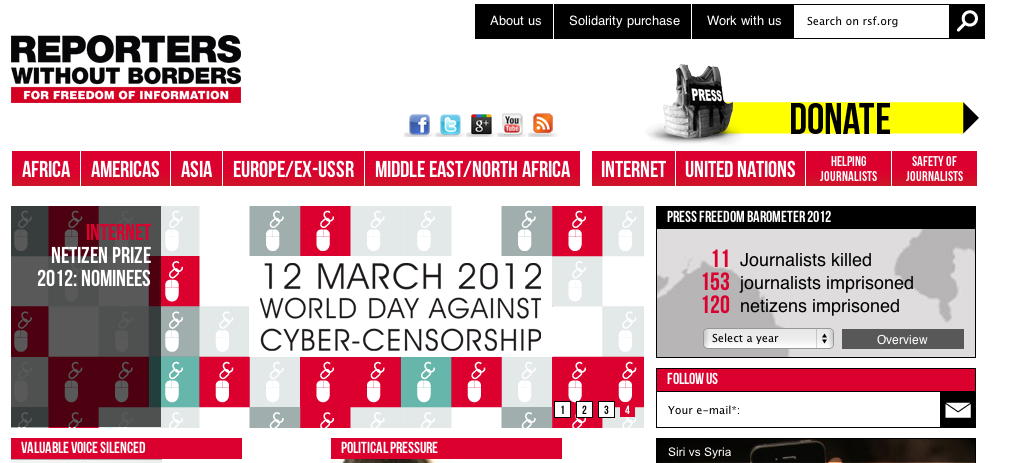
Below is a screen-shot of the front page where we see that as of this point in 2012, 11 journalists have been killed, an additional 153 journalists have been imprisoned, while 120 netizens have also been imprisoned. Clicking on the links to the graphic on their website will take you to more detailed information regarding the individuals behind these numbers. Of the 120 netizens who have been imprisoned, 68 are from China, 20 from Iran, and 18 from Vietnam.

Functions of Constitutions

In a response to a story that I blogged about yesterday, New Yorker Magazine Senior Editor, Hendrik Hertzberg, takes issue with the claim that the US Constitution has become increasingly irrelevant as a model for constitution-builders worldwide. Hertzberg writes:

The problem is that the study focusses almost exclusively on rights—the individual and civil rights that are specified in written constitutions. But it almost totally ignores structures—the mundane mechanisms of governing, the nuts and bolts, which is mainly what constitutions, written and unwritten, are about, and which determine not only whether rights are truly guaranteed but also whether a government can truly function in accordance with democratic norms. Or function at all with any semblance of efficiency, effectiveness, and accountability.

In Chapter 6 of the Dyck text, we learn that there are five main functions of any constitution, the first one of which “to define the structure of major institutions of government.” Other major functions are:

  • To divide powers and responsibilities among the various institutions of government
  • To regulate relations between the citizen and the state (this is where rights–civil, legal, political, sometimes economic, social and cultural–are enumerated)
  • To serve as a political symbol
  • To specify a method for amending the constitution

What does the study in question say about whether the US Constitution is being used as a template in these other areas? You’ll have to wait until the study is published in June of this year to find out.


PM Harper’s Foreign Policy Shift Towards China

In the National Post, Peter Godspeed argues that Prime Minister Stephen Harper’s pending visit to China represents somewhat of a foreign policy pivot for the Conservative government.

Like the United States, Canada is in the midst of a foreign policy pivot in Asia…

…Tuesday, Stephen Harper, the Prime Minister, arrives in the Chinese capital for what almost amounts to a traditional “Team Canada” trade mission, seeking to strengthen economic ties with Canada’s second-largest trading partner.

With four cabinet ministers — John Baird, the Foreign Affairs Minister, Ed Fast, the International Trade Minister, Gerry Ritz, the Agriculture Minister, and Joe Oliver, the Natural Resources Minister — and seven MPs and 40 business executives and academics, he hopes to build on rapidly expanding ties that have pushed bilateral trade to US$57.7-billion a year in 2010.

“China’s growth as an emerging market is very significant for Canada’s business community, and it is an economic relationship that requires the attention of the highest political level,” said Peter Harder, president of the Canada-China Business Council.

From the perspective of foreign-policy decision-making in IR theory, the makeup of the Team Canada mission to China would indicate the importance of the pluralist and organizational/bureaucratic models. The pluralist model notes the impact of powerful interest groups, such as the Canada-China Business Council, and business executives and academics. Radicals, especially Marxists, would note the absence of any environmental or union groups amongst the mission’s members.

About the tone of the trip, NDTV reports that

The visit can be seen as a change in attitude for Canada, which has a record of taking a hard stance on the Chinese regime’s human rights abuses, as it looks as if economic ties between the two nations are warming.

Support for Capital Punishment

On Thursday in POLI 1100, a general discussion about the distinctions between democratic and non-democratic regimes focused on the use(s) of violence by governments as a means of control. This led to a discussion of the use of, and support for, the death penalty. As many of my students knew, the death penalty is not used in Canada or Europe (with the exception of Belarus) but is used in the United States. Most of the class, however, was surprised to learn that, despite the differences in policy, until quite recently a majority of both Canadians and Americans supported the death penalty. The graphic below shows the supports of a Gallup-Ipsos survey carried out in 2004, in which Canadians just barely oppose the death penalty (although, as you can see, it is not a majority), while Great Britons (55%) and US Americans (64%) both have majorities supporting the death penalty.

Although support for capital punishment is decreasing in many countries, in many European countries a majority of the population still is in favour of the death penalty for those convicted of murder. What about Japan? In a poll released in February 2010, a record 85% of Japanese supported the death penalty!

What do you think about these results? Are they as you expected? What does this say about the political culture of the countries in question?

Regime Change, Freedom, Democracy, and Islam

In our IS210 class, we’ve been assessing nondemocratic regimes. I had my students read an article by M. Steven Fish, published in World Politics in 2002, titled “Islam and Authoritarianism.” In it, the author notes the striking empirical finding that a majority of Arab Muslim countries had nondemocratic regimes, even after controlling for potentially confounding factors such as oil wealth, level of political violence, poverty, etc. Fish asks what it is about Islam that is linked to authoritarianism. Or, to put it another way, he searches for the causal mechanism lining Islam and regime type. He tentatively finds it in the status of women in contemporary Muslim societies.


Nothing could be less heartening to democratic idealists than the notion that a particular religion is inimical to democracy. Religious traditions are usually constants within societies; they are variables only
across societies. Societies usually are “stuck” with their religious traditions and the social and psychological orientations they encode and reproduce. Yet religious practices and the salience of particular beliefs can change. Even if Muslim countries are more male dominated in some respects than non-Muslim countries, there is no logical reason why such a state of affairs must be immutable. Rigid segregation according to sex and male domination does not have a firm scriptural basis. The Koran provides no justification whatsoever for practices such as female genital mutilation and it condemns all infanticide as a heinous sin, even if it is motivated by a fear of want (17:31; 81:1–14). Much of the Koran’s instruction on marriage, divorce, and other aspects of relations between the sexes (for example, 2:222–41; 4:3; 4:128; 33:1–5; 58:1–4) is more liberal than the sharia (religious law) as practiced in some modern-day Muslim societies. It is therefore as dubious to try to locate the sources of social practice and order in scripture in Islamic settings as it is to try to locate them there in Christian and Jewish settings, because as with all holy injunction based on sacred text, interpretive traditions are powerful and ultimately determine practice. The status of women in Muslim societies is thus both paradoxical and mutable.

At the present time, however, the evidence shows that Muslim countries are markedly more authoritarian than non-Muslim societies, even when one controls for other potentially influential factors; and the station of women, more than other factors that predominate in Western thinking about religious systems and politics, links Islam and the democratic deficit.

What do the recent upheavals in the Muslim-majority states of north Africa and the Middle East portend not only for democracy but for the status of women in these societies. CBC Radio’s “the Current” program set out to try to answer that question in a show dedicated to “women and political upheaval.” Here’s a description of the women interviewed on that evening’s show:

We started this segment with a clip from Mona Seif. She was heavily involved in the protests that brought down former Egyptian President Hosni Mubarak. And in the days leading up to his resignation, she told us she really believed the revolt would lead to a significant improvement in the lives of Egyptian women.

But since then, there have been reports that the situation for Egyptian women has regressed to the way it used to be. So we checked in again with Mona Seif. She’s still in Tahrir Square. But she’s feeling a little less optimistic.

Women have often played leading roles in pushing for change in the Arab and Muslim worlds. But when the dust settles, the gains they think they have made are often elusive. For their thoughts on why that is and whether things may be different this time … we were joined by three women who have spent decades trying to improve the position of women in their societies.

Before the Iranian revolution, Mahnaz Afkhami was Iran’s Minister for Women’s Affairs. She’s now the Founder and President of the Women’s Learning Partnership. She was in Washington, D.C.

Asma Khader is a former Jordanian minister of culture. She’s now the Secretary General of the Jordanian National Commission for Women. She was in Amman, Jordan.

And Leila Ahmed is an Egyptian-born professor at Harvard University’s Divinity School. Her research focuses on women in Islam. And her book, The Quiet Revolution: The Veil’s Resurgence From the Middle East to America will be published next month. She was in Cambridge, Massachusetts.

Microcon Releases Publications in honour of International Women’s Day

As many of you may know, since the early 1900s March 8th is used to observe International Women’s Day. In honour of this day, the Microcon group, which is a group of scholars who analyze violent conflict using micro-level approaches, has made publicly available a set of research papers related to sex, gender, and violence.

International Women’s Day

These publications are being issued to coincide with the International Women’s Day, which takes place on 8th March each year. Annually on 8 March, thousands of events are held throughout the world to inspire women and celebrate achievements towards gender equality.

MICROCON is working on gender issues in conflict-affected areas in two main ways. First of all, it has a set of three projects which take gender as the main object of their analysis. The policy briefing below by Kathleen Jennings is the product of one of these projects.

Secondly, MICROCON is attempting to meet the EU guidelines in relation to gender equality, by bringing in women researchers at all levels, addressing women’s specific needs in its research rather than working in a gender neutral fashion in all aspects of our work, and ensuring that everything we do ‘contribute[s] to an enhanced understanding of gender issues’. The paper below by Colette Harris assesses our progress in this respect, and attempts to demonstrate how gender can be used at different conceptual levels in conflict analysis, and what can be gained from this analytically.

For more information see MICROCON’s gender framework, and visit the International Women’s Day website.

Of particular interest is a research working paper by Colette Harris, ” What Can Applying a Gender Lens Contribute to Conflict Studies? A review of selected MICROCON1 working papers”:

It is rare to find gender a specific focus of scholarship in conflict studies. In MICROCON we have tried to place gender in a central position within all projects and to convince all researchers to use a gender lens for their analysis. This paper uses a set of MICROCON working papers to illustrate how gender can be used at different conceptual levels in conflict analysis, and aims to show what can be gained by the use of a gender lens. The papers bear out Enloe’s insistence that those seeking an in-depth understanding of the social and political world require a feminist curiosity – that is, a curiosity about the roles gender categories play in political debate and action, as well as in scholarship.


The Political Economy of Revolution–Egypt

In our last session of IS 210 we looked at the topic, political economy. O’Neil defines political economy as “the study of the role of economic processes in shaping society and history.” The recent overthrow of the Mubarak regime in Egypt is a good case study with which to highlight some of the links between political revolution and political economy. Anybody who has taken a political economy course in political science at the graduate level in the last 15 years or so has almost certainly read Stephen Haggard and Robert R. Kaufman’s influential work, The Political Economy of Democratic Transitions. The authors attempt to answer a series of inter-related questions related to the politics/economics nexus as it appeared to them in the early 1990s:

“What role have economic crises played in the near-global wave of political liberalization and democratization? Can new democracies manage the daunting political challenges posed by economic crises and reform efforts? Under what economic and institutional conditions is democracy most likely to be consolidated?”

Haggard and Kaufman ultimately eschew both liberal theories of modernization and (neo)-Marxist theories of dependency and turn to a rational choice framework that focuses on the strategic actions of political elites–especially presidents and military leaders–under conditions of economic and institutional constraint. In addition, the authors make a few key assumptions, one of which I will highlight here: “…the 0pportunities for political elites to mobilize political support or opposition will depend on how economic policy and performance affect the income of different social groups.” (6) The empirical evidence draws from countries such as Uruguay, Brazil, Argentina, Philippines, Peru, and Bolivia. There argument certainly has relevance for the situation in Egypt today and for the potential for the Egyptian polity to make a successful transition toward consolidated democracy.
Jake Caldwell, Director of Policy for Agriculture, Trade, and Energy at American Progress, and coauthor of The Coming Food Crisis, has written recently about the daunting economic challenges facing any new government with respect to food security. In the midst of rapidly increasing global commodity prices–especially foodstuffs–the government must find a way to continue to feed its people, many of whom live on less than $2/day in income. Caldwell writes:

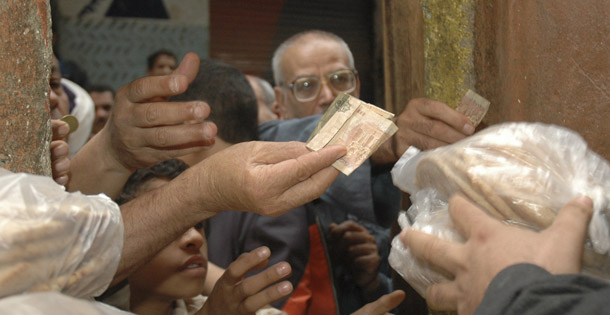
“Egypt has spent $4 billion a year, or 1.8% of GDP, on its bread subsidization program in an attempt to insulate the 40% of Egyptians living on less than $2 a day from inflation. But prices continue to rise…

…Egypt faces daunting challenges as it prepares for broad presidential and parliamentary elections within a year. Ongoing volatility in global food prices will strain resources during this critical transitional period.

As the world’s largest importer of wheat, Egypt is acutely vulnerable to any surge in food prices. Wheat prices have risen 47 percent over the last year and other staples are rapidly approaching dangerously high levels.

Food price inflation and volatility strike hard at the household budgets of average Egyptian families. Many of them spend 40 percent of their monthly income on food. As prices rise, purchasing power is eroded, and the recovery of Egypt’s fragile economy during the transition is slowed.”

How much time will the new Egyptian government have to provide food security for the Egyptian people before the polity’s patience with democracy is compromised? Or is the public yearning for democracy and liberty so strong that economic crisis will have little effect on democratization in Egypt going forward?

Social Network Media and Revolution

In the wake of the revolutionary changes that have (hopefully) taken place in Tunisia and Egypt, much has been made about the role of social media–particularly Facebook–in facilitating the participatory aspect of the revolutionary end-game. (A Google search of `Facebook AND Egypt revolution’ turns up over 22 million hits.) The Globe and Mail’s  Chrystia Freeland is the latest journalist to address the phenomenon, quoting economists Daron Acemoglu and Matthew Jackson.

Freeland notes that social network media have helped resolve what social scientists refer to as the collective action problem.

“It is a question of co-ordinating people’s beliefs,” said Daron Acemoglu, a professor of economics at the Massachusetts Institute of Technology, who, with Matthew Jackson of Stanford University in California, is working on a paper about the effect of social networks on collective action problems.

Protesting against an authoritarian regime is a prime example of this issue, Mr. Acemoglu said, because opponents of a dictator need to know that their views are widely shared and that a sufficient number of their fellow citizens are willing to join them to make opposition worthwhile.

“I need to know if other people agree with me and are willing to act,” he said. “What really stops people who are oppressed by a regime from protesting is the fear that they will be part of an unsuccessful protest. When you are living in these regimes, you have to be extremely afraid of what happens if you participate and the regime doesn’t change.”

That makes publicly protesting an oppressive regime a classic collective action problem: If everyone who wants regime change takes to the streets, the group will achieve its shared goal. But if too few protest, they will fail and be punished. Even if an overwhelming majority wants change, it is smart for individuals to speak out only if enough compatriots do, too.

To Freeland’s characterisation of the collective action problem I would add that the reason it is “smart for individuals to speak out only if enough compatriots do, too” is because each individual reasons in the following manner:

  • I am only one person; my individual marginal contribution to the probability of having a successful revolution is infinitesimally small.
  • Thus, my taking part or not will not be determinative. That is, the revolution will succeed or fail regardless with or without my participation.
  • Given the above, and given potential costs of participating, it is rational for me to not participate.

Social media, however, can help to change the calculus of participation by assuring the would-be participant that millions of others will also participate, thereby decreasing the potential costs of participation to any one individual. I do have an issue, however, with Freeland’s use of the Groupon analogy, which is based on the difference between the types of private goods Groupon specialises in and the truly public good that is a revolution.

Design a site like this with WordPress.com
Get started