Lecture on German Political Parties April 17th

Talk about serendipity!  We will finish our mock German election and government formation simulation on Tuesday, April 15th and two days later there will be a guest lecture on campus by Dieter Dettke, Visiting Scholar at the American Institute for Contemporary German Studies and Adjunct Professor at Georgetown University, Security Studies Program.  on “Is Germany Moving to the Left?  The Changing German Party System.

You can find below a copy of the flyer announcing the lecture, which will begin at 5:30 at the Gottwald Science Center Auditorium.  I’ll see you there.

The Richmond Eric M. Warburg Chapter

of the American Council on Germany

cordially invites you to a

Discussion and Reception

with

Dr. Dieter Dettke

Visiting Scholar at the American Institute for Contemporary German Studies and

Adjunct Professor at Georgetown University, Security Studies Program

on

“Is Germany Moving to the Left?

The Changing German Party System"

Thursday, April 17, 2008

5:30 – 6:45 pm

at

The University of Richmond, Gottwald Science Center Auditorium

Directions: If coming from Three Chopt Road, turn onto Boatwright Drive and continue straight ahead at the welcoming wall at the bottom of the winding hill (do not turn left for the main campus gate). After passing the Robins Center on your left and a large parking lot on your right, proceed for another 300 yards on College Road to the Westhampton entrance on your left. (If coming from River Road, turn onto College Road and turn right into the Westhampton entrance.) Continue on Keller Road to the Modlin Center and pass through the archway. Opposite the stop sign are parking spaces in front of the Westhampton Deanery and even more spaces between it and the cafeteria and science center. The science center auditorium is in the Gottwald Science Center across from the cafeteria. (In case the above parking spaces are full,  there is a parking lot behind the Modlin Center which you can access by turning right at the stop sign or left if exiting the parking lot across from the stop sign.)

If you have any questions, please contact Dr. Arthur B. Gunlicks,

Dr. Dieter Dettke is currently a visiting scholar at the American Institute for Contemporary German Studies and Adjunct Professor at Georgetown University, Security Studies Program. He is working on a book on German foreign policy and transatlantic relations – with the working title “In Search of Normalcy: German Foreign and Security Policy Between Realpolitik and the Civilian Power Paradigm.” He has also been a fellow at both the Woodrow Wilson Center and the German Marshall Fund of the United States.

From 1985 to 2006 he served as US Representative and Executive Director of the Washington Office of the Friedrich Ebert Foundation – which is affiliated with Germany’s Social Democratic Party (SPD). Prior to his work with the Ebert Foundation, Dr. Dettke was Political Counsellor of the SPD Parliamentary Group of the German Bundestag (1974 – 1984) and Staff Director of the Working Group on US-German relations. In this capacity, he coordinated all foreign, security and defence policy related issues on the agenda of the German Bundestag and the Committees for Foreign Affairs, Defence, German-German relations, Development Policy and European Affairs.

He has lectured frequently in Europe and the United States on transatlantic relations, German-American security issues and European-American economic relations. He has also presented papers, acted as a discussant and/or chair at U.S. and international conferences of the American Political Science Association, the International Studies Association, the German Studies Association and the American Association of Slavic Studies. In addition, Dr. Dettke testified in Congress on the implications of German unification for the United States and US-European relations.

Dr. Dettke has appeared on the News Hour with Jim Lehrer, C-SPAN, Voice of America as well as other American, German, Swiss, and British television and radio programs to discuss issues and developments related to domestic and foreign policy developments in Europe and the United States. Dr. Dettke studied political science and law at the universities of Bonn and Berlin (Germany) and Strasbourg (France). He was a Fulbright Scholar at the University of Washington in Seattle (1967/68).
Mock German Election and Government Formation Simulation

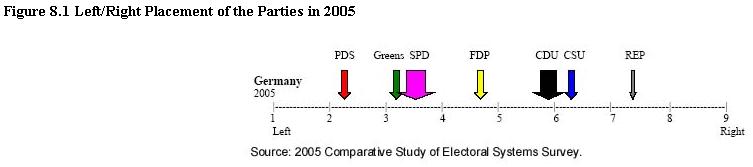
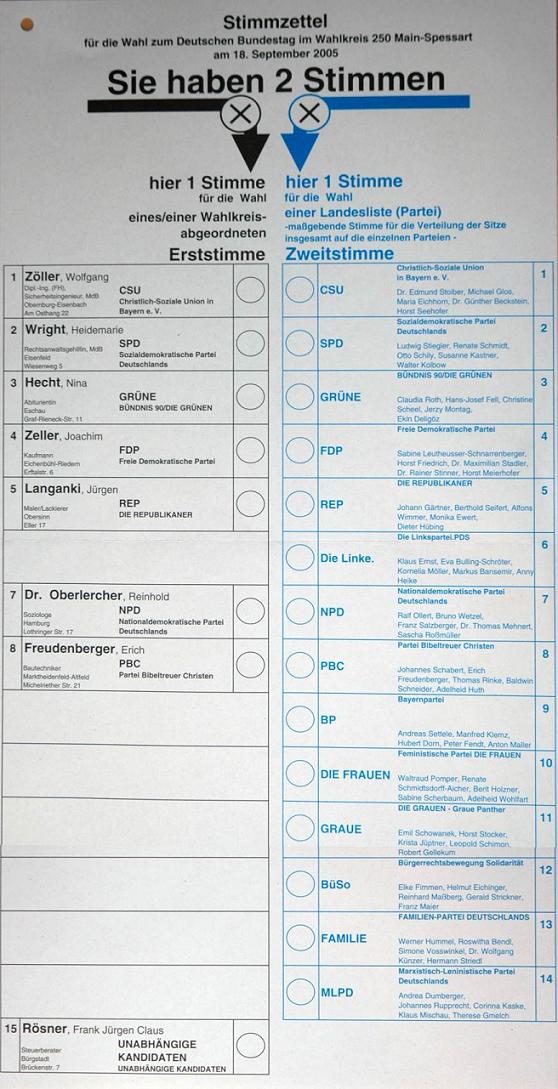
Here is a great link to information about the German electoral and political party system. You can find all sorts of information and links (to youtube videos even!) related to German political parties and the electoral system. Here are a couple of images from the link above:

The first is a one-dimensional left-right placement of political parties. Remember that given our relatively small class size, you will be a representative of only one of four parties–CDU/CSU, FDP, SPD, Green Party. [Update: I notice that they have the CDU and CSU listed as separate parties, which they technically are.  As I noted in the assignment instructions, the CSU is essentially the CDU, but in Bavaria.  They always forms coalitions in the Bundestag when deciding on government formation.]

The second image is the unique two-vote electoral ballot; remember that Germans get to vote twice–once for a candidate to fill one of the 299 single-member districts, and once for a party list in a multi-member district. You’ll notice the left side of the ballot has the individual candidate’s name prominently displayed, whereas the party-list side (the right-side of the ballot) has the party name prominently displayed.

Here’s a nice breakdown of the characteristics of demographic support for each of the parties during the 2005 Bundestag elections, the result of which was a “grand coalition” between Angela Merkel’s CDU/CSU (Merkel was voted in by parliament as the Chancellor) and Gerhard Schroeder’s SPD.

Serbian Electorate Must Choose–Stomach or Heart?

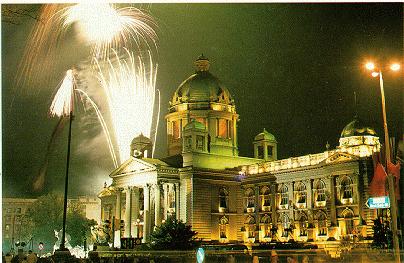
narodna_skupstina_srbije.jpgThe Serbian coalition government, with moderate nationalist Vojislav Koštunica as Prime Minister–has collapsed following dissension within the multi-party governing coalition over the “loss of Kosovo.” Voters will go to the polls to elect a new government on May 11th having to make a stark choice in the polling booth: whether to side with the nationalists in their struggle to forestall Kosovar independence, or to vote in a more moderate pro-European government, thereby placating not only members of the European Union but calming the nerves of wary international investors, who have become the life-blood of the Serbian economic system. As reports reports:

…The coalition government collapsed at the weekend, with nationalist Prime Minister Vojislav Koštunica blaming disunity over the conflicting goals of pursuing European Union membership versus defending Kosovo, the province which seceded last month with EU backing.

“Right now, around 1.0 billion euros worth of investments have been put on hold,” [Deputy Prime Minster Božidar] Djelić said. “There is a growing risk perception considering that some parties want to halt Serbia’s road to Europe. The elections will be a choice between Europe and investors are extremely careful.”

Heavily reliant on foreign investment for growth, Serbia is believed to need between 3.0 billion and 5.0 billion euros a year to ensure solid economic growth, single digit inflation and financing of its current account gap of 16 percent of GDP.

“In the absence of the required level of foreign investment, foreign creditors could also decide to put on hold lending to Serbian companies,” said Pavle Petrović of the FREN/CEVES thinktank said.

“The resulting crisis would lead to forcible reduction in external gaps through inflation, currency depreciation, a fall in output and wages. In that case, the central bank could soothe and postpone, but not eliminate the crisis,” he said.

Comparative Political Party and Electoral Systems

In a few weeks, we will conduct an in-class exercise that simulates a German national election.  This will give you a good idea of the specifics of the German political party and electoral systems, which you will then be able to compare to other systems around the world.  The German system is fairly complicated in that each citizen casts two votes, one for a member running in a single-member district, while the other is cast for a party via a proportional system.

Elections are, of course, the conditio sine qua non–and the minimal institutional requirement–of democratic political systems.   A great web site dedicated to keeping track of elections around the world is electionguide.org They do not as of yet have the results from the most recent national elections in Spain, (they will shortly) but they do have election results for countries around the world going back decades for some countries.  You should check them out.

The Christian Science Monitor  on the incumbent Spanish government’s re-election this past week:

oresults_p1.jpgAided by a near-record turnout, José Luis Rodríguez Zapatero and the Socialist Party won the Spanish national elections – suggesting further changes toward diversity in a young democracy whose older generations cut their teeth on the Franco dictatorship and the moral authority of the Roman Catholic church.

The Socialist victory suggests Mr. Zapatero’s party has broken out of the longtime secondary status it has labored under, despite winning the last election in 2004.

Now, say analysts, the Socialists’ more liberal appeal to young people, women, and immigrants – along with its contemporary style of campaigning – must be taken seriously by the conservative Popular Party (PP), which ran on an older message of Spanish traditionalism and antipathy toward the feisty Basque and Catalonia regions.

Do the cited paragraphs remind you of any other electorate?

Italians and Europeans–The Two Solitudes?

Here is an animated short film by Bruno Bozzetto, which shows the putative differences between Italians and Europeans (notice the not-so-subtle “othering” that is implicit in the title). Have you ever been to Italy? Are these differences real, and if so, can political culture account for them? What underlying differences in political attitudes would help explain the divergence in behaviors demonstrated in the video? It’s interesting that Italy was one of the original six members of the European Union (which was then called the European Coal and Steel Community (ECSC). This was quite monumental as the other five members were on the other side of the Alps. Have a look at Bozzetto’s animated short:

P.S. This could easily be titled “Europe and Croatia!”

Nationalist wins First Round of Serbian Presidential Elections

According to results released by the Election Commission of the Republic of Serbia, a second round of voting will be needed to elect Serbia’s next president. Current president, the moderate Boris Tadić, finished second (with 34.5% of votes cast) to challenger, Tomislav Nikolić, (40.0%) whose campaign was based on stark appeals to nationalist sentiments in the Serbian body politic. Given that neither candidate received the required 50% to be formally declared the first-round winner, Tadić and Nikolić will compete head-to-head in a run-off election on February 3rd. (Many European countries’ election laws also require winning candidates to have won 50% of the vote to avoid second-round run-off elections.)

The election outcome is seen as a battle between those who would aspire to a new era of Serbian politics, stressing future political and economic integration with the rest of Europe, and their opponents, who it is argued desire a return to the Milošević-era inspired nationalist ethos. The election could prove to be (yet another) important watershed in contemporary Serbian political affairs, evidence of which is the turnout, which was the largest in almost ten years. Here is a nice, short article from Time magazine explaining the future implications of the elections and below is a video report from Russia Today can be found here.

Below is a report prepared for the Sunday Telegraph in advance of the elections:

European Politics Source

One of the best sources for European politics in the English language is certainly the Financial Times, published in London. Don’t let the name of the newspaper fool you, the Financial Times writes about much more than financial and economic news. It’s coverage of domestic European politics is first-rate.

Design a site like this with WordPress.com
Get started