Serbian Electorate Must Choose–Stomach or Heart?

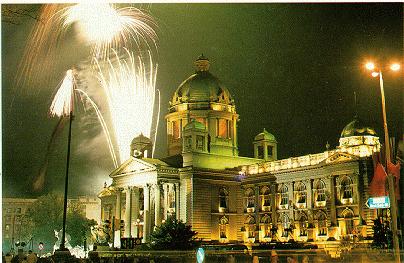
narodna_skupstina_srbije.jpgThe Serbian coalition government, with moderate nationalist Vojislav Koštunica as Prime Minister–has collapsed following dissension within the multi-party governing coalition over the “loss of Kosovo.” Voters will go to the polls to elect a new government on May 11th having to make a stark choice in the polling booth: whether to side with the nationalists in their struggle to forestall Kosovar independence, or to vote in a more moderate pro-European government, thereby placating not only members of the European Union but calming the nerves of wary international investors, who have become the life-blood of the Serbian economic system. As reports reports:

…The coalition government collapsed at the weekend, with nationalist Prime Minister Vojislav Koštunica blaming disunity over the conflicting goals of pursuing European Union membership versus defending Kosovo, the province which seceded last month with EU backing.

“Right now, around 1.0 billion euros worth of investments have been put on hold,” [Deputy Prime Minster Božidar] Djelić said. “There is a growing risk perception considering that some parties want to halt Serbia’s road to Europe. The elections will be a choice between Europe and investors are extremely careful.”

Heavily reliant on foreign investment for growth, Serbia is believed to need between 3.0 billion and 5.0 billion euros a year to ensure solid economic growth, single digit inflation and financing of its current account gap of 16 percent of GDP.

“In the absence of the required level of foreign investment, foreign creditors could also decide to put on hold lending to Serbian companies,” said Pavle Petrović of the FREN/CEVES thinktank said.

“The resulting crisis would lead to forcible reduction in external gaps through inflation, currency depreciation, a fall in output and wages. In that case, the central bank could soothe and postpone, but not eliminate the crisis,” he said.

Comparative Political Party and Electoral Systems

In a few weeks, we will conduct an in-class exercise that simulates a German national election.  This will give you a good idea of the specifics of the German political party and electoral systems, which you will then be able to compare to other systems around the world.  The German system is fairly complicated in that each citizen casts two votes, one for a member running in a single-member district, while the other is cast for a party via a proportional system.

Elections are, of course, the conditio sine qua non–and the minimal institutional requirement–of democratic political systems.   A great web site dedicated to keeping track of elections around the world is electionguide.org They do not as of yet have the results from the most recent national elections in Spain, (they will shortly) but they do have election results for countries around the world going back decades for some countries.  You should check them out.

The Christian Science Monitor  on the incumbent Spanish government’s re-election this past week:

oresults_p1.jpgAided by a near-record turnout, José Luis Rodríguez Zapatero and the Socialist Party won the Spanish national elections – suggesting further changes toward diversity in a young democracy whose older generations cut their teeth on the Franco dictatorship and the moral authority of the Roman Catholic church.

The Socialist victory suggests Mr. Zapatero’s party has broken out of the longtime secondary status it has labored under, despite winning the last election in 2004.

Now, say analysts, the Socialists’ more liberal appeal to young people, women, and immigrants – along with its contemporary style of campaigning – must be taken seriously by the conservative Popular Party (PP), which ran on an older message of Spanish traditionalism and antipathy toward the feisty Basque and Catalonia regions.

Do the cited paragraphs remind you of any other electorate?

Kenyan Leaders Sign Peace Agreement

Kenya’s political leaders have finally reached an agreement that Kenyans hope will signal the end of the recent instability and inter-ethnic bloodshed, which resulted from disputed elections in late December of last year. The New York Times reports that the structure of the political system in Kenya has been altered as a result of an agreement between President Mwai Kibaki and opposition leader Raila Odinga:

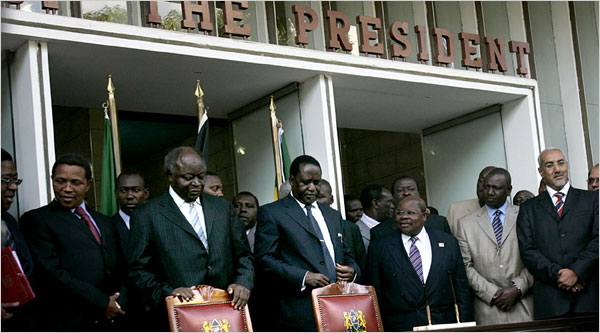
29kenya-span-600.jpgNAIROBI, Kenya — Kenya’s rival leaders broke their tense standoff on Thursday, agreeing to share power in a deal that may end the violence that has engulfed this nation but could be the beginning of a long and difficult political relationship.

The country seemed to let out a collective cheer as Mwai Kibaki, the president, and Raila Odinga, the top opposition leader, sat down at a desk in front of the president’s office, with a bank of television cameras rolling, and signed an agreement that creates a powerful prime minister position for Mr. Odinga and splits cabinet posts between the government and the opposition.

The two sides, which have been bitterly at odds for the past two months, will now be fused together in a government of national unity.

But there are still many thorny issues to resolve, starting with how the new government will function with essentially two bosses who have tried unsuccessfully to work together before. The government must also deal with the delicate business of reassigning the choice positions already given to Mr. Kibaki’s allies.

When we get back from the spring break, in intro to comparative we will analyze the political systems of several democracies around the world and you’ll realize that very few democracies have institutionalized a system that contains a strong Prime Minister and strong President. The most successful example is probably France, with its semi-presidential system. Even in strongly democratic France, however, political stability is often compromised when the President and Prime Minister are members of different political parties, as will be the case in Kenya. It will be interesting to see how the Kenyan version of cohabitation will develop in the coming months and years.

Ethnic Segregation in Kenya Continues Unabated

Kenya seems to be following the template set out in previous inter-ethnic conflicts (see a previous post on the results of residential segregation in Baghdad), where the ultimate result is a more ethnically segregated society.  The “un-mixing of peoples” continues unabated in that increasingly unstable state.  The New York Times reports:

segregation_of_kenya.jpg

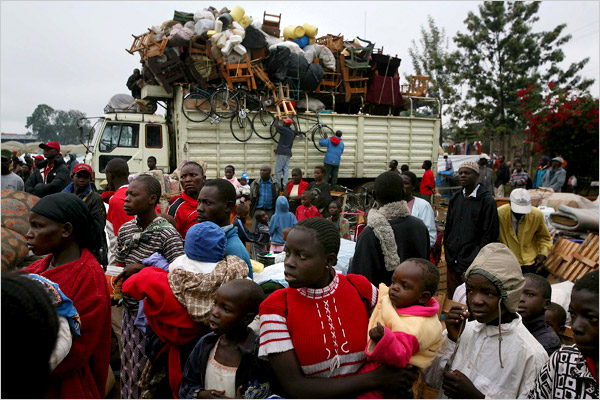
Following a flawed election, and a wave of ethnic and political violence, Kenya, once one of Africa’s most promising nations, is resegregating itself. Members of ethnic groups, like these Luos, left, waited for transportation to their ancestral homes.

Photo: Joao Silva for The New York Times

 OTHAYA, Kenya — Sarah Wangoi has spent her entire life — all 70 years of it — in the Rift Valley. But last month, she was chased off her farm by a mob that called her a foreigner. She now sleeps on the cold floor of a stranger’s house, seeking refuge in an area of Kenya where her ethnic group, the Kikuyu, is strong. It is, supposedly, her homeland.

“I am safe now,” said Ms. Wangoi, though the mob still chases her in her dreams.

Across the country, William Ojiambo sat in a field where the ground was too hard to plow. He, too, sought refuge with his ethnic group, the Luo. He used to live in an ethnically mixed town called Nakuru but was recently evicted by a gang from another ethnic group that burned everything he owned.

“We came here with nothing, like cabbages thrown in the back of a truck,” Mr. Ojiambo said.

Kenya used to be considered one of the most promising countries in Africa. Now it is in the throes of ethnically segregating itself. Ever since a deeply flawed election in December kicked off a wave of ethnic and political violence, hundreds of thousands of people have been violently driven from their homes and many are now resettling in ethnically homogenous zones.

Luos have gone back to Luo land, Kikuyus to Kikuyu land, Kambas to Kamba land and Kisiis to Kisii land. Even some of the packed slums in the capital, Nairobi, have split along ethnic lines.

Centrist wins run-off Election for Serbian Presidency

The BBC reports that centrist candidate Boris Tadić has won more than 50% of the vote in the second round of the Serbian presidential elections held on Sunday. Turnout was high and the Serbian electorate has, with a slight majority, signaled its intention of looking towards the future and the West, rather than returning to the nationalist rhetoric and policies of Serbia’s recent past.

Serbian President Boris Tadic, 3 February 2008

Mr Tadic wants to push forward his European integration agenda

Serbia’s pro-Western president, Boris Tadic, has won a second round election run-off against nationalist challenger Tomislav Nikolic, who conceded defeat. Mr Tadic was re-elected by more than 50% of voters in a contest that saw a high voter turnout.

Car horns could be heard around Belgrade as Tadic supporters took to the streets of the Serbian capital to celebrate the victory.

The election was seen as a referendum on Serbia’s relations with Europe.

“Serbia has shown its great democratic potential,” said Mr Tadic said in his victory speech, in which he lauded Mr Nikolic for his performance in the knife-edge contest, and said the country still had hard work ahead.

Another Foreign Policy List: How to Steal an Election Without Breaking a Sweat

Foreign Policy magazine frequently publishes “lists” that are meant to illuminate, in a sometimes ironic manner, political phenomena that are receiving much discussion.  In a recent issue, the focus turns to elections.   From their introduction:

From Abuja to Islamabad, autocratic regimes have become adept at manipulating “free and fair elections” to stay in power. Here’s how they do it—and how to stop them.

Here is their list, with some real-world examples of each:

  1. Control the processKenya’s constitution invests an enormous amount of power in the executive branch. This allowed President Mwai Kibaki to create a vast system of patronage throughout the government based largely on tribal ties. The head of the Electoral Commission of Kenya, Samuel Kivuitu, has recently admitted that he was pressured by the president’s office to announce results before he could verify their authenticity.
  2. Manipulate the mediaIn the months leading up to the recent presidential election in Georgia, President Mikheil Saakashvili’s government shut down Imedi TV, an opposition-friendly television station founded by one of the president’s rivals and managed by Rupert Murdoch’s News Corporation.
  3. Keep out the observersDuring the 2005 Egyptian parliamentary elections, judges at individual polling stations made seemingly arbitrary decisions about whether to allow outside monitoring. The result? Some stations were monitored and some were not. Monitors were beaten by police in one southern city, and eight were arrested and released elsewhere.
  4. Misreport resultsNadia Diuk, senior director for Europe and Eurasia at the National Endowment for Democracy (NED), relays a tale from Azerbaijan’s 2000 elections: “The light went out in the room where the counting was to take place, and the flashlights of the observers just caught sight of a bundle of ballots sailing through the air to land on the counting table.” [This is my favorite! :)]
  5. Foster incompetence and chaosNigeria’s 2007 national and state elections take the chaos prize. Ballots arrived late to polling stations, if at all, or were printed with missing or incorrect information. Polling places and procedures were changed at the last minute. With security lax, reports were rampant of militants harassing voters and youth gangs breaking into polling places and making off with ballot boxes.
  6. Resort to the crude stuff A favorite tactic in Egypt is to deploy riot police in strategic polling locations to keep out voters for the opposition Muslim Brotherhood—while state employees arrive in buses and are ushered in en masse. In 2005, a bloody showdown in the streets of Alexandria between government-backed thugs wielding machetes and Brotherhood supporters seeking to cast their votes became international news, embarrassing the regime.

South Carolina Democratic Primary, Institutional Legacies, and Generational Change

In class on Thursday, I defined institutions and described some of their major characteristics, the most important of which is that an institution endures, sometimes despite the significant impetus for change driven by changing political, social, economic, and technological sources. Last night’s Democratic primary exit polls in South Carolina provide a glimpse into the institution known as the Democratic primary and how that institution has endured over time. Here is a portion of the exit polls from CNN:

sc_primary_exit_polls1.jpg

Notice the three red boxes, which confirm that Obama was able to win a landslide victory in South Carolina despite receiving only 15% of the 60-and-older non-black vote. So what, you may respond, a pattern has emerged showing Obama captures much more support from the under-30 crowd than the over-60 cohort. But if you look at the over-60 black vote, you’ll see that they voted overwhelmingly in favor of Obama. The complete story here is the institutional legacy of the Democratic party in the South and the impact of generational change on the nature of the party. When we cover political attitudes and ideologies in about two weeks time, we’ll read Ronald Inglehart’s work, in which he highlights the importance of inter-generational changes in attitudes brought about by exposure to epoch-changing events. Lyndon Johnson’s signature on the Civil Rights Act in 1964 was just such an event.

Voter Turnout Across the World

O’Neil (in Chapter 6) argues that democracies are institutionalized through the institutions of participation, competition, and liberty.  The most common form of participation in democracies is voting in elections.  Yet, the general sense seems to be that voters are turning out to vote in ever smaller numbers over the years.  Do the data bear that out?

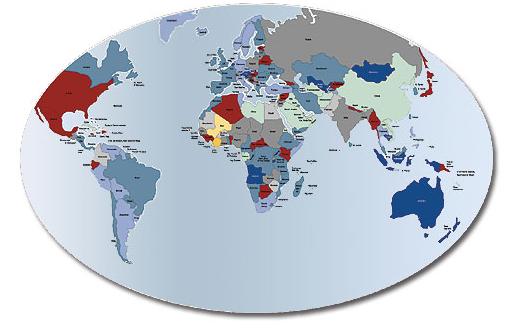
The IGO IDEA–The International Institute for Democracy and Electoral Assistance–has a fantastic website dedicated to, amongst other things, tracking voter turnout levels in elections around the world. Referring to the map below, we see that voter turnout levels differ from country to country. Why might this be the case? This observation could be used as the first step in demonstrating Lave and March’s four-step process of modeling social and political phenomena. Thus, step one (“observe a social fact”) is voter turnout levels are higher in some countries and lower in others. Step two, then, requires us to consider a social process that could have accounted for this variation in outcomes. Can you think of a social process that can account for the findings on the map below?

world_voter_turnout1.jpg

Here are some important findings from IDEA’s report on world voter turnout trends.  For a complete list of data for each respective country, go here.

  • High turnout is not solely the property of established democracies in the West. Of the top 10 countries in the 1990s only three were Western European democracies.
  • Turnout across the globe rose steadily between 1945 and 1990 – increasing from 61% in the 1940s to 68% in the 1980s. But post-1990 the average has dipped back to 64%.
  • Since 1945 Western Europe has maintained the highest average turnout (77%), and Latin America the lowest (53%), but turnout need not necessarily reflect regional wealth. North America and the Caribbean have the third lowest turnout rate, while Oceania and the former Soviet states of the Commonwealth of Independent States (CIS) and Central Eastern Europe are respectively second and third highest in the regional league table over this period.
  • The overall average turnout in the post-war period for established democracies is 73%, which contrasts with an average of 58% for all other countries. However, turnout rates in both established and non-established democracies have been converging over time.
  • Out of the 81 countries which had first and subsequent elections between 1945 and 1997, the average turnout in first elections (61%) is actually lower than the average for subsequent elections (62%). This represents a mixed pattern backed up by the fact that turnout in 41 countries dropped between the first and second elections but turnout actually rose in another 40 countries.

Nationalist wins First Round of Serbian Presidential Elections

According to results released by the Election Commission of the Republic of Serbia, a second round of voting will be needed to elect Serbia’s next president. Current president, the moderate Boris Tadić, finished second (with 34.5% of votes cast) to challenger, Tomislav Nikolić, (40.0%) whose campaign was based on stark appeals to nationalist sentiments in the Serbian body politic. Given that neither candidate received the required 50% to be formally declared the first-round winner, Tadić and Nikolić will compete head-to-head in a run-off election on February 3rd. (Many European countries’ election laws also require winning candidates to have won 50% of the vote to avoid second-round run-off elections.)

The election outcome is seen as a battle between those who would aspire to a new era of Serbian politics, stressing future political and economic integration with the rest of Europe, and their opponents, who it is argued desire a return to the Milošević-era inspired nationalist ethos. The election could prove to be (yet another) important watershed in contemporary Serbian political affairs, evidence of which is the turnout, which was the largest in almost ten years. Here is a nice, short article from Time magazine explaining the future implications of the elections and below is a video report from Russia Today can be found here.

Below is a report prepared for the Sunday Telegraph in advance of the elections:

McClatchy–Kenyan president lost election, U.S. exit poll indicates

The McClatchy Washington Bureau is an excellent resource for news on political events around the world. Here they report on the results of an exit poll commissioned by a US-government backed foundation, which claims to show the incumbent Kenyan president was soundly defeated in the recent disputed election that has set off rioting and inter-ethnic killing sprees.

NAIROBI, Kenya — An exit poll carried out on behalf of a U.S. government-backed foundation indicated that Kenyan President Mwai Kibaki suffered a resounding defeat in last month’s disputed election, according to officials with knowledge of the document.

The poll by the Washington-based International Republican Institute — not yet publicly released — further undermines Kibaki’s claims of a narrow re-election victory. The outcome has sparked protests and ethnically driven clashes nationwide, killing hundreds.

Opposition leader Raila Odinga led Kibaki by roughly 8 percentage points in the poll, which surveyed voters as they left polling places during the election Dec. 27, according to one senior Western official who’s seen the data, who spoke on condition of anonymity because of the sensitivity of the issue. That’s a sharp departure from the results that Kenyan election officials certified, which gave Kibaki a winning margin of 231,728 votes over Odinga, about 3 percentage points.

U.S. and European observers have criticized the official results, which came after long, unexplained delays in counting the votes, primarily from Kibaki strongholds. Jendayi Frazer, the assistant secretary of state for African affairs, said over the weekend that there were “serious irregularities in the vote tallying, which made it impossible to determine with certainty the final result.”

It wasn’t clear why the International Republican Institute — which has conducted opinion polls and observed elections in Kenya since 1992 — isn’t releasing its data. A spokesman for the U.S. Embassy in Kenya confirmed that a poll was conducted but referred questions to the institute, where officials couldn’t be reached for comment.

Kenyan activists called on U.S. officials to release any data that would shed light on election fraud.

Design a site like this with WordPress.com
Get started