Where do most of the World’s Poor Live?

In a recently released report. the Center for Global Development argues that there are more poor people in middle-income countries (MICs) than in low-income countries (LICs). The new “bottom billion” (the phrase made famous by economic Paul Collier’s book of the same name) is not only the result of India and China having moved from LIC to MIC status. Indeed, according to the authors of the report, “the proportion of the world’s poor in MICs has still tripled, not only from a range of other countries like Nigeria, Pakistan, Indonesia, but also from some surprising MIC countries such as Sudan, Angola, and Cameroon.” Whereas twenty years ago, more than 90% of the world’s poor lived in LICs, today more than 70% of the world’s poor live in MICs.

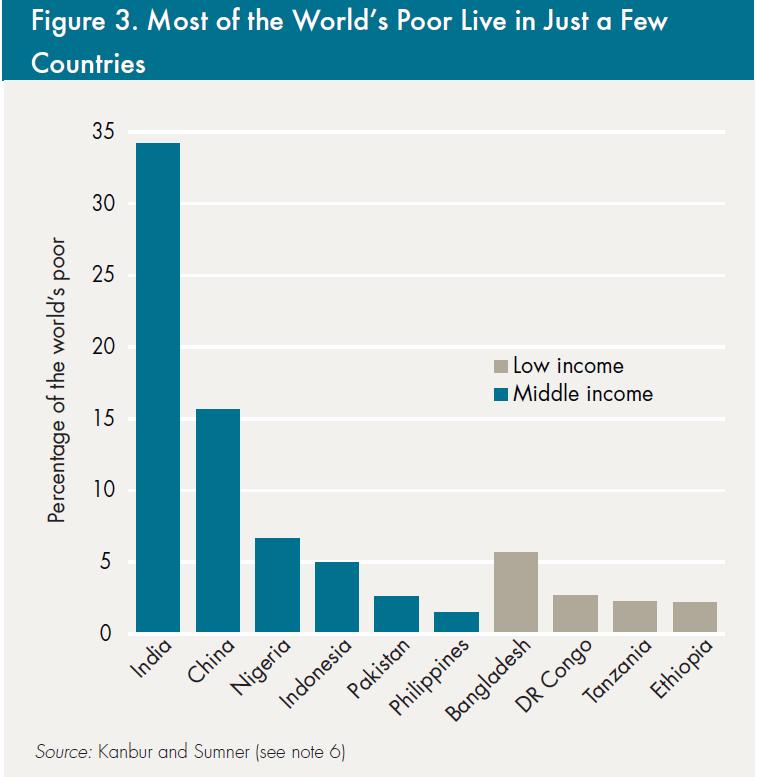
Since 2000, over 700 million poor people have “moved” into MICs by way of their countries’ graduating from low-income status (see figure 1). And this is not just about China and India. Even without them, the proportion of the world’s poor in MICs has still tripled, not only from a range of other countries like Nigeria, Pakistan, Indonesia, but also from some surprising MIC countries such as Sudan, Angola, and Cameroon. The total number of LICs has fallen from 63 in 2000 to just 40 in the most recent data (see figure 2), and this trend is likely to continue.3 India and three other countries (Pakistan, Indonesia, and Nigeria) account for much of the total number of the new MIC poor (see figure 3). Among all MICs (new and old), five populous countries are home to 854 million poor people, or two-thirds of the world’s poor. These are Pakistan, India, China, Nigeria, and Indonesia.

One might ask how sensitive the shift is to the thresholds themselves? Of the new MICs, several are very close to the threshold—notably, Lesotho, Nicaragua, Pakistan, Senegal, Vietnam, and Yemen. India is only US$180 per capita per year over the threshold, but it is reasonable to assume that growth in India will continue and keep it out of danger of slipping back. It is important to recognize, however, that a significant number of the new MICs still fall under the threshold for the International Development Association (IDA), the World Bank’s concessionary lending window for poor countries.

The authors argue that this change in the location of the world’s poor carries with it important policy implications. If most of the world’s poor live in MICs, what does that mean for foreign aid and for the economic development policies and goals of rich countries and international organizations alike? Read the report to find their answer. The report, in addition, contains some interesting charts:

Two Opportunities for Summer Study Abroad

Via the polcan listserv (Canadian Political Science Association) comes word about two opportunities for study abroad in the area of (ethnic) conflict. The first is a course offered in Kenya by the University of Toronto. The course, PCS361Y–Special Topics in Peace and Conflict Studies: Conflict in Africa: Causes, Consequences, and Responses–is described as “an intensive inquiry into the causes, consequences, and especially possible to conflict in Africa.” The course will be taught in Nairobi, Masai Mara, and Mombasa from May 13 through June 6. For more information, go here.

The second course will be taught as part of the American University in Kosovo summer program. Here is a description of the program:

American University in Kosovo is now accepting applications for the Summer of 2011 to study Peacebuilding, Post-conflict Transformation, and Development in the fun and safe ‘living laboratory’ of the Balkans. This four-week program offers a wide selection of courses in related areas from an impressive array of global scholars, diplomats, retired military officers, ex-combatants, practitioners, and representatives of international organizations. The goal of the program is to bridge the gap between theory and practice. Last year’s program included about 60 students from over 30 countries — including 6 Canadians. About 2/3 of the students were undergraduates — the remaining graduate students. Undergraduate course credits are transferrable. Several participants from 2010 referred to their experiences in the program as ‘life transforming.’

For more about this program, go here.

Links to Articles and other Sources on State Capacity

For your first paper assignment (IS 210) you will be required to compare the nature of the state in two countries. One of the dimensions across which you will compare is state capacity. To help you out, here are some interesting sources:

First, here is the link to a presentation at the World Bank building state capacity in Africa. Here is a description:

If Africa is to have a well-functioning public sector there needs to be a paradigm shift in how to analyze and build state capacity. This is the core message in a new book from the World Bank, Building State Capacity in Africa: New Approaches, Emerging Lessons. Specifically, African governments and their partners should move from a narrow focus on organizational, technocratic, and public management approaches, to a broader perspective that incorporates both the political dynamics and the institutional rules of the game within which public organizations operate.BUILDING STATE CAPACITY IN AFRICA presents and analyzes recent experiences with supply-side efforts to build administrative capacity (administrative reform, pay policies, budget formulation), and demand-side efforts to strengthen government accountability to citizens (role and impact of national parliaments, dedicated anticorruption agencies, political dynamics of decentralization, education decentralization).

The second source is a paper by Mauricio of the Brookings Institution on “State Capacity in Latin America”. Cardenas writes:

State capacity is exceptionally low in Latin America, even when compared to other former colonies. This paper analyzes four possible factors that could potentially explain this troubling feature: political inequality, inequality, interstate conflict and civil war. With the exception of external war, these variables have a negative effect on state-building in models where the accumulation of state capacity is analogous to investment under uncertainty. These analytical predictions are then tested with cross-country data, paying special attention to Latin America. Democracy’s impact on state capacity is quite positive, as is the effect of the frequency of external wars when data for the last century is used. However, in the data for the last half century, external wars have little effect, but the negative effects of internal wars and income inequality become highly significant. The model explains why Latin America has failed to develop its state, despite the improvement in the various measures of democracy. In fact, both the theoretical model and the empirical evidence suggest that the effects of democracy are undermined in the presence of high economic inequality.


ICG Report–Diamonds and the Central African Republic (CAR)

The International Crisis Group (ICG) has just released a new report on the influence of diamonds on the political situation in the Central African Republic (CAR). We’ve read various papers on the link between resource wealth (“lootable resources”) and political outcomes, such as regime type and economic outcomes. This report analyses the link between the presence of large stores of diamond wealth in CAR, the level of political instability (it’s essentially a failing state) and the existence of endemic conflict.  From the executive summary of the report:

In the diamond mines of the Central African Republic (CAR), extreme poverty and armed conflict put thousands of lives in danger. President François Bozizé keeps tight control of the diamond sector to enrich and empower his own ethnic group but does little to alleviate the poverty that drives informal miners to dig in perilous conditions. Stringent export taxes incentivise smuggling that the mining authorities are too few and too corrupt to stop. These factors combined – a parasitic state, poverty and largely unchecked crime – move jealous factions to launch rebellions and enable armed groups to collect new recruits and profit from mining and selling diamonds illegally. To ensure diamonds fuel development not bloodshed, root and branch reform of the sector must become a core priority of the country’s peacebuilding strategy.

Nature scattered diamonds liberally over the CAR, but since colonial times foreign entrepreneurs and grasping regimes have benefited from the precious stones more than the Central African people. Mining companies have repeatedly tried to extract diamonds on an industrial scale and largely failed because the deposits are alluvial, spread thinly across two large river systems. Instead, an estimated 80,000-100,000 mostly unlicensed miners dig with picks and shovels for daily rations and the chance of striking it lucky. Middlemen, mostly West Africans, buy at meagre prices and sell at a profit to exporting companies. The government lacks both the institutional capacity to govern this dispersed, transient production chain and the will to invest diamond revenues in the long-term growth of mining communities.

Chronic state fragility has ingrained in the political elite a winner-takes-all political culture and a preference for short-term gain. The French ransacked their colony of its natural resources, and successive rulers have treated power as licence to loot. Jean-Bédel Bokassa, the CAR’s one-time “emperor”, created a monopoly on diamond exports, and his personal gifts to French President Giscard d’Estaing, intended to seal their friendship, became symbols of imperial excess. Ange-Félix Patassé saw nothing wrong in using his presidency to pursue business interests and openly ran his own diamond mining company. Bozizé is more circumspect. His regime maintains tight control of mining revenues by means of a strict legal and fiscal framework and centralised, opaque management.

The full report can be accessed here. Here is a Al-Jazeera English news report on the situation in CAR.

The Age of Global (In)equality?

Many of the readings from Chapter 9 of O’Neil’s Essential Readings address the issue of global divergence/convergence in economic growth and/or inequality over the last few decades (and even further back than that–i.e., the Pritchett reading). The question comes down to whether there has been more or less inequality over time. Which is it? Well, the answer depends to a large extent on how one chooses to measure inequality. I’ll begin my response to this by quoting a student’s e-mail I received earlier today:

Hello, below is a link to a video showing one aspect or area of convergence.

I don’t know if I agree that countries are converging in regards to wealth and health; after all, Africa still seems very far behind.  I general, yes, countries today are healthier (longer life spans) and wealthier (not looking at inequality) than they were 200 years ago…

…For our purposes, what is the meaning of convergence and divergence?  From Pritchett, he seems to be measuring growth in terms of GDP and concluding that there is divergence between developed and developing nations (i.e. the levels of growth are not coming together, but separating).  What about China and India, who experienced faster or “larger growth” than some developed nations in the 80’s to mid 90’s?  Then with Milanovic, he is talking about inequality – how it is decreasing at the world level (when Indian and China are included) and this shows convergence.  To me, O’Neil seems to be trying to present two sides of an issue; however, I see two separate issues.  One is divergence in economic growth and the other is convergence in equality. I suppose that China’s and India’s economic growth can explain or at least correlate to lower inequality at the world level, but is that the correct way of interpreting Milanovic?  Is he saying that there’s a convergence of equality (or lower inequality gap worldwide), because countries (when including China and India) are converging in regards to economic growth?

Thank you.

This student is essentially correct in his reading of the respective arguments. As I mentioned earlier, which view one takes on the question of the recent direction of inequality convergence/divergence depends upon how one chooses to measure inequality. To put it differently, it depends upon whether your unit-of-analysis is the country or the individual. A Gini Index score that is calculated on the basis of mean levels of national income (or wealth) may not be the same as one calculated on the basis of comparing the wealth of individuals worldwide. In fact, Milanovic tells us that the values are indeed different, and the difference is due mainly to what has happened in China and India over the last two decades or so.


What does the HDI measure?

This post is prompted by an e-mail from one of the students in my Comparative World Government class. Here’s the e-mail message:

I’m just studying and going through my notes, and had a quick question. In topic 4 when you were talking about GDPs and the Gini Index you said that there actually was a correlation between countries with a high GDP and a low Gini index, but isn’t GDP used in calculating the gini index? So wouldn’t it kind of skew the data, forcing the gini index to be more likely to follow the same pattern as the GDP?

Just curious

Here is my response:

Thanks for the question. I’m almost certain that I didn’t say that, since there’s generally no correlation between the Gini Index and the GDP. Some rich countries have relatively high equality (Sweden, for example) and some have high inequality (USA). Conversely, some poor countries have high levels of equality (India), while some poor countries have very high levels of inequality (Central African Republic).

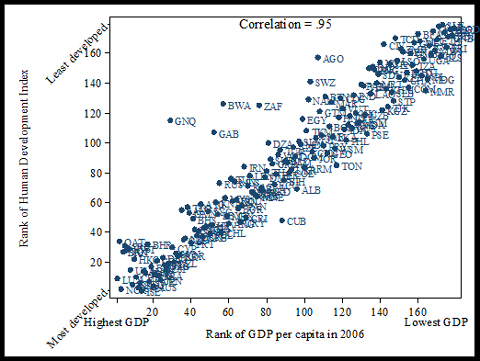
What I most likely said was that there was a very high correlation between a country’s GDP and is score on the Human Development Index (HDI). Just a bit of research…turns up this interesting bit of analysis by Justin Wolfers at the NY Times Freakonomics blog, showing a correlation of 0.95 between a country’s HDI rank and GDP rank (2006). That’s an exceptionally high correlation, suggesting that the HDI isn’t measuring much more than the country’s level of GDP.

Wolfers created a graph using the 2006 data for GDP rank and HDI rank, while I provide for your viewing pleasure below.

The Relationship between State Autonomy and State Capacity

Amongst the various dimensions of state power are state autonomy and state capacity. It is important to remember that they are distinct concepts and there is no obvious relationship beween the two. As the chart below (taken from Chapter 3 of O’Neil) demonstrates, a state can have high capacity and low autonomy (or vice versa) or high (or low) levels of both. Can you think of a country that would fit in each cell of the 2X2 matrix below?

High

Autonomy

Low

Autonomy

High

Capacity

State is able to fulfill basic tasks, with a minimum of public intervention; power highly centralized; strong state.

Danger: Too high a level of capacity and autonomy may prevent or undermine democracy.

State is able to fulfill basic tasks but public plays a direct role in determining policy and is able to limit state power and scope of activity.Danger: State may be unable to develop new policies or respond to new challenges owing to the power of organized opposition.
Low

Capacity

State is able to function with a minimum of public interference of direct control, but its capacity to fulfill basic tasks is limited.

Danger: State is ineffectual, limiting development and slow development may provoke public unrest.

State lacks the ability to fulfill basic tasks and is subject to direct public control and interference—power highly decentralized among state and nonstate actors; weak stateDanger: too low a level of capacity and autonomy may lead to internal state failure.

An Alternative to GDP as a Measure of Welfare

Over the course of the semester, we’ll address the issue of economic growth and economic well-being. We’ll ask–and attempt to answer–question such as “why are most African countries still so poor?”, “why has there been an economic miracle in many parts of east Asia?”, etc. As we’ll see, the most widely used measure of economic welfare (or well-being) is gross domestic product (GDP), which is a measure of the total goods and services produced in a country in a given year.

Evidence suggests that the higher a country’s GDP, the better that country’s residents live; that is, they are better off. Recently, there has been increasing criticism of the focus on GDP as a measure of societal welfare. Think of the recent oil spill of the US coast in the Gulf of Mexico. The money spent to (attempt to) clean the waters and beaches served to increase the GDP in this area during the clean-up. It doesn’t take too much imagination to understand that this increase in GDP was probably not a boost in the general welfare of the individuals living in the region.

Robert Kennedy, at the start of his ill-fated run for the US presidency in 1968, remarked about GDP:

“The GDP* measures everything except that which makes life worthwhile.”

In a recent TED talk, statistician Nic Marks tackles some of the issues of using the GDP as a measure of a society’s “success.” From the abstract:

Statistician Nic Marks asks why we measure a nation’s success by its productivity — instead of by the happiness and well-being of its people. He introduces the Happy Planet Index, which tracks national well-being against resource use (because a happy life doesn’t have to cost the earth). Which countries rank highest in the HPI? You might be surprised.

What is (are) LICUS?

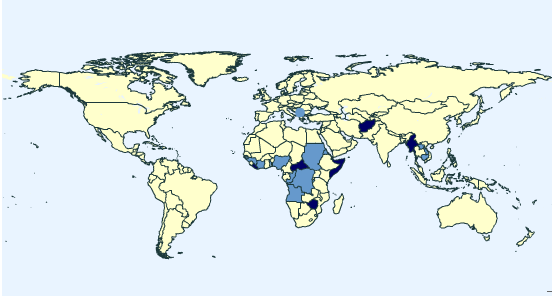
To me, it sounds like a species of tropical plant, but it is an acronym used by the World Bank and other IGOs and NGOs to refer to a specific group of less-developed countries.  According the the World Bank, LICUS, which is an acronym for Low Income Countries Under Stress, are

are countries with weak policies, institutions, and governance.

The World Bank’s IEG (Independent Evaluation Group) set out to evaluate the role of the Bank’s efforts to aid these countries in their bid to develop economically and politically.  From the report:

Home to almost 500 million people, roughly half of whom earn less than a dollar a day, fragile states, until recently known in the World Bank as low-income countries under stress (LICUS), have attracted increasing attention. Concern is growing about the ability of these countries to reach development goals as well as about the adverse economic effects they have on neighboring countries and the global spillovers that may follow.

With their multiplicity of chronic problems, these countries pose some of the toughest development challenges. Poor governance and extended internal conflicts are common among these countries, which all face similar hurdles: weak security, fractured societal relations, corruption,breakdown in the rule of law, and lack of mechanisms for generating legitimate power and authority. As low-income countries, LICUS also have a huge backlog of investment needs and limited government resources to meet them. 

Past international engagement with these countries has failed to yield significant improvements, and donors and others continue to struggle with how best to assist fragile states. LICUS are characterized by weak policies, institutions, and governance. The Bank identified 25 such countries in fiscal year 2005. These 25 countries have a number of similarities: their infant mortality rate is a third higher than that of other low-income countries, life expectancy is 12 years lower, and their maternal mortality rate is about 20 percent higher.

There are also important differences among LICUS. Some grew at around 4 percent per annum during 1995-2003. Others had negative growth rates of a similar magnitude. Some have abundant natural resources, while others are resource-poor. These differences are recognized in four business models that the Bank developed to work with countries in crisis: deterioration, prolonged crisis or impasse, post-conflict or political transition, and gradual improvement.

Countries in light blue are characterized as “core” LICUS countries, while those in dark blue are “severe” LICUS countries.


Design a site like this with WordPress.com
Get started