Barack Obama on the Financial System, Uncertainty and Risk

In my post below, I linked to an article by Thomas Homer-Dixon in which, among other things, he argued that the problem with the contemporary financial system is that the arcane machinations and lack of transparency (Level-III assets, anyone?)  have transformed the market from one of risk–which can form the basis for a stable financial system–to uncertainty–which cannot.  So the question then, is how to create the conditions under which banks and other financial institutions, and investors can adequately assess risk.  The lack of transparency is the reason that the credit markets have currently seized up and the Federal Reserve has had to come to the rescue of Bear Stearns. (Ben Bernanke–the Chairman of the Federal Reserve–himself has argued that “banks will fail” over the next couple of years.  Indeed, a couple of small regional American banks have already failed.)

By coincidence, Democratic Presidential candidate Barack Obama gave a speech at Cooper Union in New York setting out his vision of how his policies would help the engine  of the American (and international) financial system become more transparent and a solid foundation for the US and world economy.  I encourage you to watch the speech, wherein Obama presents his view of the nature of the relationship between the market and state (government).

“It’s worth taking a moment to reflect on the role that the market has played in the development of the American story.  The great task before our founders was putting into practice the ideal that government could simultaneously serve liberty and advance the common good.  For Alexander Hamilton, the young Secretary of the Treasury, that task was bound to the vigor of the American economy.  Hamilton had a strong belief in the power of the market, but he balanced that belief with the conviction that human enterprise, ‘may be beneficially stimulated by prudent aids and encouragements on the part of the government [state]'”

SKY News Report on Situation in Tibet

Here is an interesting video, which captures the events surrounding an organized (by the Chinese authorities) visit of non-Chinese journalists to the capital city of Tibet, Lhasa.  It seems as though events conspired against the Chinese authorities just a little bit:

From CSM–In Turkey, Secularists Escalate Fight Against Ruling AKP

Amongst the readings we’ll be addressing tomorrow in introduction to comparative politics is Alfred Stepan’s “The Twin Tolerations”, which analyzes the necessary mutual respect between religious society and political society that democracy demands. Please read this recent article from the Christian Science Monitor on the battle between Turkish secularists and the Islamic-oriented ruling party in Turkey, the Justice and Development Party (AKP), which is headed to Turkey’s court system. The secularists argue that the Turkish Constitution’s strict separation of church and state has been violated by the religious nature of the ruling party. Please bring this article to class tomorrow. Be prepared to discuss how well the “twin tolerations” are working here. Here are some excerpts:

Under scrutiny: Prime Minister Recep Tayyip Erdogan and his ruling party are facing heightened criticism for straying from the Constitution’s secular principles.
Umit Bektas/Reuters

turkey.jpg

After protesting the AKP’s presidential candidate, precipitating new elections, and then losing out to the AKP at the polls last year, hard-line secularists are now taking a new tack: trying to shut down the party for “expunging” the Constitution’s secular principles.

Turkey’s highest court is set to decide in the coming days whether to allow the motion, filed by the country’s top prosecutor on March 14, to go forward. If the Constitutional Court decides to allow the case to proceed, it could plunge Turkey into a deep crisis, threatening the country’s emerging political and economic stability and further jeopardizing its already troubled bid for European Union membership.

“This would definitely hinder the government in many ways. There are so many things to be done, such as issues relating to the EU, Cyprus, and the economy, and the government would no longer be in a position of authority,” says Sahin Alpay, a political science professor at Istanbul’s Bahcesehir University. “What the people going after the party are doing is really shooting the country in its own feet.”

EU officials have criticized the closure move, calling it antidemocratic.

“In a normal European democracy, political issues are debated in parliament and decided in the ballot box, not in the courtroom,” said EU Enlargement Commissioner Olli Rehn in response to the prosecutor’s unexpected call to shut down the AKP. “It is difficult to see that this lawsuit respects the democratic principles of a normal European society.”

24 parties closed since 1963

Turkish law gives the judiciary broad powers to shut political parties down. The Constitutional Court has closed 24 parties since it was established in 1963. The court is currently deciding on a motion to close the pro-Kurdish Democratic Society Party (DTP), accused of promoting ethnic separatism.

Join Me in Welcoming the World’s Newest Democracy

The Himalayan state of Bhutan has become the world’s newest democracy, upon the completion of elections there on Monday. As this Washington Post story notes, the change from monarchical to democratic rule was initiated by the benevolent monarchy. Bhutanese were reticent about what this would mean for Bhutan’s social cohesiveness and some lamented the potential danger of faction, with various political parties competing for the political allegiance of the newly-minted voters:

TOKTOKHA, Bhutan, March 24 — Without revolution or bloodshed, this tiny Himalayan kingdom became the world’s newest democracy Monday, as wildflower farmers, traditional healers, Buddhist folk artists and computer engineers voted in their country’s first parliamentary elections, ending a century of royal rule.

In a historic event for the country of 700,000, entire families took to winding mountainous roads, traveling sometimes for days in minivans, on horseback and on foot to cast their ballots, marking Bhutan’s transition to a constitutional monarchy.

Despite concerns that Bhutanese would be turned off by the rough-and-tumble world of politics, more than 79 percent of the estimated 318,000 registered voters turned out at polling places.

It was the king, as well as his father and predecessor, who ordered the subjects to vote, in the belief that democracy would foster stability in a geographically vulnerable country wedged between China and India and known as the Land of the Thunder Dragon.

Here’s an informative news report from the Canadian Broadcasting Corporation (CBC) on politics in Bhutan.

Nicolae Ceausescu and the Cult of Personality

Today in introduction to comparative we discussed various coercive tactics available and generally used by authoritarian and dictatorial leaders.  One of them is the cultivation of a “cult of personality.”  Nobody was better at it than the late (executed) Romanian Communist dictator Nicolae Ceausescu.  This clip from youtube is a treasure as it shows the dictator’s last public speech; within hours both he and his equally loathsome spouse, Elena, had been executed.

Note a couple of things; first, the dramatic banners, huge photographs of the ruling couple, and other similar accoutrements of the public celebrations of a totalitarian regime.  Note also the massive crowds. In totalitarian systems (as opposed to authoritarian ones), every thing is politicized and one’s presence at events such as this would be expected.  Apathy is not allowed, and it is considered reactionary.

The second fascinating phenomenon is when the crowd (or portions thereof) begins to whistle and jeer its disapproval while Ceausescu is speaking.  The voice on his face as he realizes that he has lost the crowd is absolutely fascinating.  Rarely in history is an event like this captured for posterity.

40th Anniversary of the Prague Spring and Soviet Invasion of Czechoslovakia

 This Spring marks the 40th anniversary of the Prague Spring–a domestic, Czech-led liberalization and democratization movement in the former Czechoslovakia–and the subsequent Soviet military invasion of that former communist state.  As Czechs sang and wrote their way towards a regime Czechs would describe as “Communism with a human face”, Leonid Brezhnev–the leader of the Soviet Union–rolled Soviet tanks onto the streets of Prague to put an end to Alexander Dubcek’s reforms.  This was the first concrete foreign policy manifestation of the “combating of anti-socialist forces,” which came to be known as the Brezhnev Doctrine.

Euronews has an interesting report on the commemoration of the Prague Spring, which has been uploaded to youtube.  I encourage you to take a look.

It’s Spring, so how is your Bracket Doing?

pakistan_gilani.jpg
Well, it’s that time of year again. Has your bracket been busted? How many of you can honestly claim that you predicted the upset of Yousaf Raza Gilani becoming Pakistan’s new Prime Minister? Now I realize that most of you were predicting a victory for Ma Ying-jeou in Taiwan’s recent presidential elections. But did you honestly think that he would win by 15! (He won 57.5% of the vote.) Mr. Gilani almost busted my bracket, but I think that I may be able to redeem myself with my pick for the winner of the upcoming Serbian Parliamentary elections (given that the Balkan Conference is a mid-major, that group of countries has not been followed very closely and I have a little bit of an advantage in prognosticating the outcome there).
taiwan_ying_jeou.jpg
Current Prime Minister, Vojislav Koštunica, disbanded his coalition government on March 13 due to tensions within the governing coalition as a result of the declaration of independence by the former Serbian province of Kosovo. New elections are slated to be held on May 11 of this year, with Koštunica’s conservative and nationalistic Democratic Party of Serbia will find its strongest challenge from Serbian President Boris Tadić‘s bloc of pro-democratic and pro-Western parties and the ultra-nationalist Serbian Radical Party. It will be interesting to observe how much the apparent loss of the Kosovo (the “Serbian Jerusalem”) will help the ultra-nationalists and hurt Koštunica.
And finally, my surprise pick to get to the Final Four from the East Region is the tiny Himalayan state of Bhutan, which has been flying under the radar but has been getting its democratic game together. As Agence-France Presse reports, democracy is marching inexorably onward in a fit of Fukuyaman glee:
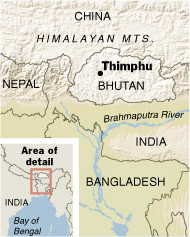
0324-web-bhutanmap.jpgTHIMPHU, Bhutan (Agence France-Presse) — Bhutan stands poised to become the world’s newest democracy on Monday with elections ordered by its revered royal family to end its absolute rule.
The tiny Buddhist state, wedged in the Himalayas between India and China, will elect members for a lower house, ending the century-long rule of the hugely popular Wangchuck dynasty.Bhutan’s Oxford-educated ruler, King Jigme Khesar Namgyel Wangchuck, 28, made a forceful last-minute appeal over the weekend to his subjects — some of whom were initially reluctant to bring in democracy — to vote.

“As you approach the duty of voting at the elections that will bring democracy, do so with pride and confidence of a people that have achieved so much,” he said in a statement published in the nation’s newspapers. “First and foremost, you must vote. Every single person must exercise his or her franchise.”

The king is the fifth ruler in the dynasty, in power since 1907. The path to democracy began in 2001, when the former king, Jigme Singye Wangchuck, handed over the day-to-day tasks of government to a council of ministers, and finally stepped down in favor of his son in late 2006.

Since then, father and son have traveled the country to explain to its 670,000 people why the nation should embrace democracy.

Wow! I think we have one of those rare instances of enlightened despotism.

Russian Journalist found Murdered

Freedom House, a prominent NGO that monitors and assesses the level of civil and political rights and freedoms in the world, downgraded Russia’s status in 2004 from Partly Free to Not Free.  This is part of the legacy of Vladimir Putin’s rule in Russia.  Another part of the legacy has been the dramatic number of journalists killed in Russia over the last decade.  Most of these journalists had either been working on, or had reported stories about, corruption in the government and business elite.

Here is the report from Euronews about the latest Russian journalist to be killed:

russian_reporter.jpgA Russian journalist has been assassinated in Moscow. Ilias Shurpaiev, who worked for the state-run Channel One, was found dead in his flat. He had apparently being strangled with a belt and suffered stab wounds. Shurpaeiv, a native of the mostly Muslim Dagestan province, was the author of several reports on the Caucusus region.

More than a dozen journalists have been killed in contract-style killings in Russia since 2000.

Resource Dependent Regimes in Sub-Saharan Africa

Jensen and Wantchekon (2000) have created an index of resource dependence and determined the level of the same for the states of sub-Sarahan Africa.  The scores range from 1 (no resource dependence) to 4 (extreme resource dependence).  They use this as an important independent variable in determining democratic transition, consolidation, and government effectiveness.  How much of an effect does resource dependence have on each of these dependent variables?  You’ll have to read the paper to find out, or attend my class in intro to comparative tomorrow.

resource_dependence_scores.jpg

Chinese Conceptions of “Rights”: From Mencius to Mao–and Now

Elizabeth has written the above-titled article, which has been published in the most recent issue of Perspectives on Politics. I will be adding this to the readings under the topic of democracy. I’ll adjust the syllabus on Blackboard accordingly and provide an electronic link to the full-text article on the electronic version of the syllabus. You can also link to the article here. [Updated: The link doesn’t work; go to Blackboard for the link.]

We will address the implications of “Asian values” for democracy and seek to understand the moral underpinnings of Chinses society (remember that we are not equating “Asian” with Chinese; Asia is a vast and heterogeneous continent), and whether western conceptions of democracy and human rights are necessary. How is political authority legitimized in Chinese society, according to Mencius, Confucius, and Mao? Here is the abstract to Perry’s article:

The recent explosion of popular protest in China, often framed as a demand for the fulfillment of “rights,” has captured widespread attention. Some observers interpret the protests as signs of a “moral vacuum.” Others see the unrest as signaling a powerful new “rights consciousness.” In either case, the protests are often regarded as a major challenge to the stability of the political system. In this article, an examination of Chinese conceptions of “rights,” as reflected in the ethical discourses of philosophers, political leaders, and protesters (and as contrasted with American understandings of rights), provides the basis for questioning prevailing assumptions about the fragility of the Chinese political order. For over two millennia, Chinese political thought, policy, and protest have assigned central priority to the attainment of socioeconomic security. As a result, the meaning of “rights” inChinese political discourse differs significantly from the Anglo-American tradition. Viewed in historical context, China’s contemporary “rights” protests seem less politically threatening. The Chinese polity appears neither as vacuous nor as vulnerable as it is sometimes assumed to be.

Design a site like this with WordPress.com
Get started