
ICG Report–Diamonds and the Central African Republic (CAR)

The International Crisis Group (ICG) has just released a new report on the influence of diamonds on the political situation in the Central African Republic (CAR). We’ve read various papers on the link between resource wealth (“lootable resources”) and political outcomes, such as regime type and economic outcomes. This report analyses the link between the presence of large stores of diamond wealth in CAR, the level of political instability (it’s essentially a failing state) and the existence of endemic conflict.  From the executive summary of the report:

In the diamond mines of the Central African Republic (CAR), extreme poverty and armed conflict put thousands of lives in danger. President François Bozizé keeps tight control of the diamond sector to enrich and empower his own ethnic group but does little to alleviate the poverty that drives informal miners to dig in perilous conditions. Stringent export taxes incentivise smuggling that the mining authorities are too few and too corrupt to stop. These factors combined – a parasitic state, poverty and largely unchecked crime – move jealous factions to launch rebellions and enable armed groups to collect new recruits and profit from mining and selling diamonds illegally. To ensure diamonds fuel development not bloodshed, root and branch reform of the sector must become a core priority of the country’s peacebuilding strategy.

Nature scattered diamonds liberally over the CAR, but since colonial times foreign entrepreneurs and grasping regimes have benefited from the precious stones more than the Central African people. Mining companies have repeatedly tried to extract diamonds on an industrial scale and largely failed because the deposits are alluvial, spread thinly across two large river systems. Instead, an estimated 80,000-100,000 mostly unlicensed miners dig with picks and shovels for daily rations and the chance of striking it lucky. Middlemen, mostly West Africans, buy at meagre prices and sell at a profit to exporting companies. The government lacks both the institutional capacity to govern this dispersed, transient production chain and the will to invest diamond revenues in the long-term growth of mining communities.

Chronic state fragility has ingrained in the political elite a winner-takes-all political culture and a preference for short-term gain. The French ransacked their colony of its natural resources, and successive rulers have treated power as licence to loot. Jean-Bédel Bokassa, the CAR’s one-time “emperor”, created a monopoly on diamond exports, and his personal gifts to French President Giscard d’Estaing, intended to seal their friendship, became symbols of imperial excess. Ange-Félix Patassé saw nothing wrong in using his presidency to pursue business interests and openly ran his own diamond mining company. Bozizé is more circumspect. His regime maintains tight control of mining revenues by means of a strict legal and fiscal framework and centralised, opaque management.

The full report can be accessed here. Here is a Al-Jazeera English news report on the situation in CAR.

“Ghosts of Rwanda” Documentary

As a video supplement to the Rwanda chapter from Samantha Power’s book on genocide, and the Gourevitch book, we viewed the first part of the PBS Frontline documentary “Ghosts of Rwanda” in class today. Please view the remaining hour or so sometime before next Friday’s class as we will use the first portion of that session to continue our discussion on the international community’s failure to halt the slaughter of more than 800,000 Tutsis by the Hutu-led Rwandan government.Here’s the first part of the documentary. Click on the video to take yourself to Youtube, where you will easily find the remaining parts.


Can the UN Keep the Peace?

Today in IS 302 we viewed the video “Can the UN Keep the Peace”, which looked at the challenges that face the UN Mission in the Democratic Republic of the Congo. Like the pairing of the perfect wine with the right meal, this video was (at least in my opinion) a perfect complement to today’s readings.

Canada’s Official Recognition of the Armenian Genocide

There was some uncertainty in seminar a few days ago regarding the Canadian government’s official stance on the Armenian genocide, which began in 1915. In short, Canada as of 2004 officially recognises the Armenian genocide. From a 2004 CBC story–“Canadian Parliament Recognizes Armenian Genocide”:

The House of Commons has reversed a long-standing policy and passed a resolution denouncing the Turks for committing genocide against Armenians in 1915.The vote passed easily, 153-68.

The motion said: “That this House acknowledges the Armenian genocide of 1915 and condemns this act as a crime against humanity.”

For decades consecutive Canadian governments have dodged the sensitive issue by calling what happened in eastern Turkey a “tragedy,” stopping well short of referring to the events as “genocide.”

The U.S. dropped a similar resolution a year earlier after the White House warned it could hurt U.S. security interests.

Before Wednesday’s vote in Parliament, Foreign Affairs Minister Bill Graham issued a statement saying “Canada has had friendly and co-operative relations with Turkey and Armenia for many years. The Canadian government is committed to make these relationships even stronger in the future.

For a transcript of the debate in the House of Commons, go here.

William Buckely and Noam Chomsky Debate Military Intervention

Here’s a fascinating debate from the 1960s between two American intellectual giants–William Buckely and Noam Chomsky–on the morality of military intervention. Chomsky makes a very strong claim: in the history of humankind never has a state intervened military on the basis of disinterested (i.e., altruistic) motives. Military intervention is always about the furthering of self-interest, but is often dressed up in garb of humanitarianism. Chomsky notes, of course, the few exceptions; exceptions, that is, in the sense that some states didn’t even bother trying to put a veneer of humanitarianism on their naked power grabs–think Belgian in the Congo.

Current United Nations Peacekeeping Operations

We discussed Tom Weiss’ book–Humanitarian Intervention–in IS 302 today. We spent some time on the changing nature, and number, of peacekeeping operations since the end of the Cold War. Below is a map listing the 16 current UN peacekeeping operations. You can find the source image, which is clickable, here.  How many of these operations are proceeding under the auspices of Chapter VII of the UN Charter?

Here is part of the textof the UNSC resolution, authorizing the establishment of MONUSCO in the Democratic Republic of the Congo:

Resolution 1925 (2010)
Adopted by the Security Council at its 6324th meeting, on 28 May 2010

The Security Council,

Continue reading “Current United Nations Peacekeeping Operations”

Michael Ignatieff and Humanitarian Intervention

Current leader of the Canadian Federal Liberal Party, Michael Ignatieff has long been involved in the issue of human rights–as a historian, journalist, public intellectual, and as the former Carr Professor and Director of the Carr Center for Human Rights Policy at the Kennedy School of Government.

In the aftermath of the contentious NATO military intervention in Kosovo (1999), Ignatieff sat down with WBUR’s Chris Lydon to assess what had gone right (and wrong) during the intervention. A self-identified member of the “something must be done [to stop alleged Serbian war crimes against the Kosovar Albanians]”, Ignatieff stands by his support for the intervention, claiming that, on the whole, the benefits outweighed the costs.

Events/Lectures that may be of Interest

I’ll use this blog to keep you informed about lectures and events that may be of interest to you that are taking place on campus or in the greater Vancouver area. There are two events this week that are relevant.

This evening, Monday September 13th, at 7:00pm the Philosophers’ Cafe is kicking off the first event of its fall series at the Shadbolt Centre for the Arts at Deer Lake in Burnaby. This evening’s discussion is titled “Mixed Up: Is Canada’s cultural mix more like a melting pot, mosaic or matrix?” We’ll be addressing issues of identity and culture in about two weeks time in IS 210. The admission is $5, and the event will be moderated by Randall Mackinnon, who has served as a president, board member, executive and consulting staff for a diversity of community service organizations since 1970. For more information about tonight’s event and directions to the venue, click here.

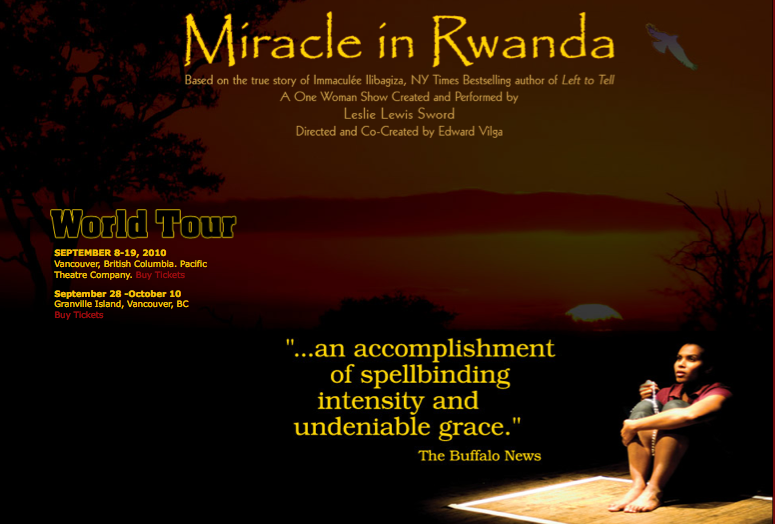
The second event is a one-woman show entitled Miracle in Rwanda, which is showing all of this week at Pacific Theatre Company and will also have a two-week run on Granville Island beginning later this month. To learn more about the show, and to purchase tickets, go here.

Update: The website I linked to above links to the wrong page. Miracle in Rwanda is part of this year’s Vancouver Fringe Festival. Here’s the correct link to information regarding show times and tickets.

Sarah Palin should have taken PLSC250

Had one of my Introduction to International Relations students been taking questions from Charlie Gibson tonight, s/he would have been well prepared to answer his question regarding the “Bush Doctrine”.  As my students (still?) know, the “Bush Doctrine” was most clearly and forcefully enunciated in the 2002 National Security Strategy of the United States.  While there are three major components to the “Bush Doctrine”, the most important of which (at least the one that received the most attention and presented the most radical departure from the part-realist, part-liberal, bi-partisan, pre-9/11 US foreign policy framework was the idea of using preemptive military force, without the need for there to be an imminent threat.

Democratic critics have often charged Bush and his administration with claiming that Saddam Hussein posed an “imminent threat”, but I have yet to see any evidence that anyone speaking for the administration did so.  And it’s not a surprise, as the Bush Doctrine allows the use of force without imminent threat.  Maybe Governor Palin should bring some of those critics along with her to my class.  And if the Republican Party would like to hire a IR tutor for Governor Palin, they’ll find my rates more than reasonable.

Is there a causal link between Natural Resources and Conflict?

The “resource curse” is the name given to the alleged causal links between a country’s abundance of natural resourcee and the existence of all sorts of “bad things”, such as authoritarianism, economic stagnation and/or outright economic decline, increased probability of attempted coups d’etat, etc.  In our session on political economy we read Jensen and Wantchekon’s article on the link between natural resource wealth and authoritarianism, specifically, and we also looked at Richard Snyder’s article on the putative link between the existence of what he calls “lootable wealth” and political (in)stability in a state.  Their conclusions were at times complementary but at times divergent.  What matters (at least for political stability), according to Snyder, is the ability of the rulers (i.e., the government) to partake of the rents/riches accrued by the exploitation of the particular “lootable” resource.

Snyder’s is, of course, not the final word on the topic and there is an avalanche of published research on this very topic.  A new resource that can be used to find data on the link between natural resources and conflict–political, civil, etc.–is the Resource Conflcit Monitor, maintained by the Bonn International Center for Conversion.  From their web site:

Many developing countries rich in natural resources, such as diamonds and oil, have been plagued by poverty, environmental degradation and violent conflicts. In many of these countries, the natural wealth has not led to sustainable development. On the contrary, in some instances resource wealth has provided the funding and reasons for sustaining civil wars. This so-called ‘resource curse’ brought a lot of attention to the link between resources and conflict over the past decade. ’Governance’ has been identified as key factor for understanding the resource-conflict dynamic and for mitigating its negative impact in developing countries. ‘Resource governance’ in the present context describes the way in which governments regulate and manage the use of natural resources as well as the redistribution of costs and revenues deriving from those resources

The Resource Conflict Monitor (RCM) monitors how resource-rich countries manage, administer and govern their natural resources and illustrates the impact of the quality of resource governance on the onset, intensity and duration of violent conflict. The RCM serves as a tool for identifying and supporting viable resource governance and contributes to conflict prevention, post-conflict reconstruction and sustainable development….

There is an informative, and user-friendly, application that provides historical annual information on conflict and resources in individual countries.  Here is the result for Sierra Leone, the specifics of which should be familiar to those of you who watched Cry Freetown.  For an explanation of “resource governance” and “resource regime compliance, go here and scroll down.

There’s an additional methodological point that is crying out to be made here.  Notice that the level of conflict intensity first decreases rather significantly between 1996 and 1997, then increases dramatically between 1997-1999, to then fall just as dramatically between 2000 and 2002, while at the same time “resource governance” and “resource regime compliance” do not change much at all.  This means that we have to be very careful about attributing the level of conflict to the two afore-mentioned phenomena.  Maybe the causal link between these two and conflict intensity is not monotonic, maybe there is a threshold effect at work, or maybe the existence of an abundance of natural resources is a sufficient (under certain conditions) cause of conflict intensity.  On the whole, though, there certainlly doesn’t seem to be a clear linear, and/or monotonic relationship between resources and conflict (at least in Sierra Leone,  between 1996-2006)

Design a site like this with WordPress.com
Get started