
Rice Prices Surge 30% in one Day

I think I’ll start eating more quinoa.

The Financial Times reports that “fears of unrest rise across Asia as rice price surges 30% in a day.”  In a BBC interview, the director of the International Rice Research Institute (IRRI–don’t tell me you didn’t know one existed) bluntly states why this could be a major problem.

“Rice is the staple food for about half the world’s population, and over half the world’s poor.”

As the FT reports, many events has transpired to cause such a dramatic, sudden rise in the price of this extremely important food staple and the potential political effects.

Rice prices jumped 30 per cent to a record high yesterday, raising fears of fresh outbreaks of social unrest across Asia, where the grain is a staple food for more than 2.5bn people.

The increase came after Egypt, a leading exporter, imposed a formal ban on selling rice abroad to keep local prices down and the Philippines announced plans for a major purchase of the grain in the international market to boost supplies.

Global rice stocks are at their lowest since 1976. While prices of wheat, corn and other agricultural commodities have surged since late 2006, the rice prices increase started in January.

The Egyptian export ban formalises a previous poorly enforced curb and follows similar restrictions imposed by Vietnam and India, the world’s second and third-largest exporters.

Cambodia, a small seller, also announced an export ban.

These foreign sales restrictions have removed about a third of the rice traded in the international market.

Chookiat Ophaswongse, president of the Thai Rice Exporters Association, said: “I have no idea how importing countries will get rice.” He forecast prices would rise further.

Here is the BBC interview with the head of the IRRI:
Political Ideology/Attitudes and Happiness

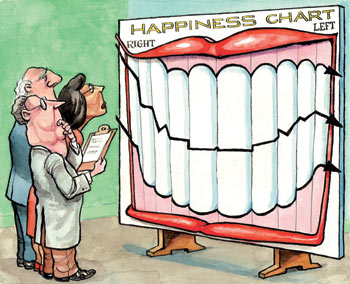
Are individuals of a certain political attitude orientation more likely to be happy than those with competing political attitudes?  The short answer, in the United States at least, may be yes; moreover, self-defined conservatives seem to be much happier (or at least claim they are) than are liberals, and extremists of either group are happier than moderates.  From the Economist:

economist_happiness.jpgIn 2004 Americans who called themselves “conservative” or “very conservative” were nearly twice as likely to tell pollsters they were “very happy” as those who considered themselves “liberal” or “very liberal” (44% versus 25%). One might think this was because liberals were made wretched by George Bush. But the data show that American conservatives have been consistently happier than liberals for at least 35 years.

This is not because they are richer; they are not. Mr Brooks thinks three factors are important. Conservatives are twice as likely as liberals to be married and twice as likely to attend church every week. Married, religious people are more likely than secular singles to be happy. They are also more likely to have children, which makes Mr Brooks confident that the next generation will be at least as happy as the current one.

When religious and political differences are combined, the results are striking. Secular liberals are as likely to say they are “not too happy” as to say they are very happy (22% to 22%). Religious conservatives are ten times more likely to report being very happy than not too happy (50% to 5%). Religious liberals are about as happy as secular conservatives.

Why should this be so? Mr Brooks proposes that whatever their respective merits, the conservative world view is more conducive to happiness than the liberal one (in the American sense of both words). American conservatives tend to believe that if you work hard and play by the rules, you can succeed. This makes them more optimistic than liberals, more likely to feel in control of their lives and therefore happier. American liberals, at their most pessimistic, stress the injustice of the economic system, the crushing impersonal forces that keep the little guy down and what David Mamet, a playwright, recently summed up as the belief that “everything is always wrong”. Emphasising victimhood was noble during the 1950s and 1960s, says Mr Brooks. By overturning Jim Crow laws, liberals gave the victims of foul injustice greater control over their lives. But in as much as the American left is now a coalition of groups that define themselves as the victims of social and economic forces, and in as much as its leaders encourage people to feel helpless and aggrieved, he thinks they make America a glummer place.

Unrest in Egypt due to Inflation

The Financial Times reports a rise in social unrest in Egypt, which has been attributed to inflation, rising food costs in particular. Inflation is soaring in most parts of the Middle East, from the affluent enclaves of the United Arab Emirates to the more distressed countries, such as Egypt. The main culprit is the record-level price of oil.

A wave of discontent has been sweeping through Egypt in response to mounting food prices and the return of long queues in front of bakeries selling subsidised bread – the only food item that has not recently risen in price.

Civil servants, industrial workers and even groups considered privileged such as doctors and university lecturers have been staging strikes and demanding higher pay to meet price increases of up to 50 per cent for some basic foods.

State university lecturers have gone on strike this week, bringing many classes to a halt for a day. “Faculty members in Egypt are normally a very conservative group who do not want to expose themselves to trouble,” said Hany Al Husseini, one of the strike organisers. “But now the economic situation has become so bad that people are prepared to do anything.”

Barack Obama on the Financial System, Uncertainty and Risk

In my post below, I linked to an article by Thomas Homer-Dixon in which, among other things, he argued that the problem with the contemporary financial system is that the arcane machinations and lack of transparency (Level-III assets, anyone?)  have transformed the market from one of risk–which can form the basis for a stable financial system–to uncertainty–which cannot.  So the question then, is how to create the conditions under which banks and other financial institutions, and investors can adequately assess risk.  The lack of transparency is the reason that the credit markets have currently seized up and the Federal Reserve has had to come to the rescue of Bear Stearns. (Ben Bernanke–the Chairman of the Federal Reserve–himself has argued that “banks will fail” over the next couple of years.  Indeed, a couple of small regional American banks have already failed.)

By coincidence, Democratic Presidential candidate Barack Obama gave a speech at Cooper Union in New York setting out his vision of how his policies would help the engine  of the American (and international) financial system become more transparent and a solid foundation for the US and world economy.  I encourage you to watch the speech, wherein Obama presents his view of the nature of the relationship between the market and state (government).

“It’s worth taking a moment to reflect on the role that the market has played in the development of the American story.  The great task before our founders was putting into practice the ideal that government could simultaneously serve liberty and advance the common good.  For Alexander Hamilton, the young Secretary of the Treasury, that task was bound to the vigor of the American economy.  Hamilton had a strong belief in the power of the market, but he balanced that belief with the conviction that human enterprise, ‘may be beneficially stimulated by prudent aids and encouragements on the part of the government [state]'”

Risk, Uncertainty–From Governor Weld to the Modern Financial System

Canadian academic Thomas Homer-Dixon (we will read one of his papers this semester in Intro to IR) has written a piece for Canada’s “paper of record”–the Globe and Mail, which is titled “From Risk to Uncertainty.”  Those of you in my intro to comparative politics class will surely recognize immediately the difference between the tho concepts.

Remember when we read the first two chapter of Shepsle and Bonchek on instrumental rationality, the authors used the example of then-Massachusetts Governor Weld.  Weld had to decide whether to run for Governor again, or to commit to challenging Democratic Senator Ted Kennedy’s Senate seat.  A win there would have given him a nice platform for an eventual presidential run.  Weld, as we know, was operating in a world or risk rather than uncertainty when making his decision, given that there were public opinion polls published that estimated his chances of winning in either election.

What is the difference between risk and uncertainty and how does it apply to the contemporary global financial system (which, by the way, for those of you not paying attention is precariously teetering on the edge of meltdown–you heard it here first!)?

So the rules of the game have now fundamentally changed. Our global financial system has become so staggeringly complex and opaque that we’ve moved from a world of risk to a world of uncertainty. In a world of risk, we can judge dangers and opportunities by using the best evidence at hand [what Shepsle and Bonchek call beliefs] to estimate the probability of a particular outcome. But in a world of uncertainty, we can’t estimate probabilities, because we don’t have any clear basis for making such a judgment. In fact, we might not even know what the possible outcomes are. Surprises keep coming out of the blue, because we’re fundamentally ignorant of our own ignorance. We’re surrounded by unknown unknowns.

Introduction to Comparative Politics–Second Paper

Here is the second paper, whose theme is “culture” (or not) and democracy.*”

Introduction to Comparative Politics Paper–Culture and Democracy

“In Islam, God is Caesar,in [Confucianism], Caesar is God; In [Eastern Christian] Orthodoxy, God is Caesar’s junior partner.”

“The underlying problem for the West in not Islamic fundamentalism. It is Islam.”

“Contemporary China’s Confucian heritage, with its emphasis on authority, order, hierarchy, and supremacy of the collectivity over the individual, creates obstacles to democratization.”

The quotes above will serve as the inspiration for your second paper this semester. I would like you to argue in favor or against the claims made by Huntington quoted above. You can argue that they are basically true, essentially false, or some combination thereof2. Regardless, your task is to provide a reasoned, well researched response to the declarative statements above, using Chapters 5 and 6 in O’Neil, and the articles by Fish, Stepan, Perry, Zakaria, and any others we have read, as your starting points.

Assess the arguments in light of what you know about the requirements (institutional, cultural, structural) of democracy and the nature of authoritarianism. Your outside research will most likely focus on understanding more about Islam, “Asian values,” and/or Christian Orthodoxy (as it is practiced in Eastern Europe).

While the main focus of your paper will be in setting up an argument for or against the claims above, I would like you to then use two states–one “predominantly Muslim”, and one Asian (or Eastern Orthodox)–to illustrate your main arguments and to act as supporting evidence for your claims. Please use chapters 5 and 6 of the Essentials and of Readings as the main source for the paper. For information related to your specific states, you will have to consult at least 4 other academically reputable sources. Note that this means Google is not your friend here!! This will entail a trip down to the library by foot, or a virtual trip to the library’s electronic resources.

Your paper should be 4-5 pages long, double-spaced on 8:5X11-inch paper, with 1-inch margins on the top, bottom, and the sides. The paper must be written in Times Roman 12pt. font. In addition, please cut and paste the “Paper Evaluation Sheet” from Blackboard to the end of your paper (after the works cited page). The paper is due electronically via Digital Dropbox in Blackboard by the beginning of class on Tuesday, April 15th.

Good luck, you kings and queens of comparative!!

*Note: See the version of this assignment posted to Blackboard as it has informative (and helpful) footnotes.

SKY News Report on Situation in Tibet

Here is an interesting video, which captures the events surrounding an organized (by the Chinese authorities) visit of non-Chinese journalists to the capital city of Tibet, Lhasa.  It seems as though events conspired against the Chinese authorities just a little bit:

From CSM–In Turkey, Secularists Escalate Fight Against Ruling AKP

Amongst the readings we’ll be addressing tomorrow in introduction to comparative politics is Alfred Stepan’s “The Twin Tolerations”, which analyzes the necessary mutual respect between religious society and political society that democracy demands. Please read this recent article from the Christian Science Monitor on the battle between Turkish secularists and the Islamic-oriented ruling party in Turkey, the Justice and Development Party (AKP), which is headed to Turkey’s court system. The secularists argue that the Turkish Constitution’s strict separation of church and state has been violated by the religious nature of the ruling party. Please bring this article to class tomorrow. Be prepared to discuss how well the “twin tolerations” are working here. Here are some excerpts:

Under scrutiny: Prime Minister Recep Tayyip Erdogan and his ruling party are facing heightened criticism for straying from the Constitution’s secular principles.
Umit Bektas/Reuters

turkey.jpg

After protesting the AKP’s presidential candidate, precipitating new elections, and then losing out to the AKP at the polls last year, hard-line secularists are now taking a new tack: trying to shut down the party for “expunging” the Constitution’s secular principles.

Turkey’s highest court is set to decide in the coming days whether to allow the motion, filed by the country’s top prosecutor on March 14, to go forward. If the Constitutional Court decides to allow the case to proceed, it could plunge Turkey into a deep crisis, threatening the country’s emerging political and economic stability and further jeopardizing its already troubled bid for European Union membership.

“This would definitely hinder the government in many ways. There are so many things to be done, such as issues relating to the EU, Cyprus, and the economy, and the government would no longer be in a position of authority,” says Sahin Alpay, a political science professor at Istanbul’s Bahcesehir University. “What the people going after the party are doing is really shooting the country in its own feet.”

EU officials have criticized the closure move, calling it antidemocratic.

“In a normal European democracy, political issues are debated in parliament and decided in the ballot box, not in the courtroom,” said EU Enlargement Commissioner Olli Rehn in response to the prosecutor’s unexpected call to shut down the AKP. “It is difficult to see that this lawsuit respects the democratic principles of a normal European society.”

24 parties closed since 1963

Turkish law gives the judiciary broad powers to shut political parties down. The Constitutional Court has closed 24 parties since it was established in 1963. The court is currently deciding on a motion to close the pro-Kurdish Democratic Society Party (DTP), accused of promoting ethnic separatism.

Join Me in Welcoming the World’s Newest Democracy

The Himalayan state of Bhutan has become the world’s newest democracy, upon the completion of elections there on Monday. As this Washington Post story notes, the change from monarchical to democratic rule was initiated by the benevolent monarchy. Bhutanese were reticent about what this would mean for Bhutan’s social cohesiveness and some lamented the potential danger of faction, with various political parties competing for the political allegiance of the newly-minted voters:

TOKTOKHA, Bhutan, March 24 — Without revolution or bloodshed, this tiny Himalayan kingdom became the world’s newest democracy Monday, as wildflower farmers, traditional healers, Buddhist folk artists and computer engineers voted in their country’s first parliamentary elections, ending a century of royal rule.

In a historic event for the country of 700,000, entire families took to winding mountainous roads, traveling sometimes for days in minivans, on horseback and on foot to cast their ballots, marking Bhutan’s transition to a constitutional monarchy.

Despite concerns that Bhutanese would be turned off by the rough-and-tumble world of politics, more than 79 percent of the estimated 318,000 registered voters turned out at polling places.

It was the king, as well as his father and predecessor, who ordered the subjects to vote, in the belief that democracy would foster stability in a geographically vulnerable country wedged between China and India and known as the Land of the Thunder Dragon.

Here’s an informative news report from the Canadian Broadcasting Corporation (CBC) on politics in Bhutan.

Nicolae Ceausescu and the Cult of Personality

Today in introduction to comparative we discussed various coercive tactics available and generally used by authoritarian and dictatorial leaders.  One of them is the cultivation of a “cult of personality.”  Nobody was better at it than the late (executed) Romanian Communist dictator Nicolae Ceausescu.  This clip from youtube is a treasure as it shows the dictator’s last public speech; within hours both he and his equally loathsome spouse, Elena, had been executed.

Note a couple of things; first, the dramatic banners, huge photographs of the ruling couple, and other similar accoutrements of the public celebrations of a totalitarian regime.  Note also the massive crowds. In totalitarian systems (as opposed to authoritarian ones), every thing is politicized and one’s presence at events such as this would be expected.  Apathy is not allowed, and it is considered reactionary.

The second fascinating phenomenon is when the crowd (or portions thereof) begins to whistle and jeer its disapproval while Ceausescu is speaking.  The voice on his face as he realizes that he has lost the crowd is absolutely fascinating.  Rarely in history is an event like this captured for posterity.

Design a site like this with WordPress.com
Get started