Weber’s Theory of Social Action

Weber’s theory of social action is important because it sets out, I believe, more clearly than any other theorist the idea behind social action, and the foundations for explanation in the social sciences.

Andrew Roberts, at the University of Middlesex, has written a critical commentary on Weber’s concept of social action:

Continue reading “Weber’s Theory of Social Action”

Coalition Government set to be Formed in Croatia

In a previous post, I noted the relatively democratic nature of the post-election bargaining amongst the various parties, coalitions, and options. Party leaders and other officials assured the public that a new governing coalition would be sworn in before the expiration of the constitutionally-mandated period. This has, indeed, been the case with an 83-member coalition government presiding over the Croatian Parliament’s (Sabor) 153-seat single chamber. The Financial Times reports on some highlights of the new government:

he prime minister, who has governed in a minority coalition for the past four years, secured a slender parliamentary majority through deals earlier this week with the Peasants and Social Liberal parties and the Serb ethnic-minority party.

Other ethnic-minority representatives and a pensioners’ party member bring the new governing coalition to a comfortable 83-seat total.

A Serb member enters the cabinet for the first time as one of four deputy prime ministers, while the new governing coalition also includes the first-ever member of parliament from the Roma minority.

Globalization and Collective Action

Deborah Yasher wrote an interesting article on the link between globalization and collective action. If you are on campus, here is a link to a pdf version of the article. A well-known phenomenon in the field of social movements and collective is the so-called “free-rider problem”. From the Stanford Encyclopedia of Philosophy:

In many contexts, all of the individual members of a group can benefit from the efforts of each member and all can benefit substantially from collective action. For example, if each of us pollutes less by paying a bit extra for our cars, we all benefit from the reduction of harmful gases in the air we breathe and even in the reduced harm to the ozone layer that protects us against exposure to carcinogenic ultraviolet radiation (although those with fair skin benefit far more from the latter than do those with dark skin). If all of us or some subgroup of us prefer the state of affairs in which we each pay this bit over the state of affairs in which we do not, then the provision of cleaner air is a collective good for us. (If it costs more than it is worth to us, then its provision is not a collective good for us.)

Unfortunately, my polluting less does not matter enough for anyone — especially me — to notice. Therefore, I may not contribute my share toward not fouling the atmosphere. I may be a freerider on the beneficial actions of others. This is a compelling instance of the logic of collective action, an instance of such grave import that we pass laws to regulate the behavior of individuals to force them to pollute less.

Review Article

Globalization and Collective Action

Activists beyond Borders: Advocacy Networks in International Politics

Margaret E. Keck; Kathryn Sikkink
Has Globalization Gone Too Far?

Dani Rodrik
Limits of Citizenship: Migrants and Postnational Membership in Europe

Yasemin Nuhoğlu Soysal
Review author[s]: Deborah J. Yashar
Comparative Politics, Vol. 34, No. 3. (Apr., 2002), pp. 355-375.


Ethnicity and Democratic Stability

Ethnic identity and the interaction of ethnic groups form form the basis of a disparate and burgeoning literature in the field of comparative politics (and economics, sociology, psychology, etc.) Two important sub-literatures in this field analyze the effect of ethnicity, and ethnic homogeneity and democratic stability. The first is Arend Lijphart’s consociational theory (consociationalism) and Shepsle and Rabushka’s “ethnic outbidding” model.

The State–Weber’s definition, the role of legitimacy & Iraq

The state is an important concept in politics, and it is often one that is difficult to grasp for many students new to the study of comparative politics. Probably the most studied work on the state is that of German social scientist Max Weber, who in a lecture given in 1918 (which would eventually be published in 1919 under the name “The Politics of Vocation”) set out a formal definition of the state, and demonstrated the link between that and what is called “legitimacy”.

Below the fold, I’ll provide what I consider to be the crucial part of Weber’s lecture, with an assessment of how this relates to the contemporary situation in Iraq below:
Continue reading “The State–Weber’s definition, the role of legitimacy & Iraq”

Foreign Direct Investment(FDI)–an Indicator of Globalization

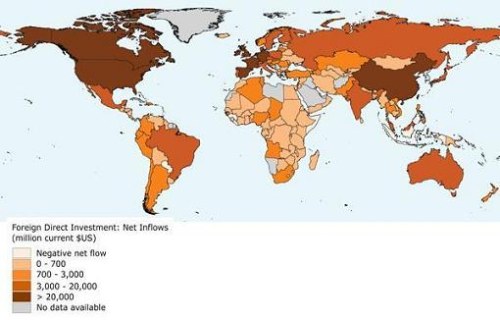
As we will see, globalization is a word (and phenomenon) that is analogous to a Rorschach test in that everyone seems to have his, or her, own slightly unique definition of what it actually means. There is wide agreement, however, that an important characteristic of contemporary globalization is the level of economic integration internationally. One such component of that integration is foreign direct investment (FDI). From the World Resources Institute, here is a map that shows the differing levels of FDI around the globe. The patterns should, by now, be exceedingly familiar.

world_fdi_map_450.jpg

Here is the map description:

Foreign direct investment data do not give a complete picture of international investment in an economy. Balance of payments data on foreign direct investment do not include capital raised locally, which has become an important source of financing for investment projects in some developing countries. In addition, foreign direct investment data capture only cross-border investment flows involving equity participation and thus omit nonequity cross-border transactions such as intrafirm flows of goods and services. For a detailed discussion of the data issues see the World Bank’s World Debt Tables 1993-1994 (volume 1, chapter 3). Also, cross-country comparisons may not be accurate, because of differences in the definition of what constitutes foreign direct investment.

Source: World Bank Group. 2004, World Development Indicators Online. Washington, DC:World Bank.
Available On-line at: Source Link

A Unique Indicator of Economic Development–Luminous Flux

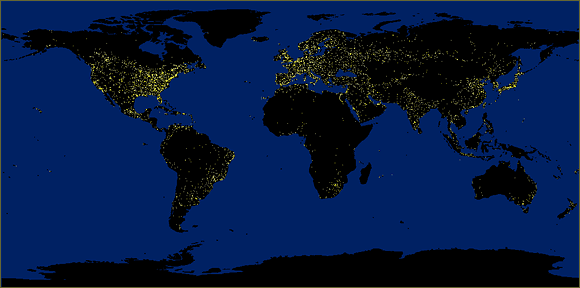
Or light. Below you will find a fascinating map from the World Resources Institute, (which is a great website, featuring information on such matters as renewable fresh water resources, literacy rates, and other phenomena that are found at the “intersection of the environment and human needs.”

world_city_lights.gif

Here is a description of the map:

“The National Geophysical “city lights” database depicts stable lights and radiance calibrated lights of the world (which includes lights from cities, towns, industrial sites, gas flares, fires, and lightning illuminated clouds). A high concentration of city lights is especially found in industrialized densely populated regions such as western Europe, Japan, and the U.S.. Alternatively, few “city lights” are shown in economically poorer and sparsely populated regions (e.g. central and northern Africa and South America). Moderate “city lights” are found in several densely populated “developing countries” (e.g. India, Indonesia, eastern Brazil, and South Africa). The “city lights” data may be used a proxy for population distribution or infrastructure (e.g. in which it may be assumed that the occurrence of few city lights is correlated with the presence of institutional, political, and industrial infrastructure).”

European Politics Source

One of the best sources for European politics in the English language is certainly the Financial Times, published in London. Don’t let the name of the newspaper fool you, the Financial Times writes about much more than financial and economic news. It’s coverage of domestic European politics is first-rate.

What does an Intro to Comparative final exam at MIT look like?

Here are a couple of examples:

Final exam last semester

After three and a half years of occupation, U.S. attempts to build stable, democratic government in Iraq have utterly failed. Iraq is plagued by a weak state unable to guarantee public order, mounting ethnic conflict, pervasive corruption, anemic economic performance, and poor prospects for democracy. Drawing on the knowledge you have gained over the semester, think about the five issues mentioned above (state-building, ethnic conflict, corruption, economic growth, and democracy).

Then answer the following three questions:

1. What recommendations would you have made to Coalition authorities at the beginning of the occupation to maximize the odds of a successful outcome?
2. To the extent that they are different, what recommendations would you make now?
3. How effective or ineffective do you think these your recommendations would have been or would be?

At 1:30 p.m. on the day of the exam (Tuesday the 19th), we will ask you to address ONE of these topics only, and we will specify which one you should address. For instance, we might ask you to answer the three questions listed above as they apply to economic growth: (1) what policies should the Coalition have adopted to maximize economic growth, (2) what recommendations would you make now to increase economic growth, and (3) how effective or ineffective do you think these recommendations would have been or would be in stimulating economic growth? The exam topic will be emailed to the class and posted on the class website. You are encouraged to collaborate with your fellow students in working through possible responses between now and the 19th. However, you must write the exam entirely by yourself. We do NOT expect you to do additional reading for the exam beyond the materials covered in class and the papers on Iraq that is now posted on Rather, you should leverage the general knowledge you have obtained over the semester — and the rather limited information you have acquired on Iraq — to address the topic.

Submit your exams to me and Professor Lawson byemail as an MS Word attachment or hand in a hard copy to Professor Lawson’s office. The deadline is 7:30 p.m. December 19th. No extensions will be given, and you will be penalized for lateness in a draconian fashion. If you hand your exam in by email, you are responsible for ensuring that the attachment can be opened in MS Word.

Final exam topic two years ago
Continue reading “What does an Intro to Comparative final exam at MIT look like?”

Islam, Religious Attitudes, and Democracy

There is a lot of ink being spilled on the question of the compatibility of Islam with democracy. Here is a link to a paper by Mark Tessler, published in the journal, Comparative Politics, in 2002.

“Islam and Democracy in the Middle East: The Impact of Religious Orientations on Attitudes Toward Democracy in Four Arab Countries,” Comparative Politics, Vol. 34 (April 2002): 337-354.

If you are on campus, here is a direct link to a pdf version of the article.

From the Abstract:

Continue reading “Islam, Religious Attitudes, and Democracy”

Design a site like this with WordPress.com
Get started