Proportional Represenation versus Plurality

In IS210 we will discuss the relative merits of the two most frequently instituted electoral systems–proportional representation and plurality (also called majority or “first-past-the-post” electoral systems.

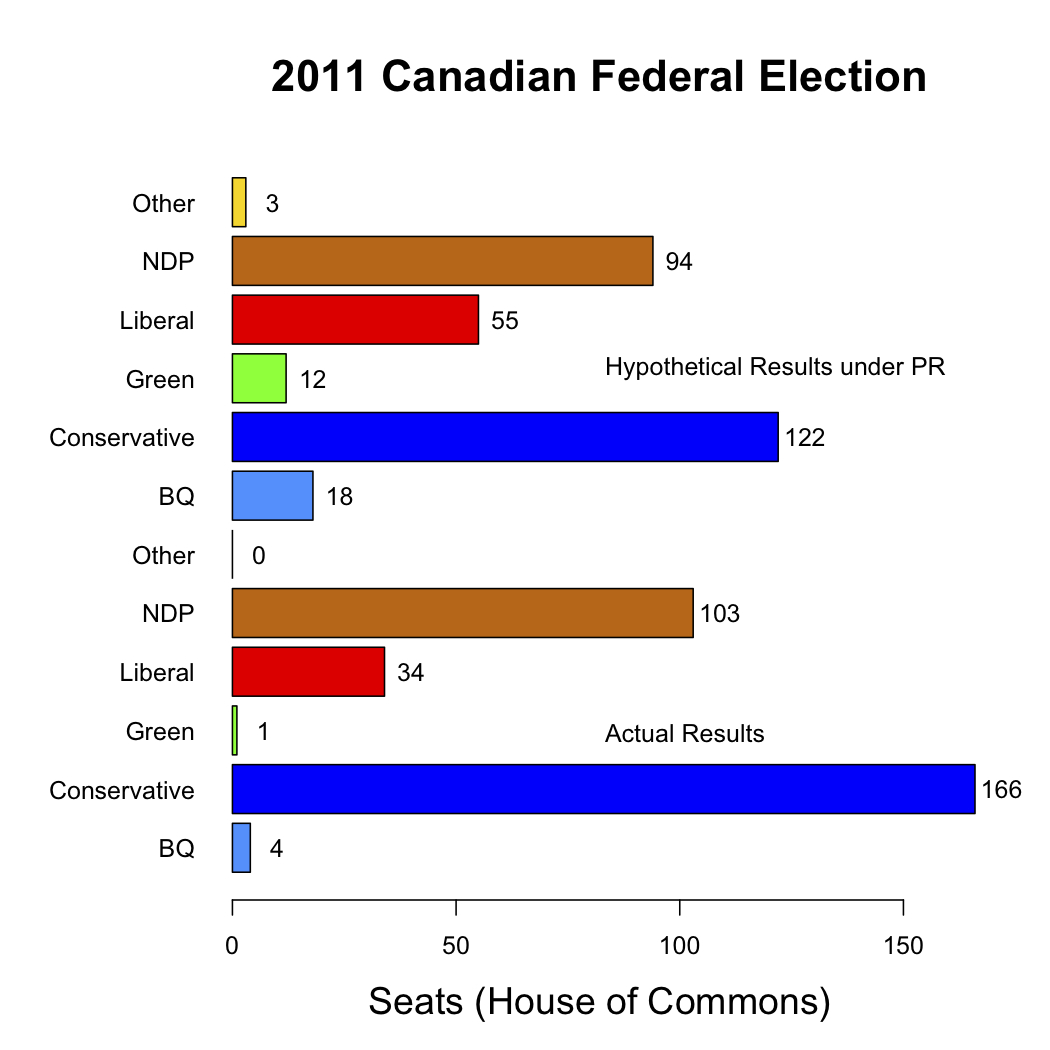
In advance, here is a chart that I’ve created, which shows the electoral results (in terms of number of seats won in the House of Commons) of the 2011 Canadian Federal election. The bottom of the chart contains the actual number of seats won, while the top lists the hypothetical number of seats each party would have won if Canada’s electoral system were one of proportional representation. So, Canada’s electoral system is working as it should, correct?

canada_2011_election_PR

How much does political culture explain?

For decades now, comparativists have debated the usefulness of cultural explanations of political phenomena. In their path-breaking book, The Civic Culture, Almond and Verba argued that there was a relationship between, what they called, a country’s political culture and the nature and quality of democracy. (In fact, the relationship is a bit more complex in that the believed that a country’s political culture mediated the link between individual attitudes and the political system.) Moreover, the political culture was itself a product of underlying and enduring socially cultural factors, such as either an emphasis on the family, bias towards individualism, etc. Although Almond and Verba studied only five countries–the United States, West Germany, Mexico, Italy, and the United Kingdom–they suggested that the results could be generalized to (all) other countries.

How much, however, does culture explain? Can it explain why some countries have strong economies? Or why some countries have strong democracies? We know that cultural traits and values are relatively enduring, so how can we account for change? We know that a constant can not explain a variable.
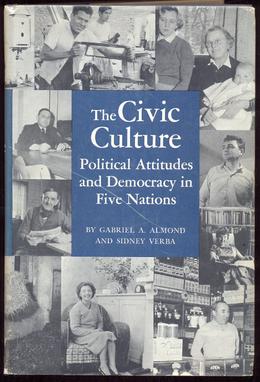
The 1963 Cover of Almond and Verba's classic work.

In a recent op-ed piece in the New York Times, Professor Stephen L. Sass asks whether China can innovate its way to technological and economic dominance over the United States. There is much consternation in the United States over recent standardized test scores showing US students doing poorly, relative to their global peers, on science exams. (How have Canadian students been faring?)

Professor Sass answers his own question in the negative. Why, in his estimation, will China not innovate to the top? In a word (well, actually two words)–political culture:

Free societies encourage people to be skeptical and ask critical questions. When I was teaching at a university in Beijing in 2009, my students acknowledged that I frequently asked if they had any questions — and that they rarely did. After my last lecture, at their insistence, we discussed the reasons for their reticence.

Several students pointed out that, from childhood, they were not encouraged to ask questions. I knew that the Cultural Revolution had upturned higher education — and intellectual inquiry generally — during their parents’ lifetimes, but as a guest I didn’t want to get into a political discussion. Instead, I gently pointed out to my students that they were planning to be scientists, and that skepticism and critical questioning were essential for separating the wheat from the chaff in all scholarly endeavors.

Although Sass admits that there are institutional and other reasons that will also serve to limit China’s future technological innovation, he ends up affirming the primacy of political culture:

Perhaps I’m wrong that political freedom is critical for scientific innovation. As a scientist, I have to be skeptical of my own conclusions. But sometime in this still-new century, we will see the results of this unfolding experiment. At the moment, I’d still bet on America.

Do you agree? What other important political phenomena can be explained by political culture?

Electoral Systems

Here’s an interesting post by a student on the effect of different electoral systems on the strategic calculations of voters. Would Canadian voters vote differently if our electoral system were PR? The evidence suggests that for a substantial minority, the answer is yes.

Here’s an example: in many (most) ridings, there is no chance that a member of the Green Party would be elected to parliament. Thus, rather than voting for the Green Party, many voters in these ridings who would prefer to vote Green, vote their 2nd preference, meaning that the Liberal Party and the NDP receive more votes during our elections than they otherwise would under a PR system. (Very few voters whose favoured party is the Green Party have the Conservative Party as their 2nd preference). Check out the post…

Electoral Systems.

In POLI 1140 this week, we’ll look at war and conflict (and strife), which, according to Mingst and Arreguin-Toft, “is generally viewed as the oldest, the most prevalent, and in the long term, the most salient” issue in international relations. Indeed, this attention to war and security is warranted given that without at least a minimal degree of security it is difficult to achieve other, worthy values.

As many of you are well aware, the US military, with its NATO allies, has been at war in Afghanistan since just after the terrorist attacks of 9/11. The Canadian military, of course, stood by its NATO ally from the beginning taking a large number of casualties during its time in Afghanistan. Our last combat troops left Afghanistan last summer. While in Afghanistan, the Canadian military was responsible for securing the Kandahar province, which was, by all accounts, the most dangerous province in that war-torn country:

The military first went into Kandahar in 2005, the beginning of the combat mission. The forces are now into a training mission based in Kabul, where they’re teaching Afghan national security forces.

Kandahar was Afghanistan’s most dangerous province, Defence Minister Peter MacKay said in a statement.

Following Canada’s military withdrawal from Kandahar, the US military took over responsibility for the area. Unfortunately, tragedy struck over the weekend as a US soldier allegedly walked off of his military base in Kandahar and killed at least 16 civilians, 9 of which were children, who were all asleep at the time. Those who are familiar with war and its effects on the psychic health of all involved understand that these types of things do happen in war zones. I have personally interviewed soldiers who described to me similar incidents that they either witnessed or in which they were personally involved.

Based on what you’ve read in Chapter 8 of the textbook, which theory of IR best accounts for the war in Afghanistan and for why NATO troops are still in combat there?

More on Representation and Electoral Systems

Prompted by a comment on a previous post regarding how voter representation would be different if Canada had a proportional representation system, I decided to do some reading on the Fair Vote website and stumbled upon some interesting facts. The first is an illuminating quote regarding the difference between decision-making (rule) and representation by somebody named Ernest Haville:

 “In a democratic government, the right of decision belongs to the majority, but the right of representation belongs to all.”

As we noted in class earlier today, many of the votes cast in our elections are wasted as a result of our first-past-the-post system. Below is a screenshot from the website wastedvotes.ca, which shows that in the 2008 federal election in Gatineau, QC, fully 70% of the voters were not represented. This is because the Bloc Quebecois candidate, Richard Nadeau, won a tight four-way battle, garnering a plurality of the vote at 29.2%.

This is just the most egregious example of wasted votes (and, thereby, of non-representation), but every Canadian election and electoral district sees wasted votes. Indeed, the folks at wastedvote.ca have calculated that of the more than 14 million votes cast during Canada’s last federal election (2011) only slightly more than half (50.4%) were effective, while 49.6% were wasted.

Why is this bad for democracy? Well, here is another excerpt from fairvote.ca:

Does Canada actually have representative democracy? In the 2008 federal election:

  • 940,000 voters supporting the Green Party elected no one, while fewer Conservative voters in Alberta alone elected 27 Conservative MPs.
  • In the prairie provinces, Conservatives received roughly twice the votes of the Liberals and NDP combined, but took seven times as many seats.
  • Similar to the last election, a quarter-million Conservative voters in Toronto elected no one and neither did Conservative voters in Montreal.
  • New Democrats: The NDP attracted 1.1 million more votes than the Bloc, but the voting system gave the Bloc 49 seats, the NDP 37.

What about majority rule? Canadians are usually ruled by majority governments that the majority voted against. In some provincial elections, parties coming in second in the popular vote have won majority control of the legislature.

In class, we noted the irony of the part above that is in bold font! The 1988 federal election was fought primarily on the basis of a pending free trade agreement amongst Canada, the United States, and Mexico. In Canada, the Progressive Conservatives (led by Prime Minister Brian Mulroney) were in favour of (what would become) NAFTA, while the NDP and the Liberal Party were against. In the end, a majority of Canadians voted for parties that were against NAFTA, yet the PCs won a majority of seats in parliament, enabling them to push through the necessary legislation.

Design a site like this with WordPress.com
Get started