I’ve visited a lot of places in the world, but I’d have to say that this place is my absolute favourite.

I’ve visited a lot of places in the world, but I’d have to say that this place is my absolute favourite.
In my previous post, I noted that the narrator of the Globalization is Good documentary claimed that there was a strong correlation between how globalized a country is and poverty. Specifically, those countries that are globalized are likely to have less poverty. How does this claim stand up to empirical scrutiny? Well, one answer comes from the National Bureau of Economic Research (NBER) in Cambridge, Massachusetts.
“The evidence strongly suggests that export growth and incoming foreign investment have reduced poverty everywhere from Mexico to India to Poland. Yet at the same time currency crises can cripple the poor.”
Does globalization, as its advocates maintain, help spread the wealth? Or, as its critics charge, does globalization hurt the poor? In a new book titled Globalization and Poverty, edited by NBER Research Associate Ann Harrison, 15 economists consider these and other questions. In Globalization and Poverty (NBER Working Paper No. 12347), Harrison summarizes many of the findings in the book. Her central conclusion is that the poor will indeed benefit from globalization if the appropriate complementary policies and institutions are in place.
Harrison first notes that most of the evidence on the links between globalization and poverty is indirect. To be sure, as developing countries have become increasingly integrated into the world trading system over the past 20 years, world poverty rates have steadily fallen. Yet little evidence exists to show a clear-cut cause-and-effect relationship between these two phenomena.
Many of the studies in Globalization and Poverty in fact suggest that globalization has been associated with rising inequality, and that the poor do not always share in the gains from trade. Other themes emerge from the book. One is that the poor in countries with an abundance of unskilled labor do not always gain from trade reform. Another is that the poor are more likely to share in the gains from globalization when workers enjoy maximum mobility, especially from contracting economic sectors into expanding sectors (India and Colombia). Gains likewise arise when poor farmers have access to credit and technical know-how (Zambia), when poor farmers have such social safety nets as income support (Mexico) and when food aid is well targeted (Ethiopia).
The evidence strongly suggests that export growth and incoming foreign investment have reduced poverty everywhere from Mexico to India to Poland. Yet at the same time currency crises can cripple the poor. In Indonesia, poverty rates increased by at least 50 percent after the 1997 currency crisis in that country, and the poor in Mexico have yet to recover from the pummeling of the peso in 1995.
Without doubt, Harrison asserts, globalization produces both winners and losers among the poor. In Mexico, for example, small and medium corn growers saw their incomes halved in the 1990s, while larger corn growers prospered. In other countries, poor workers in exporting sectors or in sectors with foreign investment gained from trade and investment reforms, while poverty rates increased in previously protected areas that were exposed to import competition. Even within a country, a trade reform may hurt rural agricultural producers and benefit rural or urban consumers of those farmers’ products.
The relationship between globalization and poverty is complex, Harrison acknowledges, yet she says that a number of persuasive conclusions may be drawn from the studies in Globalization and Poverty. One conclusion is that the relationship depends not just on trade or financial globalization but on the interaction of globalization with the rest of the economic environment: investments in human capital and infrastructure, promotion of credit and technical assistance to farmers, worthy institutions and governance, and macroeconomic stability, including flexible exchange rates. The existence of such conditions, Harrison writes, is emerging as a critical theme for multilateral institutions like the World Bank.
Is globalization good for those in developing countries? What is the link between globalization and poverty? What about globalization and democracy? Today in IS210 we watched a documentary in which the narrator argued that more globalization is good for the poor in developing countries. He argued that countries that have (and are) globalizing, such as Taiwan and Vietnam, have become richer, more democratic, and poverty levels have plummeted. On the other hand, countries that haven’t democratized, regardless of whether this is the result of domestic or external policy, have done poorly. They’re less democratic and poorer than they otherwise could be.
Here’s a link to the documentary, and some questions that you may want to think about:
Today’s session in IS 309 addressed the link between globalization and ethnic conflict. Our main reading material came from Amy Chu’s book, World On Fire, the thesis of which is that the twin phenomena of economic globalization and the spread of liberal democracy cause ethnic conflict in countries that have “market-dominant minorities.” Cynthia Olzak’s recently published article in the Journal of Conflict Resolution answers the same question in this way:
This article examines how different components of globalization affect the death toll from internal armed conflict. Conventional wisdom once held that the severity of internal conflict would gradually decline with the spread of globalization, but fatalities still remain high. Moreover, leading theories of civil war sharply disagree about how different aspects of globalization might affect the severity of ethnic and nonethnic armed conflicts. Using arguments from a variety of social science perspectives on globalization, civil war, and ethnic conflict to guide the analysis, this article finds that (1) economic globalization and cultural globalization significantly increase fatalities from ethnic conflicts, supporting arguments from ethnic competition and world polity perspectives, (2) sociotechnical aspects of globalization increase deaths from
ethnic conflict but decrease deaths from nonethnic conflict, and (3) regime corruption increases fatalities from nonethnic conflict, which supports explanations suggesting that the severity of civil war is greater in weak and corrupt states.
Chua’s book was received with some praise but also with a fair amount of criticism. Here are some links to videos that may be of interest to you:
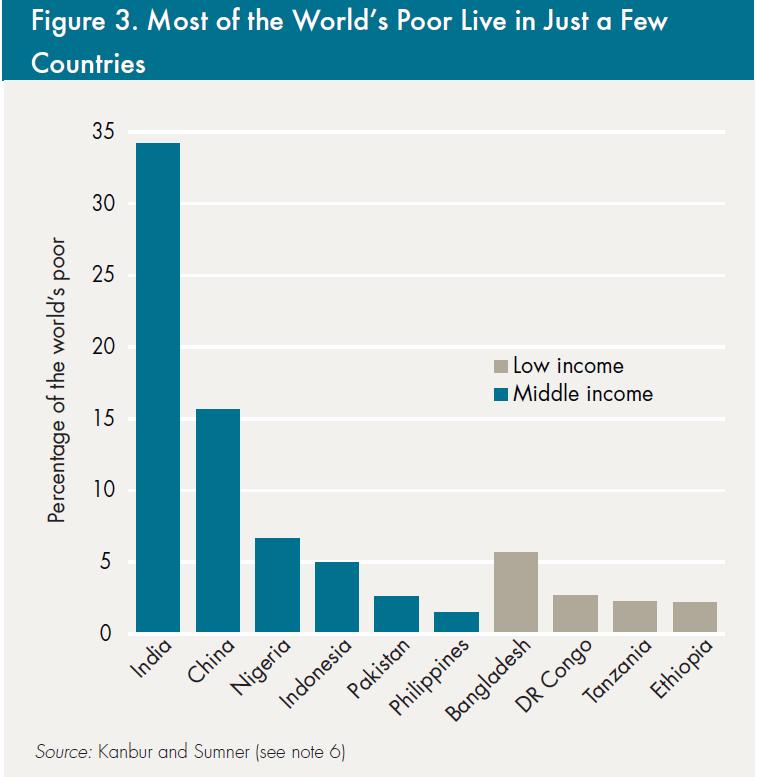
In a recently released report. the Center for Global Development argues that there are more poor people in middle-income countries (MICs) than in low-income countries (LICs). The new “bottom billion” (the phrase made famous by economic Paul Collier’s book of the same name) is not only the result of India and China having moved from LIC to MIC status. Indeed, according to the authors of the report, “the proportion of the world’s poor in MICs has still tripled, not only from a range of other countries like Nigeria, Pakistan, Indonesia, but also from some surprising MIC countries such as Sudan, Angola, and Cameroon.” Whereas twenty years ago, more than 90% of the world’s poor lived in LICs, today more than 70% of the world’s poor live in MICs.
Since 2000, over 700 million poor people have “moved” into MICs by way of their countries’ graduating from low-income status (see figure 1). And this is not just about China and India. Even without them, the proportion of the world’s poor in MICs has still tripled, not only from a range of other countries like Nigeria, Pakistan, Indonesia, but also from some surprising MIC countries such as Sudan, Angola, and Cameroon. The total number of LICs has fallen from 63 in 2000 to just 40 in the most recent data (see figure 2), and this trend is likely to continue.3 India and three other countries (Pakistan, Indonesia, and Nigeria) account for much of the total number of the new MIC poor (see figure 3). Among all MICs (new and old), five populous countries are home to 854 million poor people, or two-thirds of the world’s poor. These are Pakistan, India, China, Nigeria, and Indonesia.
One might ask how sensitive the shift is to the thresholds themselves? Of the new MICs, several are very close to the threshold—notably, Lesotho, Nicaragua, Pakistan, Senegal, Vietnam, and Yemen. India is only US$180 per capita per year over the threshold, but it is reasonable to assume that growth in India will continue and keep it out of danger of slipping back. It is important to recognize, however, that a significant number of the new MICs still fall under the threshold for the International Development Association (IDA), the World Bank’s concessionary lending window for poor countries.
The authors argue that this change in the location of the world’s poor carries with it important policy implications. If most of the world’s poor live in MICs, what does that mean for foreign aid and for the economic development policies and goals of rich countries and international organizations alike? Read the report to find their answer. The report, in addition, contains some interesting charts:

In 1947, the UN General Assembly voted 33-13 (with 10 abstentions and 1 absent) in favour of a resolution (181) that would partition Palestine between Jews and Arabs. Today in IS309 we watched Benny Brunner’s documentary, Al Nakba (“the catastrophe”, in Arabic), which sets out to tell the story of the partition, the ensuing civil war, and the Arab-Israel war of 1948. The documentary was based on the historian Benny Morris’ book, The birth of the Palestinian refugee problem, 1947-49. We discussed (at times heatedly) issues regarding the morality/efficacy of partition as a potential solution to some situations of inter-ethnic conflict. In addition, we read Chaim Kaufmann’s article “When all else fails: Population Transfers and Partitions in the Twentieth Century,” which argues that there are situations where partition is a legitimate policy approach to inter-ethnic violence.

Via the Oxford University Press blog (what a great idea!), Philip Howard assesses the link between digital (specifically, social) media and political unrest in the Middle East and north Africa. Although he cautions against running afoul of the common “correlation is not causation” fallacy, Howard does make an illuminating point about the impact of social media and civil society on the potential for a country to experience political unrest:
Digitally enabled protesters in Tunisia and Egypt tossed out their dictator. The protests in Libya have posed the first serious challenge to Gaddafi’s rule in decades and the crisis in that country is not over. Several regimes have had to dismiss their cabinets and offer major concessions to their citizens. Discontent has cascaded over transnational networks of family and friends to Algeria, Bahrain, Jordan, Lebanon, Saudi Arabia, and Yemen. Ben Ali ruled Tunisia for 20 years, Mubarak reigned in Egypt for 30 years, and Gaddafi has held Libya in a tight grip for 40 years. Yet their bravest challengers are 20- and 30-year-olds without ideological baggage, violent intentions or clear leaders.
The answer, for the most part, is online. And it is not just that digital media provided new tools for organizing protest and inspiring stories of success from Tunisia and Egypt. The important structural change in Mideast political life is not so much about digital ties between the West and the Arab street, but about connections between Arab streets.
But a reasonable foreign policy question remains. If digital media changes the political game in countries run by tough dictators, who will fall next?
Here’s a handy chart that gives us an indication of the answer to that question:

In our IS210 class, we’ve been assessing nondemocratic regimes. I had my students read an article by M. Steven Fish, published in World Politics in 2002, titled “Islam and Authoritarianism.” In it, the author notes the striking empirical finding that a majority of Arab Muslim countries had nondemocratic regimes, even after controlling for potentially confounding factors such as oil wealth, level of political violence, poverty, etc. Fish asks what it is about Islam that is linked to authoritarianism. Or, to put it another way, he searches for the causal mechanism lining Islam and regime type. He tentatively finds it in the status of women in contemporary Muslim societies.

Nothing could be less heartening to democratic idealists than the notion that a particular religion is inimical to democracy. Religious traditions are usually constants within societies; they are variables only
across societies. Societies usually are “stuck” with their religious traditions and the social and psychological orientations they encode and reproduce. Yet religious practices and the salience of particular beliefs can change. Even if Muslim countries are more male dominated in some respects than non-Muslim countries, there is no logical reason why such a state of affairs must be immutable. Rigid segregation according to sex and male domination does not have a firm scriptural basis. The Koran provides no justification whatsoever for practices such as female genital mutilation and it condemns all infanticide as a heinous sin, even if it is motivated by a fear of want (17:31; 81:1–14). Much of the Koran’s instruction on marriage, divorce, and other aspects of relations between the sexes (for example, 2:222–41; 4:3; 4:128; 33:1–5; 58:1–4) is more liberal than the sharia (religious law) as practiced in some modern-day Muslim societies. It is therefore as dubious to try to locate the sources of social practice and order in scripture in Islamic settings as it is to try to locate them there in Christian and Jewish settings, because as with all holy injunction based on sacred text, interpretive traditions are powerful and ultimately determine practice. The status of women in Muslim societies is thus both paradoxical and mutable.At the present time, however, the evidence shows that Muslim countries are markedly more authoritarian than non-Muslim societies, even when one controls for other potentially influential factors; and the station of women, more than other factors that predominate in Western thinking about religious systems and politics, links Islam and the democratic deficit.
What do the recent upheavals in the Muslim-majority states of north Africa and the Middle East portend not only for democracy but for the status of women in these societies. CBC Radio’s “the Current” program set out to try to answer that question in a show dedicated to “women and political upheaval.” Here’s a description of the women interviewed on that evening’s show:
We started this segment with a clip from Mona Seif. She was heavily involved in the protests that brought down former Egyptian President Hosni Mubarak. And in the days leading up to his resignation, she told us she really believed the revolt would lead to a significant improvement in the lives of Egyptian women.
But since then, there have been reports that the situation for Egyptian women has regressed to the way it used to be. So we checked in again with Mona Seif. She’s still in Tahrir Square. But she’s feeling a little less optimistic.
Women have often played leading roles in pushing for change in the Arab and Muslim worlds. But when the dust settles, the gains they think they have made are often elusive. For their thoughts on why that is and whether things may be different this time … we were joined by three women who have spent decades trying to improve the position of women in their societies.
Before the Iranian revolution, Mahnaz Afkhami was Iran’s Minister for Women’s Affairs. She’s now the Founder and President of the Women’s Learning Partnership. She was in Washington, D.C.
Asma Khader is a former Jordanian minister of culture. She’s now the Secretary General of the Jordanian National Commission for Women. She was in Amman, Jordan.
And Leila Ahmed is an Egyptian-born professor at Harvard University’s Divinity School. Her research focuses on women in Islam. And her book, The Quiet Revolution: The Veil’s Resurgence From the Middle East to America will be published next month. She was in Cambridge, Massachusetts.
As many of you may know, since the early 1900s March 8th is used to observe International Women’s Day. In honour of this day, the Microcon group, which is a group of scholars who analyze violent conflict using micro-level approaches, has made publicly available a set of research papers related to sex, gender, and violence.
International Women’s Day
These publications are being issued to coincide with the International Women’s Day, which takes place on 8th March each year. Annually on 8 March, thousands of events are held throughout the world to inspire women and celebrate achievements towards gender equality.
MICROCON is working on gender issues in conflict-affected areas in two main ways. First of all, it has a set of three projects which take gender as the main object of their analysis. The policy briefing below by Kathleen Jennings is the product of one of these projects.
Secondly, MICROCON is attempting to meet the EU guidelines in relation to gender equality, by bringing in women researchers at all levels, addressing women’s specific needs in its research rather than working in a gender neutral fashion in all aspects of our work, and ensuring that everything we do ‘contribute[s] to an enhanced understanding of gender issues’. The paper below by Colette Harris assesses our progress in this respect, and attempts to demonstrate how gender can be used at different conceptual levels in conflict analysis, and what can be gained from this analytically.
For more information see MICROCON’s gender framework, and visit the International Women’s Day website.
Of particular interest is a research working paper by Colette Harris, ” What Can Applying a Gender Lens Contribute to Conflict Studies? A review of selected MICROCON1 working papers”:
It is rare to find gender a specific focus of scholarship in conflict studies. In MICROCON we have tried to place gender in a central position within all projects and to convince all researchers to use a gender lens for their analysis. This paper uses a set of MICROCON working papers to illustrate how gender can be used at different conceptual levels in conflict analysis, and aims to show what can be gained by the use of a gender lens. The papers bear out Enloe’s insistence that those seeking an in-depth understanding of the social and political world require a feminist curiosity – that is, a curiosity about the roles gender categories play in political debate and action, as well as in scholarship.
In a recent post, I made reference to a fascinating and very informative BBC documentary that deals with the final days of British rule on the Indian subcontinent and the eventual partition of that territory in 1947 into a Muslim-dominated Pakistan (east and west) and a Hindu-dominated India. In part four of the documentary an elderly Sikh gentleman from the Punjab region tells the harrowing tale of how his female relatives were the victims of brutal violence. Many scholars have argued that the ethnicization of the violence that accompanied the Partition obscure the fact that women bore the brunt of the violence. In a recent paper, Richard Lee writes about the gendered nature of the violence:
Women were arguably the worst victims of the Partition of India in 1947 and endured displacement, violence, abduction, prostitution, mutilation, and rape. However, on reading histories of the division of India, one finds that the life-stories of women are often elided, and that there is an unwillingness to address the atrocities of 1947. This reticence results partly from the desires of the Indian and Pakistani governments to portray the events as freak occurrences with no place in their modern nations. Literature can play an important role in interrupting state-managed histories, and ‘The Rebirth of Inherited Memories’ focuses upon the manner in which Shauna Singh Baldwin’s What the Body Remembers (2001) unsettles official versions of Partition. It examines how the novel acts as a counterpoint to ‘national’ accounts of 1947 through its depiction of the gendered nature of much of the violence, and it explores Baldwin’s representation of the elusive concept of ‘body memory’. The possibility of remembrances being passed on physically, or born within people, has found support in the eschatologies of Eastern religions, in Western psychological theories, and in recent scientific investigations into the ‘mind-body’ problem. The transmission of ‘body memories’ between generations serves to disrupt accounts that downplay the brutalities at the splitting of India. This paper draws upon a chapter of my doctoral thesis that investigates issues of memory and the enduring influence of Partition in South Asia.
 Clouds, Clocks, and Sitting at Tables
You must be logged in to post a comment.