
New York Times special Report on Pollution and Economic Growth in China

You can find a fascinating 10-part report on the dramatic environmental impact of China’s miraculous economic growth in the New York Times. The report, Choking on Growth, provides readers and viewers a multimedia perspective on growth and pollution. From the perspective of comparative politics, it is important to note that some scientists and other scholars in China are trying to estimate the impact of environmental destruction on the general welfare of China’s citizens. They have begun to use a new measure of well-being, “green GDP”, arguing in effect that GDP itself is not an accurate measurement of a society’s well-being. In PLSC240, we will analyze other indicators of well-being, including HDI, the Gini Index, etc, when we study Political Economy (Chapter 4). From an IR perspective, we can ask ourselves what right or responsibility those outside China (whether IGOs like the UN, or other states like Japan and the US) have to intervene and attempt to reverse the damage China is causing to its own and the planet’s fragile ecosystem. Here is a link to a compelling video and some images below from the New York Times:

[rockyou id=99737780&w=500&h=350]
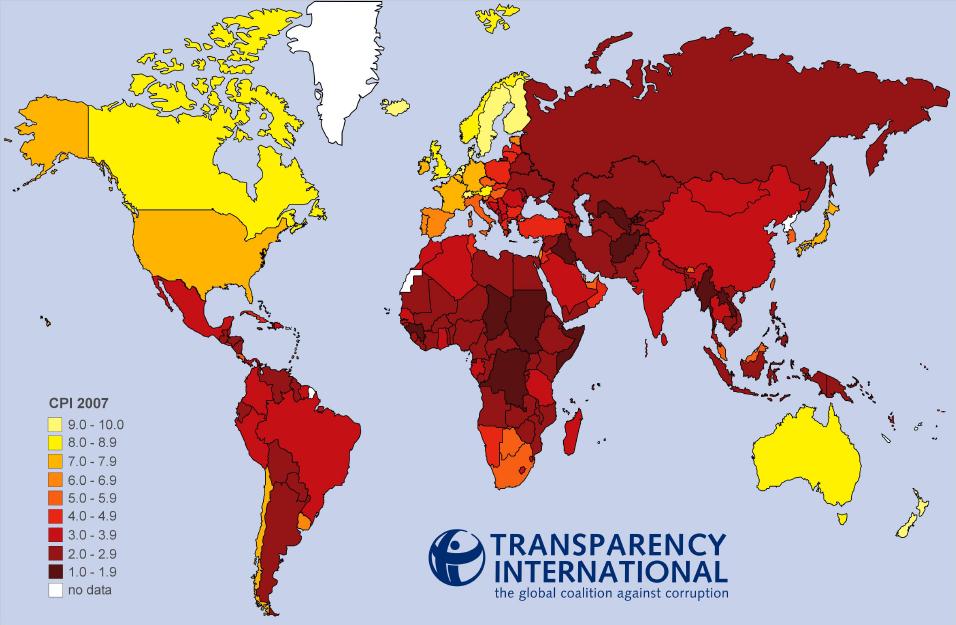
Transparency International Corruption Perceptions Index for 2007

Economists, political scientists and practitioners have long been aware of the deleterious effects of corruption. Transparency International, an international NGO, has been playing a lead role since its inception in 1993 in the fight to highlight the problem of corruption and in creating a forceful international anti-corruption movement. What is corruption?

Corruption is the abuse of entrusted power for private gain. It hurts everyone whose life, livelihood or happiness depends on the integrity of people in a position of authority.

What are some of the effects of corruption, but obvious and hidden?

Corruption hurts everyone, and it harms the poor the most. Sometimes its devastating impact is obvious:

* A father who must do without shoes because his meagre wages are used to pay a bribe to get his child into a supposedly free school.

* The unsuspecting sick person who buys useless counterfeit drugs, putting their health in grave danger.

* A small shop owner whose weekly bribe to the local inspector cuts severely into his modest earnings.

* The family trapped for generations in poverty because a corrupt and autocratic leadership has systematically siphoned off a nation’s riches.

Other times corruption’s impact is less visible:

* The prosperous multinational corporation that secured a contract by buying an unfair advantage in a competitive market through illegal kickbacks to corrupt government officials, at the expense of the honest companies who didn’t.

* Post-disaster donations provided by compassionate people, directly or through their governments, that never reach the victims, callously diverted instead into the bank accounts of criminals.

* The faulty buildings, built to lower safety standards because a bribe passed under the table in the construction process that collapse in an earthquake or hurricane.

Corruption has dire global consequences, trapping millions in poverty and misery and breeding social, economic and political unrest.

Corruption is both a cause of poverty, and a barrier to overcoming it. It is one of the most serious obstacles to reducing poverty.

Here is a chart comparing corruption levels around the world in 2007. The higher the cpi score, the higher the level of perceived corruption.

transparency_corruption_world_map_2007.jpg

Nationalist wins First Round of Serbian Presidential Elections

According to results released by the Election Commission of the Republic of Serbia, a second round of voting will be needed to elect Serbia’s next president. Current president, the moderate Boris Tadić, finished second (with 34.5% of votes cast) to challenger, Tomislav Nikolić, (40.0%) whose campaign was based on stark appeals to nationalist sentiments in the Serbian body politic. Given that neither candidate received the required 50% to be formally declared the first-round winner, Tadić and Nikolić will compete head-to-head in a run-off election on February 3rd. (Many European countries’ election laws also require winning candidates to have won 50% of the vote to avoid second-round run-off elections.)

The election outcome is seen as a battle between those who would aspire to a new era of Serbian politics, stressing future political and economic integration with the rest of Europe, and their opponents, who it is argued desire a return to the Milošević-era inspired nationalist ethos. The election could prove to be (yet another) important watershed in contemporary Serbian political affairs, evidence of which is the turnout, which was the largest in almost ten years. Here is a nice, short article from Time magazine explaining the future implications of the elections and below is a video report from Russia Today can be found here.

Below is a report prepared for the Sunday Telegraph in advance of the elections:

Blog Assignment–PLSC 250-Introduction to International Relations

The function of your blog will be to select, research, analyze, and contribute knowledge and information on a topic of interest to you (the group will select one topic only) in international relations. As we address the theories and principles of international relations over the course of the semester, you will post to your blog analyzing how these theories, principles, and ideas apply to your chosen topic. The goal is for your group to learn more about that topic than we could ever hope to cover in class over the course of a single semester. You will have to post your topic of choice, and a brief description of the topic, by midnight, Sunday, January 27th.

There is a myriad of topics in international relations that may be of interest to you. To help you begin to narrow down your choice of topic, go to the index of Mingst’s Essentials, and browse the list of entries.

Continue reading “Blog Assignment–PLSC 250-Introduction to International Relations”

Percentage of the World’s Denizens who Live on Less than $2/day

Using data from the United Nations’ Human Development Index, I put together this table of the thirty states in the world with the highest percentage of residents living on less than two dollars per day. After we have covered (international) political economy later this semester, you’ll know to ask whether the two dollar a day statistic is PPP-adjusted or not. The HDI rank is the Human Development Index rank (out of 177 countries ranked in 2007).

Using Country Watch (you can find a link to it at the course’s page at the library’s website, or click here), we see that Nigeria’s 2006 estimated (ethnic tensions in Africa’s most populous state prevent it from ever completing a census that is acceptable for all interested parties) population is approximately 132 million, meaning that fully 122 million persons in Nigeria survive on less than two dollars per day.

[UPDATE: “A world where some live in comfort and plenty, while half of the human race lives on less than $2 a day, is neither just nor stable. Including all of the world’s poor in a expanding circle of development–and opportunity–is a moral imperative and one of the top priorities of U.S. international policy.

-President George W. Bush, The National Security Strategy of the U.S.A. 2002]

Country

Below 2$/day (%)

HDI Rank

Nigeria

92.4

158

Tanzania (United Republic of)

89.9

159

Rwanda

87.8

161

Burundi

87.6

167

Zambia

87.2

165

Niger

85.8

174

Madagascar

85.1

143

Bangladesh

84

140

Central African Republic

84

171

Zimbabwe

83

151

Gambia

82.9

155

India

80.4

128

Nicaragua

79.9

110

Ghana

78.5

135

Haiti

78

146

Swaziland

77.8

141

Ethiopia

77.8

169

Cambodia

77.7

131

Sierra Leone

74.5

177

Lao P.D.R.

74.1

130

Mozambique

74.1

172

Benin

73.7

163

Pakistan

73.6

136

Mali

72.1

173

Burkina Faso

71.8

176

Nepal

68.5

142

Mauritania

63.1

137

Malawi

62.9

164

Kenya

58.3

148

Data Sources on Development, Poverty, Economics, Environment, etc.

For your edification, but also to help you with your assignments, papers, and blogs, here are some data sources that will allow you to compare levels of development and poverty across the globe. The United Nations Development Programme’s Human Development Report is an excellent source of information on indicators related to development. Click here if you would like to look up data and/or statistics. You can search for statistics by country, indicator, or table.

Another excellent data source is the World Bank Development Indicators collected by the World Bank. This link provides access to the Education, Gender, Health & Nutrition & Population, and Poverty databases as well as Country Statistical Information, and Development Gateway Data and Statistics.

Finally, the United Nations maintains a statistical division, whose website can be found here, and which collects a wide range of data from social and demographic statistics, through economic, environmental and energy statistics, to statistics related to Millennium goal indicators.

Pulitzer Center on Crisis Reporting

Here is some information about an interesting new NGO dedicated to reporting on the world’s crisis spots. The World Security Institute’s Pulitzer Center on Crisis Reporting was established in 2006.   Be sure to also have a look at their “untold stories” blog page.  Here is a description of their mission, in their own words:

The World Security Institute’s Pulitzer Center on Crisis Reporting, established in 2006, intends to be a leader in sponsoring the independent reporting that media organizations are increasingly less willing to undertake on their own. The Center’s goal is to raise the standard of coverage of global affairs, and to do so in a way that engages both the broad public and government policy-makers.

The Pulitzer Center is a bold initiative, in keeping with its sponsorship by a family whose name for more than a century has been a watchword for journalistic integrity and courage. From Teapot Dome through the civil rights struggle, Vietnam and the run-up to Iraq, the Pulitzers have stood for a “drastically independent” journalism that would “never be satisfied with merely printing news.”

When the third Joseph Pulitzer became editor of the St. Louis Post-Dispatch a half century ago, he paid tribute to that legacy. “Not only will we report the day’s news,” he said, “but we will illuminate dark places and, with a deep sense of responsibility, interpret these troubled times.” The Pulitzer Center is driven by that same mission and deep sense of responsibility, in times just as troubled.

The Pulitzer Center functions as an independent division of the World Security Institute, itself a leader in the sponsorship of independent journalism and scholarship. The Center will partner with the Institute’s other divisions, especially in television production and Internet publications, both to identify potential reporting topics and to insure global distribution of the projects that result.

The Center welcomes proposals for enterprising reporting projects throughout the world, with an emphasis on issues that have gone unreported, under-reported or mis-reported in the mainstream American media. The Center’s director is Jon Sawyer.

How do you Affect International Relations in your Daily Life?

In Mingst’s first chapter, she asks “How does international relations affect you in your daily life?” More potentially meaningful information may be garnered by turning that question over on its head: “how do you affect international relations in your daily life?” Are you thinking of buying a new cell phone? What will you do with your old one? You may want to think twice about your decision, as it could have an effect on people thousands of miles away.

…did you know that throwing your old cell phone in the garbage helps support civil war in central Africa, driving endangered gorillas closer to extinction in the process? A little explanation: A used cell phone’s value lies mainly in small amounts of minerals in its circuits — gold, nickel and especially tantalum, a high-melting-point metal sometimes referred to as coltan. Like something from a Clive Cussler thriller, tantalum is vital to manufacturing cell phones and many other electronic devices, but 80 percent of the world’s reserves are in the DRC (Democratic Republic of the Congo). There, it is mined under frequently appalling conditions and fought over during the DRC’s ongoing civil and international wars. Tantalum-mining revenues help fuel these wars, along with the associated destruction of human lives and gorilla habitat.

Tantalum and other minerals command a premium, so cell-phone manufacturers have turned to recycling because it’s easier (and more ethical) than dealing with warlords — or commodities brokers who buy from them. An entire tantalum-recycling economy has sprung up, and now accounts for 20 to 25 percent of manufacturing input per year.

In addition, cell phones and their electronic cousins may also contain potentially toxic compounds of lead and arsenic, so it behooves us to keep them from winding up in landfills and afterward, the water supply.

Here are some of the ways that you can keep your old phone’s minerals and plastics in circulation while easing your conscience about making calls using the equivalent of a conflict diamond.

Your next blog entry will be dedicated to documenting either how international relations affects you or how you affect international relations, or both.

Here is a compelling documentary.

Globalization, Migration and Music

What do you get when you combine a Bosnian lead singer, Croatian and Bulgarian guitarists, Japanese bass player, American drummer and violinist, move them all to the Pacific Northwest of the United States? The answer is “Kultur Shock”, whose “gypsy-punk” fusion can inspire even the most jaded of Political Science professors. From the Seattle Post-Intelligencer:

WHAT: Multinational Seattle rock band featuring Srdjan “Gino” Yevdjevich (lead vocals, percussion), Mario Butkovic (guitar, vocals), Masa Kobayashi (bass, vocals), Val Kiossovski (guitar, vocals), Chris Stromquist (drums, vocals) and Matty Noble (violin)

SOUND: The band describes its incendiary music as “Balkan punk-rock/Gypsy-metal/wedding-meets-riot music from Bulgaria, Bosnia, Croatia, Japan and the United States. We have six members, and no two of us really speak the same language.”

QUOTE: “Right now we are stuck between two worlds. One we left (that of our homelands), but we did not become a part of the other world, the hip rock-star world,” the band says on its Web site. “We had to work for our living like all the other immigrants, and working means sweat, sweat means stinky — not cool. What we’ve worked so hard to build over these 10 years is this ‘monster’ we play on stage. And we dare you to try and stop us, because we’re not going to stop ourselves.”

Here’s a sample of their sound:

Constitutions of the World–Source/Archive

Here is a great source of political constitutions from states around the world, provided to the public by the University of Richmond Law School.

From the website:

This database offers constitutions, charters, amendments, and other related documents. Nations of the world are linked to their constitutional text posted somewhere on the Internet.

Design a site like this with WordPress.com
Get started