The Economist Intelligence Unit’s Global “Livability” Survey Omits Cost-of-Living

Before we can say anything definitive about the concepts and ideas that we’re studying, it is imperative that we have some understanding about whether the data that we observe and collect are actually “tapping into” the concept of interest.

For example, if my desire were to collect data that are meant to represent how democratic a country is, it would probably not be beneficial to that enterprise to collect measures of annual rainfall. [Though, in some predominantly agricultural countries, that might be an instrument for economic growth.] Presumably, I would want to collect data like whether elections were regularly held, free, and fair, whether the judiciary was independent of elected leaders, etc. That seems quite obvious to most.

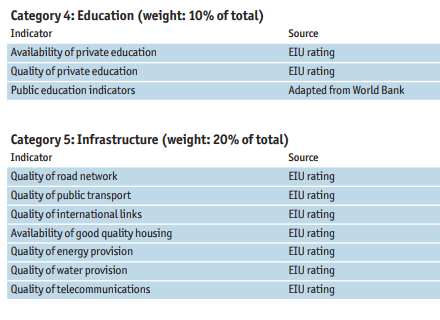
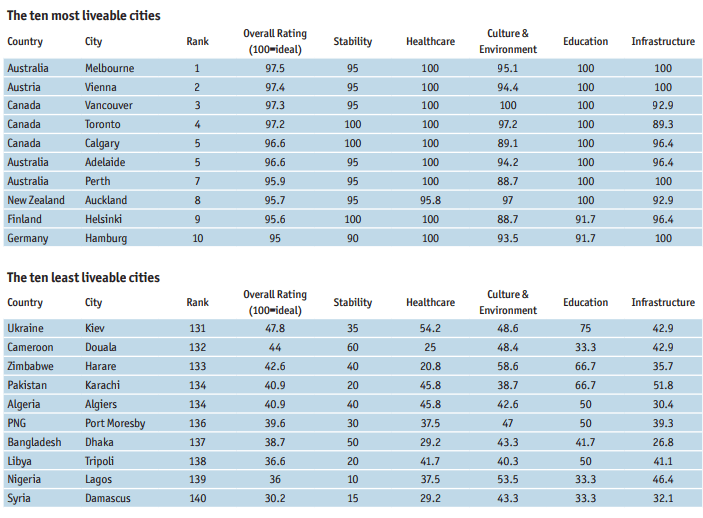
The Economist’s Intelligence Unit puts out an annual  “Global Livability Report” , which claims to comparatively assess “livability” in about 140 cities worldwide. The EIU uses many different indicators (across five broad categories) to arrive at a single index value that allegedly reflects the level of livability of each city in the survey.  Have a look at the indicators below. Do you notice that the cost-of-living is not include? Why might that be?
livability_top_bottom_teneconomist_livability_1economist_livability_2


You may not be registered to vote even though you think you are.

I read a somewhat troubling story this morning about Canadian citizens who have previously not only been registered to vote, but who have voted, and are no longer registered with Elections Canada. Here is an excerpt:

Delaney Ryan is a 23-year-old anthropology student at Simon Fraser University. Unlike many of her contemporaries, she voted in both the last provincial and federal elections. She meets all the criteria for voter registration, having her driver’s licence and maintaining the same address since voting in those elections.

She can’t understand why, then, this time, she wasn’t registered on the voters list.

“I had heard rumours about people not being registered, and a friend’s Facebook page had postings on it of other people finding out they were suddenly no longer registered. A lot of these people seemed to be in the same demographic as me. So I went online (to the Elections Canada website) and checked, and I wasn’t on it, either.

“So I had to reapply for registration.”

So, go to the Elections Canada website and verify that you are registered to vote this October 19.

Political Psychology–How the gut, head, and heart decide our political views

David Moscrop of Maclean’s magazine, has been writing a series of articles on the psychology of politics. Why do we have the political opinions that we do? The answer, as you now know, is a combination of environmental, demographic, and personal characteristics. More and more, political scientists and psychologists have been researching the importance of psychology as a factor that influences political beliefs and behaviours.

moscrop-graphic

At the beginning of his article, Moscrop reveals the inspiration behind the series:

But the truth is that your gut is as much a source of your political decisions as your rational brain, and much of the time your gut—emotions, feelings, intuition—does its work outside of your awareness.

Yep. The faces of the candidates, the pitch of their voices, their gender and ethnicity and height; whether or not you believe in God, whether or not you’re hungry, whether you’re a lawyer or dock worker or school teacher; the effects of political advertising, the effects of issue framing or priming, the effects of your peer group; your partisanship, your family, your fears.

Here we see an image taken from the article, that demonstrates the various parts of our bodies that are involved in the making of political decisions.

Political Ideology and Political Parties

The Conservative Party of Canada website in the weeks leading up to the 2015 federal election.

Today, we continue to look at Canada’s glorious Prime Minister, Stephen Harper. Besides being the current PM of Canada, Stephen Harper is also an honourable MP (member of parliament–we Canadians are forever grateful to the glorious denizens of Calgary Southwest*) and the leader of the federal Conservative Party.

On the short quiz that I gave on Tuesday, you were asked to write three words or phrases that are usually associated with conservatism, as a political ideology. Did any of you use the word “protect?”

Below you’ll find some screenshots of the scrolling images on the home page of the Conservative Party website. You’ll notice that the political campaign operatives have decided to portray PM Harper is our daddy, whose job it is to protect us in a dangerous world. Protect our jobs (presumably from being snatched away by foreigners); protect our children; protecting our economy, and protecting us from terrorists and others who would do us harm. Will it work?

“Fear makes man unwise in the three great departments of human conduct: his dealings with nature, his dealings with other men, and his dealings with himself. Until you have admitted your own fears to yourself, and have guarded yourself by a difficult effort of will against their myth-making power, you cannot hope to think truly about many matters of great importance … .”

—Bertrand Russell (“Outline of Intellectual Rubbish” in Unpopular Essays 1950)

*Calgary Southwest is no longer a federal constituency. It has been dissolved into Calgary Heritage and Calgary Midnapore.

Should Canada have Mandatory Voting?

When political scientists engage in studies of political phenomena there are many approaches that they may take. One oft-used approach is the so-called most similar systems design. This approach tries to “control for concomitant variation.” What does that mean? In social research it is difficult to clear cause-and-effect relationships because phenomena are complex and multi-faceted. Thus, if we wanted to determine why, for example, Canada is a relatively enduring and stable democracy, and Azerbaijan is not, one potential reason could be the relatively different histories of the two countries–Canada is a former British colony, while Azerbaijan was a former republic in the Soviet Union (which was a communist state).

Figure_3_3

Could this be the reason? Possibly. But, there are so many other differences between Canada and Azerbaijan that could also be the cause of the divergent outcomes regarding present political regime. Which one of these myriad differences, then, is the true cause of the difference between Canada and Azerbaijan regarding the level of democracy in each? (Indeed, the answer may not be mono-causal, but more complex and multi-causal.)

This is why many comparativists use the most similar systems design. By selecting units (countries) that are as similar as possible, they can control for many other potential causes for the alleged divergence in outcomes across the political phenomenon of interest.

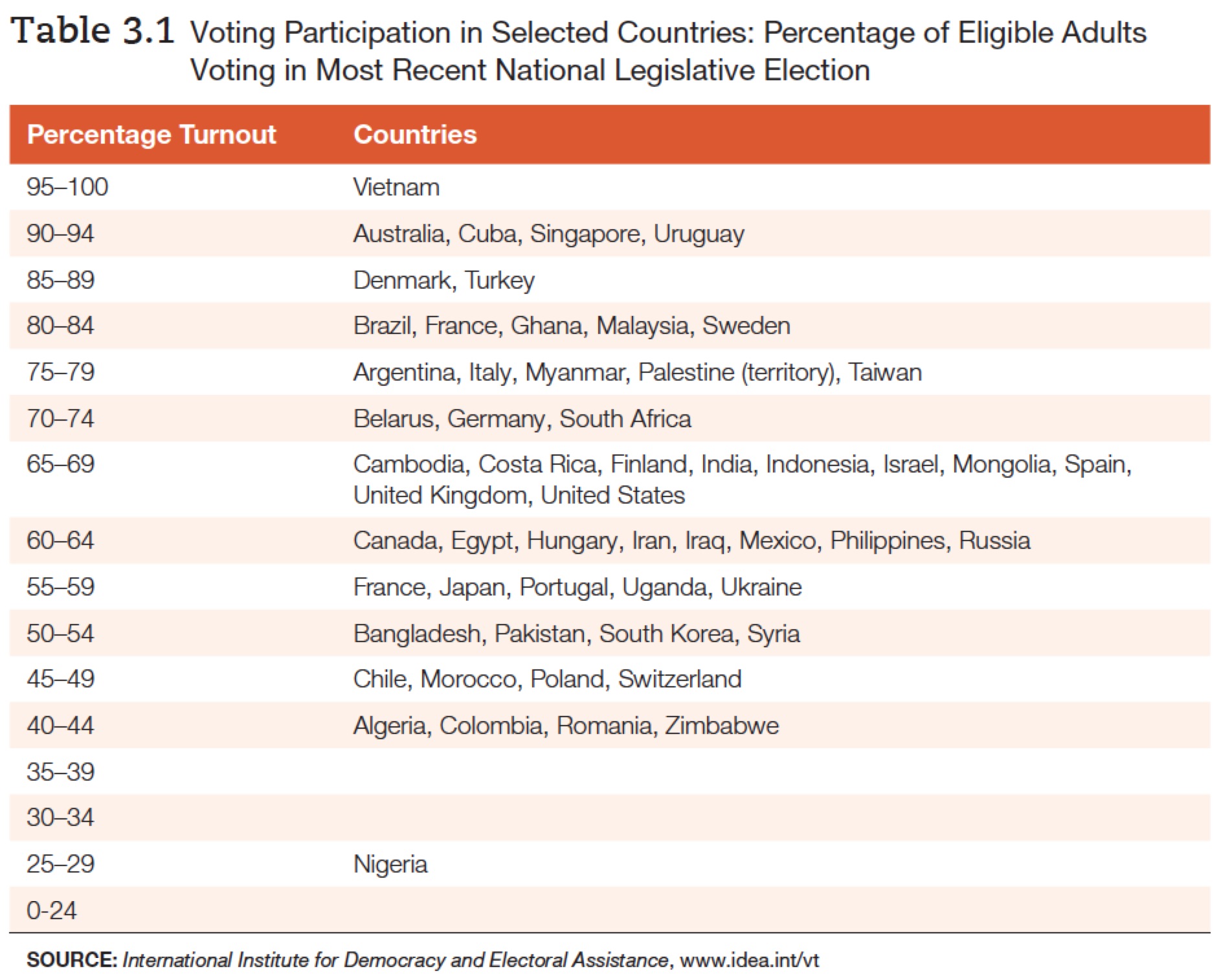
So, let’s look at Canada and Australia–two countries that are quite similar in many respects: former British colonies, large land masses with relatively small populations, multi-cultural, constitutional monarchies, parliamentary democracies, economies reliant on natural resources, neither of which has won FIFA’s World Cup (men or women), etc. The two countries, differ, however, in levels of voting participation. Whereas barely 60% of eligible Canadians vote in federal elections, the corresponding figure for Australia is well over 90%. Do Aussies simply value political participation more than Canadians? Hardly! Australia has a mandatory voting law, which penalizes (monetarily) those who do not vote.

Should Canada enact a mandatory voting law? What do you think? Is it anti-democratic to force citizens to participate in the democratic process?

Stephen Harper says voting is divisive!

The clever folks at The Syrup Trap (think The Onion, but sweeter…and more Canuckistani!) have a new article out on Canadian Prime Minister Stephen Harper’s attitude towards voting. With the big election coming up in just under three weeks (19 October), here’s Harper’s message regarding Canadians’ voting proclivities:

The [new election] campaign, titled “Voting: Not super important,” will encourage Canadians not to get too serious or divisive about politics, and promote a series of alternative, “more fun” activities to do on election day.

“Canadians are absolutely tired of partisan activities, like voting in an election, which is just about the most divisive thing you can do,” Harper explained during a press conference.

“I guess what we’re trying to tell Canadians is to just chill out for a second. Because, voting? It’s not that big of a deal.”

The campaign will also illustrate, using data and infographics, exactly how little influence each individual Canadian has, all things considered.

Snark
Stephen Harper’s new election campaign aims to make Canadian society less politically divisive by discouraging citizens from voting.

P.S. Before you freak out, look at the Tags to the post below.

Russell Brand defends his decision not to vote

As we learned in class today, voting is the most conventional form of political activity. Although an ever-increasing number of citizens in advanced industrial economies refuses to vote, still a majority of citizens gets out and votes during national elections. But, for a majority of these voters, voting is the extent of their political activity.

What can we say about most non-voters and the reasons that they don’t vote? Well, fortunately, pollsters and academics have tried to answer this question. Let’s take a look at the Canadian federal election from 2011. In that election, only 61.1% of eligible voters bothered to vote. To determine why Canadians were not voting, Elections Canada, in conjunction with the monthly Labour Force Survey, asked those who didn’t vote their main reason for not doing so. Here are the results:

Canadian Federal Election 2011

What do you think about these results? Below is an excerpt from an interview of Russell Brand on BBC, in which the actor/comedian explains why it is that he refuses to vote in elections in Great Britain. [By the way, he has since changed his views on voting.]

How to lie with Statistics

In class last week, we were introduced to recent research on the effect of same-sex parenting on children’s welfare, specifically on high school graduation rates. We discussed how easy it can be to manipulate data in order to present a distorted view of reality.

I’ll use a fictitious example to make the point. Let’s assume you had two schools–Sir Charles Tupper and William Gladstone. Assume further that the graduation rates of the two schools are 98% and 94% for Tupper and Gladstone, respectively. Is one school substantially better at graduating its students than the other? Not really. In fact, the graduation rate at Tupper is about 4.3% higher than at Gladstone. So, Tupper is marginally better at graduating students than is Gladstone.

But, what if we compared non-graduation rates instead? Well, the non-graduation rate at Tupper is 2%, while the non-graduation rate at Gladstone is 6%. Thus, the following accurate statistical claim can legitimately be made: “Gladstone’s drop-out [non-graduation] rate is 300% greater than is Tupper’s.” Or, “Tupper non-graduation rate is 33% of Gladstone’s!” Would parents’ reactions be the same if the data were presented in this manner?

Another way to lie with statistics using graphs.

Generation Y Political Apathy

In advance of the Canadian federal election (for up-to-date poll-based projections, go here), Kensington TV has produced a compelling documentary, which aims to understand the current political apathy within the “millennial” generation, both in Canada and the United States. Hosted by Dylan Playfair, the documentary critically examines stereotypical assumptions that have been made about the reasons for youth political apathy.

The documentary will be showing at select universities around Canada in the run-up to the federal election, which is being held on October 19th. For more about the documentary and where it may be viewed, click here. The documentary will be available for television and Internet viewing in early October. Please watch the trailer below.

Nicholas Stern (of the Report) argues that climate agreement should not be legally binding

We used the last session of IS450 as a chance to hold a mock United Nations climate conference simulation. The participants brought forward many intriguing and instructive topics, and I applaud them for putting in the time and energy to make the simulation as successful as I, at least, judged it to be. At some point during the proceedings, there was majority agreement (finally!) on one small element of the overall framework resolution. Interestingly, though, immediately upon the successful passing of that small piece of the framework a couple of delegates put forward a motion to make the obligations legally binding. A heated discussion ensued debating the merits and disadvantages of such an approach.

In the current round of UNFCCC climate negotiations, behind held in Lima, Peru, Nicholas Stern (author of the well-known Stern Review Report on the Economics of Climate Change) has argued against making international climate treaty obligations legally binding. What is Lord Stern’s rationale for this?

“Some may fear that commitments that are not internationally legally-binding may lack credibility,” he said.

“That, in my view, is a serious mistake. The sanctions available under the Kyoto Protocol, for example, were notionally legally-binding but were simply not credible and failed to guarantee domestic implementation of commitments.”

In Lima, negotiators are trying to hammer out the format that mitigation efforts should take. By the end of March next year countries have to declare their hands, but they have yet to formalize what will be included in these commitments and what will not.

Lord Stern believes that grounding the process in the laws and promises that countries undertake by themselves is a better model for a deal than a top-down process like Kyoto.

“It will be enforceable and deliverable through the arrangements and laws in the countries themselves.

“That way you will get stronger ambition as countries won’t be tempted to be hesitant about some type of international sanction.”

What do you think about Lord Stern argument? Would you support voluntary obligations over mandatory ones?

Here is an interview with Lord Stern from earlier this week in Lima, wherein he speaks on the link between economic growth, development, and better climate responsibility?


Design a site like this with WordPress.com
Get started