Serbian Electorate Must Choose–Stomach or Heart?

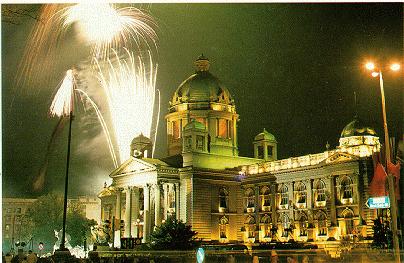
narodna_skupstina_srbije.jpgThe Serbian coalition government, with moderate nationalist Vojislav Koštunica as Prime Minister–has collapsed following dissension within the multi-party governing coalition over the “loss of Kosovo.” Voters will go to the polls to elect a new government on May 11th having to make a stark choice in the polling booth: whether to side with the nationalists in their struggle to forestall Kosovar independence, or to vote in a more moderate pro-European government, thereby placating not only members of the European Union but calming the nerves of wary international investors, who have become the life-blood of the Serbian economic system. As reports reports:

…The coalition government collapsed at the weekend, with nationalist Prime Minister Vojislav Koštunica blaming disunity over the conflicting goals of pursuing European Union membership versus defending Kosovo, the province which seceded last month with EU backing.

“Right now, around 1.0 billion euros worth of investments have been put on hold,” [Deputy Prime Minster Božidar] Djelić said. “There is a growing risk perception considering that some parties want to halt Serbia’s road to Europe. The elections will be a choice between Europe and investors are extremely careful.”

Heavily reliant on foreign investment for growth, Serbia is believed to need between 3.0 billion and 5.0 billion euros a year to ensure solid economic growth, single digit inflation and financing of its current account gap of 16 percent of GDP.

“In the absence of the required level of foreign investment, foreign creditors could also decide to put on hold lending to Serbian companies,” said Pavle Petrović of the FREN/CEVES thinktank said.

“The resulting crisis would lead to forcible reduction in external gaps through inflation, currency depreciation, a fall in output and wages. In that case, the central bank could soothe and postpone, but not eliminate the crisis,” he said.

Comparative Political Party and Electoral Systems

In a few weeks, we will conduct an in-class exercise that simulates a German national election.  This will give you a good idea of the specifics of the German political party and electoral systems, which you will then be able to compare to other systems around the world.  The German system is fairly complicated in that each citizen casts two votes, one for a member running in a single-member district, while the other is cast for a party via a proportional system.

Elections are, of course, the conditio sine qua non–and the minimal institutional requirement–of democratic political systems.   A great web site dedicated to keeping track of elections around the world is electionguide.org They do not as of yet have the results from the most recent national elections in Spain, (they will shortly) but they do have election results for countries around the world going back decades for some countries.  You should check them out.

The Christian Science Monitor  on the incumbent Spanish government’s re-election this past week:

oresults_p1.jpgAided by a near-record turnout, José Luis Rodríguez Zapatero and the Socialist Party won the Spanish national elections – suggesting further changes toward diversity in a young democracy whose older generations cut their teeth on the Franco dictatorship and the moral authority of the Roman Catholic church.

The Socialist victory suggests Mr. Zapatero’s party has broken out of the longtime secondary status it has labored under, despite winning the last election in 2004.

Now, say analysts, the Socialists’ more liberal appeal to young people, women, and immigrants – along with its contemporary style of campaigning – must be taken seriously by the conservative Popular Party (PP), which ran on an older message of Spanish traditionalism and antipathy toward the feisty Basque and Catalonia regions.

Do the cited paragraphs remind you of any other electorate?

Islam Democracy, and Authoritarianism and Paper Assignment

The topic for the next paper assignment in PLSC240  is “Democracy and Culture”.  You will be required to assess the democratic potential of various cultural orientations for democracy, using the Diamond and Morlino volume as a guide.  In Assessing the Quality of Democracy, various essential components of democracy are analyzed, including responsiveness, equality, freedom and accountability.  Your task will be to comparatively assess the quality of democracy in two countries, one of which is “Western” in its cultural orientation, the other of which is “non-Western.”  I’ll have more information for you on the specifics of the assignment when you get back from break on the 18th.

For now, I’ll remind you that on Thursday, those of you who did not leave early for spring break watched a Frontline documentary on Muslims and the democratic potential of Islam. You were shown the diversity in the manner in which Islam is practiced across five different countries–Egypt, Iran, Malaysia, and Turkey, and Nigeria. You were also able to begin to understand the varied roles and treatment of women across all of these predominantly Muslim countries.  This tied in well with the Steven Fish article [you have to be on campus to access the article] that you were assigned to read in advance of viewing the video.  What is Fish’s argument about the link between women in Islamic societies and democracy?  I’ve attached a preview of the documentary below. You can watch the whole documentary online, by clicking here.

Kenyan Leaders Sign Peace Agreement

Kenya’s political leaders have finally reached an agreement that Kenyans hope will signal the end of the recent instability and inter-ethnic bloodshed, which resulted from disputed elections in late December of last year. The New York Times reports that the structure of the political system in Kenya has been altered as a result of an agreement between President Mwai Kibaki and opposition leader Raila Odinga:

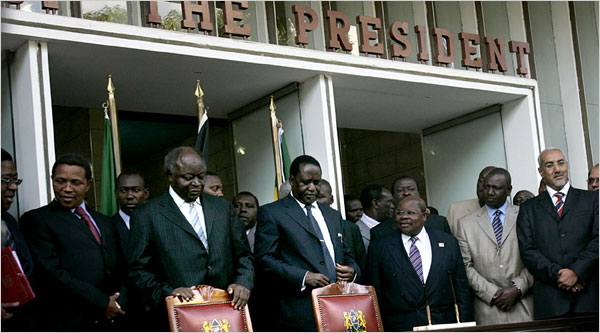
29kenya-span-600.jpgNAIROBI, Kenya — Kenya’s rival leaders broke their tense standoff on Thursday, agreeing to share power in a deal that may end the violence that has engulfed this nation but could be the beginning of a long and difficult political relationship.

The country seemed to let out a collective cheer as Mwai Kibaki, the president, and Raila Odinga, the top opposition leader, sat down at a desk in front of the president’s office, with a bank of television cameras rolling, and signed an agreement that creates a powerful prime minister position for Mr. Odinga and splits cabinet posts between the government and the opposition.

The two sides, which have been bitterly at odds for the past two months, will now be fused together in a government of national unity.

But there are still many thorny issues to resolve, starting with how the new government will function with essentially two bosses who have tried unsuccessfully to work together before. The government must also deal with the delicate business of reassigning the choice positions already given to Mr. Kibaki’s allies.

When we get back from the spring break, in intro to comparative we will analyze the political systems of several democracies around the world and you’ll realize that very few democracies have institutionalized a system that contains a strong Prime Minister and strong President. The most successful example is probably France, with its semi-presidential system. Even in strongly democratic France, however, political stability is often compromised when the President and Prime Minister are members of different political parties, as will be the case in Kenya. It will be interesting to see how the Kenyan version of cohabitation will develop in the coming months and years.

Who Speaks for Islam–a New Book by the Gallup Poll

The Gallup Polling outfit has a new book out based on a massive (over 50,000 respondents) recent poll on attitudes amongst the world’s approximately 1.3 billion Muslims. Let us allow the publishers to describe the content themselves:

islamwld.jpgGallup’s largest study of Muslim populations worldwide challenges conventional wisdom and the inevitability of a global conflict as the wars in Iraq and Afghanistan continue. Despite widespread media coverage of global terrorism from America and Europe to the Middle East and Asia, little is known about what majorities of the world’s Muslims really think and feel. What do Muslims say about violence and terrorist attacks? What do they say about democracy, women, and relations with the West? What are their values, goals, and religious beliefs?

Who Speaks for Islam? What a Billion Muslims Really Think by John L. Esposito and Dalia Mogahed (Gallup Press; March 2008; hardcover) sheds new light into the “increasing hostility” that Archbishop Tutu characterizes.

In the wake of the terrorist attacks on 9/11, U.S. public officials seemed to have no idea whether or not many Muslims supported the bombings. This troubled Gallup Chairman and CEO Jim Clifton, who felt that “no one in Washington had any idea what 1.3 billion Muslims were thinking, and yet we were working on intricate strategies that were going to change the world for all time.” Clifton commissioned his company to undertake the enormous job.

The result is Who Speaks for Islam? What a Billion Muslims Really Think, based on six years of research and more than 50,000 interviews representing 1.3 billion Muslims who reside in more than 35 nations that are predominantly Muslim or have sizable Muslim populations.

Some of the more intriguing findins?

  • Muslims and Americans are equally likely to reject attacks on civilians as morally unjustifiable.
  • Large majorities of Muslims would guarantee free speech if it were up to them to write a new constitution AND they say religious leaders should have no direct role in drafting that constitution.
  • Muslims around the world say that what they LEAST admire about the West is its perceived moral decay and breakdown of traditional values — the same answers that Americans themselves give when asked this question.
  • When asked about their dreams for the future, Muslims say they want better jobs and security, not conflict and violence.
  • Muslims say the most important thing Westerners can do to improve relations with their societies is to change their negative views toward Muslims and respect Islam.

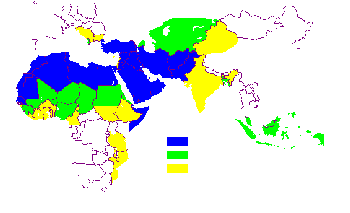
Note: the map above is from Professor Juan Cole.  The colors refer to the percentage of inhabitants of each state who are Muslims.

Design a site like this with WordPress.com
Get started